Azerbaijan Workspace as a Service Market Size & Growth Rate (2026-2032)
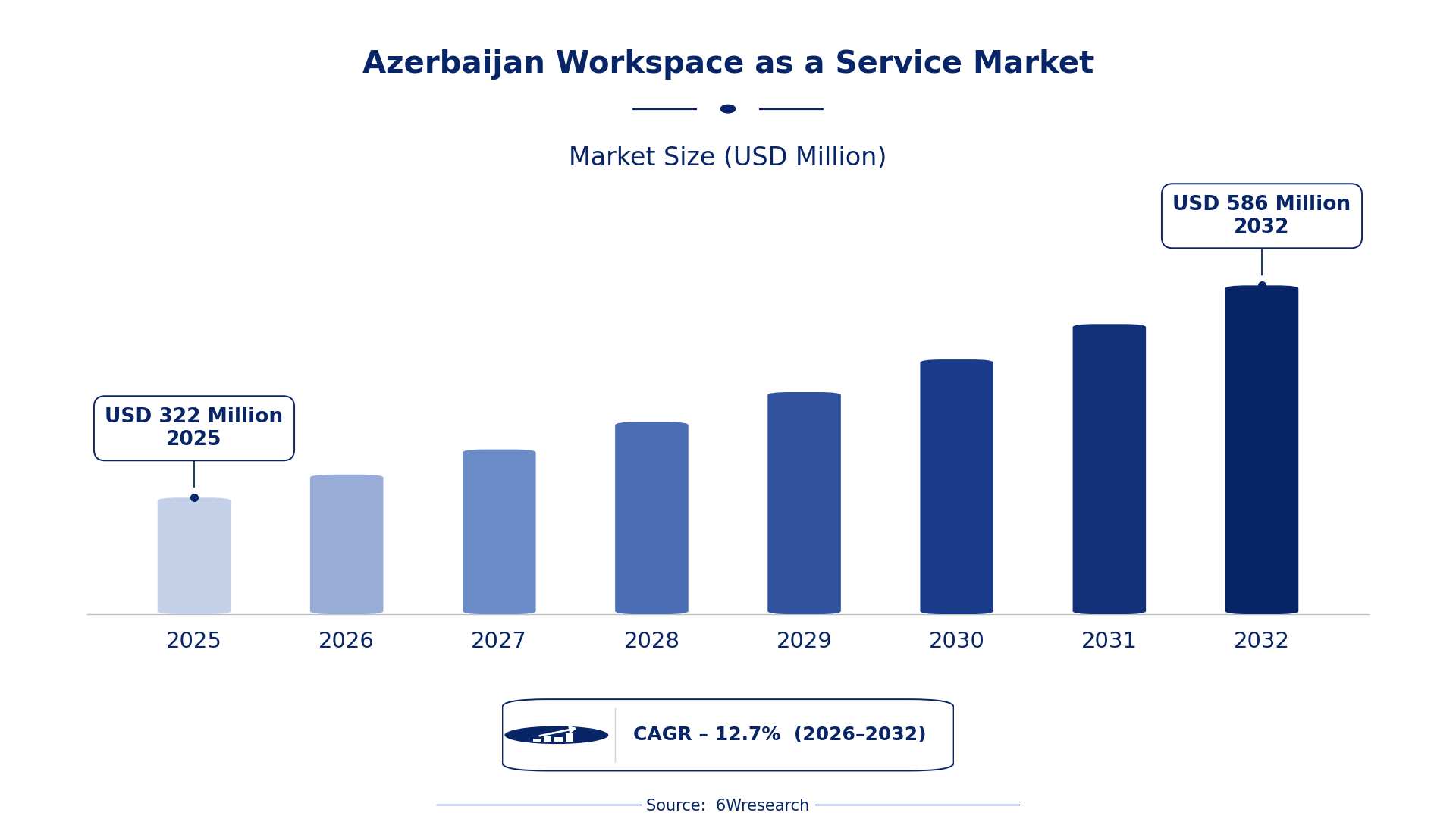
The Azerbaijan Workspace as a Service Market was estimated at USD 322 Million in 2025 and is projected to reach USD 586 Million by 2032, growing at a CAGR of 12.7% from 2026 to 2032.
Azerbaijan Workspace as a Service Market Synopsis
The demand for workspace as a service (WaaS) in Azerbaijan is rapidly gaining traction, driven by the rising adoption of remote work practices and flexible working arrangements. With businesses seeking cost-effective solutions, WaaS offers the ability to access virtual desktops and applications seamlessly across various devices, enhancing productivity and collaboration.
In Azerbaijan, this market is not only about enhancing remote work capabilities; it reflects a significant shift toward digital transformation. As companies embrace cloud technologies, the need for secure and compliant access to business applications has never been more critical, pushing WaaS into the spotlight as a viable option for enterprises, government agencies, and small to medium-sized businesses.
Azerbaijan Workspace as a Service Market Year-wise Growth Rate and Key Drivers
This graph illustrates the annual growth rates of the Azerbaijan Workspace as a Service Market from 2021 to 2032, highlighting a steady upward trajectory and projected expansion over the forecast period.
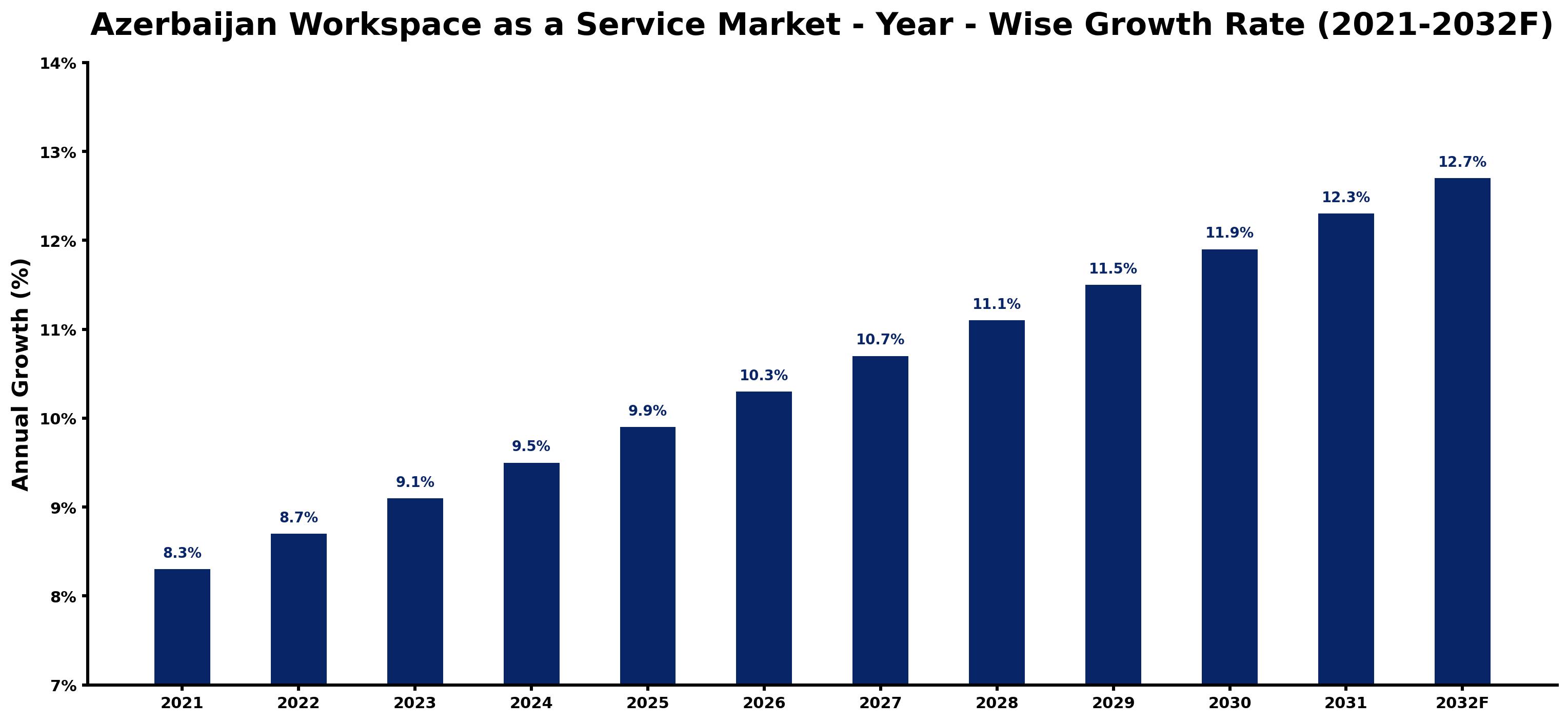
The table below presents the year‑wise growth rates along with the key drivers influencing the market
| Year | Growth Rate | Major Drivers |
| 2021 | 8.3% | Government incentives for digital entrepreneurship expansion |
| 2022 | 8.7% | Increase in remote work policies due to COVID-19 |
| 2023 | 9.1% | Surge in tech startups leveraging flex office solutions |
| 2024 | 9.5% | Rising foreign investment in tech infrastructure development |
| 2025 | 9.9% | Adoption of hybrid working models by local enterprises |
| 2026 | 10.3% | Integration of AI technologies in workspace management |
| 2027 | 10.7% | Increased demand for flexible lease options among SMEs |
| 2028 | 11.1% | Support from Ministry of Economy for digital transformation |
| 2029 | 11.5% | Growth of freelance economy boosting co-working spaces |
| 2030 | 11.9% | Integration of smart technologies in workspace design |
| 2031 | 12.3% | Rise in digital nomadism influencing workspace demand |
| 2032 | 12.7% | Government focus on enhancing digital literacy initiatives |
Note: Market size estimations and growth projections presented in this report are based on 6Wresearch's proprietary forecasting methodology, utilizing the latest available industry data, government publications, and primary research inputs.
Azerbaijan Workspace as a Service Market Key Takeaways
Below are some of the specific key takeaways from the market, including:
- The shift towards remote work is a primary driver for the growth of the WaaS market in Azerbaijan.
- Enhanced security measures are essential for businesses adopting cloud-based workspace solutions.
- Government initiatives are increasingly supporting the adoption of WaaS through regulatory frameworks and incentives.
- Flexible pricing models are crucial for customer satisfaction and market competitiveness.
- Continuous advancements in cloud technology and VDI are reshaping the service offerings in this market.
Evaluation of Restraints in Azerbaijan Workspace as a Service Market
Despite the promising outlook, the Azerbaijan Workspace as a Service market faces significant challenges. One major restraint is the existing infrastructure, which can hinder the effective deployment of WaaS solutions. Concerns regarding data sovereignty and compliance with local regulations further complicate the landscape for service providers. Additionally, integrating WaaS solutions with legacy systems remains a critical hurdle, as businesses strive to maintain performance while ensuring user satisfaction. Ultimately, these factors may slow down the adoption rate, especially among traditional enterprises wary of transitioning to cloud-based models.
Azerbaijan Workspace as a Service Market Trends
Several trends are shaping the future of the WaaS market in Azerbaijan. The rise of hybrid work models is compelling businesses to invest in flexible and scalable solutions. Increasingly, organizations are implementing Bring Your Own Device (BYOD) policies, which necessitate robust security and management capabilities within WaaS offerings. on top of that, the integration of artificial intelligence and machine learning into WaaS solutions is becoming more common, enhancing user experience and operational efficiency. These trends indicate a strong shift toward more adaptive and intelligent workspace solutions.
Azerbaijan Workspace as a Service Market Opportunities
The future of the Azerbaijan Workspace as a Service market is ripe with opportunities. Companies can harness the growing demand for customized WaaS solutions tailored to specific industry needs. The push towards digital transformation across various sectors opens avenues for innovative partnerships and service offerings. Additionally, as more businesses recognize the value of remote work, the market is likely to see an influx of investments aimed at enhancing cloud infrastructure and security measures. This environment presents an excellent opportunity for service providers to differentiate themselves through specialized services and customer-centric solutions.
Government Initiatives in the Azerbaijan Workspace as a Service Market
The Azerbaijani government has recognized the importance of the workspace as a service market in supporting economic growth and innovation. Recent policies are aimed at fostering a conducive environment for businesses to adopt cloud technologies, ensuring security, and enhancing digital infrastructure. These initiatives reflect the government's commitment to modernizing the workforce and promoting flexible working arrangements throughout the country.
- A regulatory framework introduced in 2025 mandating data security and privacy standards for cloud services.
- A national digital infrastructure upgrade program currently underway to enhance connectivity and access to cloud services.
- An incentive program for businesses adopting cloud-based workspace solutions, launched in early 2025, aimed at promoting WaaS.
- A planned public-private initiative expected to expand technology infrastructure access by 2028.
Future Insights of the Azerbaijan Workspace as a Service Market
Looking ahead to 2026-2032, the Azerbaijan Workspace as a Service market is expected to flourish. The continued emphasis on remote work and digital transformation will likely drive further adoption of WaaS solutions. As organizations prioritize operational agility and employee productivity, the demand for secure, flexible, and scalable workspace options will increase. Innovations in technology, particularly in cloud computing and cybersecurity, will play a crucial role in shaping the market's trajectory, enabling companies to thrive in a competitive environment.
Azerbaijan Workspace as a Service Market Latest Developments
Recent months have witnessed a surge in activity within the Azerbaijan Workspace as a Service market. Companies are actively exploring new partnerships and technologies to enhance their service offerings. This momentum signals a strong commitment to transforming how businesses operate and engage with their workforce.
- A major technology vendor launched a new WaaS platform in early 2025, aimed at improving user experience and security features.
- An initiative that began in mid-2025 and remains underway focuses on upgrading existing cloud infrastructure to support increased demand.
- A leading regional operator is currently developing a comprehensive training program for businesses to facilitate the transition to WaaS.
- A rollout expected to begin in the second half of 2026 will introduce advanced analytics capabilities within WaaS solutions to enhance decision-making.
Azerbaijan Workspace as a Service Market - Key Attractiveness of the Report
- 10 Years of Market Numbers
- Historical Data Starting from 2022 to 2025
- Base Year: 2025
- Forecast Data until 2032
- Key Performance Indicators Impacting the Market
- Major Upcoming Developments and Projects
Key Highlights of the Report:
- Azerbaijan Workspace as a Service Market Outlook
- Market Size of Azerbaijan Workspace as a Service Market, 2025
- Forecast of Azerbaijan Workspace as a Service Market, 2032
- Historical Data and Forecast of Azerbaijan Workspace as a Service Revenues & Volume for the Period 2022-2032F
- Azerbaijan Workspace as a Service Market Trend Evolution
- Azerbaijan Workspace as a Service Market Drivers and Challenges
- Azerbaijan Workspace as a Service Price Trends
- Azerbaijan Workspace as a Service Porter's Five Forces
- Azerbaijan Workspace as a Service Industry Life Cycle
- Historical Data and Forecast of Azerbaijan Workspace as a Service Market Revenues & Volume By Solutions for the Period 2022-2032F
- Historical Data and Forecast of Azerbaijan Workspace as a Service Market Revenues & Volume By VDI and Applications for the Period 2022-2032F
- Historical Data and Forecast of Azerbaijan Workspace as a Service Market Revenues & Volume By Desktop as a Service for the Period 2022-2032F
- Historical Data and Forecast of Azerbaijan Workspace as a Service Market Revenues & Volume By Hosted Applications (Unified Communication Applications) for the Period 2022-2032F
- Historical Data and Forecast of Azerbaijan Workspace as a Service Market Revenues & Volume By Security Solutions for the Period 2022-2032F
- Historical Data and Forecast of Azerbaijan Workspace as a Service Market Revenues & Volume By Others (Browser-based WaaS solutions) for the Period 2022-2032F
- Historical Data and Forecast of Azerbaijan Workspace as a Service Market Revenues & Volume By Services for the Period 2022-2032F
- Historical Data and Forecast of Azerbaijan Workspace as a Service Market Revenues & Volume By System Integration for the Period 2022-2032F
- Historical Data and Forecast of Azerbaijan Workspace as a Service Market Revenues & Volume By Consulting services for the Period 2022-2032F
- Historical Data and Forecast of Azerbaijan Workspace as a Service Market Revenues & Volume By Managed services for the Period 2022-2032F
- Historical Data and Forecast of Azerbaijan Workspace as a Service Market Revenues & Volume By Deployment Type for the Period 2022-2032F
- Historical Data and Forecast of Azerbaijan Workspace as a Service Market Revenues & Volume By Public for the Period 2022-2032F
- Historical Data and Forecast of Azerbaijan Workspace as a Service Market Revenues & Volume By Private for the Period 2022-2032F
- Historical Data and Forecast of Azerbaijan Workspace as a Service Market Revenues & Volume By Hybrid for the Period 2022-2032F
- Historical Data and Forecast of Azerbaijan Workspace as a Service Market Revenues & Volume By End-Users for the Period 2022-2032F
- Historical Data and Forecast of Azerbaijan Workspace as a Service Market Revenues & Volume By Enterprises for the Period 2022-2032F
- Historical Data and Forecast of Azerbaijan Workspace as a Service Market Revenues & Volume By Small and medium businesses(SMB) for the Period 2022-2032F
- Historical Data and Forecast of Azerbaijan Workspace as a Service Market Revenues & Volume By Verticals for the Period 2022-2032F
- Historical Data and Forecast of Azerbaijan Workspace as a Service Market Revenues & Volume By Banking, Financial Services and Insurance (BFSI) for the Period 2022-2032F
- Historical Data and Forecast of Azerbaijan Workspace as a Service Market Revenues & Volume By Retail for the Period 2022-2032F
- Historical Data and Forecast of Azerbaijan Workspace as a Service Market Revenues & Volume By Government for the Period 2022-2032F
- Historical Data and Forecast of Azerbaijan Workspace as a Service Market Revenues & Volume By Healthcare for the Period 2022-2032F
- Historical Data and Forecast of Azerbaijan Workspace as a Service Market Revenues & Volume By Manufacturing for the Period 2022-2032F
- Historical Data and Forecast of Azerbaijan Workspace as a Service Market Revenues & Volume By Telecom and IT for the Period 2022-2032F
- Historical Data and Forecast of Azerbaijan Workspace as a Service Market Revenues & Volume By Utilities for the Period 2022-2032F
- Historical Data and Forecast of Azerbaijan Workspace as a Service Market Revenues & Volume By Travel and Hospitality for the Period 2022-2032F
- Azerbaijan Workspace as a Service Import Export Trade Statistics
- Market Opportunity Assessment By Solutions
- Market Opportunity Assessment By Services
- Market Opportunity Assessment By Deployment Type
- Market Opportunity Assessment By End-Users
- Market Opportunity Assessment By Verticals
- Azerbaijan Workspace as a Service Top Companies Market Share
- Azerbaijan Workspace as a Service Competitive Benchmarking By Technical and Operational Parameters
- Azerbaijan Workspace as a Service Company Profiles
- Azerbaijan Workspace as a Service Key Strategic Recommendations






































