Bahamas Consumer Iot Market: Import Trend Analysis
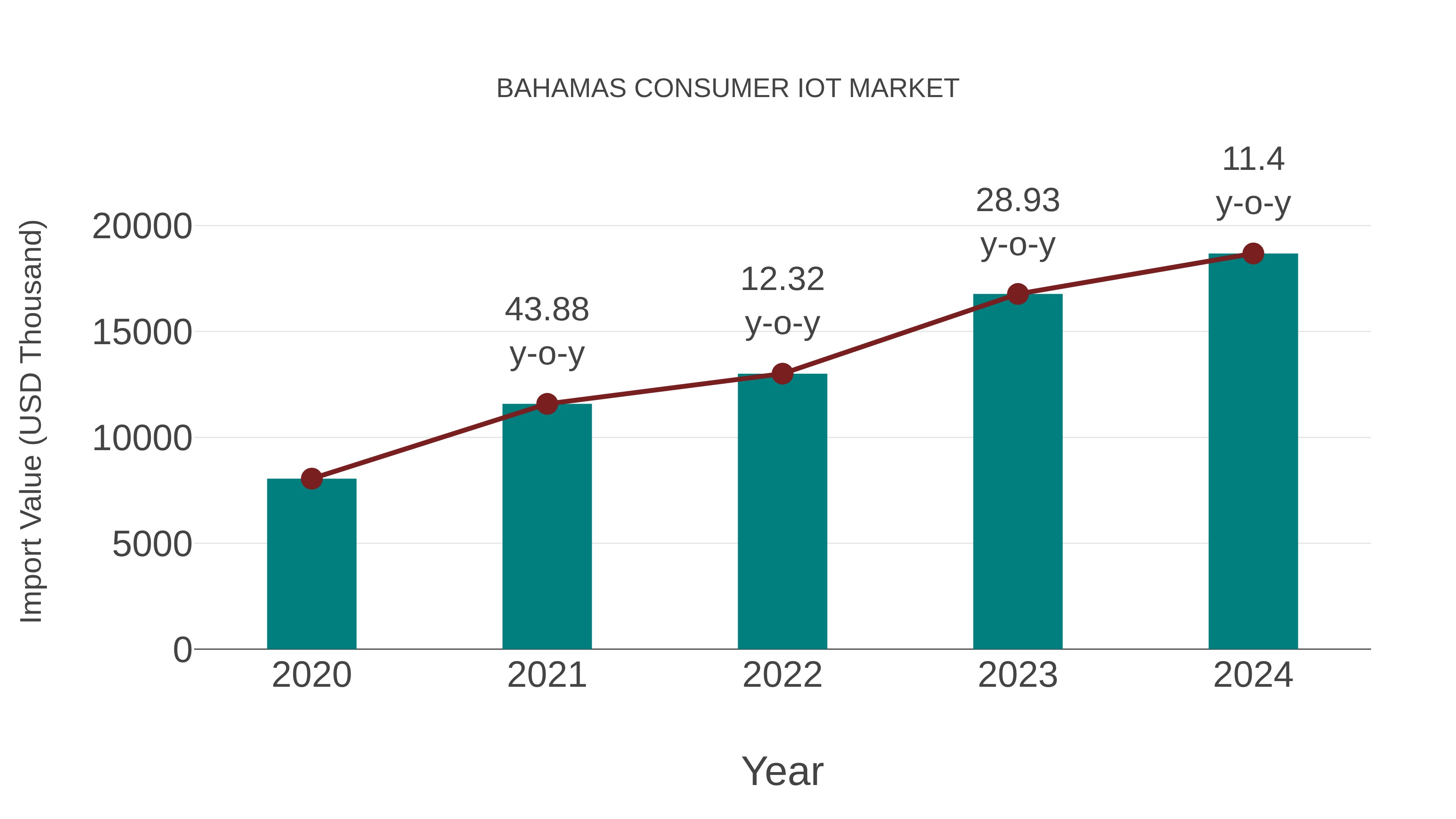
The Bahamas consumer IoT market witnessed a steady increase in imports from 2020 to 2024. The Compound Annual Growth Rate (CAGR) for this period stood at 23.43%. Notably, in 2023-2024, the year-on-year growth rate was 11.40%, indicating a significant rise in imports during that specific year.
Bahamas Consumer IoT Market Overview
The Bahamas consumer IoT market is expanding with smart home devices and wearable technology gaining popularity. Connectivity platforms and data security measures are critical for consumer acceptance and market growth.
Drivers of the market
In the Bahamas, the consumer IoT market is driven by the proliferation of connected devices and smart home technologies. Key drivers include consumer demand for convenience, energy efficiency, and security solutions enabled by IoT devices. Advancements in wireless connectivity, AI-driven automation, and data analytics further propel market expansion. Regulatory frameworks and privacy concerns also influence market dynamics.
Challenges of the market
Challenges in the Bahamas consumer IoT market include data privacy concerns in connected devices, interoperability of IoT platforms for seamless device integration, and cybersecurity risks in smart home networks affecting consumer trust and adoption rates.
Government Policy of the market
Government policies in the Bahamas consumer IoT market involve telecommunications regulations, import tariffs on IoT devices, and data privacy laws for connected consumer products ensuring interoperability, security, and user privacy in smart home, healthcare, and wearable technology applications.
Key Highlights of the Report:
- Bahamas Consumer IoT Market Outlook
- Market Size of Bahamas Consumer IoT Market, 2025
- Forecast of Bahamas Consumer IoT Market, 2032
- Historical Data and Forecast of Bahamas Consumer IoT Revenues & Volume for the Period 2022-2032F
- Bahamas Consumer IoT Market Trend Evolution
- Bahamas Consumer IoT Market Drivers and Challenges
- Bahamas Consumer IoT Price Trends
- Bahamas Consumer IoT Porter`s Five Forces
- Bahamas Consumer IoT Industry Life Cycle
- Historical Data and Forecast of Bahamas Consumer IoT Market Revenues & Volume By Offering for the Period 2022-2032F
- Historical Data and Forecast of Bahamas Consumer IoT Market Revenues & Volume By Hardware for the Period 2022-2032F
- Historical Data and Forecast of Bahamas Consumer IoT Market Revenues & Volume By Software for the Period 2022-2032F
- Historical Data and Forecast of Bahamas Consumer IoT Market Revenues & Volume By Services for the Period 2022-2032F
- Historical Data and Forecast of Bahamas Consumer IoT Market Revenues & Volume By Connectivity for the Period 2022-2032F
- Historical Data and Forecast of Bahamas Consumer IoT Market Revenues & Volume By Wired for the Period 2022-2032F
- Historical Data and Forecast of Bahamas Consumer IoT Market Revenues & Volume By Wireless for the Period 2022-2032F
- Historical Data and Forecast of Bahamas Consumer IoT Market Revenues & Volume By End User for the Period 2022-2032F
- Historical Data and Forecast of Bahamas Consumer IoT Market Revenues & Volume By Home Automation for the Period 2022-2032F
- Historical Data and Forecast of Bahamas Consumer IoT Market Revenues & Volume By Consumer Electronics for the Period 2022-2032F
- Historical Data and Forecast of Bahamas Consumer IoT Market Revenues & Volume By Automotive for the Period 2022-2032F
- Historical Data and Forecast of Bahamas Consumer IoT Market Revenues & Volume By Healthcare for the Period 2022-2032F
- Historical Data and Forecast of Bahamas Consumer IoT Market Revenues & Volume By Others for the Period 2022-2032F
- Bahamas Consumer IoT Import Export Trade Statistics
- Market Opportunity Assessment By Offering
- Market Opportunity Assessment By Connectivity
- Market Opportunity Assessment By End User
- Bahamas Consumer IoT Top Companies Market Share
- Bahamas Consumer IoT Competitive Benchmarking By Technical and Operational Parameters
- Bahamas Consumer IoT Company Profiles
- Bahamas Consumer IoT Key Strategic Recommendations






































