Bahrain Aerosol Market: Import Trend Analysis
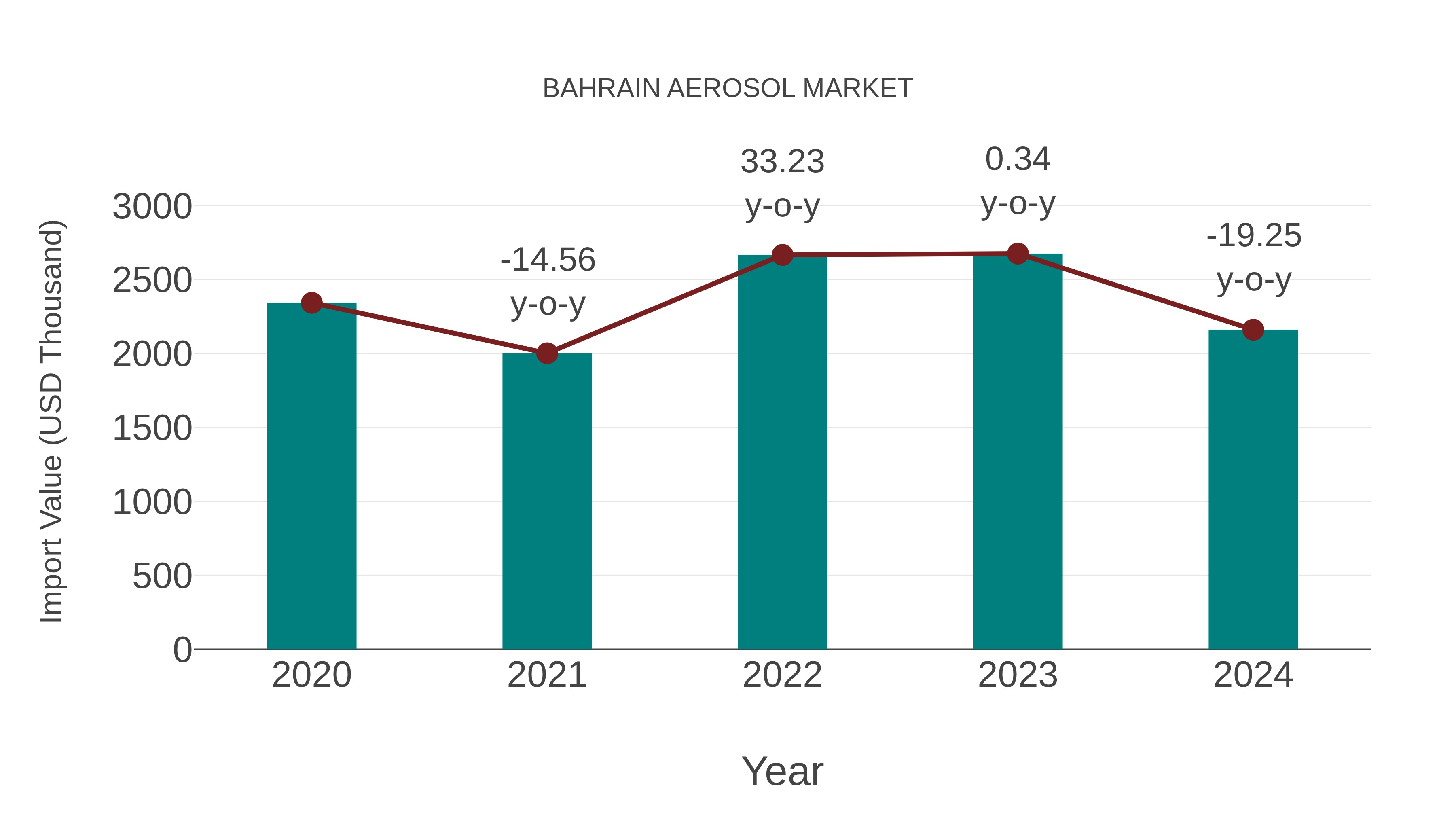
In the Bahrain aerosol market, the import trend experienced a decline with a growth rate of -19.25% from 2023 to 2024. The compound annual growth rate (CAGR) for imports over the period 2020-2024 stood at -2.0%. This negative import momentum could be attributed to shifting demand patterns or changes in trade policies affecting market stability.
Bahrain Aerosol Market Synopsis
Bahrains Aerosol Market encompasses a wide range of products including deodorants, disinfectants, insecticides, and automotive sprays. Consumer lifestyle shifts and a growing middle-class population are major factors behind rising demand. Environmental concerns have led to the introduction of eco-friendly propellants and recyclable packaging, shaping the future of aerosol product lines.
Trends of the market
The aerosol market in Bahrain is trending upward across segments such as personal care, automotive, and household cleaning. Consumers are increasingly opting for convenient, mess-free product formats. Sustainability is a growing focus, leading manufacturers to invest in recyclable packaging and eco-friendly propellants. Innovation in product formulation, such as dry sprays and dual-action aerosols, is further diversifying the market.
Challenges of the market
The aerosol market in Bahrain faces challenges related to regulatory constraints, particularly concerning volatile organic compounds (VOCs) and environmental sustainability. There is increasing scrutiny over the ecological impact of aerosol propellants, which could restrict the use of certain formulations. Additionally, local manufacturing is limited, making the market heavily reliant on imports. This dependence exposes the market to global price fluctuations and logistical delays. Consumer awareness regarding eco-friendly alternatives is also rising, creating pressure on traditional aerosol producers to innovate while managing costs.
Investment opportunities in the Market
The demand for aerosols in personal care, household cleaning, automotive, and industrial applications is growing. Investors can explore opportunities in contract manufacturing, private-label development for personal care brands, or importing niche aerosol products like air fresheners, disinfectants, and grooming sprays tailored to local preferences.
Government Policy of the market
The aerosol market in Bahrain includes personal care products, household sprays, automotive cleaners, and industrial lubricants. Government policies regulating pressurized containers are in line with international safety and environmental protocols. The Supreme Council for Environment mandates CFC-free formulations, pushing manufacturers and importers to adopt eco-friendly propellants. Additionally, consumer protection laws enforced by the Ministry of Industry and Commerce ensure accurate labeling and safe use. Growth in retail and hospitality sectors has also positively influenced the aerosol market.
Key Highlights of the Report:
- Bahrain Aerosol Market Outlook
- Market Size of Bahrain Aerosol Market, 2025
- Forecast of Bahrain Aerosol Market, 2032
- Historical Data and Forecast of Bahrain Aerosol Revenues & Volume for the Period 2022 - 2032F
- Bahrain Aerosol Market Trend Evolution
- Bahrain Aerosol Market Drivers and Challenges
- Bahrain Aerosol Price Trends
- Bahrain Aerosol Porter's Five Forces
- Bahrain Aerosol Industry Life Cycle
- Historical Data and Forecast of Bahrain Aerosol Market Revenues & Volume By Material for the Period 2022 - 2032F
- Historical Data and Forecast of Bahrain Aerosol Market Revenues & Volume By Steel for the Period 2022 - 2032F
- Historical Data and Forecast of Bahrain Aerosol Market Revenues & Volume By Aluminum for the Period 2022 - 2032F
- Historical Data and Forecast of Bahrain Aerosol Market Revenues & Volume By Others for the Period 2022 - 2032F
- Historical Data and Forecast of Bahrain Aerosol Market Revenues & Volume By Type for the Period 2022 - 2032F
- Historical Data and Forecast of Bahrain Aerosol Market Revenues & Volume By Bag-In-Valve for the Period 2022 - 2032F
- Historical Data and Forecast of Bahrain Aerosol Market Revenues & Volume By Standard for the Period 2022 - 2032F
- Historical Data and Forecast of Bahrain Aerosol Market Revenues & Volume By Application for the Period 2022 - 2032F
- Historical Data and Forecast of Bahrain Aerosol Market Revenues & Volume By Personal Care for the Period 2022 - 2032F
- Historical Data and Forecast of Bahrain Aerosol Market Revenues & Volume By Household for the Period 2022 - 2032F
- Historical Data and Forecast of Bahrain Aerosol Market Revenues & Volume By Automotive & Industrial for the Period 2022 - 2032F
- Historical Data and Forecast of Bahrain Aerosol Market Revenues & Volume By Food for the Period 2022 - 2032F
- Historical Data and Forecast of Bahrain Aerosol Market Revenues & Volume By Paints for the Period 2022 - 2032F
- Historical Data and Forecast of Bahrain Aerosol Market Revenues & Volume By Medical for the Period 2022 - 2032F
- Historical Data and Forecast of Bahrain Aerosol Market Revenues & Volume By Others for the Period 2022 - 2032F
- Bahrain Aerosol Import Export Trade Statistics
- Market Opportunity Assessment By Material
- Market Opportunity Assessment By Type
- Market Opportunity Assessment By Application
- Bahrain Aerosol Top Companies Market Share
- Bahrain Aerosol Competitive Benchmarking By Technical and Operational Parameters
- Bahrain Aerosol Company Profiles
- Bahrain Aerosol Key Strategic Recommendations






































