Bahrain AI in Education Market Size & Growth Rate (2026-2032)
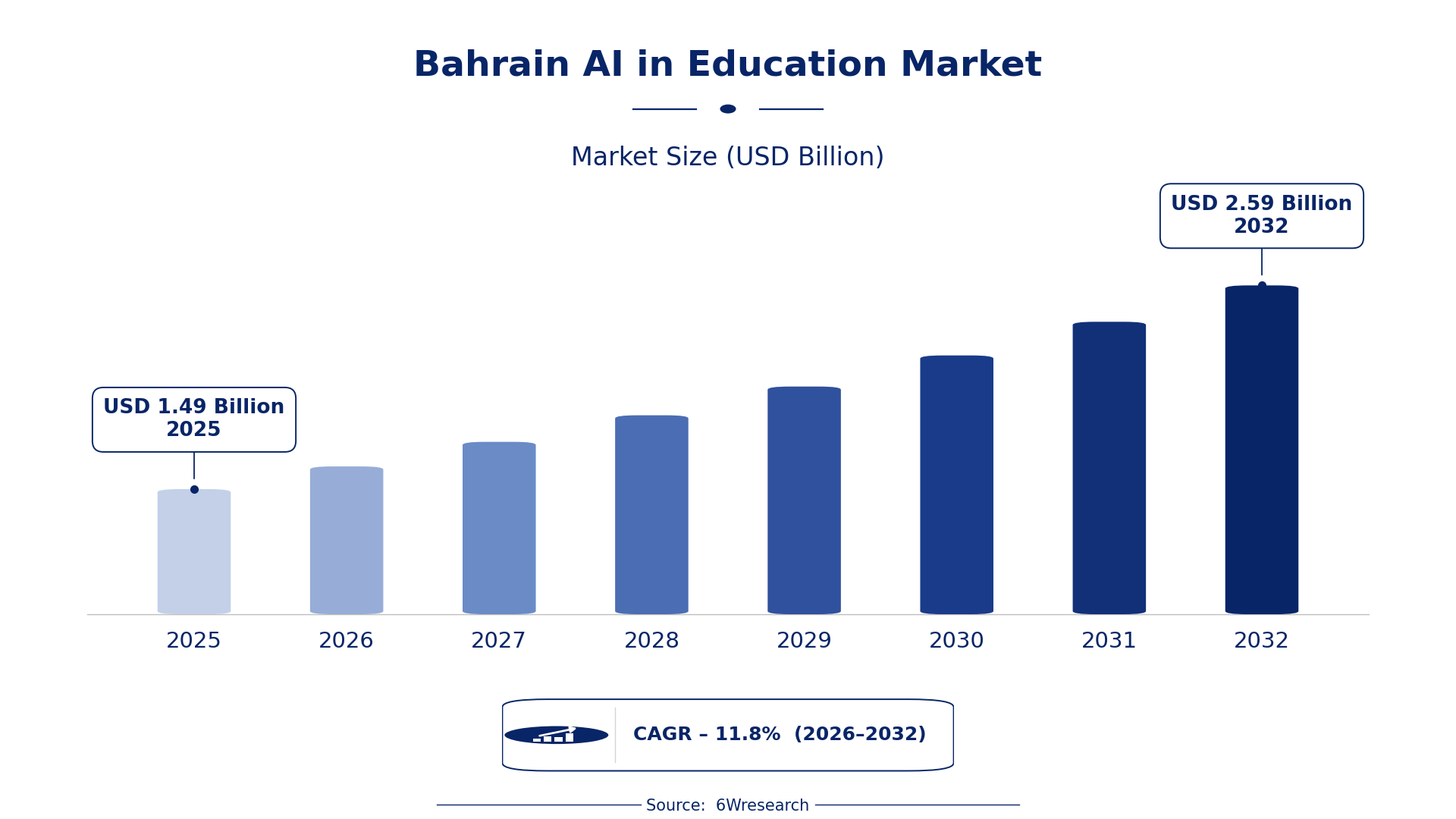
The Bahrain AI in Education Market was estimated at USD 1493 Million in 2025 and is projected to reach USD 2587 Million by 2032, growing at a CAGR of 11.8% from 2026 to 2032.
Bahrain AI in Education Market Synopsis
The demand for AI in education within Bahrain is being driven by a national commitment to digital transformation. Educational institutions, both public and private, are increasingly adopting AI technologies to create tailored learning experiences that cater to individual student needs.
As the country invests in modernizing its education system, AI applications such as intelligent tutoring systems and automated grading are becoming integral. This shift not only enhances student engagement but also optimizes administrative processes, reflecting a broader trend of innovation in Bahrain's educational framework.
Bahrain AI in Education Market Year-wise Growth Rate and Key Drivers
This graph illustrates the annual growth rates of the Bahrain AI in Education Market from 2021 to 2032, highlighting a steady upward trajectory and projected expansion over the forecast period.
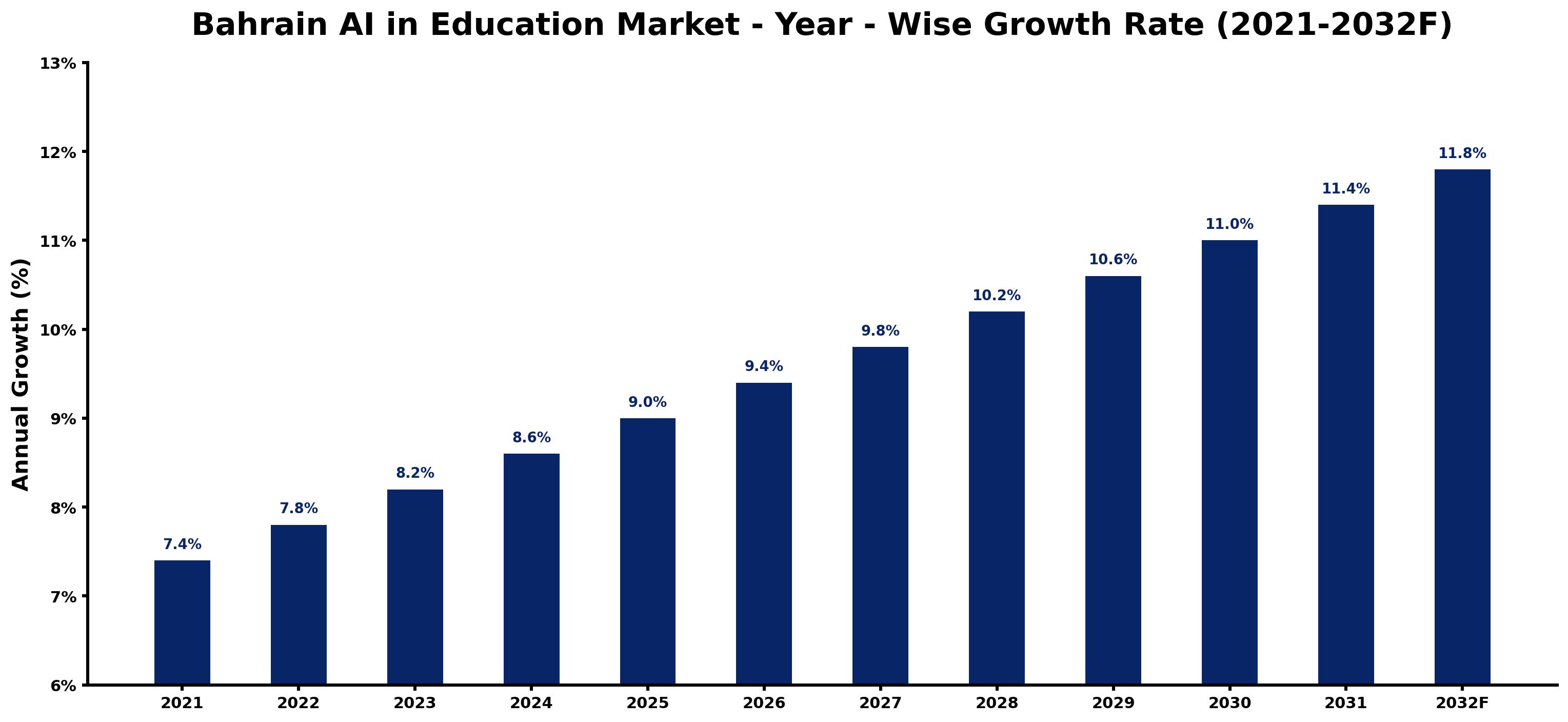
The table below presents the year‑wise growth rates along with the key drivers influencing the market
| Year | Growth Rate | Major Drivers |
| 2021 | 7.4% | Bahrain's Education and Training Sector Strategy 2030 launch. |
| 2022 | 7.8% | Integration of AI tools in national school curricula. |
| 2023 | 8.2% | Partnerships between universities and AI tech companies. |
| 2024 | 8.6% | Rising student enrollment in online learning platforms. |
| 2025 | 9.0% | Increased focus on STEM education funding by government. |
| 2026 | 9.4% | Bahrain's Digital Economy Strategy promoting EdTech startups. |
| 2027 | 9.8% | Local demand for skills training in AI technologies. |
| 2028 | 10.2% | Adoption of AI-driven assessment tools by schools. |
| 2029 | 10.6% | Government initiatives for teacher training in AI usage. |
| 2030 | 11.0% | Collaboration with international AI educational institutes. |
| 2031 | 11.4% | Bahrain's vision for a knowledge-based economy boosts AI. |
| 2032 | 11.8% | Expanding internet access fuels online learning adoption. |
Note: Market size estimations and growth projections presented in this report are based on 6Wresearch's proprietary forecasting methodology, utilizing the latest available industry data, government publications, and primary research inputs.
Bahrain AI in Education Market Key Takeaways
Below are some of the specific key takeaways from the market, including:
- The market is experiencing rapid growth, driven by government initiatives and institutional investments in EdTech.
- AI technologies are being utilized to personalize learning experiences and automate administrative tasks.
- Adaptive learning platforms are gaining traction, allowing for tailored educational content based on student performance.
- Concerns around data privacy and the ethical use of AI remain significant hurdles for broader adoption.
- Investment opportunities exist in AI-based learning management systems and student analytics tools.
Evaluation of Restraints in Bahrain AI in Education Market
Despite its promising growth, the Bahrain AI in Education Market faces notable constraints. The high initial costs associated with implementing AI solutions deter many educational institutions from adopting these technologies. Additionally, there's a marked shortage of skilled professionals capable of integrating AI into existing systems, which hampers progress. Concerns regarding data privacy and ethical implications of AI usage in educational settings further complicate the landscape, potentially slowing the momentum of adoption.
Bahrain AI in Education Market Trends
A few key trends are emerging in the Bahrain AI in Education Market. Firstly, the use of AI-driven personalized learning paths is gaining popularity, allowing educators to tailor instruction to individual student needs. Secondly, institutions are increasingly interested in AI-powered assessment tools, which help streamline grading processes and enhance academic integrity. Finally, the rise of virtual assistants in educational settings is changing how students interact with learning materials, making education more accessible and engaging.
Bahrain AI in Education Market Opportunities
The market presents significant investment opportunities, particularly in developing AI-based Learning Management Systems (LMS) and analytics tools that focus on student performance metrics. There's a growing need for platforms that cater specifically to Arabic-language education, which remains underserved in the AI domain. Public-private partnerships aimed at digitizing education can further stimulate growth, leveraging technological advancements to improve educational outcomes across Bahrain.
Government Initiatives in the Bahrain AI in Education Market
The Bahraini government is taking decisive steps to integrate AI into the education sector, aligning with its Vision 2030 objectives. By promoting digital literacy and encouraging partnerships with technology firms, the government is creating a favorable environment for AI adoption. Ensuring data privacy and transparency in student analytics is also a priority, reflecting the government's commitment to ethical AI deployment in education.
- A recently completed initiative involved pilot programs in smart classrooms across Manama, providing valuable insights into effective AI tools.
- Currently ongoing projects include collaborations between the Ministry of Education and edtech companies to roll out adaptive learning systems in public schools.
- Plans are underway for a national digital infrastructure upgrade, expected to enhance connectivity and support AI integration by 2026.
- Training programs focused on AI literacy for educators are being implemented, aiming to empower teaching staff in the integration of new technologies.
Future Insights of the Bahrain AI in Education Market
Looking ahead to 2026-2032, the Bahrain AI in Education Market is likely to experience substantial evolution. The government's commitment to digital transformation will continue to drive investment in AI technologies, fostering innovation in educational practices. As institutions become more adept at utilizing AI, we can expect to see enhancements in student engagement and academic outcomes, along with a gradual easing of data privacy concerns through stringent regulatory measures.
Bahrain AI in Education Market Latest Developments
In the past year, Bahrain has witnessed significant developments in the AI in Education sector. These activities reflect a strong commitment to enhancing educational experiences through technology, with various projects aimed at improving both teaching and administrative processes.
- A major technology vendor launched an AI-powered tutoring platform in early 2025, designed to support personalized learning in schools.
- An initiative that began in mid-2025 is currently underway, focusing on the integration of AI tools in remote learning environments.
- Plans for a public-private partnership expected to begin in late 2026 aim to develop AI-driven educational resources for underserved communities.
- A recent collaboration between the Ministry of Education and local universities is establishing research centers dedicated to AI in education, enhancing academic research capabilities.
Bahrain AI in Education Market - Key Attractiveness of the Report
- 10 Years of Market Numbers
- Historical Data Starting from 2022 to 2025
- Base Year: 2025
- Forecast Data until 2032
- Key Performance Indicators Impacting the Market
- Major Upcoming Developments and Projects
Key Highlights of the Report:
- Bahrain AI in Education Market Outlook
- Market Size of Bahrain AI in Education Market, 2025
- Forecast of Bahrain AI in Education Market, 2032
- Historical Data and Forecast of Bahrain AI in Education Revenues & Volume for the Period 2022-2032F
- Bahrain AI in Education Market Trend Evolution
- Bahrain AI in Education Market Drivers and Challenges
- Bahrain AI in Education Price Trends
- Bahrain AI in Education Porter's Five Forces
- Bahrain AI in Education Industry Life Cycle
- Historical Data and Forecast of Bahrain AI in Education Market Revenues & Volume By Technology for the Period 2022-2032F
- Historical Data and Forecast of Bahrain AI in Education Market Revenues & Volume By Deep Learning and Machine Learning for the Period 2022-2032F
- Historical Data and Forecast of Bahrain AI in Education Market Revenues & Volume By Natural Language Processing (NLP) for the Period 2022-2032F
- Historical Data and Forecast of Bahrain AI in Education Market Revenues & Volume By Component for the Period 2022-2032F
- Historical Data and Forecast of Bahrain AI in Education Market Revenues & Volume By Solutions for the Period 2022-2032F
- Historical Data and Forecast of Bahrain AI in Education Market Revenues & Volume By Services for the Period 2022-2032F
- Historical Data and Forecast of Bahrain AI in Education Market Revenues & Volume By Application for the Period 2022-2032F
- Historical Data and Forecast of Bahrain AI in Education Market Revenues & Volume By Virtual Facilitators and Learning Environments for the Period 2022-2032F
- Historical Data and Forecast of Bahrain AI in Education Market Revenues & Volume By Intelligent Tutoring Systems (ITS) for the Period 2022-2032F
- Historical Data and Forecast of Bahrain AI in Education Market Revenues & Volume By Content Delivery Systems for the Period 2022-2032F
- Historical Data and Forecast of Bahrain AI in Education Market Revenues & Volume By Fraud and Risk Management for the Period 2022-2032F
- Historical Data and Forecast of Bahrain AI in Education Market Revenues & Volume By Student-initiated learning for the Period 2022-2032F
- Historical Data and Forecast of Bahrain AI in Education Market Revenues & Volume By Others for the Period 2022-2032F
- Historical Data and Forecast of Bahrain AI in Education Market Revenues & Volume By Deployment for the Period 2022-2032F
- Historical Data and Forecast of Bahrain AI in Education Market Revenues & Volume By Cloud for the Period 2022-2032F
- Historical Data and Forecast of Bahrain AI in Education Market Revenues & Volume By On-premises for the Period 2022-2032F
- Historical Data and Forecast of Bahrain AI in Education Market Revenues & Volume By End for the Period 2022-2032F
- Historical Data and Forecast of Bahrain AI in Education Market Revenues & Volume By Educational Institutes for the Period 2022-2032F
- Historical Data and Forecast of Bahrain AI in Education Market Revenues & Volume By Educational Publishers for the Period 2022-2032F
- Historical Data and Forecast of Bahrain AI in Education Market Revenues & Volume By Others for the Period 2022-2032F
- Bahrain AI in Education Import Export Trade Statistics
- Market Opportunity Assessment By Technology
- Market Opportunity Assessment By Component
- Market Opportunity Assessment By Application
- Market Opportunity Assessment By Deployment
- Market Opportunity Assessment By End
- Bahrain AI in Education Top Companies Market Share
- Bahrain AI in Education Competitive Benchmarking By Technical and Operational Parameters
- Bahrain AI in Education Company Profiles
- Bahrain AI in Education Key Strategic Recommendations






































