Bahrain Anti-money Laundering Market Size & Growth Rate (2026-2032)
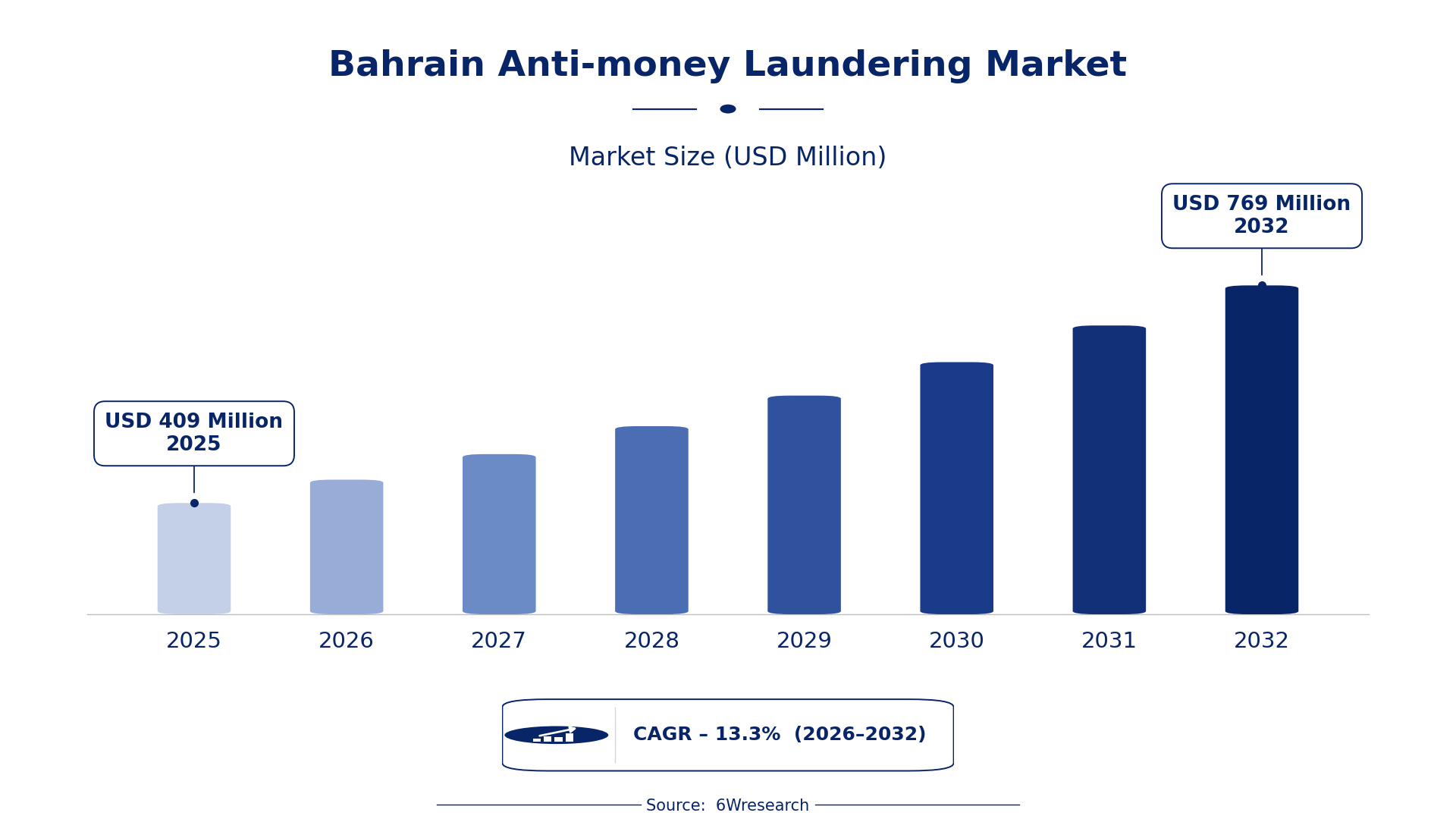
The Bahrain Anti-money Laundering Market was estimated at USD 409 Million in 2025 and is projected to reach USD 769 Million by 2032, growing at a CAGR of 13.3% from 2026 to 2032.
Bahrain Anti-money Laundering Market Synopsis
The Bahrain Anti-money Laundering Market is witnessing a surge in demand as financial institutions recognize the necessity of advanced compliance solutions. Stricter regulatory frameworks and the rise of digital finance have compelled banks and fintech companies to adopt AI-driven tools to streamline transaction monitoring and enhance customer due diligence.
With the Central Bank of Bahrain mandating stringent compliance measures, organizations are increasingly investing in technologies that ensure real-time monitoring and effective risk management. The market is seeing notable advancements in KYC processes and cross-border surveillance, driven by a relentless focus on operational integrity.
Bahrain Anti-money Laundering Market Year-wise Growth Rate and Key Drivers
This graph illustrates the annual growth rates of the Bahrain Anti-money Laundering Market from 2021 to 2032, highlighting a steady upward trajectory and projected expansion over the forecast period.
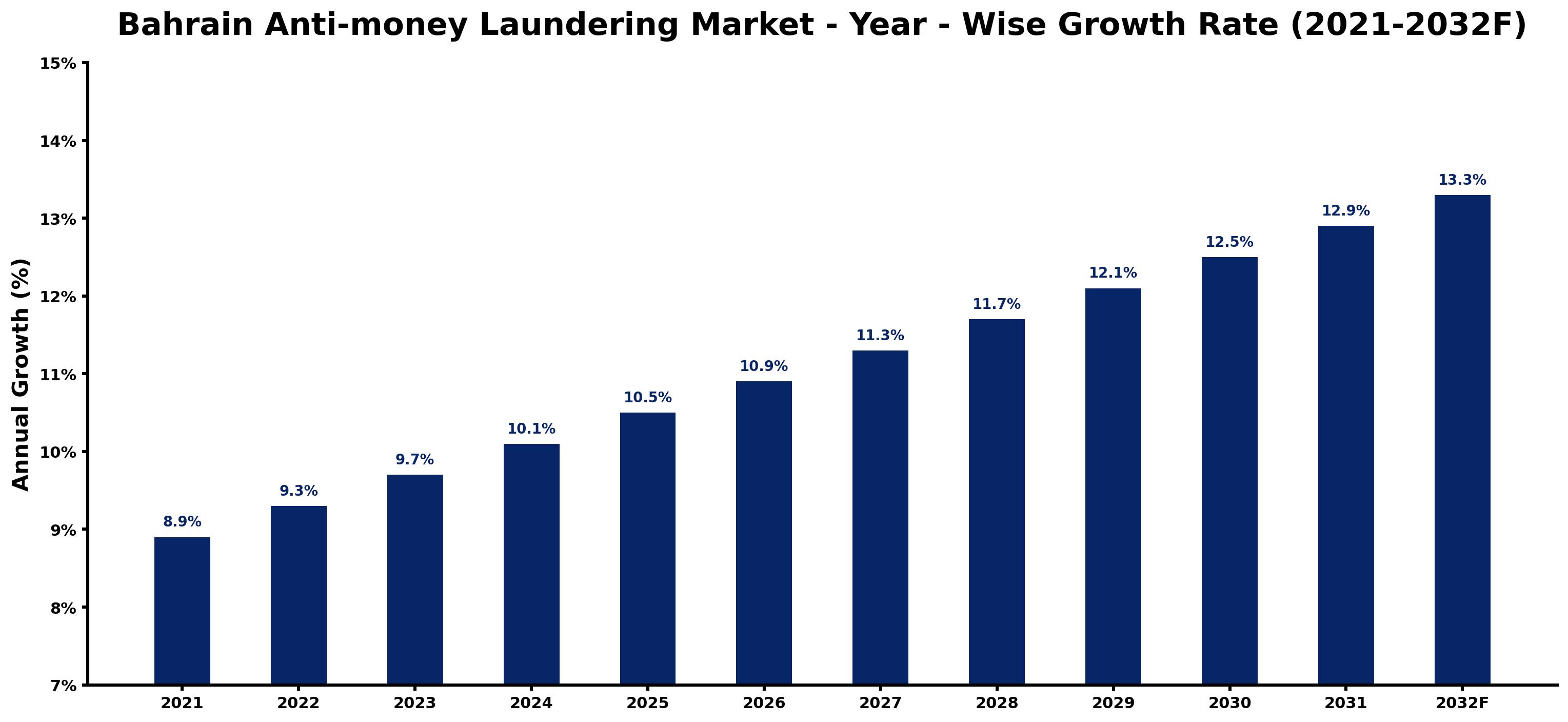
The table below presents the year‑wise growth rates along with the key drivers influencing the market
| Year | Growth Rate | Major Drivers |
| 2021 | 8.9% | Increased regulatory scrutiny from Central Bank of Bahrain. |
| 2022 | 9.3% | Implementation of updated national AML framework and strategies. |
| 2023 | 9.7% | Rise in financial crime reporting requirements for banks. |
| 2024 | 10.1% | Expanded training programs on AML best practices for firms. |
| 2025 | 10.5% | Collaboration with international bodies on compliance enhancement. |
| 2026 | 10.9% | Emergence of fintech solutions tailored for AML compliance. |
| 2027 | 11.3% | Strengthening of legislative measures against money laundering activities. |
| 2028 | 11.7% | Growing awareness of risks in real estate transactions. |
| 2029 | 12.1% | Enhanced due diligence requirements for high-risk sectors. |
| 2030 | 12.5% | Adoption of advanced analytics for AML transaction monitoring. |
| 2031 | 12.9% | Increased investment in regulatory technology by financial institutions. |
| 2032 | 13.3% | Rise in public-private partnerships focused on combating money laundering. |
Note: Market size estimations and growth projections presented in this report are based on 6Wresearch's proprietary forecasting methodology, utilizing the latest available industry data, government publications, and primary research inputs.
Bahrain Anti-money Laundering Market Key Takeaways
Below are some of the specific key takeaways from the market, including:
- The market's growth is primarily fueled by regulatory pressures and the digitalization of financial services.
- AI and machine learning technologies are becoming essential for real-time transaction monitoring.
- There is a growing need for cross-border surveillance tools to combat sophisticated money laundering tactics.
- The shortage of qualified AML professionals presents a significant challenge for financial institutions.
- Investment in AML solutions is rising among banks, fintech firms, and insurance companies.
Evaluation of Restraints in Bahrain Anti-money Laundering Market
Several factors impede the growth of the Bahrain Anti-money Laundering Market. Financial institutions face immense pressure to integrate advanced technology solutions, which must align with existing systems while adapting to evolving money laundering tactics. As transaction volumes continue to grow, ensuring effective real-time monitoring presents considerable challenges. Compliance with both local and international AML regulations requires extensive resources, further complicating efforts to maintain operational effectiveness. Furthermore, the shortage of skilled AML professionals exacerbates these challenges, leaving many organizations vulnerable to risks.
Bahrain Anti-money Laundering Market Trends
Current trends in Bahrain’s AML market reflect an increasing reliance on technology to tackle complex challenges. Financial institutions are investing in sophisticated AI algorithms for transaction monitoring, enabling them to identify suspicious activities swiftly. Concurrently, the integration of Know Your Customer (KYC) processes is becoming a standard practice, enhancing client verification methods. Additionally, collaborative efforts among banks, fintech companies, and regulators are paving the way for innovative approaches to compliance, setting a benchmark for operational transparency in the financial sector.
Bahrain Anti-money Laundering Market Opportunities
As regulatory requirements tighten, Bahrain's AML market presents numerous investment opportunities. There's a rising demand for transaction monitoring systems, customer due diligence tools, and AI-enhanced fraud detection solutions. The emphasis on real-time analytics and automated compliance reporting is attracting significant interest from investors. Collaborations with regulatory bodies can facilitate the adoption of innovative AML technologies, positioning firms for success in this highly compliant environment.
Government Initiatives in the Bahrain Anti-money Laundering Market
Government policy plays a crucial role in shaping the Bahrain Anti-money Laundering Market. The Central Bank of Bahrain enforces stringent AML regulations in line with international standards, emphasizing the necessity for financial institutions to adopt advanced digital tools. By supporting regulatory technology (RegTech) innovations, the government seeks to enhance compliance efficiency while fostering a secure financial ecosystem.
- A regulatory framework established in 2023 mandates comprehensive digital AML tools for transaction monitoring and suspicious activity reporting.
- A national initiative launched in early 2024 focuses on financial transparency, promoting compliance with global AML standards.
- Currently ongoing efforts include the establishment of a regulatory sandbox that allows fintech companies to test compliance solutions in a controlled environment.
- Upcoming plans for 2025 involve the rollout of a nationwide training program aimed at developing skilled AML professionals within the financial sector.
- Collaborative partnerships with international bodies are being strengthened to align with best practices in AML compliance.
Future Insights of the Bahrain Anti-money Laundering Market
The outlook for the Bahrain Anti-money Laundering Market from 2026 to 2032 is decidedly optimistic. As regulatory demands intensify, financial institutions will continue to prioritize investments in cutting-edge AML solutions, driving further innovation in the sector. The ongoing digital transformation of financial services will necessitate more sophisticated risk management frameworks, reinforcing the importance of real-time compliance measures. In this evolving environment, the focus will be on enhancing collaboration among stakeholders, ensuring that Bahrain remains a leader in the fight against money laundering.
Bahrain Anti-money Laundering Market Latest Developments
Recent developments in the Bahrain Anti-money Laundering Market highlight a proactive approach among financial institutions and regulators to address emerging challenges. The integration of AI technologies and automated systems is reshaping how organizations manage compliance and risk.
- A major technology vendor launched a comprehensive AI-driven transaction monitoring platform in Q1 2024, enhancing detection capabilities for financial institutions.
- An ongoing partnership initiated in mid-2023 between banks and local fintechs aims to improve KYC processes through advanced data analytics.
- A pilot program focusing on cross-border surveillance tools began in late 2023, with plans to expand its scope in 2025.
- By early 2025, a leading regional operator plans to implement an upgraded compliance reporting system, streamlining the audit process for financial institutions.
- A comprehensive review of existing AML regulations is expected to commence in mid-2024, aiming to align local policies with international standards.
Bahrain Anti-money Laundering Market - Key Attractiveness of the Report
- 10 Years of Market Numbers
- Historical Data Starting from 2022 to 2025
- Base Year: 2025
- Forecast Data until 2032
- Key Performance Indicators Impacting the Market
- Major Upcoming Developments and Projects
The Central Bank of Bahrain’s strict regulatory framework mandates financial institutions to adopt digital AML tools, thereby driving the demand for innovative compliance solutions and promoting overall market growth.
Key Highlights of the Report:
- Bahrain Anti-money Laundering Market Outlook
- Market Size of Bahrain Anti-money Laundering Market, 2025
- Forecast of Bahrain Anti-money Laundering Market, 2032
- Historical Data and Forecast of Bahrain Anti-money Laundering Revenues & Volume for the Period 2022-2032F
- Bahrain Anti-money Laundering Market Trend Evolution
- Bahrain Anti-money Laundering Market Drivers and Challenges
- Bahrain Anti-money Laundering Price Trends
- Bahrain Anti-money Laundering Porter's Five Forces
- Bahrain Anti-money Laundering Industry Life Cycle
- Historical Data and Forecast of Bahrain Anti-money Laundering Market Revenues & Volume By Component for the Period 2022-2032F
- Historical Data and Forecast of Bahrain Anti-money Laundering Market Revenues & Volume By Services for the Period 2022-2032F
- Historical Data and Forecast of Bahrain Anti-money Laundering Market Revenues & Volume By Solutions for the Period 2022-2032F
- Historical Data and Forecast of Bahrain Anti-money Laundering Market Revenues & Volume By Deployment Mode for the Period 2022-2032F
- Historical Data and Forecast of Bahrain Anti-money Laundering Market Revenues & Volume By On-Premises for the Period 2022-2032F
- Historical Data and Forecast of Bahrain Anti-money Laundering Market Revenues & Volume By Cloud for the Period 2022-2032F
- Historical Data and Forecast of Bahrain Anti-money Laundering Market Revenues & Volume By End User for the Period 2022-2032F
- Historical Data and Forecast of Bahrain Anti-money Laundering Market Revenues & Volume By Banking & Financial Institutes for the Period 2022-2032F
- Historical Data and Forecast of Bahrain Anti-money Laundering Market Revenues & Volume By Insurance for the Period 2022-2032F
- Historical Data and Forecast of Bahrain Anti-money Laundering Market Revenues & Volume By Gaming & Gambling for the Period 2022-2032F
- Historical Data and Forecast of Bahrain Anti-money Laundering Market Revenues & Volume By Organization Size for the Period 2022-2032F
- Historical Data and Forecast of Bahrain Anti-money Laundering Market Revenues & Volume By Large Enterprises for the Period 2022-2032F
- Historical Data and Forecast of Bahrain Anti-money Laundering Market Revenues & Volume By SMEs for the Period 2022-2032F
- Bahrain Anti-money Laundering Import Export Trade Statistics
- Market Opportunity Assessment By Component
- Market Opportunity Assessment By Deployment Mode
- Market Opportunity Assessment By End User
- Market Opportunity Assessment By Organization Size
- Bahrain Anti-money Laundering Top Companies Market Share
- Bahrain Anti-money Laundering Competitive Benchmarking By Technical and Operational Parameters
- Bahrain Anti-money Laundering Company Profiles
- Bahrain Anti-money Laundering Key Strategic Recommendations






































