Bahrain Antiparasitics Drugs Market Size, Share & Growth Rate
The Bahrain Antiparasitics Drugs Market was estimated at USD 309 Million in 2025 and is projected to reach USD 577 Million by 2032, growing at a CAGR of 9.3% from 2026 to 2032. This growth trajectory is driven by a marked increase in the incidence of parasitic infections, coupled with heightened public awareness regarding their treatment and prevention. Furthermore, the government's commitment to enhancing healthcare access plays a pivotal role in bolstering the demand for effective antiparasitic medications.
Bahrain Antiparasitics Drugs Market Year-wise Growth Rate and Key Drivers
This graph highlights how the Bahrain Antiparasitics Drugs Market has steadily grown over the years, supported by major growth factors.
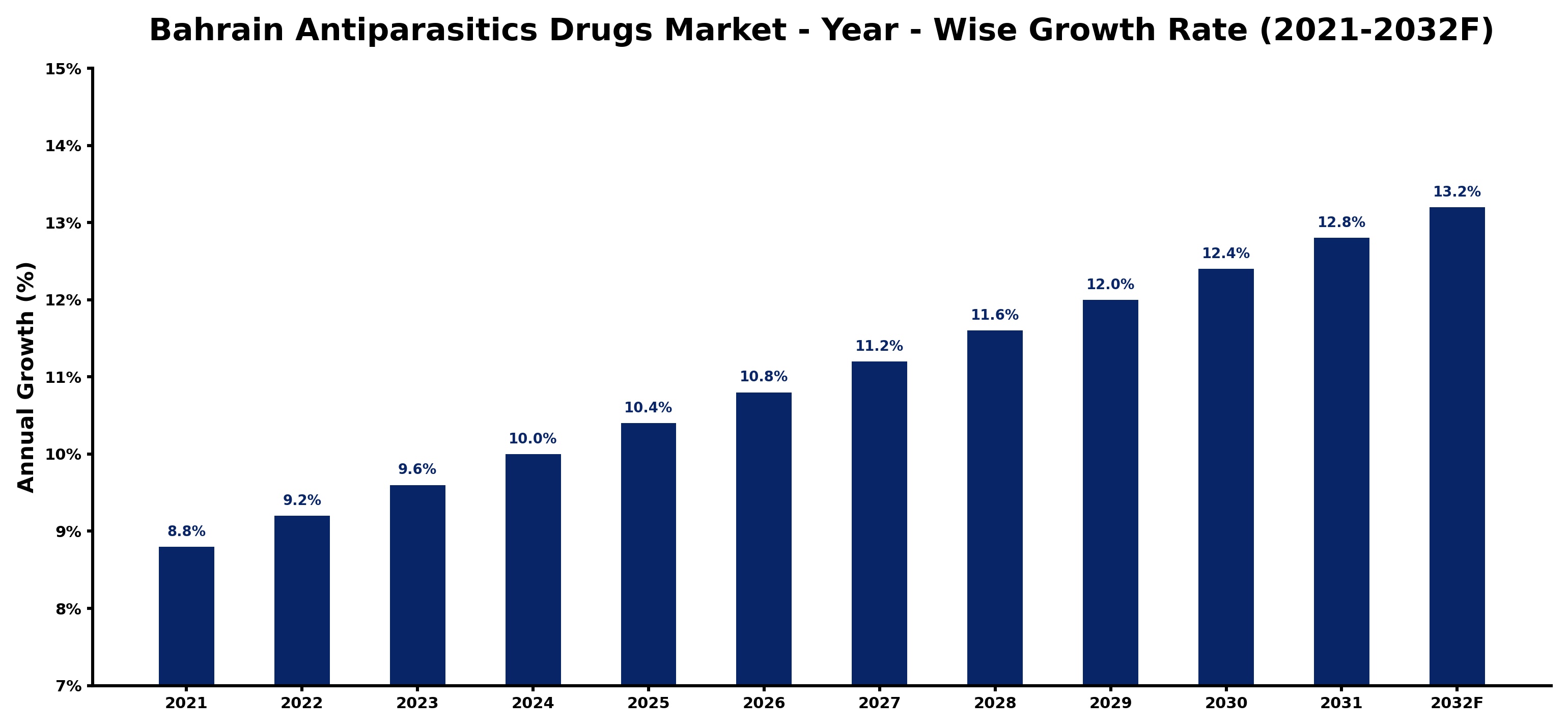
The table below presents the year‑wise growth rates along with the key drivers influencing the market
| Year | Growth Rate | Major Drivers |
| 2021 | 8.8% | Higher livestock health awareness boosts antiparasitic drug sales |
| 2022 | 9.2% | Local pharmaceutical manufacturers scale up antiparasitic drug production capacity |
| 2023 | 9.6% | Manufacturing investments in advanced formulations boost production capabilities |
| 2024 | 10.0% | Capacity expansion at local plants boosts antiparasitics production efficiency |
| 2025 | 10.4% | Digital transformation in drug manufacturing streamlined supply chain processes |
| 2026 | 10.8% | Local manufacturers adopt advanced technologies for antiparasitic drug production |
| 2027 | 11.2% | Technology integration improved precision in antiparasitic drug formulation processes |
| 2028 | 11.6% | Investment in new production facilities boosts antiparasitics drug output |
| 2029 | 12.0% | Export driven pharmaceutical partnerships boost antiparasitic drug production capacity |
| 2030 | 12.4% | Manufacturing investments in biotechnology enhance antiparasitic drug production capacity |
| 2031 | 12.8% | Improved manufacturing capabilities boosted antiparasitic drug production rates |
| 2032 | 13.2% | Local pharmaceutical manufacturing capacity boosts antiparasitic drug supply |
Note - Market size estimations and growth projections presented in this report are based on 6Wresearch’s advanced forecasting approach, validated with industry datasets as of June 2026.
Bahrain Antiparasitics Drugs Market Synopsis
In recent years, the Bahrain Antiparasitics Drugs Market has gained momentum, reflecting a broader recognition of the public health challenges posed by parasitic infections. Moving forward, this market is expected to maintain its growth trajectory, driven by continuous advancements in drug formulations and an expanding healthcare framework.
While the rising demand for antiparasitic medications among the human population is noteworthy, the increasing focus on veterinary health is also shaping market dynamics. As public health initiatives evolve, the integration of effective antiparasitic treatments for both humans and animals will be crucial in addressing the broader public health landscape in Bahrain.
Bahrain Antiparasitics Drugs Market Key Takeaways
- The market is witnessing robust growth due to rising incidences of parasitic infections.
- Government initiatives to enhance healthcare accessibility significantly influence market dynamics.
- Advancements in drug formulations are expected to enhance treatment efficacy.
- Growing demand for veterinary antiparasitic drugs presents additional market opportunities.
- The threat of drug resistance poses challenges that necessitate ongoing research and development.
Evaluation of Restraints in Bahrain Antiparasitics Drugs Market
Despite the promising growth prospects, the Bahrain Antiparasitics Drugs Market faces significant restraints. One of the primary concerns is the increasing issue of drug resistance among parasites, which diminishes the effectiveness of existing treatments. This resistance underscores the urgent need for innovative drug development, yet the costs associated with research and clinical trials may dissuade smaller companies from participating in the market. Additionally, the rise of alternative treatments, including herbal remedies, complicates the competitive landscape for conventional antiparasitic drugs.
Bahrain Antiparasitics Drugs Market Trends
Several current and emerging trends are influencing the Bahrain Antiparasitics Drugs Market. The increasing integration of technology in healthcare is paving the way for more effective treatment regimens, while personalized medicine is beginning to shape the future of antiparasitic therapies. Moreover, the growing emphasis on preventive healthcare is driving awareness campaigns about the importance of treating and preventing parasitic infections, further fueling market demand.
Bahrain Antiparasitics Drugs Market Opportunities
Investment opportunities are plentiful in the Bahrain Antiparasitics Drugs Market, especially within the healthcare sector. Companies focusing on the development and distribution of innovative antiparasitic drugs can benefit from the expanding network of hospitals and clinics. Additionally, as animal healthcare gains traction, there is a significant potential to cater to veterinary practices. Strategic partnerships with pharmaceutical distributors can enhance market penetration and service delivery to meet growing needs.
Government Initiatives in the Bahrain Antiparasitics Drugs Market
Bahrain's government plays an instrumental role in shaping the antiparasitics drugs market through policies that promote public health and access to essential medicines. Regulatory measures ensure that antiparasitic treatments adhere to international safety standards, thereby fostering a conducive environment for market growth. Local initiatives aimed at enhancing healthcare infrastructure and addressing animal welfare also support the increasing demand for antiparasitic medications.
Future Insights of the Bahrain Antiparasitics Drugs Market
Looking ahead to 2026-2032, the Bahrain Antiparasitics Drugs Market is poised for significant advancements. The ongoing evolution in drug development, combined with government support and increased public awareness, will drive market growth. Furthermore, the collaboration between public health sectors and pharmaceutical entities will be crucial in combating parasitic diseases effectively. Continuous investment in R&D will be vital to address the challenges of drug resistance and cater to the evolving needs of both human and veterinary healthcare.
Bahrain Antiparasitics Drugs Market Latest Developments (May 2025 - June 2026)
Recent industry developments reflect a strategic shift towards enhancing the availability of antiparasitic drugs in Bahrain. There is a growing trend of pharmaceutical companies focusing on innovative drug formulations and delivery methods to increase efficacy. Additionally, collaborations among healthcare providers and government agencies have been pivotal in addressing public health challenges associated with parasitic infections, further shaping the future of this vital market.
Bahrain Antiparasitics Drugs Market - Key Attractiveness of the Report
- 10 Years of Market Numbers
- Historical Data Starting from 2022 to 2025
- Base Year: 2025
- Forecast Data until 2032
- Key Performance Indicators Impacting the Market
- Major Upcoming Developments and Projects
Key Highlights of the Report:
- Bahrain Antiparasitics Drugs Market Outlook
- Market Size of Bahrain Antiparasitics Drugs Market, 2025
- Forecast of Bahrain Antiparasitics Drugs Market, 2032
- Historical Data and Forecast of Bahrain Antiparasitics Drugs Revenues & Volume for the Period 2022-2032F
- Bahrain Antiparasitics Drugs Market Trend Evolution
- Bahrain Antiparasitics Drugs Market Drivers and Challenges
- Bahrain Antiparasitics Drugs Price Trends
- Bahrain Antiparasitics Drugs Porter's Five Forces
- Bahrain Antiparasitics Drugs Industry Life Cycle
- Historical Data and Forecast of Bahrain Antiparasitics Drugs Market Revenues & Volume By Route of Administration for the Period 2022-2032F
- Historical Data and Forecast of Bahrain Antiparasitics Drugs Market Revenues & Volume By Oral for the Period 2022-2032F
- Historical Data and Forecast of Bahrain Antiparasitics Drugs Market Revenues & Volume By Injectable for the Period 2022-2032F
- Historical Data and Forecast of Bahrain Antiparasitics Drugs Market Revenues & Volume By Topical for the Period 2022-2032F
- Historical Data and Forecast of Bahrain Antiparasitics Drugs Market Revenues & Volume By Drug class for the Period 2022-2032F
- Historical Data and Forecast of Bahrain Antiparasitics Drugs Market Revenues & Volume By Anthelmintics for the Period 2022-2032F
- Historical Data and Forecast of Bahrain Antiparasitics Drugs Market Revenues & Volume By Antiprotozoals for the Period 2022-2032F
- Historical Data and Forecast of Bahrain Antiparasitics Drugs Market Revenues & Volume By Others for the Period 2022-2032F
- Historical Data and Forecast of Bahrain Antiparasitics Drugs Market Revenues & Volume By Distribution Channel for the Period 2022-2032F
- Historical Data and Forecast of Bahrain Antiparasitics Drugs Market Revenues & Volume By Hospital Pharmacies for the Period 2022-2032F
- Historical Data and Forecast of Bahrain Antiparasitics Drugs Market Revenues & Volume By Retail Pharmacies for the Period 2022-2032F
- Historical Data and Forecast of Bahrain Antiparasitics Drugs Market Revenues & Volume By Online Pharmacies for the Period 2022-2032F
- Bahrain Antiparasitics Drugs Import Export Trade Statistics
- Market Opportunity Assessment By Route of Administration
- Market Opportunity Assessment By Drug class
- Market Opportunity Assessment By Distribution Channel
- Bahrain Antiparasitics Drugs Top Companies Market Share
- Bahrain Antiparasitics Drugs Competitive Benchmarking By Technical and Operational Parameters
- Bahrain Antiparasitics Drugs Company Profiles
- Bahrain Antiparasitics Drugs Key Strategic Recommendations






































