Bahrain Asbestos Mining Market Size, Share & Growth Rate
The Bahrain Asbestos Mining Market was estimated at USD 1198 Million in 2025 and is projected to reach USD 2228 Million by 2032, growing at a CAGR of 9.3% from 2026 to 2032. This growth trajectory is primarily driven by increased emphasis on remediation efforts, as the country aims to manage its legacy asbestos issues while transitioning towards safer construction materials. The rising awareness of health risks associated with asbestos is also propelling investments in alternative materials and safe disposal services.
Bahrain Asbestos Mining Market Year-wise Growth Rate and Key Drivers
This graph highlights how the Bahrain Asbestos Mining Market has steadily grown over the years, supported by major growth factors.
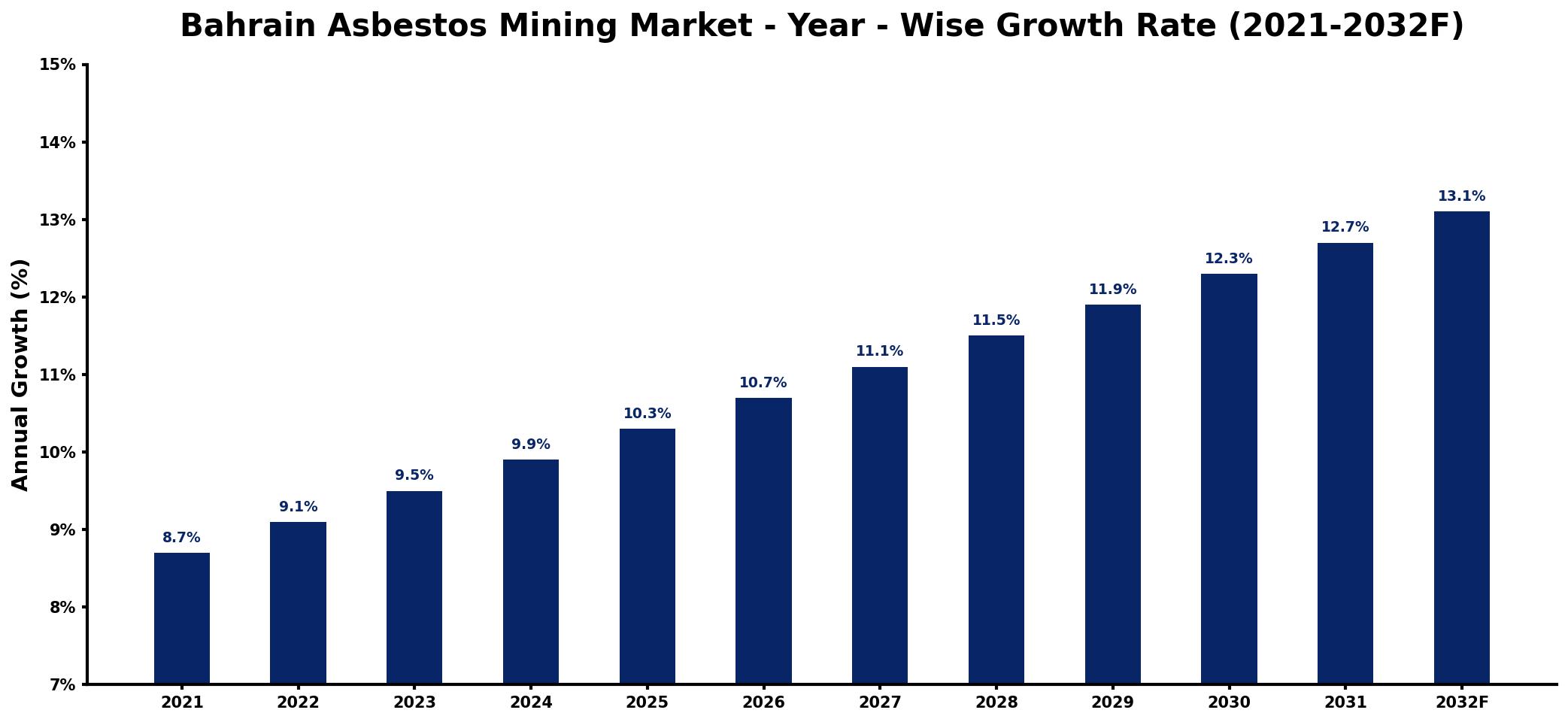
The table below presents the year‑wise growth rates along with the key drivers influencing the market
| Year | Growth Rate | Major Drivers |
| 2021 | 8.7% | Increased demand from construction sector |
| 2022 | 9.1% | Rising investments in infrastructure projects |
| 2023 | 9.5% | Growth in industrial applications utilization |
| 2024 | 9.9% | Expansion of building materials market |
| 2025 | 10.3% | rising end-use demand growth |
| 2026 | 10.7% | Higher consumer awareness on durability |
| 2027 | 11.1% | Demand from emerging markets rises |
| 2028 | 11.5% | Innovations in product applications enhance |
| 2029 | 11.9% | Government support for industrial growth |
| 2030 | 12.3% | Increased exports to neighboring regions |
| 2031 | 12.7% | Technological advancements drive efficiency |
| 2032 | 13.1% | Sustainable practices attract new investments |
Note: Market size estimations and growth projections presented in this report are based on 6Wresearch's proprietary forecasting methodology, utilizing the latest available industry data, government publications, and primary research inputs.
Bahrain Asbestos Mining Market Synopsis
In Bahrain, asbestos mining is effectively non-existent due to stringent health and environmental regulations that have led to a complete ban on the import and use of asbestos-containing materials. Consequently, the market dynamics center on the management of historical asbestos—specifically, abatement and safe disposal efforts concerning legacy materials found in older buildings.
The focus on replacement materials such as fiberglass and mineral wool is notable within the construction sector. Public awareness campaigns and mandatory building inspections are integral to Bahrain's ongoing strategy to ensure that existing asbestos materials are effectively managed and that construction practices adhere to stringent safety standards.
Bahrain Asbestos Mining Market Key Takeaways
- The market is fundamentally centered around remediation and abatement services rather than mining activities.
- Regulatory measures have effectively phased out the use of asbestos, leading to a robust shift towards non-toxic substitutes.
- Demand for safe disposal services and specialized safety equipment remains high as Bahrain addresses its asbestos legacy.
- Growth opportunities lie within compliance services for managing existing asbestos materials and public education initiatives.
- The market's future will continue to be shaped by increasing health awareness and the transition to safer construction alternatives.
Evaluation of Restraints in Bahrain Asbestos Mining Market
Bahrain's asbestos mining market is significantly restrained by the rigorous environmental and health regulations that govern the industry. The outright ban on the use and importation of asbestos-containing materials has curtailed any potential for active mining operations, relegating market activities to historical remediation efforts. The high costs associated with compliance and the need for specialized training further limit the attractiveness of this sector, leading to a preference for safer, more sustainable alternatives.
Bahrain Asbestos Mining Market Trends
A prominent trend within the Bahrain asbestos mining market is the increasing adoption of sustainable materials in construction. As public health considerations gain prominence, there is a discernible shift towards the use of fiberglass and mineral wool as effective substitutes. Additionally, the rise of technology-driven solutions for asbestos detection and abatement is reshaping how industry stakeholders approach legacy materials, ensuring compliance and safety standards are met.
Bahrain Asbestos Mining Market Opportunities
Despite the challenges, genuine growth opportunities exist primarily in the areas of asbestos removal and compliance services. Organizations involved in the abatement process can capitalize on increasing governmental and corporate initiatives to safely manage existing asbestos materials. Moreover, investments in training programs for specialized labor and innovations in safety equipment create a niche market ready for expansion.
Government Initiatives in the Bahrain Asbestos Mining Market
Bahrain's government has implemented comprehensive initiatives aimed at minimizing the health risks associated with asbestos exposure. The Ministry of Industry and Commerce actively enforces safety regulations to protect workers and the public, while promoting policies that encourage the use of alternative materials in construction and manufacturing. Awareness programs aimed at educating the public and businesses on the dangers of asbestos are essential components of Bahrain's strategy to ensure a safer environment.
Future Insights of the Bahrain Asbestos Mining Market
Looking ahead to the 2026-2032 period, the Bahrain asbestos mining market is expected to evolve significantly as legacy asbestos management remains a critical issue. The ongoing shift towards sustainable construction practices will continue to diminish any residual reliance on asbestos-related materials. With increased investments in safety and compliance measures, the market is poised for a gradual phase-out, favoring alternatives that align with global health standards.
Bahrain Asbestos Mining Market Latest Developments (2025 - 2026)
Recent developments in the Bahrain asbestos mining market indicate a continued emphasis on the safe management of asbestos materials. Efforts are being made to enhance public awareness about the risks associated with asbestos and promote safer alternatives. Additionally, new regulations are expected to emerge, reinforcing the importance of compliance and encouraging innovative solutions for asbestos remediation and disposal.
Bahrain Asbestos Mining Market - Key Attractiveness of the Report
- 10 Years of Market Numbers
- Historical Data Starting from 2022 to 2025
- Base Year: 2025
- Forecast Data until 2032
- Key Performance Indicators Impacting the Market
- Major Upcoming Developments and Projects
Key Highlights of the Report:
- Bahrain Asbestos Mining Market Outlook
- Market Size of Bahrain Asbestos Mining Market, 2025
- Forecast of Bahrain Asbestos Mining Market, 2032
- Historical Data and Forecast of Bahrain Asbestos Mining Revenues & Volume for the Period 2022-2032F
- Bahrain Asbestos Mining Market Trend Evolution
- Bahrain Asbestos Mining Market Drivers and Challenges
- Bahrain Asbestos Mining Price Trends
- Bahrain Asbestos Mining Porter's Five Forces
- Bahrain Asbestos Mining Industry Life Cycle
- Historical Data and Forecast of Bahrain Asbestos Mining Market Revenues & Volume By End-use for the Period 2022-2032F
- Historical Data and Forecast of Bahrain Asbestos Mining Market Revenues & Volume By Automobile for the Period 2022-2032F
- Historical Data and Forecast of Bahrain Asbestos Mining Market Revenues & Volume By Pharmaceutical for the Period 2022-2032F
- Historical Data and Forecast of Bahrain Asbestos Mining Market Revenues & Volume By Refinery for the Period 2022-2032F
- Bahrain Asbestos Mining Import Export Trade Statistics
- Market Opportunity Assessment By End-use
- Bahrain Asbestos Mining Top Companies Market Share
- Bahrain Asbestos Mining Competitive Benchmarking By Technical and Operational Parameters
- Bahrain Asbestos Mining Company Profiles
- Bahrain Asbestos Mining Key Strategic Recommendations






































