Bahrain Automotive Differential Market: Import Trend Analysis
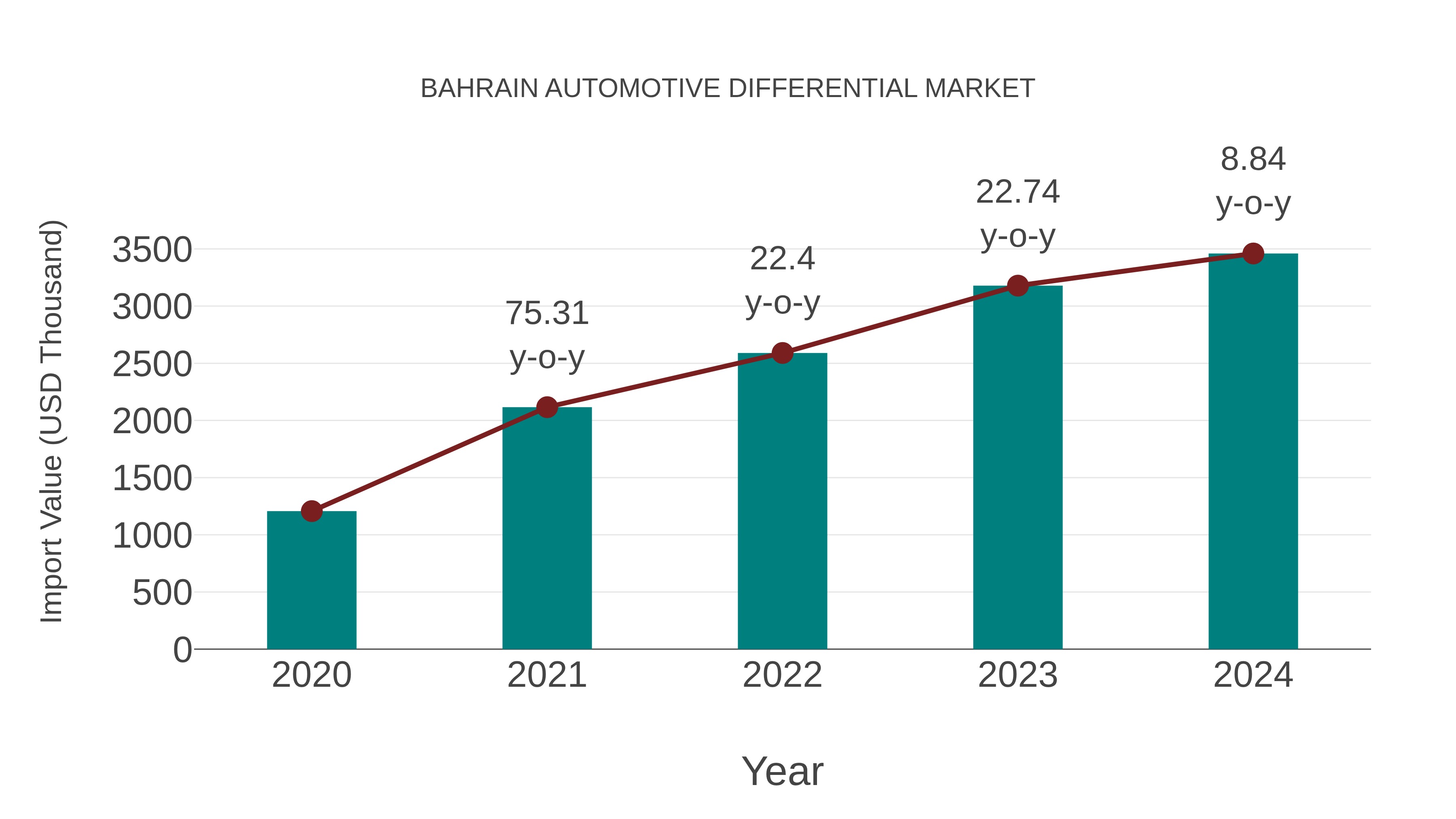
The Bahrain automotive differential market witnessed a significant increase in imports from 2020 to 2024, with a Compound Annual Growth Rate (CAGR) of 30.12%. Notably, in 2023-2024, the year-on-year growth rate was 8.84%, contributing to the overall rise in import volumes during this period.
Bahrain Automotive Differential Market Synopsis
The Bahrain Automotive Differential Market is witnessing steady growth driven by increasing demand for vehicles, particularly in the luxury and sports car segments. The differential market in Bahrain is primarily dominated by aftermarket sales, with a growing trend towards customization and performance upgrades. The market is also influenced by factors such as government initiatives promoting electric vehicles and stringent emission regulations, leading to a shift towards more fuel-efficient and environmentally friendly differentials. Key players in the Bahrain differential market include global automotive manufacturers as well as local aftermarket suppliers catering to the specific needs of the region. With a focus on innovation and technological advancements, the Bahrain Automotive Differential Market is poised for further expansion in the coming years.
Bahrain Automotive Differential Market Trends
The Bahrain Automotive Differential Market is experiencing a shift towards advanced technologies such as electronic limited-slip differentials and torque vectoring systems, which improve vehicle performance and handling. There is also a growing demand for eco-friendly differentials to reduce emissions and enhance fuel efficiency. Opportunities exist for manufacturers to collaborate with automotive companies in Bahrain to develop customized differential solutions for luxury and high-performance vehicles. Additionally, the increasing focus on off-road and sports vehicles in the region presents a niche market for specialized differential systems. Market players can capitalize on these trends by investing in research and development to create innovative and sustainable solutions that cater to the evolving needs of Bahrain`s automotive sector.
Bahrain Automotive Differential Market Challenges
In the Bahrain Automotive Differential Market, challenges include increasing competition from international brands, fluctuating oil prices affecting consumer spending power, and evolving consumer preferences towards more fuel-efficient vehicles. Additionally, the market is impacted by regulatory changes, such as emission standards and import regulations, which can affect the availability and pricing of differential products. Furthermore, the limited size of the Bahraini market poses a challenge for companies to achieve economies of scale and maintain competitive pricing. To succeed in this market, companies need to adapt to changing consumer demands, invest in research and development for innovative differential technologies, and establish strong distribution networks to reach customers effectively.
Bahrain Automotive Differential Market Investment Opportunities
The Bahrain Automotive Differential Market is primarily driven by the growing demand for vehicles in the country, fueled by economic growth and increasing disposable income levels. Additionally, the rising trend towards off-road and sports vehicles has led to a higher adoption of automotive differentials for improved performance and handling. Stringent government regulations emphasizing vehicle safety and stability also contribute to the market growth, as differential systems play a crucial role in enhancing overall vehicle stability and control. Technological advancements in automotive differentials, such as electronic differential locks and limited-slip differentials, further drive market expansion by offering better efficiency and performance. Overall, the increasing consumer preference for high-performance vehicles and the emphasis on vehicle safety are key factors propelling the Bahrain Automotive Differential Market forward.
Bahrain Automotive Differential Market Government Polices
The Bahrain government has implemented policies aimed at promoting the automotive industry, including the automotive differential market. These policies focus on creating a favorable business environment through initiatives such as tax incentives, subsidies for research and development, and investment promotion programs. Additionally, the government has taken steps to encourage the adoption of environmentally friendly technologies in the automotive sector, which could impact the differential market by driving demand for more efficient and sustainable products. Overall, these government policies are designed to support the growth and competitiveness of the automotive industry in Bahrain, including the automotive differential market.
Bahrain Automotive Differential Market Future Outlook
The Bahrain Automotive Differential Market is expected to witness steady growth in the coming years, driven by factors such as increasing vehicle sales, growing demand for off-road vehicles, and advancements in automotive technology. The market is likely to benefit from the rising popularity of SUVs and electric vehicles, which often require sophisticated differential systems for optimal performance. Additionally, the government`s focus on infrastructure development and road safety initiatives is anticipated to boost the demand for vehicles equipped with advanced differential systems. As a result, automotive manufacturers and suppliers in Bahrain are expected to invest in research and development to offer innovative differential solutions that cater to the evolving needs of consumers. Overall, the Bahrain Automotive Differential Market is poised for expansion and technological advancements in the foreseeable future.
Key Highlights of the Report:
- Bahrain Automotive Differential Market Outlook
- Market Size of Bahrain Automotive Differential Market, 2025
- Forecast of Bahrain Automotive Differential Market, 2032
- Historical Data and Forecast of Bahrain Automotive Differential Revenues & Volume for the Period 2022 - 2032F
- Bahrain Automotive Differential Market Trend Evolution
- Bahrain Automotive Differential Market Drivers and Challenges
- Bahrain Automotive Differential Price Trends
- Bahrain Automotive Differential Porter's Five Forces
- Bahrain Automotive Differential Industry Life Cycle
- Historical Data and Forecast of Bahrain Automotive Differential Market Revenues & Volume By Type for the Period 2022 - 2032F
- Historical Data and Forecast of Bahrain Automotive Differential Market Revenues & Volume By Open for the Period 2022 - 2032F
- Historical Data and Forecast of Bahrain Automotive Differential Market Revenues & Volume By Locking for the Period 2022 - 2032F
- Historical Data and Forecast of Bahrain Automotive Differential Market Revenues & Volume By Limited Slip for the Period 2022 - 2032F
- Historical Data and Forecast of Bahrain Automotive Differential Market Revenues & Volume By Electronic Limited Slip for the Period 2022 - 2032F
- Historical Data and Forecast of Bahrain Automotive Differential Market Revenues & Volume By Torque-Vectoring for the Period 2022 - 2032F
- Historical Data and Forecast of Bahrain Automotive Differential Market Revenues & Volume By Drive Type for the Period 2022 - 2032F
- Historical Data and Forecast of Bahrain Automotive Differential Market Revenues & Volume By FWD for the Period 2022 - 2032F
- Historical Data and Forecast of Bahrain Automotive Differential Market Revenues & Volume By RWD for the Period 2022 - 2032F
- Historical Data and Forecast of Bahrain Automotive Differential Market Revenues & Volume By 4WD/AWD for the Period 2022 - 2032F
- Bahrain Automotive Differential Import Export Trade Statistics
- Market Opportunity Assessment By Type
- Market Opportunity Assessment By Drive Type
- Bahrain Automotive Differential Top Companies Market Share
- Bahrain Automotive Differential Competitive Benchmarking By Technical and Operational Parameters
- Bahrain Automotive Differential Company Profiles
- Bahrain Automotive Differential Key Strategic Recommendations






































