Bahrain Blockchain In Insurance Market Size & Growth Rate (2026-2032)
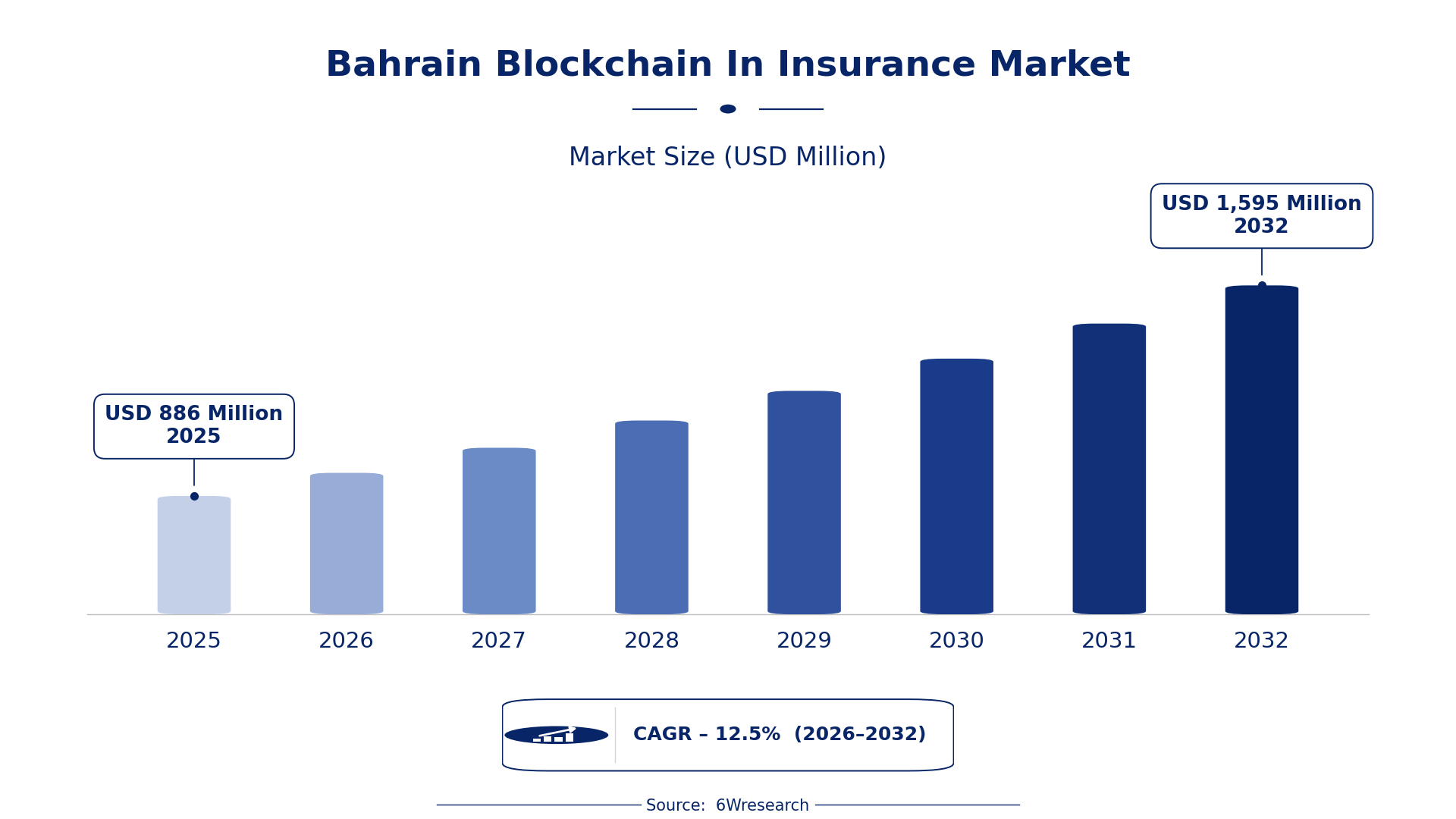
The Bahrain Blockchain In Insurance Market was estimated at USD 886 Million in 2025 and is projected to reach USD 1595 Million by 2032, growing at a CAGR of 12.5% from 2026 to 2032.
Bahrain Blockchain In Insurance Market Synopsis
The integration of blockchain technology within Bahrain's insurance sector is transforming how companies manage claims, underwriting, and policy issuance. Insurers are increasingly adopting smart contracts and distributed ledger systems, which enhance transaction transparency and improve trust between insurers and clients.
As the Central Bank of Bahrain promotes fintech innovation, insurance providers are actively exploring blockchain pilot programs. This shift aims to enhance operational efficiency, reduce fraud, and streamline processes, ensuring a more responsive and customer-focused insurance experience.
Bahrain Blockchain In Insurance Market Year-wise Growth Rate and Key Drivers
This graph illustrates the annual growth rates of the Bahrain Blockchain In Insurance Market from 2021 to 2032, highlighting a steady upward trajectory and projected expansion over the forecast period.
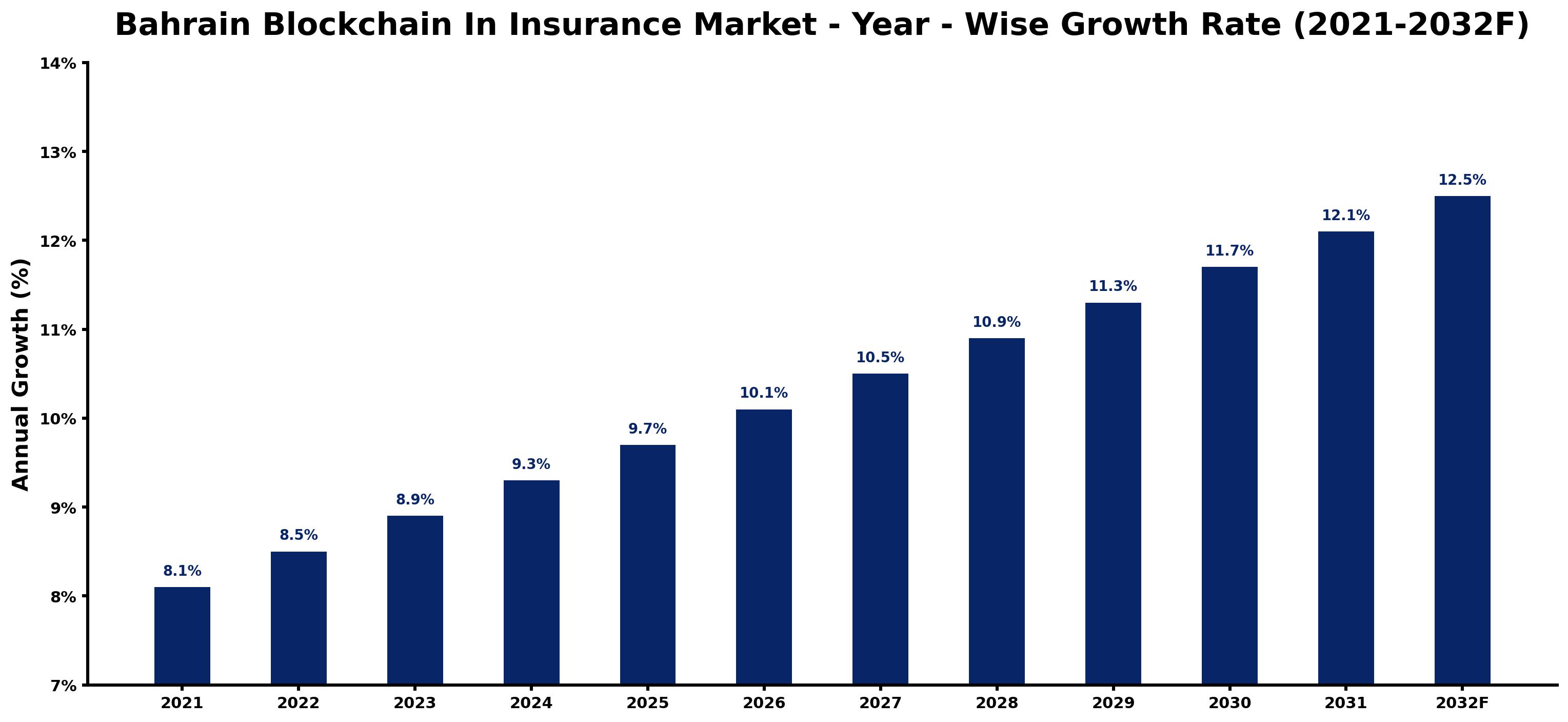
The table below presents the year‑wise growth rates along with the key drivers influencing the market
| Year | Growth Rate | Major Drivers |
| 2021 | 8.1% | Central Bank of Bahrain's blockchain regulatory framework adoption. |
| 2022 | 8.5% | Increased investments in insurtech solutions by local startups. |
| 2023 | 8.9% | Growing collaboration between insurers and tech startups. |
| 2024 | 9.3% | Bahrain's financial sector digitization strategy boost. |
| 2025 | 9.7% | Enhanced customer trust in insurance through blockchain transparency. |
| 2026 | 10.1% | Demand for smart contracts in insurance policies rises. |
| 2027 | 10.5% | Regulatory support for blockchain in risk management solutions. |
| 2028 | 10.9% | Public awareness campaigns on blockchain benefits in insurance. |
| 2029 | 11.3% | Integration of blockchain in Bahrain's financial ecosystem advances. |
| 2030 | 11.7% | Rising regional interest in digital assets and insurance synergy. |
| 2031 | 12.1% | Local universities introducing blockchain courses for insurance focus. |
| 2032 | 12.5% | Government incentives for innovation in digital insurance services. |
Note: Market size estimations and growth projections presented in this report are based on 6Wresearch's proprietary forecasting methodology, utilizing the latest available industry data, government publications, and primary research inputs.
Bahrain Blockchain In Insurance Market Key Takeaways
Below are some of the specific key takeaways from the market, including:
- Blockchain technology is revolutionizing claims processing and policy management.
- Smart contracts are enhancing operational efficiencies and customer satisfaction.
- The Central Bank's support fosters innovation and encourages partnerships.
- Demand for transparency and fraud reduction drives market growth.
- Investment opportunities are emerging in blockchain-based insurance solutions.
Evaluation of Restraints in Bahrain Blockchain In Insurance Market
Despite its promise, the Bahrain Blockchain In Insurance Market faces notable hurdles. Regulatory constraints can impede the swift adoption of blockchain solutions, with existing frameworks sometimes lagging behind technological advancements. Interoperability with legacy systems also presents a significant challenge, as many insurers are still reliant on outdated processes. on top of that, the high costs associated with implementing blockchain technology can deter smaller firms from participating in this transformative shift.
Bahrain Blockchain In Insurance Market Trends
Currently, the market is experiencing a surge in the adoption of blockchain for identity verification and transparent underwriting processes. Insurers are increasingly utilizing blockchain to create tamper-proof records, thus fostering higher levels of trust. The trend towards automation is also significant, as insurers seek to minimize administrative overheads while enhancing service delivery. Partnerships between technology providers and insurance companies are becoming more common, signaling a collaborative approach to innovation.
Bahrain Blockchain In Insurance Market Opportunities
The Bahrain Blockchain In Insurance Market presents numerous growth opportunities for investors and technology providers. The demand for secure, efficient claims processing systems is escalating, creating a market for innovative blockchain solutions. Additionally, as regulatory bodies increasingly emphasize data protection and transparency, blockchain's ability to provide a secure, decentralized platform will become indispensable. Companies that can offer tailored blockchain solutions for policy management and customer interactions stand to benefit significantly in this evolving landscape.
Government Initiatives in the Bahrain Blockchain In Insurance Market
The Bahraini government is actively fostering a supportive environment for blockchain technology within the insurance sector. By prioritizing regulatory clarity and digital innovation, authorities aim to enhance trust and efficiency in insurance operations. Current initiatives focus on creating a framework that encourages pilot programs and partnerships, driving the adoption of blockchain solutions.
- A regulatory framework introduced in 2025 promoting transparency in billing processes.
- Ongoing initiatives to upgrade digital infrastructure across the insurance sector, enhancing data security.
- A planned public-private partnership expected to boost blockchain pilot projects by 2026.
- Current efforts by the Central Bank to facilitate fintech innovation through collaborative workshops.
- Upcoming policies aimed at integrating blockchain with existing insurance practices by 2027.
Future Insights of the Bahrain Blockchain In Insurance Market
Looking ahead to 2026-2032, the Bahrain Blockchain In Insurance Market is set to expand significantly. As insurers continue to recognize the advantages of blockchain, the technology will likely become a standard within operational frameworks. Increasing regulatory support and a growing demand for transparent processes will drive further innovation. Expect more partnerships between insurers and tech firms, paving the way for next-generation solutions that improve efficiency and customer satisfaction.
Bahrain Blockchain In Insurance Market Latest Developments
Recent developments within the Bahrain Blockchain In Insurance Market have highlighted a trend towards greater adoption of blockchain solutions. Over the past year, insurers have begun to pilot new technologies that streamline claims processing and improve customer interactions. This movement reflects a broader shift towards digital transformation in the insurance sector.
- A major insurance provider launched a blockchain-based claims management system in early 2025, significantly reducing processing times.
- An ongoing initiative, started in mid-2025, is focused on integrating blockchain for secure identity verification in underwriting processes.
- A planned rollout of a decentralized platform for policyholder data management is expected to commence in late 2026.
- In Q1 2025, a consortium of local insurers began collaborating with technology vendors to develop blockchain solutions tailored to the regional market.
Bahrain Blockchain In Insurance Market - Key Attractiveness of the Report
- 10 Years of Market Numbers
- Historical Data Starting from 2022 to 2025
- Base Year: 2025
- Forecast Data until 2032
- Key Performance Indicators Impacting the Market
- Major Upcoming Developments and Projects
Key Highlights of the Report:
- Bahrain Blockchain In Insurance Market Outlook
- Market Size of Bahrain Blockchain In Insurance Market, 2025
- Forecast of Bahrain Blockchain In Insurance Market, 2032
- Historical Data and Forecast of Bahrain Blockchain In Insurance Revenues & Volume for the Period 2022-2032F
- Bahrain Blockchain In Insurance Market Trend Evolution
- Bahrain Blockchain In Insurance Market Drivers and Challenges
- Bahrain Blockchain In Insurance Price Trends
- Bahrain Blockchain In Insurance Porter's Five Forces
- Bahrain Blockchain In Insurance Industry Life Cycle
- Historical Data and Forecast of Bahrain Blockchain In Insurance Market Revenues & Volume By Provider for the Period 2022-2032F
- Historical Data and Forecast of Bahrain Blockchain In Insurance Market Revenues & Volume By Application and solution provider for the Period 2022-2032F
- Historical Data and Forecast of Bahrain Blockchain In Insurance Market Revenues & Volume By Middleware provider for the Period 2022-2032F
- Historical Data and Forecast of Bahrain Blockchain In Insurance Market Revenues & Volume By Infrastructure and protocols provider for the Period 2022-2032F
- Historical Data and Forecast of Bahrain Blockchain In Insurance Market Revenues & Volume By Application for the Period 2022-2032F
- Historical Data and Forecast of Bahrain Blockchain In Insurance Market Revenues & Volume By GRC management for the Period 2022-2032F
- Historical Data and Forecast of Bahrain Blockchain In Insurance Market Revenues & Volume By Death and claims management for the Period 2022-2032F
- Historical Data and Forecast of Bahrain Blockchain In Insurance Market Revenues & Volume By Identity management and fraud detection for the Period 2022-2032F
- Historical Data and Forecast of Bahrain Blockchain In Insurance Market Revenues & Volume By Payments for the Period 2022-2032F
- Historical Data and Forecast of Bahrain Blockchain In Insurance Market Revenues & Volume By Smart contracts for the Period 2022-2032F
- Historical Data and Forecast of Bahrain Blockchain In Insurance Market Revenues & Volume By Others for the Period 2022-2032F
- Historical Data and Forecast of Bahrain Blockchain In Insurance Market Revenues & Volume By Organization Size for the Period 2022-2032F
- Historical Data and Forecast of Bahrain Blockchain In Insurance Market Revenues & Volume By Large Enterprises for the Period 2022-2032F
- Historical Data and Forecast of Bahrain Blockchain In Insurance Market Revenues & Volume By SMEs for the Period 2022-2032F
- Bahrain Blockchain In Insurance Import Export Trade Statistics
- Market Opportunity Assessment By Provider
- Market Opportunity Assessment By Application
- Market Opportunity Assessment By Organization Size
- Bahrain Blockchain In Insurance Top Companies Market Share
- Bahrain Blockchain In Insurance Competitive Benchmarking By Technical and Operational Parameters
- Bahrain Blockchain In Insurance Company Profiles
- Bahrain Blockchain In Insurance Key Strategic Recommendations






































