Bahrain Chlorine Market: Import Trend Analysis
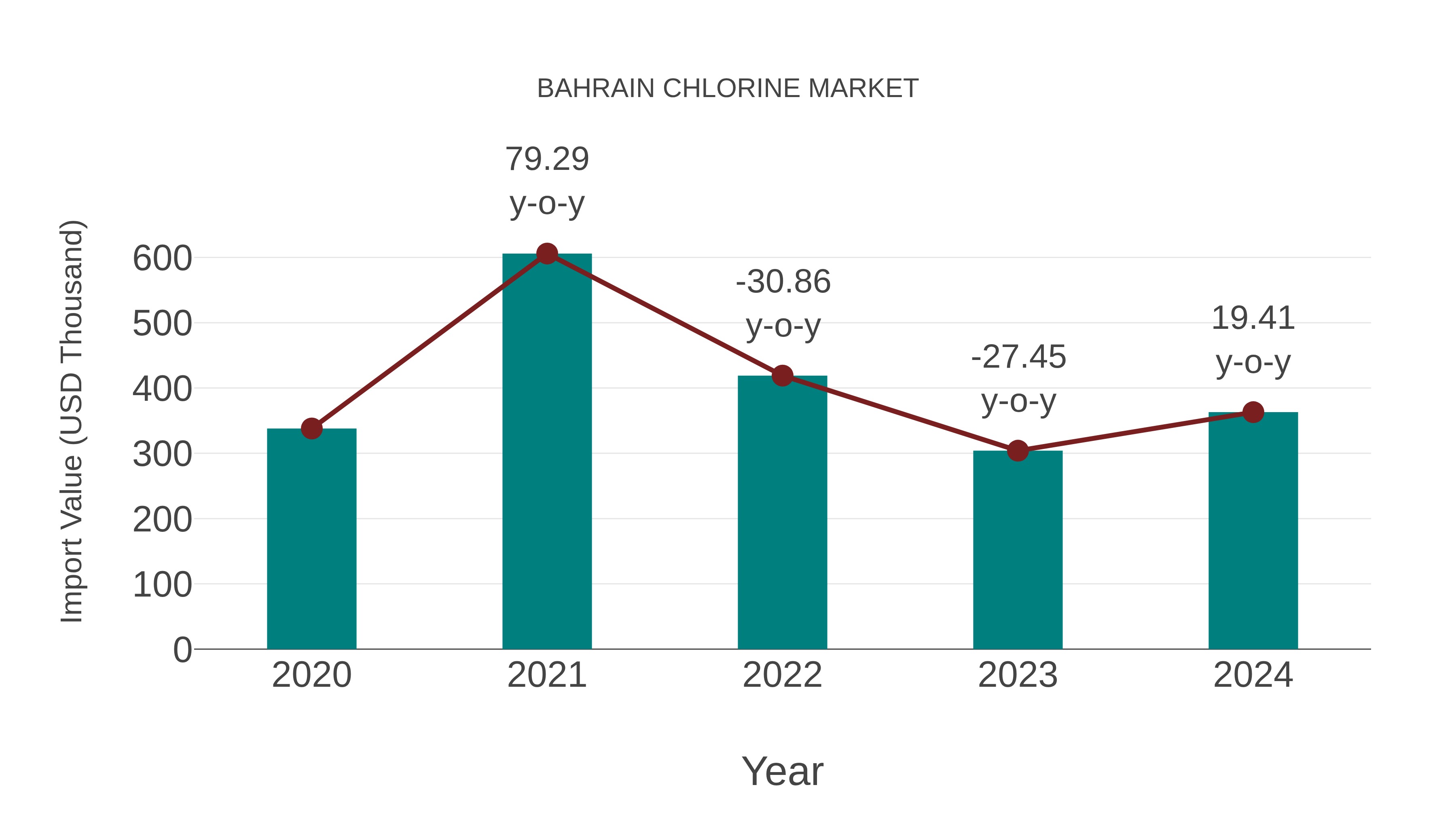
In 2024, Bahrain import trend for the chlorine market exhibited strong growth, with a notable 19.41% increase from 2023. The compound annual growth rate (CAGR) for imports between 2020 and 2024 stood at 1.8%. This import momentum could be attributed to a shift in demand dynamics or evolving trade policies impacting market stability.
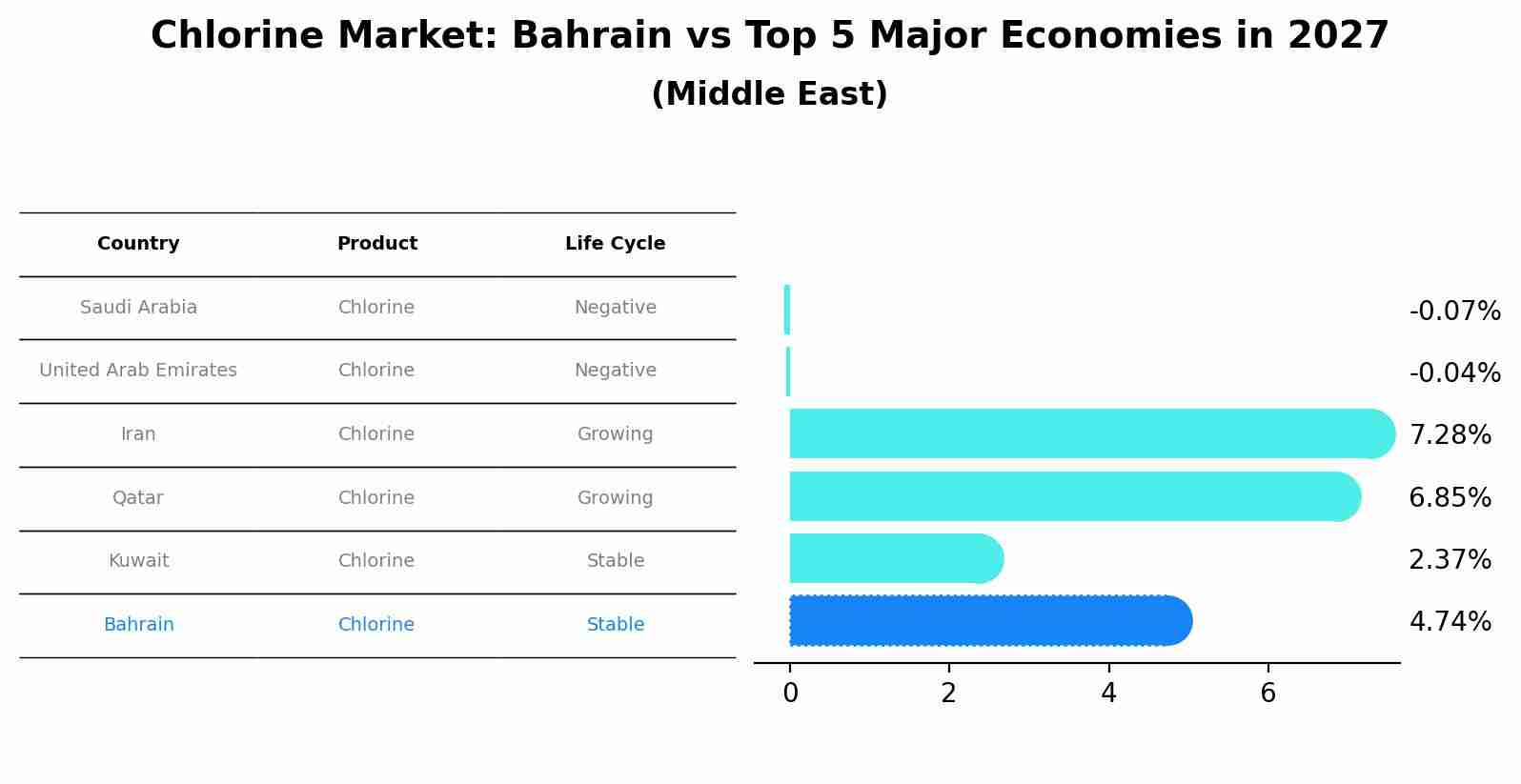
Chlorine Market: Bahrain vs Top 5 Major Economies in 2027 (Middle East)
The Chlorine market in Bahrain is projected to grow at a stable growth rate of 4.74% by 2027, within the Middle East region led by Saudi Arabia, along with other countries like United Arab Emirates, Iran, Qatar and Kuwait, collectively shaping a dynamic and evolving market environment driven by innovation and increasing adoption of emerging technologies.
Bahrain Chlorine Market
Chlorine is a versatile chemical used in various industrial processes such as water treatment, chemical manufacturing, and pharmaceutical production, driving the growth of the Bahrain chlorine market. In Bahrain, industries such as water treatment, pulp and paper, and textiles are major consumers of chlorine for disinfection, bleaching, and chemical synthesis applications. Moreover, the increasing demand for clean water and sanitation solutions is driving investments in water treatment infrastructure, further fueling market growth. With ongoing advancements in chemical processes and expanding industrial applications, the Bahrain chlorine market is expected to witness sustained growth.
Drivers of the market
The Bahrain Chlorine market is driven by the increasing demand for disinfection and sanitation products, the rising applications in water treatment and chemical manufacturing, and the growing emphasis on public health and safety. Chlorine is a versatile chemical element used for various purposes such as water purification, bleaching, and synthesis of industrial chemicals, offering advantages such as broad-spectrum antimicrobial activity, oxidizing power, and cost-effectiveness. The expanding municipal water supply networks, the rise of swimming pool facilities, and the growing need for disinfection in healthcare facilities in Bahrain are driving the consumption of chlorine products. Moreover, the benefits of pathogen control, odor removal, and color bleaching associated with chlorine-based treatments are further fueling market growth, enabling industries to maintain hygiene standards and regulatory compliance effectively.
Challenges of the market
One of the challenges facing the Bahrain Chlorine Market is the demand-supply imbalance and price volatility in the global chlorine market, which is influenced by factors such as feedstock availability, production capacity, and end-user demand. Additionally, concerns about environmental regulations, mercury emissions, and mercury cell phase-out pose challenges for chlorine producers and consumers in adapting to market dynamics and sustainability requirements in Bahrain and international markets.
Government Policy of the market
Government policies may address chemical industry regulations, product safety standards, and import/export requirements for chlorine used in water treatment, disinfection, and chemical synthesis. Measures may include chemical handling guidelines, transport regulations, and emergency response protocols to ensure the safe production, storage, transportation, and use of chlorine in Bahrain.
Key Highlights of the Report:
- Bahrain Chlorine Market Outlook
- Market Size of Bahrain Chlorine Market, 2024
- Forecast of Bahrain Chlorine Market, 2031
- Historical Data and Forecast of Bahrain Chlorine Revenues & Volume for the Period 2018 - 2031
- Bahrain Chlorine Market Trend Evolution
- Bahrain Chlorine Market Drivers and Challenges
- Bahrain Chlorine Price Trends
- Bahrain Chlorine Porter's Five Forces
- Bahrain Chlorine Industry Life Cycle
- Historical Data and Forecast of Bahrain Chlorine Market Revenues & Volume By Application for the Period 2018 - 2031
- Historical Data and Forecast of Bahrain Chlorine Market Revenues & Volume By EDC/PVC for the Period 2018 - 2031
- Historical Data and Forecast of Bahrain Chlorine Market Revenues & Volume By Isocyanates and Oxygenates for the Period 2018 - 2031
- Historical Data and Forecast of Bahrain Chlorine Market Revenues & Volume By Chloromethanes for the Period 2018 - 2031
- Historical Data and Forecast of Bahrain Chlorine Market Revenues & Volume By Solvents and Epichlorohydrin for the Period 2018 - 2031
- Historical Data and Forecast of Bahrain Chlorine Market Revenues & Volume By Inorganic Chemicals for the Period 2018 - 2031
- Historical Data and Forecast of Bahrain Chlorine Market Revenues & Volume By Other Applications for the Period 2018 - 2031
- Historical Data and Forecast of Bahrain Chlorine Market Revenues & Volume By End-user Industry for the Period 2018 - 2031
- Historical Data and Forecast of Bahrain Chlorine Market Revenues & Volume By Water Treatment for the Period 2018 - 2031
- Historical Data and Forecast of Bahrain Chlorine Market Revenues & Volume By Pharmaceutical for the Period 2018 - 2031
- Historical Data and Forecast of Bahrain Chlorine Market Revenues & Volume By Chemicals for the Period 2018 - 2031
- Historical Data and Forecast of Bahrain Chlorine Market Revenues & Volume By Paper and Pulp for the Period 2018 - 2031
- Historical Data and Forecast of Bahrain Chlorine Market Revenues & Volume By Plastic for the Period 2018 - 2031
- Historical Data and Forecast of Bahrain Chlorine Market Revenues & Volume By Pesticides for the Period 2018 - 2031
- Historical Data and Forecast of Bahrain Chlorine Market Revenues & Volume By Other End-user Industries for the Period 2018 - 2031
- Bahrain Chlorine Import Export Trade Statistics
- Market Opportunity Assessment By Application
- Market Opportunity Assessment By End-user Industry
- Bahrain Chlorine Top Companies Market Share
- Bahrain Chlorine Competitive Benchmarking By Technical and Operational Parameters
- Bahrain Chlorine Company Profiles
- Bahrain Chlorine Key Strategic Recommendations






































