Bahrain Consumer IAM Market Size & Growth Rate (2026-2032)
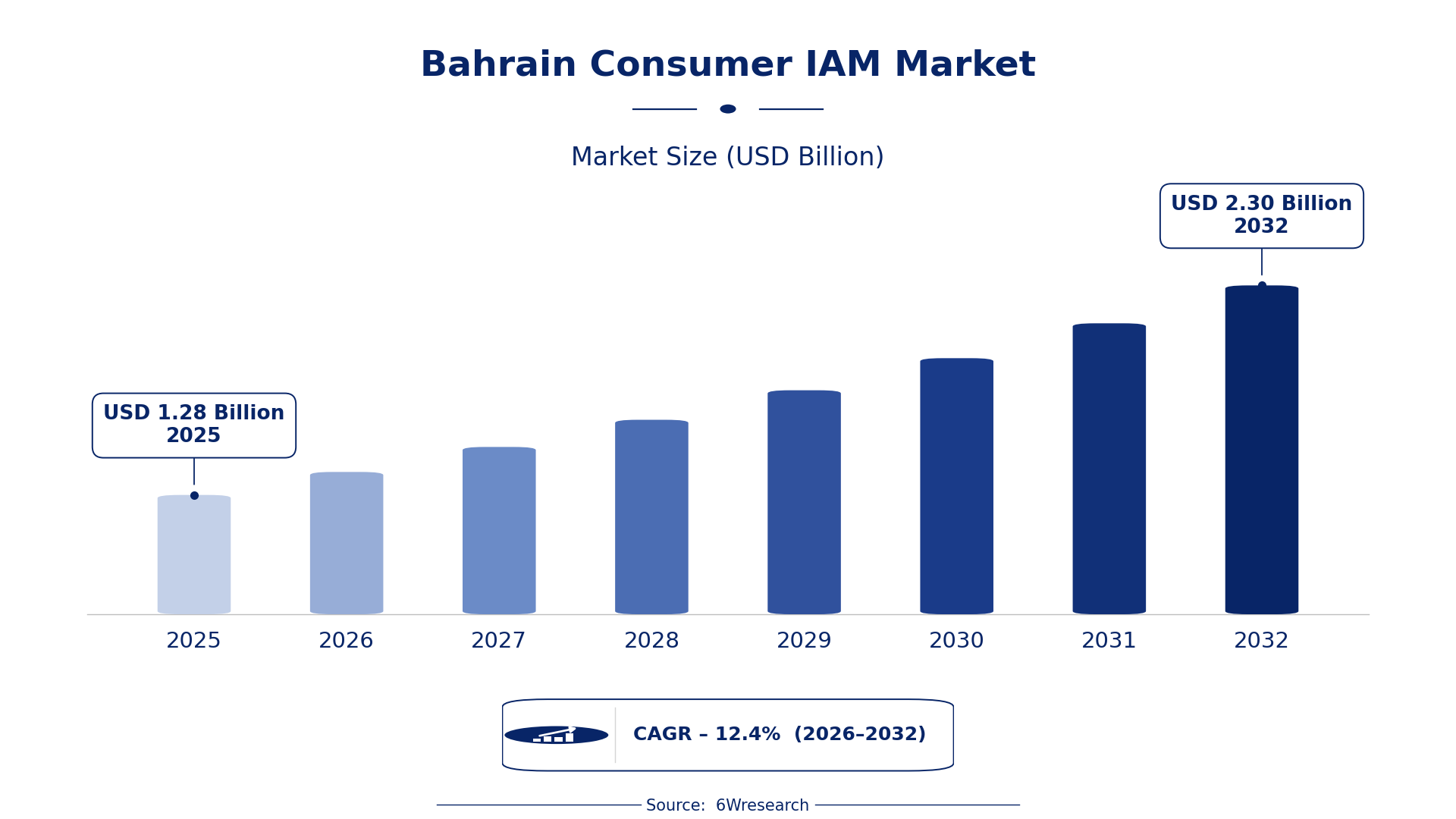
The Bahrain Consumer IAM Market was estimated at USD 1284 Million in 2025 and is projected to reach USD 2299 Million by 2032, growing at a CAGR of 12.4% from 2026 to 2032.
Bahrain Consumer IAM Market Synopsis
As Bahrain continues its digital transformation journey, the demand for Consumer Identity and Access Management (CIAM) solutions is escalating. Companies in various sectors are recognizing the importance of managing customer identities effectively, particularly as more applications come online.
The retail, telecom, and financial services sectors are at the forefront, investing in CIAM frameworks to streamline user experiences while adhering to regulatory standards. This move is critical for organizations aiming to balance user privacy and data security amid rising consumer expectations.
Bahrain Consumer IAM Market Year-wise Growth Rate and Key Drivers
This graph illustrates the annual growth rates of the Bahrain Consumer IAM Market from 2021 to 2032, highlighting a steady upward trajectory and projected expansion over the forecast period.
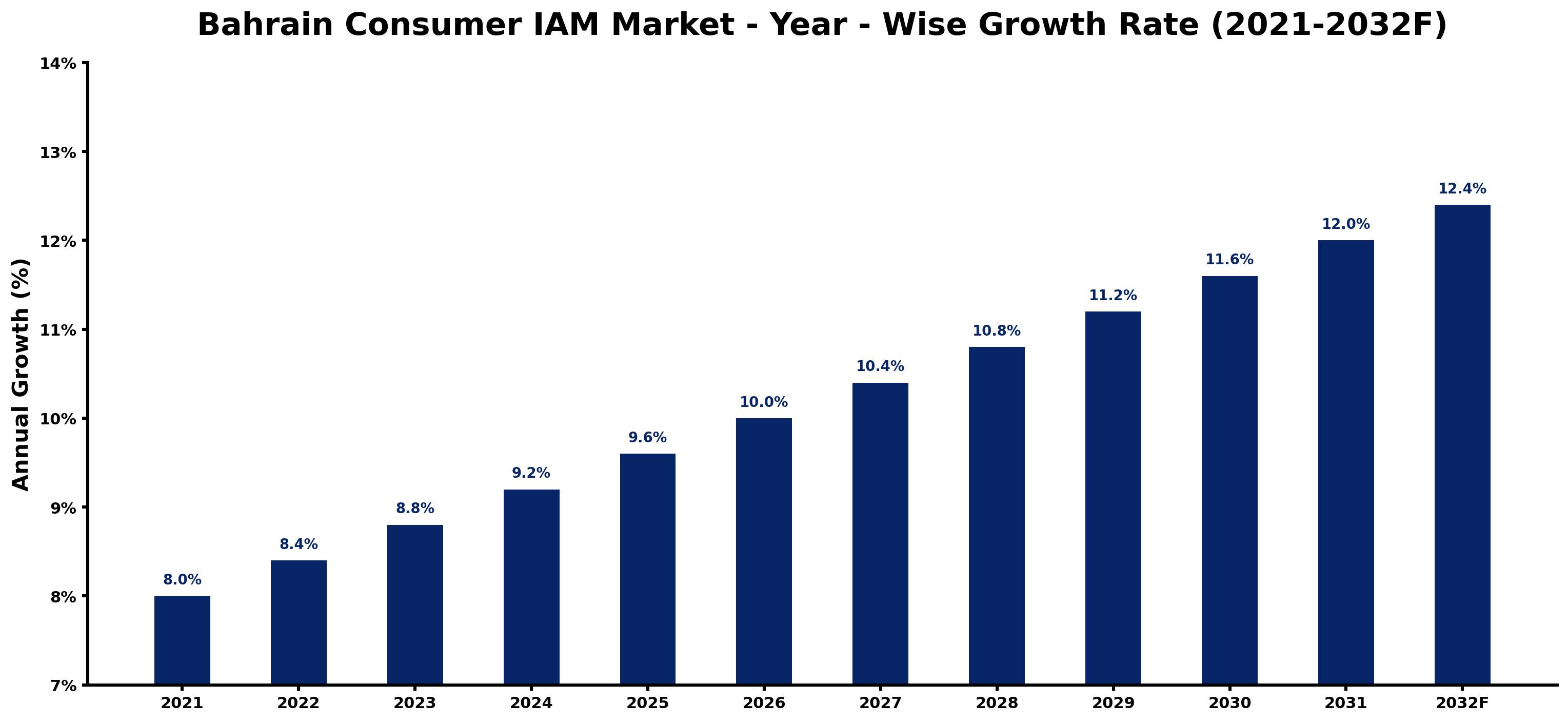
The table below presents the year‑wise growth rates along with the key drivers influencing the market
| Year | Growth Rate | Major Drivers |
| 2021 | 8.0% | Bahrain's National Cybersecurity Strategy boost user privacy. |
| 2022 | 8.4% | Increase in mobile banking driving identity management solutions. |
| 2023 | 8.8% | Regulatory emphasis on KYC compliance from Central Bank of Bahrain. |
| 2024 | 9.2% | Growing e-commerce adoption requiring robust identity verification. |
| 2025 | 9.6% | Digital transformation initiatives by Bahrain Economic Development Board. |
| 2026 | 10.0% | Widespread mobile app usage enhancing demand for IAM solutions. |
| 2027 | 10.4% | Government support for cybersecurity innovation among startups. |
| 2028 | 10.8% | Increased digital identity concerns after regional security incidents. |
| 2029 | 11.2% | Expanding fintech sector necessitating streamlined user authentication. |
| 2030 | 11.6% | Emergence of biometric payment systems fostering new IAM needs. |
| 2031 | 12.0% | Regulatory updates demanding enhanced consumer data protection. |
| 2032 | 12.4% | Rise of IoT creating complexity in identity management. |
Note: Market size estimations and growth projections presented in this report are based on 6Wresearch's proprietary forecasting methodology, utilizing the latest available industry data, government publications, and primary research inputs.
Bahrain Consumer IAM Market Key Takeaways
Below are some of the specific key takeaways from the market, including:
- The market is driven by the increasing need for personalized and secure digital experiences.
- Businesses face hurdles in scalability and flexibility of IAM solutions.
- Government initiatives are enhancing the regulatory framework for CIAM implementation.
- Investment in AI and machine learning technologies offers new opportunities for CIAM providers.
- Consumer-facing applications are expected to expand, boosting demand for efficient IAM solutions.
Evaluation of Restraints in Bahrain Consumer IAM Market
Despite the burgeoning demand for CIAM solutions, several constraints are impeding growth. Organizations struggle with effectively integrating IAM systems across various platforms, leading to fragmented user experiences. Additionally, the balancing act between security measures and user convenience is proving challenging; overly complex authentication methods can frustrate users and lead to high abandonment rates.
on top of that, maintaining compliance with stringent data protection regulations while addressing emerging threats, such as identity theft and data breaches, creates a significant burden. The rapid shift towards mobile-first experiences requires IAM systems to be both adaptable and resilient across all digital touchpoints.
Bahrain Consumer IAM Market Trends
Several key trends are currently shaping the Bahrain Consumer IAM Market. First, there is a marked shift towards AI-driven solutions that enhance user personalization while simultaneously fortifying security measures. Companies are increasingly adopting multi-factor authentication to better protect user identities.
The rise of mobile applications necessitates CIAM systems that can offer consistent performance across devices. Additionally, businesses are prioritizing self-service features to empower users in managing their accounts and preferences, thereby enhancing customer engagement and satisfaction.
Bahrain Consumer IAM Market Opportunities
Significant investment opportunities lie in developing CIAM solutions tailored to the unique needs of Bahrain's evolving digital market. The integration of artificial intelligence and machine learning can provide businesses with the tools needed to offer personalized customer experiences while mitigating fraud.
on top of that, there’s an increasing need for compliance-oriented solutions that help businesses adhere to privacy regulations, creating a demand for innovative self-service options, such as password management tools and user-friendly consent interfaces.
Government Initiatives in the Bahrain Consumer IAM Market
Bahrain's government has recognized the critical role of Consumer IAM solutions in securing digital transactions and ensuring user trust. Public policy is increasingly geared towards fostering the adoption of CIAM frameworks across essential sectors like banking and telecommunications. This proactive stance creates a favorable environment for businesses looking to enhance user identity management.
- A national regulatory framework was established in 2025 mandating enhanced data protection measures across digital platforms.
- Ongoing public sector initiatives aim to integrate CIAM systems within government digital services, improving accessibility and user management.
- Recent campaigns promote awareness around secure identity management and data privacy practices among citizens.
- A planned initiative focuses on expanding CIAM capabilities within e-commerce to boost consumer confidence and drive online spending.
- Future collaborations are anticipated between government entities and private sector players to enhance CIAM technology in public services.
Future Insights of the Bahrain Consumer IAM Market
Looking ahead to 2026-2032, the Bahrain Consumer IAM Market is expected to continue on a growth trajectory fueled by increasing digital engagement across multiple sectors. As businesses prioritize security and customer experience, the demand for sophisticated CIAM solutions will rise correspondingly. Regulatory developments will further shape the market dynamics, compelling organizations to adopt cutting-edge technology that ensures compliance while enhancing user satisfaction.
Bahrain Consumer IAM Market Latest Developments
In the past year, Bahrain's Consumer IAM Market has witnessed a flurry of activity, with numerous companies pushing forward with advanced identity management solutions. This growth reflects a broader commitment to secure user experiences amidst escalating digital interactions.
- A major technology vendor launched a new CIAM platform in early 2025, designed to streamline user authentication processes across mobile and web applications.
- An ongoing initiative began in mid-2025 aimed at integrating multi-factor authentication into banking apps to enhance security measures.
- In late 2025, a public awareness campaign was completed, focusing on educating citizens about the importance of digital identity protection and privacy.
- A partnership is currently underway between public and private sectors to develop a comprehensive digital identity verification system expected to roll out by 2026.
- Plans are in place for a nationwide seminar series scheduled for early 2026, aimed at training businesses on implementing CIAM solutions effectively.
Bahrain Consumer IAM Market - Key Attractiveness of the Report
- 10 Years of Market Numbers
- Historical Data Starting from 2022 to 2025
- Base Year: 2025
- Forecast Data until 2032
- Key Performance Indicators Impacting the Market
- Major Upcoming Developments and Projects
Key Highlights of the Report:
- Bahrain Consumer IAM Market Outlook
- Market Size of Bahrain Consumer IAM Market, 2025
- Forecast of Bahrain Consumer IAM Market, 2032
- Historical Data and Forecast of Bahrain Consumer IAM Revenues & Volume for the Period 2022-2032F
- Bahrain Consumer IAM Market Trend Evolution
- Bahrain Consumer IAM Market Drivers and Challenges
- Bahrain Consumer IAM Price Trends
- Bahrain Consumer IAM Porter's Five Forces
- Bahrain Consumer IAM Industry Life Cycle
- Historical Data and Forecast of Bahrain Consumer IAM Market Revenues & Volume By Component for the Period 2022-2032F
- Historical Data and Forecast of Bahrain Consumer IAM Market Revenues & Volume By Solutions for the Period 2022-2032F
- Historical Data and Forecast of Bahrain Consumer IAM Market Revenues & Volume By Services for the Period 2022-2032F
- Historical Data and Forecast of Bahrain Consumer IAM Market Revenues & Volume By Solutions for the Period 2022-2032F
- Historical Data and Forecast of Bahrain Consumer IAM Market Revenues & Volume By Identity Governance for the Period 2022-2032F
- Historical Data and Forecast of Bahrain Consumer IAM Market Revenues & Volume By Identity Verification for the Period 2022-2032F
- Historical Data and Forecast of Bahrain Consumer IAM Market Revenues & Volume By Authentication for the Period 2022-2032F
- Historical Data and Forecast of Bahrain Consumer IAM Market Revenues & Volume By Vertical for the Period 2022-2032F
- Historical Data and Forecast of Bahrain Consumer IAM Market Revenues & Volume By BFSI for the Period 2022-2032F
- Historical Data and Forecast of Bahrain Consumer IAM Market Revenues & Volume By Hospitality for the Period 2022-2032F
- Historical Data and Forecast of Bahrain Consumer IAM Market Revenues & Volume By Healthcare for the Period 2022-2032F
- Historical Data and Forecast of Bahrain Consumer IAM Market Revenues & Volume By Retail and e-commerce for the Period 2022-2032F
- Historical Data and Forecast of Bahrain Consumer IAM Market Revenues & Volume By Public Sector for the Period 2022-2032F
- Historical Data and Forecast of Bahrain Consumer IAM Market Revenues & Volume By Automotive for the Period 2022-2032F
- Historical Data and Forecast of Bahrain Consumer IAM Market Revenues & Volume By Education for the Period 2022-2032F
- Historical Data and Forecast of Bahrain Consumer IAM Market Revenues & Volume By IT for the Period 2022-2032F
- Historical Data and Forecast of Bahrain Consumer IAM Market Revenues & Volume By Deployment Mode for the Period 2022-2032F
- Historical Data and Forecast of Bahrain Consumer IAM Market Revenues & Volume By Cloud for the Period 2022-2032F
- Historical Data and Forecast of Bahrain Consumer IAM Market Revenues & Volume By On-Premises for the Period 2022-2032F
- Historical Data and Forecast of Bahrain Consumer IAM Market Revenues & Volume By Organization Size for the Period 2022-2032F
- Historical Data and Forecast of Bahrain Consumer IAM Market Revenues & Volume By Large Enterprises for the Period 2022-2032F
- Historical Data and Forecast of Bahrain Consumer IAM Market Revenues & Volume By SMEs for the Period 2022-2032F
- Bahrain Consumer IAM Import Export Trade Statistics
- Market Opportunity Assessment By Component
- Market Opportunity Assessment By Solutions
- Market Opportunity Assessment By Vertical
- Market Opportunity Assessment By Deployment Mode
- Market Opportunity Assessment By Organization Size
- Bahrain Consumer IAM Top Companies Market Share
- Bahrain Consumer IAM Competitive Benchmarking By Technical and Operational Parameters
- Bahrain Consumer IAM Company Profiles
- Bahrain Consumer IAM Key Strategic Recommendations






































