Bahrain Dried Apricots Market (2026-2032) Outlook | Industry, Share, Revenue, Value, Analysis, Forecast, Trends, Size, Companies & Growth
Market Forecast By Product Type (Organic, Conventional), By Form Type (Powdered, Whole dried, Diced), By Distribution Channel (Online, Offline) And Competitive Landscape
| Product Code: ETC411100 | Publication Date: Oct 2022 | Updated Date: Mar 2026 | Product Type: Market Research Report | |
| Publisher: 6Wresearch | Author: Sumit Sagar | No. of Pages: 75 | No. of Figures: 35 | No. of Tables: 20 |
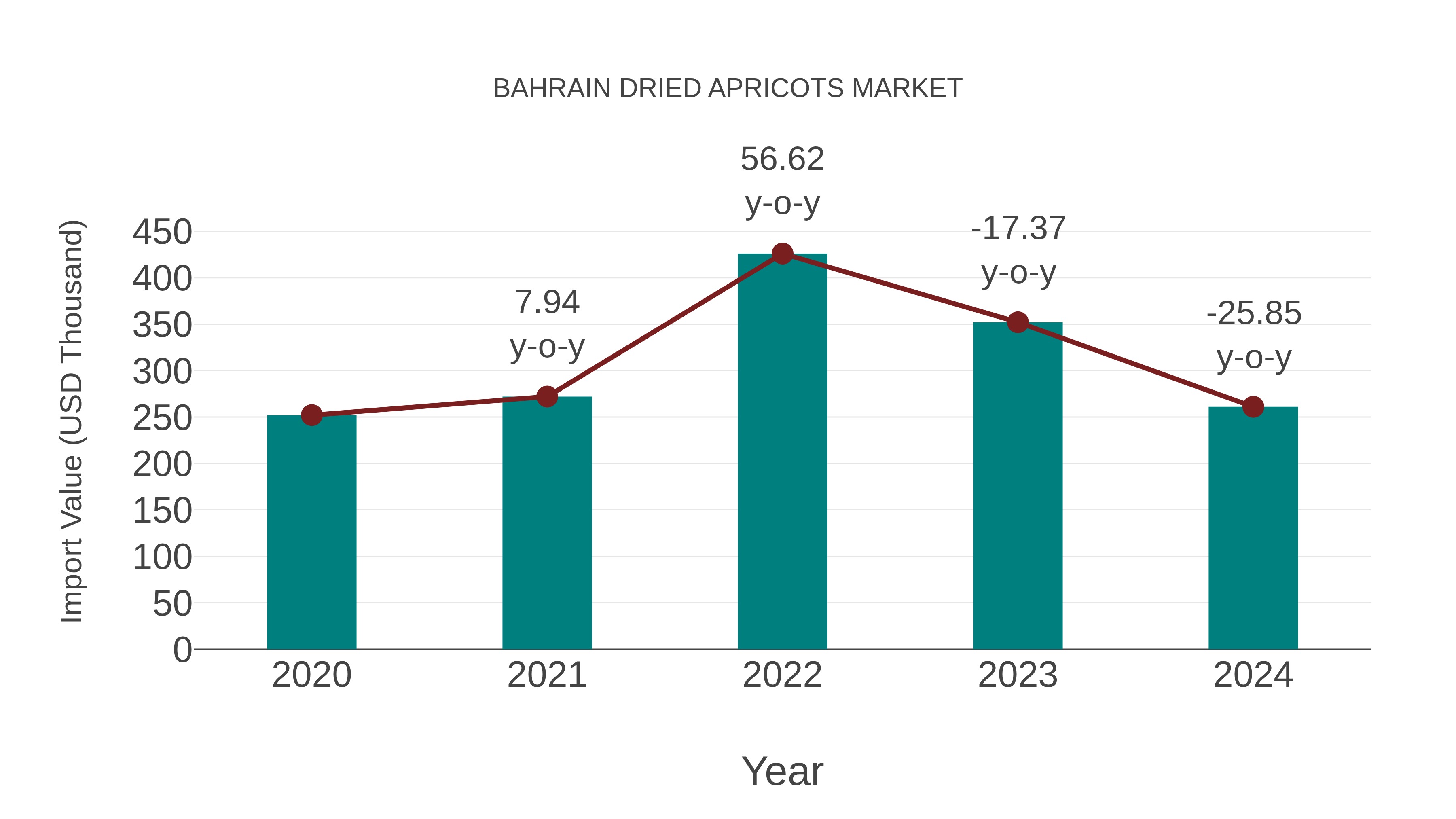
Bahrain Dried Apricots Market: Import Trend Analysis
Bahrain import trend for dried apricots in 2024 experienced a decline of -25.85% compared to the previous year, with a compound annual growth rate (CAGR) of 0.88% from 2020 to 2024. This negative growth can be attributed to shifting consumer preferences or fluctuations in global supply, impacting market stability.
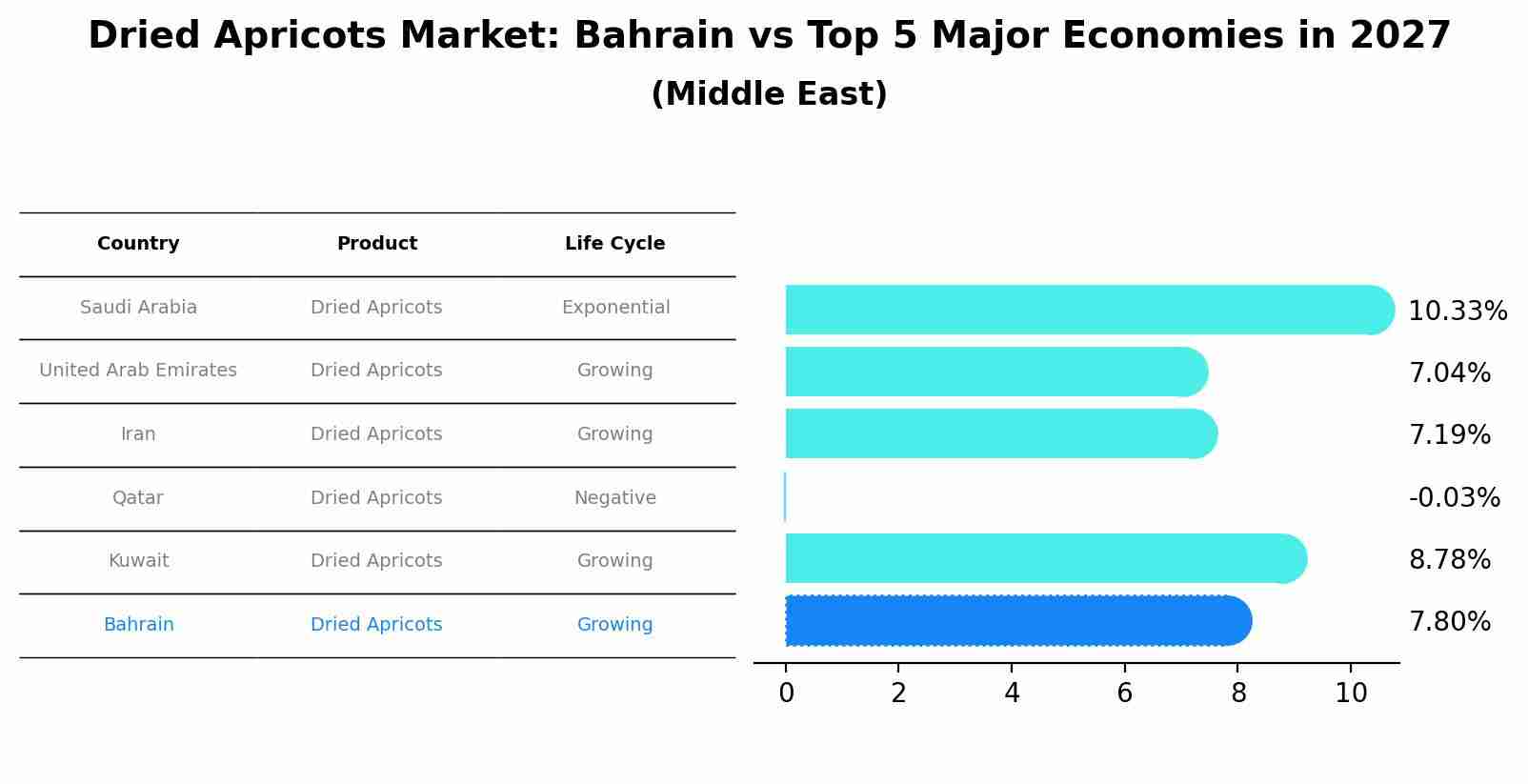
Dried Apricots Market: Bahrain vs Top 5 Major Economies in 2027 (Middle East)
Bahrain's Dried Apricots market is anticipated to experience a growing growth rate of 7.80% by 2027, reflecting trends observed in the largest economy Saudi Arabia, followed by United Arab Emirates, Iran, Qatar and Kuwait.
Bahrain Dried Apricots Market Synopsis
Dried apricots hold cultural and culinary significance in Bahrain, often consumed during Ramadan and festive seasons. Sourced primarily from Turkey and Iran, dried apricots are sold in bulk, pre-packed, and gourmet formats. Their high nutritional value ensures steady demand across retail, gifting, and foodservice segments.
Trends of the market
The dried apricots market in Bahrain enjoys consistent demand, driven by their widespread use in traditional desserts, gifting, and healthy snacking. Most dried apricots are imported from Turkey and Iran, offering high-quality options for consumers. Rising health awareness has boosted consumption due to their high fiber and nutrient content. Premium packaging and value-added varieties, such as organic or sulfite-free apricots, are gaining popularity. The market outlook remains strong, particularly during Ramadan and festive seasons.
Challenges of the market
Dried apricots are not widely integrated into Bahraini cuisine, limiting their popularity. Most products are imported from Turkey or Central Asia, making them vulnerable to supply chain disruptions. Price fluctuations and lack of quality standardization impact consumer satisfaction. Limited promotional campaigns and unfamiliarity with the products health benefits further slow market growth. Additionally, the presence of sulfites in some dried apricots can deter health-conscious buyers.
Investment opportunities in the Market
Dried apricots have consistent demand in Bahrain due to their appeal as a healthy snack and traditional inclusion in festive and Ramadan assortments. Investors can explore importing premium dried apricots from countries like Turkey and Uzbekistan, while also setting up local packaging, flavoring, or private-label ventures. Organic, sulfur-free, and sugar-free variants have rising demand among health-focused consumers. Supermarkets, dry fruit chains, and online food retailers are viable sales channels. The product also integrates well into breakfast cereals, baked goods, and desserts, expanding its B2B usage. With proper branding and festive tie-ins, dried apricots can be marketed as both luxury and wellness-focused. There`s also room for exports to nearby Gulf countries through Bahrains re-export channels.
Government Policy of the market
The dried apricots market in Bahrain is growing, driven by increasing consumer interest in healthy snacking and convenient food options. The government supports the agricultural sector through policies that encourage the cultivation of fruits such as apricots and their use in dried form for export and local consumption. Bahrains government also implements stringent food safety regulations, ensuring that dried apricots meet the necessary health standards, with the Bahrain Food and Drug Authority (BFDA) overseeing these practices. Additionally, the government has introduced initiatives to support sustainable farming practices, which help ensure the long-term viability of the dried fruit market. As consumer demand for dried fruits rises, government policies are likely to continue supporting the growth of the sector.
Key Highlights of the Report:
- Bahrain Dried Apricots Market Outlook
- Market Size of Bahrain Dried Apricots Market, 2025
- Forecast of Bahrain Dried Apricots Market, 2032
- Historical Data and Forecast of Bahrain Dried Apricots Revenues & Volume for the Period 2022 - 2032F
- Bahrain Dried Apricots Market Trend Evolution
- Bahrain Dried Apricots Market Drivers and Challenges
- Bahrain Dried Apricots Price Trends
- Bahrain Dried Apricots Porter's Five Forces
- Bahrain Dried Apricots Industry Life Cycle
- Historical Data and Forecast of Bahrain Dried Apricots Market Revenues & Volume By Product Type for the Period 2022 - 2032F
- Historical Data and Forecast of Bahrain Dried Apricots Market Revenues & Volume By Organic for the Period 2022 - 2032F
- Historical Data and Forecast of Bahrain Dried Apricots Market Revenues & Volume By Conventional for the Period 2022 - 2032F
- Historical Data and Forecast of Bahrain Dried Apricots Market Revenues & Volume By Form Type for the Period 2022 - 2032F
- Historical Data and Forecast of Bahrain Dried Apricots Market Revenues & Volume By Powdered for the Period 2022 - 2032F
- Historical Data and Forecast of Bahrain Dried Apricots Market Revenues & Volume By Whole dried for the Period 2022 - 2032F
- Historical Data and Forecast of Bahrain Dried Apricots Market Revenues & Volume By Diced for the Period 2022 - 2032F
- Historical Data and Forecast of Bahrain Dried Apricots Market Revenues & Volume By Distribution Channel for the Period 2022 - 2032F
- Historical Data and Forecast of Bahrain Dried Apricots Market Revenues & Volume By Online for the Period 2022 - 2032F
- Historical Data and Forecast of Bahrain Dried Apricots Market Revenues & Volume By Offline for the Period 2022 - 2032F
- Bahrain Dried Apricots Import Export Trade Statistics
- Market Opportunity Assessment By Product Type
- Market Opportunity Assessment By Form Type
- Market Opportunity Assessment By Distribution Channel
- Bahrain Dried Apricots Top Companies Market Share
- Bahrain Dried Apricots Competitive Benchmarking By Technical and Operational Parameters
- Bahrain Dried Apricots Company Profiles
- Bahrain Dried Apricots Key Strategic Recommendations
Bahrain Dried Apricots Market (2026-2032): FAQs
6Wresearch actively monitors the Bahrain Dried Apricots Market and publishes its comprehensive annual report, highlighting emerging trends, growth drivers, revenue analysis, and forecast outlook. Our insights help businesses to make data-backed strategic decisions with ongoing market dynamics. Our analysts track relevent industries related to the Bahrain Dried Apricots Market, allowing our clients with actionable intelligence and reliable forecasts tailored to emerging regional needs.
Yes, we provide customisation as per your requirements. To learn more, feel free to contact us on sales@6wresearch.com
Global Go To Market Strategy - 2030
Export potential enables firms to identify high-growth global markets with greater confidence by combining advanced trade intelligence with a structured quantitative methodology. The framework analyzes emerging demand trends and country-level import patterns while integrating macroeconomic and trade datasets such as GDP and population forecasts, bilateral import–export flows, tariff structures, elasticity differentials between developed and developing economies, geographic distance, and import demand projections. Using weighted trade values from 2020–2024 as the base period to project country-to-country export potential for 2030, these inputs are operationalized through calculated drivers such as gravity model parameters, tariff impact factors, and projected GDP per-capita growth. Through an analysis of hidden potentials, demand hotspots, and market conditions that are most favorable to success, this method enables firms to focus on target countries, maximize returns, and global expansion with data, backed by accuracy.
By factoring in the projected importer demand gap that is currently unmet and could be potential opportunity, it identifies the potential for the Exporter (Country) among 190 countries, against the general trade analysis, which identifies the biggest importer or exporter.
To discover high-growth global markets and optimize your business strategy:
Click Here
Pricing
- Single User License$ 1,995
- Department License$ 2,400
- Site License$ 3,120
- Global License$ 3,795

Leadership Perspectives from Industry Events
Search
Thought Leadership and Analyst Meet





Our Clients








6WResearch In News
- India Air Conditioner Market Set for Strong Rebound in 2026 After Weather-Led Correction and GST-Driven Recovery: 6Wresearch
- ADAS in India: How Automatic Emergency Braking, Blind Spot Detection & Driver Monitoring are Transforming Road Safety
- Doha a strategic location for EV manufacturing hub: IPA Qatar
- Demand for luxury TVs surging in the GCC, says Samsung
- Empowering Growth: The Thriving Journey of Bangladesh’s Cable Industry
- Demand for luxury TVs surging in the GCC, says Samsung
Latest Reports
- Poland Fire Protection Systems Market (2026-2032)
- Cape Verde Portable Hand-Thrown Extinguisher Market (2026-2032)
- Canada Portable Hand-Thrown Extinguisher Market (2026-2032)
- Cameroon Portable Hand-Thrown Extinguisher Market (2026-2032)
- Burundi Portable Hand-Thrown Extinguisher Market (2026-2032)
- Burkina Faso Portable Hand-Thrown Extinguisher Market (2026-2032)
- Bulgaria Portable Hand-Thrown Extinguisher Market (2026-2032)
- Brunei Portable Hand-Thrown Extinguisher Market (2026-2032)
- Botswana Portable Hand-Thrown Extinguisher Market (2026-2032)
- Bosnia and Herzegovina Portable Hand-Thrown Extinguisher Market (2026-2032)
Industry Events and Analyst Meet

HIMTEX 2026

India Refining Summit 2026

India EV Show 2026

EV tech India Expo 2026

Auto Tech Asia 2026
Whitepaper
- Middle East & Africa Commercial Security Market Click here to view more.
- Middle East & Africa Fire Safety Systems & Equipment Market Click here to view more.
- GCC Drone Market Click here to view more.
- Middle East Lighting Fixture Market Click here to view more.
- GCC Physical & Perimeter Security Market Click here to view more.


