Bahrain Food & Beverages Processing Equipment Market Summary
The bahrain food & beverages processing equipment market was estimated at USD 1147 Million in 2025 and is projected to reach USD 1998 Million by 2032, growing at a CAGR of 9.5% from 2026 to 2032.
Bahrain Food & Beverages Processing Equipment Market Year-wise Growth Rate and Key Drivers
This graph highlights how the Bahrain Food & Beverages Processing Equipment Market has steadily grown over the past five years, supported by major growth factors.
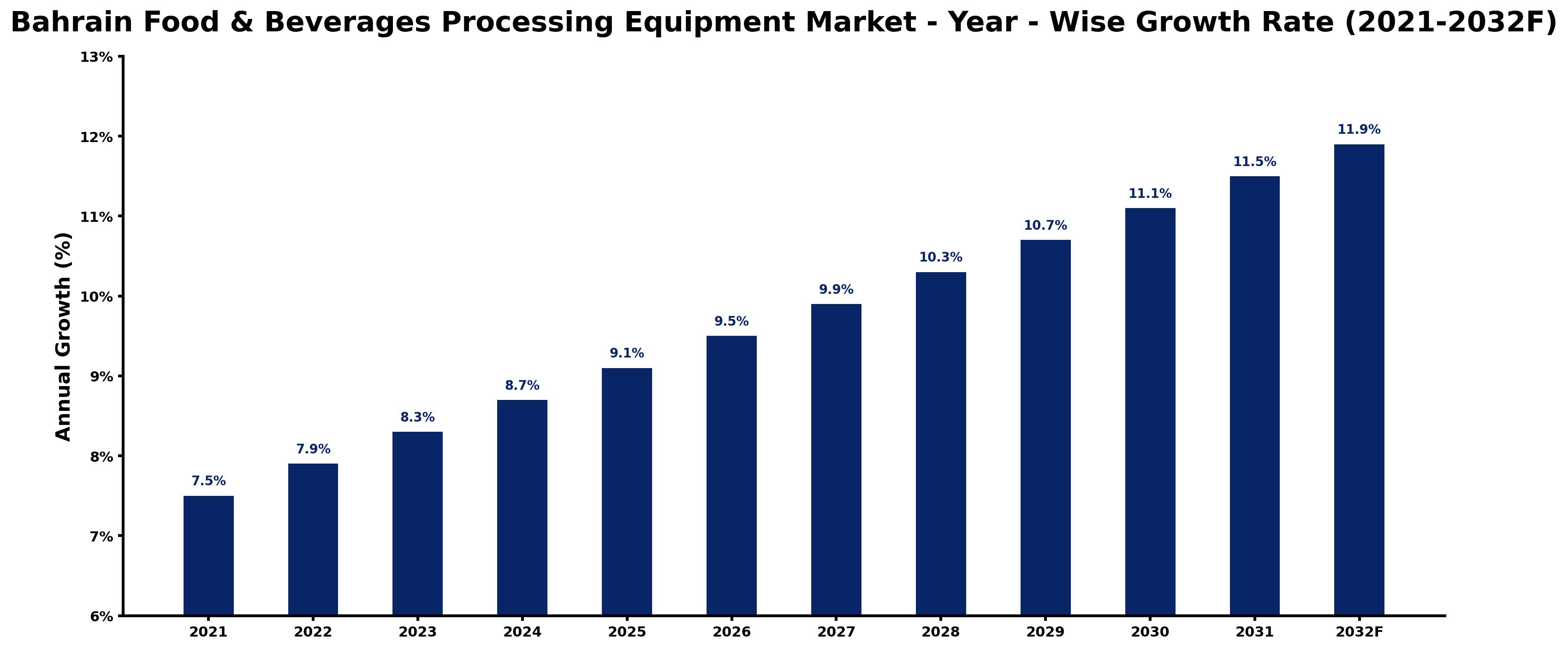
The table below presents the year wise growth rates along with the key drivers influencing the market
| Year | Growth Rate | Major Drivers |
| 2021 | 7.5% | Market recovery post-COVID-19 pandemic includes increased investment in food processing equipment. |
| 2022 | 7.9% | Local companies began prioritizing sustainability in manufacturing to meet global standards. |
| 2023 | 8.3% | Technological integration with IoT devices enhances operational efficiency in food processing. |
| 2024 | 8.7% | Bahrain's strategic location fosters regional supply chain efficiencies for food and beverage producers. |
| 2025 | 9.1% | Consumer preferences shift towards packaged, convenient food options, driving machinery demand. |
| 2026 | 9.5% | Increased tourism leads to higher demand for diverse food and beverage offerings. |
| 2027 | 9.9% | Local agriculture initiatives encourage modernization of food processing techniques and equipment. |
| 2028 | 10.3% | Emergence of health-conscious consumers pushes manufacturers to adapt processing technologies. |
| 2029 | 10.7% | The construction of new facilities drives demand for advanced processing machinery investments. |
| 2030 | 11.1% | Partnerships with international firms introduce innovative technologies to the local market. |
| 2031 | 11.5% | Government incentives for food startups stimulate innovation in processing technologies. |
| 2032 | 11.9% | Sustainability certifications become crucial for market access, influencing equipment modernization. |
Note - Market size estimations and growth projections presented in this report are based on 6Wresearch's advanced forecasting approach, validated with industry datasets as of June 2026.
Bahrain Food & Beverages Processing Equipment Market Synopsis
The Bahrain Food Beverages Processing Equipment Market is projected to reach 9.5% and witness significant growth during the forecast period (2026-2032). This growth can be attributed to an expanding food production and processing sector within the country, addressing the rising consumer demand for packaged and processed food products. Bahrain's strategic geographical position enhances its role as a pivotal hub for food exports, consequently increasing the market need for innovative processing equipment.
Bahrain Food & Beverages Processing Equipment Market Growth Drivers
The proliferation of the Bahrain Food & Beverages Processing Equipment Market is driven by several key factors:
- The increasing inclination of consumers towards convenience food options and ready-to-eat meals has intensified demand for efficient processing equipment, which helps manufacturers improve production turnaround and quality standards.
- A surge in the number of food processing facilities across Bahrain emphasizes the need for advanced machinery, leading to higher investments in state-of-the-art processing technologies.
- Government initiatives aimed at enhancing food security and promoting local production are propelling the demand for modern processing equipment, particularly in sectors such as dairy and beverages.
- Technological advancements in equipment, including automation and smart systems, are gaining traction as manufacturers strive for improved efficiency and output.
- As Bahrain continues to strengthen its position as an export hub, there is an amplified requirement for processing equipment that aligns with international standards, further boosting the market.
Bahrain Food & Beverages Processing Equipment Market Challenges and Restraints
While the Bahrain Food & Beverages Processing Equipment Market is on an upward trajectory, several challenges impede its growth:
- The demand for automation and technological integration poses a significant hurdle, as many smaller food processing firms struggle with the high initial capital needed to invest in modern equipment.
- Regular maintenance and equipment upgrades add to operational expenses, particularly for businesses unable to absorb such costs without impacting their profitability.
- Stringent food safety regulations necessitate ongoing compliance, requiring continuous monitoring and possibly frequent investments to meet evolving standards.
- The competitive landscape necessitates that companies remain agile and innovative, which can be a challenge for businesses tied to outdated systems and methodologies.
- Fluctuating raw material costs and supply chain disruptions could impact operational efficiencies, necessitating strategic adaptations in the processing sector.
Bahrain Food & Beverages Processing Equipment Market Investment Opportunities
The landscape of the Bahrain Food & Beverages Processing Equipment Market presents various investment avenues:
- Investors can venture into supplying or manufacturing equipment tailored to food processing, packaging, and preservation to capitalize on the increasing demand driven by local production initiatives.
- With government emphasis on food security, opportunities exist in developing advanced processing technologies that enhance efficiency across the dairy, meat, bakery, and beverage sectors.
- Investments focused on food technology and automation are likely to yield significant returns, given the push for modernization in processing facilities.
- Engagements with small and medium-sized enterprises (SMEs) can foster innovative solutions tailored for local food production challenges.
- As consumer preferences evolve towards healthier and sustainable food options, there is a market gap for equipment supporting niche processing needs that align with modern consumer trends.
Bahrain Food & Beverages Processing Equipment Market Government Investment and Initiatives
Government policy plays a crucial role in shaping the Bahrain Food & Beverages Processing Equipment Market, where various initiatives are in place to bolster the food and beverage industry:
- The Bahraini government has implemented programs to promote local food production, significantly impacting the market for processing equipment by encouraging domestic investments.
- Import regulations are established to ensure that processing equipment complies with hygiene and food safety requirements, safeguarding consumer health.
- Incentives for small and medium-sized enterprises (SMEs) include funding opportunities aimed at facilitating their entry into the food processing sector.
- Public spending on infrastructure aimed at supporting food processing facilities enhances the sector's capability, creating further demand for advanced equipment.
- Government support for local industries is crucial in fostering innovations in food technology, ensuring that Bahrain can meet both local needs and export demands.
Bahrain Food & Beverages Processing Equipment Market Latest Developments (May 2025 - June 2026)
Recent industry developments in the Bahrain Food & Beverages Processing Equipment Market highlight ongoing transformations and strategic movements:
- There has been a notable increase in the establishment of food processing facilities, contributing to the demand for advanced machinery that meets modern quality standards.
- Investment interest in the food processing sector has surged, with various stakeholders exploring innovative technologies to enhance production efficiency and sustainability.
- Government initiatives aimed at diversifying the food supply chain have gained momentum, leading to partnerships aimed at enhancing local food production capabilities.
- Technological upgrades in processing equipment have been emphasized, aligning with global trends towards automation and smart manufacturing within the food sector.
- The emphasis on export readiness is shaping investments in processing equipment, as businesses aim to meet international quality benchmarks and expand their market reach.
Bahrain Food & Beverages Processing Equipment Market - Key Attractiveness of the Report
- 10 Years of Market Numbers
- Historical Data Starting from 2022 to 2025
- Base Year: 2025
- Forecast Data until 2032
- Key Performance Indicators Impacting the Market
- Major Upcoming Developments and Projects
Key Highlights of the Report:
- Bahrain Food & Beverages Processing Equipment Market Outlook
- Market Size of Bahrain Food & Beverages Processing Equipment Market, 2025
- Forecast of Bahrain Food & Beverages Processing Equipment Market, 2032F
- Historical Data and Forecast of Bahrain Food & Beverages Processing Equipment Revenues & Volume for the Period 2022-2032F
- Bahrain Food & Beverages Processing Equipment Market Trend Evolution
- Bahrain Food & Beverages Processing Equipment Market Drivers and Challenges
- Bahrain Food & Beverages Processing Equipment Price Trends
- Bahrain Food & Beverages Processing Equipment Porter's Five Forces
- Bahrain Food & Beverages Processing Equipment Industry Life Cycle
- Historical Data and Forecast of Bahrain Food & Beverages Processing Equipment Market Revenues & Volume By Types for the Period 2022-2032F
- Historical Data and Forecast of Bahrain Food & Beverages Processing Equipment Market Revenues & Volume By Pre-processing Equipment for the Period 2022-2032F
- Historical Data and Forecast of Bahrain Food & Beverages Processing Equipment Market Revenues & Volume By Sorting & Grading for the Period 2022-2032F
- Historical Data and Forecast of Bahrain Food & Beverages Processing Equipment Market Revenues & Volume By Processing Equipment for the Period 2022-2032F
- Historical Data and Forecast of Bahrain Food & Beverages Processing Equipment Market Revenues & Volume By Mode of Operations for the Period 2022-2032F
- Historical Data and Forecast of Bahrain Food & Beverages Processing Equipment Market Revenues & Volume By Automatic for the Period 2022-2032F
- Historical Data and Forecast of Bahrain Food & Beverages Processing Equipment Market Revenues & Volume By Semi-Automatic for the Period 2022-2032F
- Historical Data and Forecast of Bahrain Food & Beverages Processing Equipment Market Revenues & Volume By Forms for the Period 2022-2032F
- Historical Data and Forecast of Bahrain Food & Beverages Processing Equipment Market Revenues & Volume By Liquid for the Period 2022-2032F
- Historical Data and Forecast of Bahrain Food & Beverages Processing Equipment Market Revenues & Volume By Solid for the Period 2022-2032F
- Historical Data and Forecast of Bahrain Food & Beverages Processing Equipment Market Revenues & Volume By Semi-Solid for the Period 2022-2032F
- Historical Data and Forecast of Bahrain Food & Beverages Processing Equipment Market Revenues & Volume By Applications for the Period 2022-2032F
- Historical Data and Forecast of Bahrain Food & Beverages Processing Equipment Market Revenues & Volume By Bakery & Confectionery Products for the Period 2022-2032F
- Historical Data and Forecast of Bahrain Food & Beverages Processing Equipment Market Revenues & Volume By Meat & Poultry Products for the Period 2022-2032F
- Historical Data and Forecast of Bahrain Food & Beverages Processing Equipment Market Revenues & Volume By Fish & Sea food for the Period 2022-2032F
- Historical Data and Forecast of Bahrain Food & Beverages Processing Equipment Market Revenues & Volume By Dairy Products for the Period 2022-2032F
- Historical Data and Forecast of Bahrain Food & Beverages Processing Equipment Market Revenues & Volume By Alcoholic Beverages for the Period 2022-2032F
- Historical Data and Forecast of Bahrain Food & Beverages Processing Equipment Market Revenues & Volume By Non-Alcoholic Beverages for the Period 2022-2032F
- Historical Data and Forecast of Bahrain Food & Beverages Processing Equipment Market Revenues & Volume By Others for the Period 2022-2032F
- Bahrain Food & Beverages Processing Equipment Import Export Trade Statistics
- Market Opportunity Assessment By Types
- Market Opportunity Assessment By Mode of Operations
- Market Opportunity Assessment By Forms
- Market Opportunity Assessment By Applications
- Bahrain Food & Beverages Processing Equipment Top Companies Market Share
- Bahrain Food & Beverages Processing Equipment Competitive Benchmarking By Technical and Operational Parameters
- Bahrain Food & Beverages Processing Equipment Company Profiles
- Bahrain Food & Beverages Processing Equipment Key Strategic Recommendations






































