Bahrain Groceries Market Summary
The bahrain groceries market was estimated at USD 661 Million in 2025 and is projected to reach USD 1249 Million by 2032, growing at a CAGR of 11.0% from 2026 to 2032.
Bahrain Groceries Market Year-wise Growth Rate and Key Drivers
This graph highlights how the Bahrain Groceries Market has steadily grown over the past five years, supported by major growth factors.
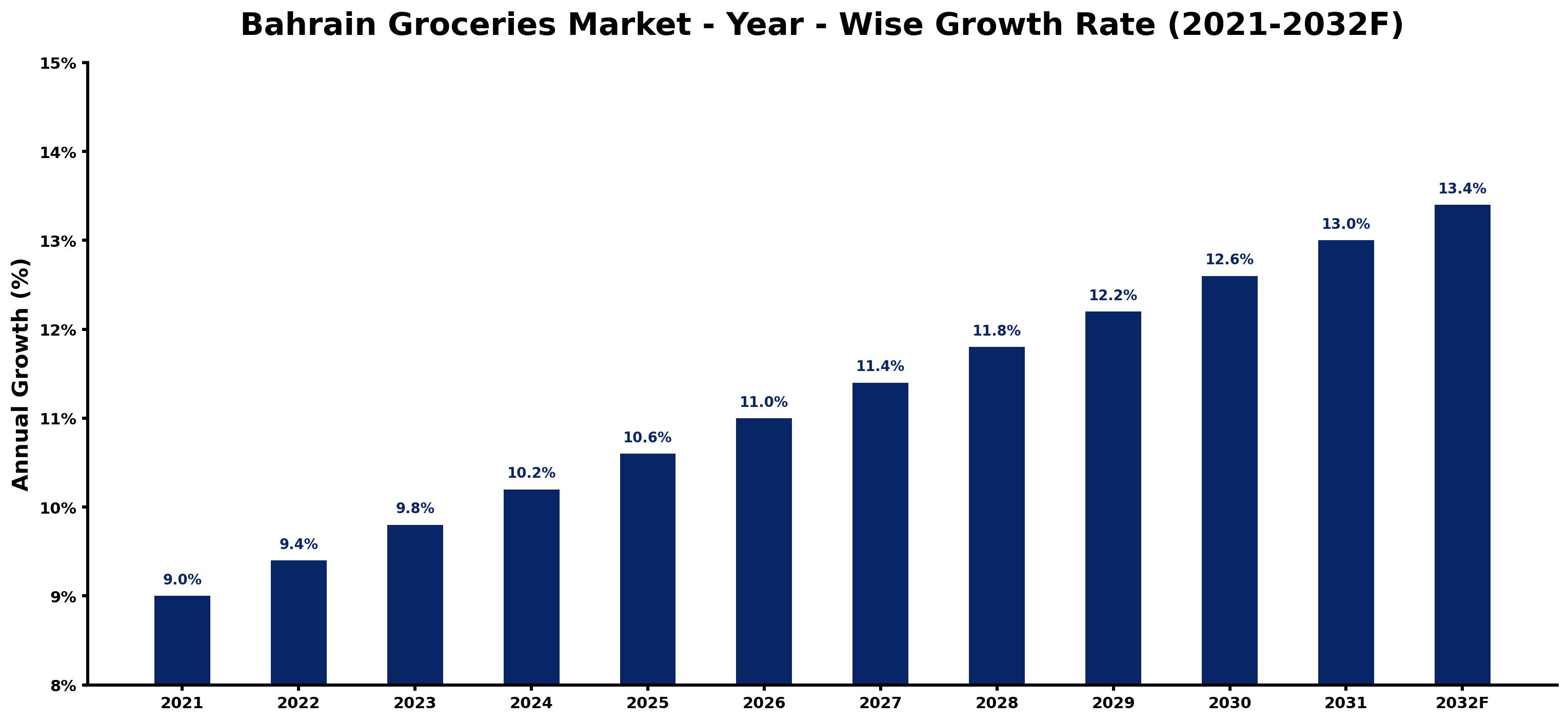
The table below presents the year wise growth rates along with the key drivers influencing the market
| Year | Growth Rate | Major Drivers |
| 2021 | 9.0% | Online grocery shopping experiences started transforming consumer purchasing preferences significantly. |
| 2022 | 9.4% | Local markets increasingly focused on enhancing product quality and sourcing transparency. |
| 2023 | 9.8% | Consumer interest shifted toward organic and healthy food options in grocery selections. |
| 2024 | 10.2% | Technological innovations improved logistics and supply chain efficiency for grocery providers. |
| 2025 | 10.6% | Rising expatriate populations fueled diverse food product offerings in grocery stores. |
| 2026 | 11.0% | Sustainability concerns prompted grocery chains to adopt eco-friendly packaging solutions. |
| 2027 | 11.4% | Inflationary pressures led consumers to seek cheaper alternatives and bulk purchasing options. |
| 2028 | 11.8% | Grocery retailers began leveraging data analytics for personalized customer shopping experiences. |
| 2029 | 12.2% | Health crises prompted heightened focus on hygiene and food safety standards in groceries. |
| 2030 | 12.6% | Increased competition among retailers sparked innovation in product variety and services. |
| 2031 | 13.0% | Partnerships with local farmers enhanced supply chains and community engagement among consumers. |
| 2032 | 13.4% | The expansion of urban areas necessitated new grocery store formats and delivery solutions. |
Note - Market size estimations and growth projections presented in this report are based on 6Wresearch's advanced forecasting approach, validated with industry datasets as of June 2026.
Bahrain Groceries Market Synopsis
The Bahrain Groceries Market is projected to reach 11.0% and witness significant growth during the forecast period (2026-2032). This development is driven by a combination of demographic shifts, evolving consumer preferences, and the expansion of modern retail formats. The market is characterized by a diverse range of products, including fresh produce, packaged goods, beverages, and frozen foods, all of which cater to the increasing consumer demand for variety and quality.
Bahrain Groceries Market Growth Drivers
Several key factors are contributing to the growth of the Bahrain Groceries Market. First and foremost, the country's population is on the rise, leading to heightened demand for grocery products. Increased disposable incomes among consumers further bolster this demand, enabling consumers to opt for higher-quality grocery items.
- Urbanization is leading to a shift in shopping habits, with more consumers preferring the convenience offered by supermarkets and hypermarkets.
- The increasing focus on health and nutrition is appealing to consumers seeking fresh, organic, and natural food options.
- E-commerce is transforming the grocery shopping experience, facilitating access to a wider range of products through online platforms.
- Consumer trends are shifting towards convenience, with ready-to-eat meals and pre-packaged items gaining popularity.
- Health consciousness is influencing purchasing decisions, driving demand for whole grains, gluten-free products, and plant-based alternatives.
Bahrain Groceries Market Challenges and Restraints
Despite its growth potential, the Bahrain Groceries Market faces several challenges. A significant issue is the heavy reliance on imports for grocery items, making the market susceptible to fluctuations in global food prices and shipping costs.
- Competition from large international retailers poses a challenge to local grocers, often resulting in price wars that affect profit margins.
- Price sensitivity among consumers necessitates that retailers carefully manage operational costs to remain competitive.
- The demand for specialty foods, such as organic and gluten-free products, can lead to increased supply chain complexities and costs.
- Traditional retail outlets must adapt to the growing trend of online grocery shopping and delivery services, often requiring significant investment in digital infrastructure.
- Economic fluctuations and currency exchange rate volatility can impact the pricing of imported goods, complicating market dynamics.
Bahrain Groceries Market Trends and Opportunities
The evolving landscape of the Bahrain Groceries Market is marked by clear trends that present numerous opportunities for stakeholders. Consumers are increasingly gravitating towards health-oriented products, as evidenced by the rising demand for organic and natural food items.
- Investors may find promising prospects in premium grocery products that cater to the health-conscious segment of the market.
- The growth of digital platforms offers opportunities for entrepreneurs to establish online grocery delivery services, tapping into the convenience-driven consumer base.
- Expansion and diversification of grocery offerings can enhance consumer appeal, leading to increased market share for retailers.
- Partnerships with local farmers and producers might offer a competitive edge in sourcing fresh, high-quality produce.
- Government initiatives focused on local agriculture can create a more sustainable food supply chain, benefiting both consumers and retailers.
Bahrain Groceries Market Government Investment and Initiatives
The government of Bahrain actively stimulates the groceries market through various policies aimed at ensuring food security and promoting local agriculture. These initiatives involve import regulations that comply with food safety and quality standards, thereby enhancing consumer confidence in grocery products.
- Government programs designed to support local producers help foster a more robust agricultural sector, which is vital for grocery supply.
- Incentives for sustainable farming practices are part of broader efforts to promote eco-friendly grocery sourcing.
- Investment in food security measures further strengthens the grocery supply chain, providing stability in times of market volatility.
- Public health campaigns advocating for nutritious eating are directly linked to increased demand for fresh grocery products.
- Collaborative efforts between the public and private sectors aim to enhance the overall resilience of the grocery supply chain.
Bahrain Groceries Market Latest Developments (May 2025 - June 2026)
Recent developments within the Bahrain Groceries Market reflect significant industry shifts that are shaping its trajectory. Over the past year, there has been a marked increase in online grocery platforms, which are becoming a preferred shopping method for many consumers.
- The introduction of contactless delivery options has contributed to the growth of online sales, catering to changing consumer preferences.
- Retailers are increasingly investing in technology to enhance the shopping experience, including mobile apps and integration of AI for personalized recommendations.
- Health and wellness trends continue to dominate product offerings, with retailers expanding their range of organic and health-focused grocery items.
- Supply chain innovations, including partnerships with local producers, are becoming more prevalent as retailers seek to improve product freshness and quality.
- Government-led initiatives to promote food security have gained momentum, supporting local agriculture and bolstering the grocery supply chain.
Bahrain Groceries Market - Key Attractiveness of the Report
- 10 Years of Market Numbers
- Historical Data Starting from 2022 to 2025
- Base Year: 2025
- Forecast Data until 2032
- Key Performance Indicators Impacting the Market
- Major Upcoming Developments and Projects
Key Highlights of the Report:
- Bahrain Groceries Market Outlook
- Market Size of Bahrain Groceries Market, 2025
- Forecast of Bahrain Groceries Market, 2032F
- Historical Data and Forecast of Bahrain Groceries Revenues & Volume for the Period 2022-2032F
- Bahrain Groceries Market Trend Evolution
- Bahrain Groceries Market Drivers and Challenges
- Bahrain Groceries Price Trends
- Bahrain Groceries Porter's Five Forces
- Bahrain Groceries Industry Life Cycle
- Historical Data and Forecast of Bahrain Groceries Market Revenues & Volume By Product Types for the Period 2022-2032F
- Historical Data and Forecast of Bahrain Groceries Market Revenues & Volume By Packaged Food for the Period 2022-2032F
- Historical Data and Forecast of Bahrain Groceries Market Revenues & Volume By Unpackaged Food for the Period 2022-2032F
- Historical Data and Forecast of Bahrain Groceries Market Revenues & Volume By Drinks for the Period 2022-2032F
- Historical Data and Forecast of Bahrain Groceries Market Revenues & Volume By Tobacco for the Period 2022-2032F
- Historical Data and Forecast of Bahrain Groceries Market Revenues & Volume By Household Products for the Period 2022-2032F
- Historical Data and Forecast of Bahrain Groceries Market Revenues & Volume By Others for the Period 2022-2032F
- Historical Data and Forecast of Bahrain Groceries Market Revenues & Volume By Distribution Channel for the Period 2022-2032F
- Historical Data and Forecast of Bahrain Groceries Market Revenues & Volume By Supermarkets & Hypermarkets for the Period 2022-2032F
- Historical Data and Forecast of Bahrain Groceries Market Revenues & Volume By Convenience Store for the Period 2022-2032F
- Historical Data and Forecast of Bahrain Groceries Market Revenues & Volume By Online for the Period 2022-2032F
- Bahrain Groceries Import Export Trade Statistics
- Market Opportunity Assessment By Product Types
- Market Opportunity Assessment By Distribution Channel
- Bahrain Groceries Top Companies Market Share
- Bahrain Groceries Competitive Benchmarking By Technical and Operational Parameters
- Bahrain Groceries Company Profiles
- Bahrain Groceries Key Strategic Recommendations






































