Bahrain Industrial machinery and equipment Market Summary
The bahrain industrial machinery and equipment market was estimated at USD 329 Million in 2025 and is projected to reach USD 419 Million by 2032, growing at a CAGR of 3.7% from 2026 to 2032.
Bahrain Industrial machinery and equipment Market Year-wise Growth Rate and Key Drivers
This graph highlights how the Bahrain Industrial machinery and equipment Market has steadily grown over the past five years, supported by major growth factors.
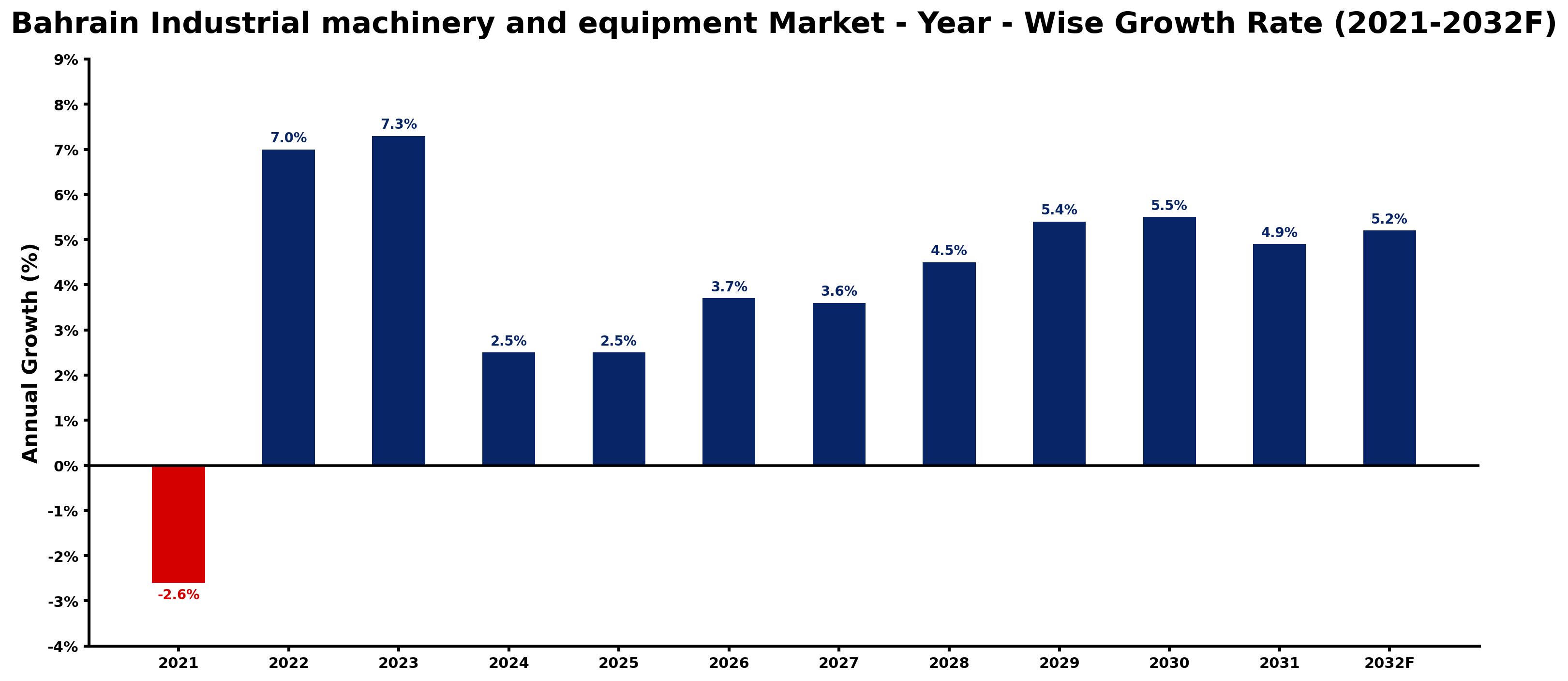
The table below presents the year wise growth rates along with the key drivers influencing the market
| Year | Growth Rate | Major Drivers |
| 2021 | -2.6% | Supply chain disruptions stemming from global logistics challenges hindered machinery availability and delayed project completions. |
| 2022 | 7.0% | Bahrain's infrastructural expansion stimulates equipment demand across varied sectors. |
| 2023 | 7.3% | Local manufacturing initiatives enhance machinery procurement, driving market competitiveness and innovation. |
| 2024 | 2.5% | Increased focus on sustainability fosters interest in energy-efficient equipment solutions. |
| 2025 | 2.5% | Regional economic diversification encourages investments in advanced industrial machinery technologies. |
| 2026 | 3.7% | The push for automation in manufacturing aligns with workforce skill development programs. |
| 2027 | 3.6% | Collaborations between local firms and global suppliers enhance equipment accessibility and variety. |
| 2028 | 4.5% | Emerging technologies in IoT and AI revolutionize machinery efficiency across industries. |
| 2029 | 5.4% | A robust construction pipeline further drives demand for specialized industrial equipment. |
| 2030 | 5.5% | Shifts towards smart manufacturing create new demands for advanced machinery solutions. |
| 2031 | 4.9% | Economic resilience efforts promote industrial growth, boosting machinery and equipment investments. |
| 2032 | 5.2% | As regional trade agreements expand, Bahrain positions itself as a machinery export hub. |
Note - Market size estimations and growth projections presented in this report are based on 6Wresearch's advanced forecasting approach, validated with industry datasets as of June 2026.
Bahrain Industrial machinery and equipment Market Synopsis
The Bahrain Industrial machinery and equipment Market is projected to reach 3.7% and witness significant growth during the forecast period (2026-2032). The expanding infrastructure projects coupled with increased investments in the manufacturing sector are pivotal in stimulating this market. As Bahrain's economy diversifies, the demand for advanced industrial machinery is expected to rise, driven by technological advancements and the need for greater operational efficiencies across various industries.
Bahrain Industrial machinery and equipment Market Growth Drivers
The growth of the Bahrain Industrial machinery and equipment Market is primarily propelled by the following factors:
- The ongoing expansion of key industries such as manufacturing, construction, and oil and gas contributes significantly to the demand for industrial machinery. The government's commitment to diversifying the economy encourages investments in these sectors.
- A shift towards automation is evident, with industries increasingly adopting cutting-edge machinery to improve efficiency and production capacity. Technologies such as robotics and Industry 4.0 solutions are becoming integral to operational strategies.
- The government's focus on sustainability drives the demand for energy-efficient machinery. Industries are keen to reduce their carbon footprint, leading to the adoption of advanced equipment designed for lower energy consumption.
- Infrastructure projects that span various sectors create a consistent need for heavy machinery, further enhancing market growth. The construction boom in Bahrain is particularly noteworthy, requiring substantial investments in equipment and technology.
- As global competition heightens, Bahraini industries are compelled to innovate and modernize, spurring further demand for sophisticated machinery that can offer a competitive edge.
Bahrain Industrial machinery and equipment Market Challenges and Restraints
Despite the growth prospects, the Bahrain Industrial machinery and equipment Market faces several challenges:
- The high cost associated with advanced machinery poses a significant barrier, especially for small and medium-sized enterprises (SMEs) that often lack the necessary capital to invest in cutting-edge technologies.
- The market's reliance on imports makes it vulnerable to global trade policy changes and exchange rate fluctuations, which can affect pricing and availability of machinery.
- Continuous innovation is crucial due to rising demand for automation and energy efficiency, increasing research and development costs for local manufacturers striving to keep up with international standards.
- Intense competition from international suppliers offering a wider array of machinery at more competitive prices presents a challenge for local manufacturers to maintain market share.
- Compliance with regulatory standards for safety and environmental impact adds complexity to market operations, necessitating additional resources for adherence to evolving regulations.
Bahrain Industrial machinery and equipment Market Investment Opportunities
The evolving landscape of the Bahrain Industrial machinery and equipment Market presents various investment opportunities:
- Investors can explore ventures in the manufacturing of automated systems and precision tools, capitalizing on the trend towards enhanced operational efficiencies.
- The demand for advanced heavy machinery remains robust, providing opportunities for companies engaged in import and distribution.
- As Industry 4.0 technologies gain traction, there is significant potential for developing smart machinery solutions that further boost productivity across diverse industries.
- Investments in research and development present avenues for innovation, particularly in energy-efficient machinery that aligns with global sustainability initiatives.
- Partnerships with local firms can help investors navigate the market, leveraging established networks and knowledge of regional compliance and operational challenges.
Bahrain Industrial machinery and equipment Market Government Investment and Initiatives
The government plays a critical role in the Bahrain Industrial machinery and equipment Market through various initiatives:
- Government policies are designed to encourage the growth of manufacturing and construction sectors, with incentives for businesses adopting advanced industrial machinery to enhance productivity.
- A focus on infrastructure development translates to increased public spending, which significantly benefits the market for industrial machinery and equipment.
- Import regulations ensure that industrial equipment adheres to international safety and performance standards, fostering a reliable market environment.
- Public sector investment plans target the construction industry, directly impacting the demand for industrial machinery required for large-scale projects.
- Support for research and innovation initiatives aims to bolster local manufacturing capabilities, ultimately enhancing the competitive landscape of the Bahrain industrial machinery market.
Bahrain Industrial machinery and equipment Market Latest Developments (May 2025 - June 2026)
Recent developments indicate a dynamic environment in the Bahrain Industrial machinery and equipment Market:
- There has been a noticeable uptick in investments directed towards automation technologies, with various industries enhancing their operational frameworks to integrate sophisticated machinery.
- Government initiatives aimed at reducing carbon emissions have led to increased focus on energy-efficient machinery, prompting local manufacturers to adopt newer technologies.
- The construction sector has seen a surge in infrastructural projects, resulting in heightened demand for heavy machinery capable of meeting project requirements.
- Collaboration between governmental bodies and industrial sectors has prompted forums to discuss challenges and opportunities, fostering an environment of innovation and growth.
- Enhancements in supply chain logistics have been observed, as businesses strive to mitigate the impacts of global trade fluctuations and improve access to essential machinery.
Bahrain Industrial machinery and equipment Market - Key Attractiveness of the Report
- 10 Years of Market Numbers
- Historical Data Starting from 2022 to 2025
- Base Year: 2025
- Forecast Data until 2032
- Key Performance Indicators Impacting the Market
- Major Upcoming Developments and Projects
Key Highlights of the Report:
- Bahrain Industrial machinery and equipment Market Outlook
- Market Size of Bahrain Industrial machinery and equipment Market, 2025
- Forecast of Bahrain Industrial machinery and equipment Market, 2032F
- Historical Data and Forecast of Bahrain Industrial machinery and equipment Revenues & Volume for the Period 2022-2032F
- Bahrain Industrial machinery and equipment Market Trend Evolution
- Bahrain Industrial machinery and equipment Market Drivers and Challenges
- Bahrain Industrial machinery and equipment Price Trends
- Bahrain Industrial machinery and equipment Porter's Five Forces
- Bahrain Industrial machinery and equipment Industry Life Cycle
- Historical Data and Forecast of Bahrain Industrial machinery and equipment Market Revenues & Volume By Types for the Period 2022-2032F
- Historical Data and Forecast of Bahrain Industrial machinery and equipment Market Revenues & Volume By Packaging Machinery for the Period 2022-2032F
- Historical Data and Forecast of Bahrain Industrial machinery and equipment Market Revenues & Volume By Food Processing Equipment for the Period 2022-2032F
- Historical Data and Forecast of Bahrain Industrial machinery and equipment Market Revenues & Volume By Plastics Processing Machinery for the Period 2022-2032F
- Historical Data and Forecast of Bahrain Industrial machinery and equipment Market Revenues & Volume By Metal Forming Machine Tools for the Period 2022-2032F
- Historical Data and Forecast of Bahrain Industrial machinery and equipment Market Revenues & Volume By Woodworking Machinery for the Period 2022-2032F
- Historical Data and Forecast of Bahrain Industrial machinery and equipment Market Revenues & Volume By Application for the Period 2022-2032F
- Historical Data and Forecast of Bahrain Industrial machinery and equipment Market Revenues & Volume By Agriculture for the Period 2022-2032F
- Historical Data and Forecast of Bahrain Industrial machinery and equipment Market Revenues & Volume By Construction for the Period 2022-2032F
- Historical Data and Forecast of Bahrain Industrial machinery and equipment Market Revenues & Volume By Packaging for the Period 2022-2032F
- Historical Data and Forecast of Bahrain Industrial machinery and equipment Market Revenues & Volume By Food processing for the Period 2022-2032F
- Historical Data and Forecast of Bahrain Industrial machinery and equipment Market Revenues & Volume By Mining for the Period 2022-2032F
- Historical Data and Forecast of Bahrain Industrial machinery and equipment Market Revenues & Volume By Others for the Period 2022-2032F
- Bahrain Industrial machinery and equipment Import Export Trade Statistics
- Market Opportunity Assessment By Types
- Market Opportunity Assessment By Application
- Bahrain Industrial machinery and equipment Top Companies Market Share
- Bahrain Industrial machinery and equipment Competitive Benchmarking By Technical and Operational Parameters
- Bahrain Industrial machinery and equipment Company Profiles
- Bahrain Industrial machinery and equipment Key Strategic Recommendations






































