Bahrain Isoprene Market Size, Share & Growth Rate
The Bahrain Isoprene Market was estimated at USD 1365 Million in 2025 and is projected to reach USD 2511 Million by 2032, growing at a CAGR of 9.1% from 2026 to 2032. This growth trajectory is significantly driven by the increasing demand for synthetic rubber in both the automotive and industrial sectors, particularly as Bahrain's automotive industry continues to expand. The push for high-quality, durable products in tire manufacturing and various rubber applications underpins the need for isoprene as a key raw material.
Bahrain Isoprene Market Year-wise Growth Rate and Key Drivers
This graph highlights how the Bahrain Isoprene Market has steadily grown over the years, supported by major growth factors.
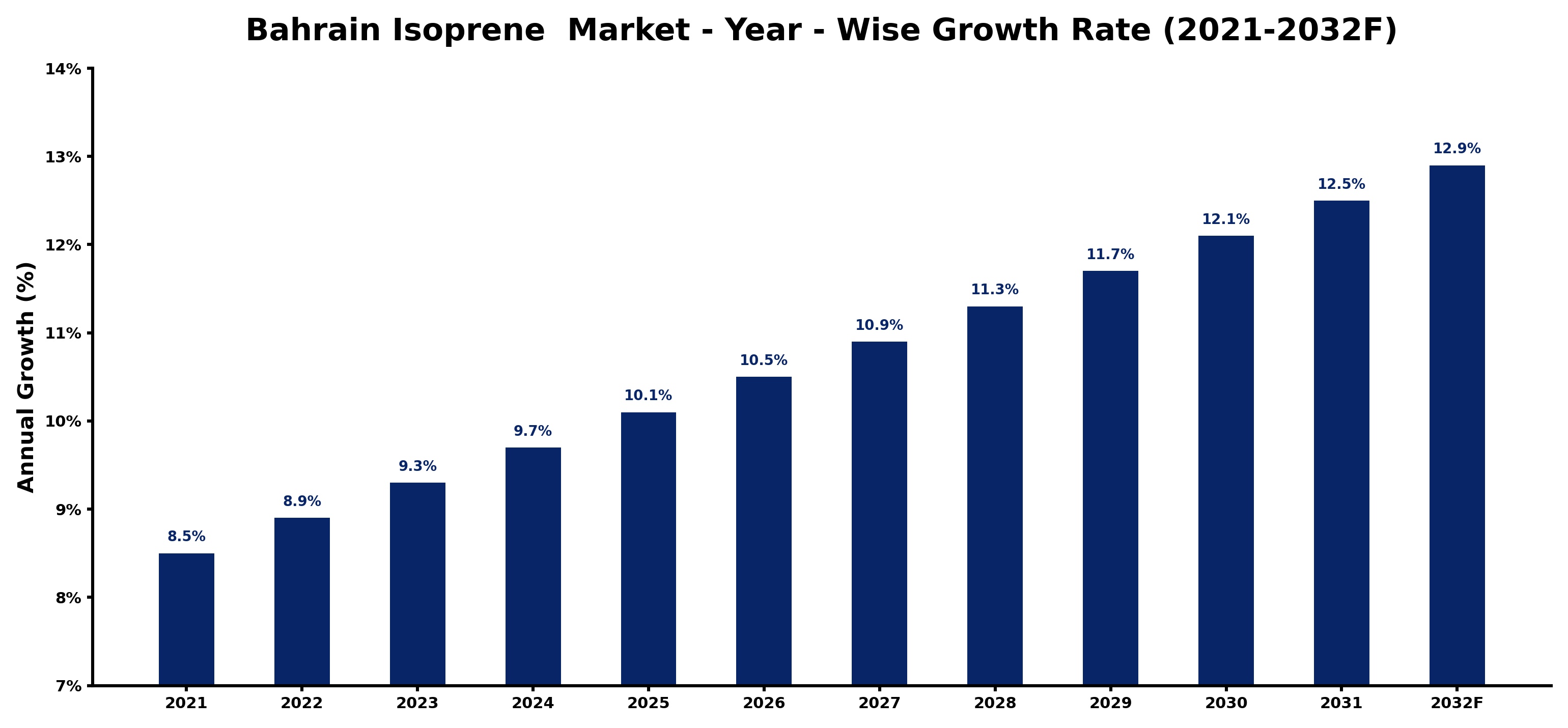
The table below presents the year‑wise growth rates along with the key drivers influencing the market
| Year | Growth Rate | Major Drivers |
| 2021 | 8.5% | Growing renewable energy integration projects |
| 2022 | 8.9% | Rapid growth in telecom and data center sectors |
| 2023 | 9.3% | Government infrastructure modernization initiatives |
| 2024 | 9.7% | Increasing smart city development projects |
| 2025 | 10.1% | Increasing smart city development projects |
| 2026 | 10.5% | Growing renewable energy integration projects |
| 2027 | 10.9% | Expansion of commercial construction activities |
| 2028 | 11.3% | Increasing adoption of advanced technologies |
| 2029 | 11.7% | Expansion of transportation and logistics networks |
| 2030 | 12.1% | Government infrastructure modernization initiatives |
| 2031 | 12.5% | Rising electricity demand across industries |
| 2032 | 12.9% | Expansion of transportation and logistics networks |
Note - Market size estimations and growth projections presented in this report are based on 6Wresearch’s advanced forecasting approach, validated with industry datasets as of June 2026.
Bahrain Isoprene Market Synopsis
The isoprene market in Bahrain is characterized by a strong correlation with the automotive sector, where synthetic rubber plays a vital role in tire production. As Bahrain focuses on enhancing its automotive manufacturing capabilities, the demand for isoprene is poised to grow correspondingly.
Furthermore, the expansion of the construction industry, utilizing isoprene-derived materials in hoses, seals, and belts, further solidifies the market's growth. As local manufacturers prioritize high-performance rubber solutions, the push for isoprene is expected to intensify in the coming years.
Bahrain Isoprene Market Key Takeaways
- Robust growth projected with a CAGR of 9.1% from 2026 to 2032.
- Strong demand from the automotive sector significantly drives isoprene consumption.
- Expansion in the construction industry increases the application range for synthetic rubber.
- Environmental regulations shape production practices and market dynamics.
- Investment opportunities abound in the growing automotive and industrial sectors.
Evaluation of Restraints in Bahrain Isoprene Market
Despite its growth potential, the Bahrain isoprene market faces notable challenges. The local manufacturing sector is relatively limited, leading to a dependency on imports for isoprene production, which exposes the market to fluctuations in global prices and supply chain vulnerabilities. Moreover, stringent environmental regulations regarding isoprene production necessitate compliance, adding complexity to operational frameworks. The presence of synthetic alternatives, such as butadiene, further intensifies market competition, which can impede growth prospects.
Bahrain Isoprene Market Trends
A notable trend influencing the Bahrain isoprene market is the growing emphasis on sustainable and high-performance rubber materials. With increasing consumer demand for eco-friendly and durable products, manufacturers are seeking advanced formulations that incorporate isoprene. Additionally, innovations in manufacturing processes aimed at enhancing the quality and properties of synthetic rubber products are emerging as crucial focal points for industry players.
Bahrain Isoprene Market Opportunities
There are considerable investment opportunities in the Bahrain isoprene market, primarily within the automotive and industrial sectors. Investors can capitalize on the increasing demand for high-performance tires, industrial belts, and other rubber-based products. Moreover, as local production capabilities are enhanced, suppliers of isoprene can play a crucial role in supporting domestic manufacturers, thereby fostering a more resilient supply chain.
Government Initiatives in the Bahrain Isoprene Market
The Bahraini government is actively promoting industrial growth through policies aimed at bolstering the automotive and construction sectors. By incentivizing local production in the chemicals sector, these initiatives are designed to stimulate the isoprene market. Additionally, stringent regulatory standards for the safe production and handling of isoprene ensure that manufacturers adhere to safety and environmental guidelines, further facilitating industry growth.
Future Insights of the Bahrain Isoprene Market
Looking ahead to 2026-2032, the Bahrain isoprene market is set to evolve significantly. The expanding automotive industry will likely remain a primary driver, with increasing production of high-performance tires. As Bahrain continues to invest in its industrial capabilities, the demand for synthetic rubber across various applications will further solidify the market's growth. Ultimately, adapting to regulatory changes and embracing sustainable practices will be essential for stakeholders navigating this dynamic landscape.
Bahrain Isoprene Market Latest Developments (May 2025 - June 2026)
In recent months, the Bahrain isoprene market has witnessed a focus on enhancing production efficiencies within the synthetic rubber sector. Industry stakeholders are exploring advanced technologies to streamline operations and improve product quality. Additionally, there has been an uptick in collaboration between local manufacturers and international suppliers, aimed at strengthening the supply chain and boosting local production capabilities.
Bahrain Isoprene Market - Key Attractiveness of the Report
- 10 Years of Market Numbers
- Historical Data Starting from 2022 to 2025
- Base Year: 2025
- Forecast Data until 2032
- Key Performance Indicators Impacting the Market
- Major Upcoming Developments and Projects
Key Highlights of the Report:
- Bahrain Isoprene Market Outlook
- Market Size of Bahrain Isoprene Market, 2025
- Forecast of Bahrain Isoprene Market, 2032
- Historical Data and Forecast of Bahrain Isoprene Revenues & Volume for the Period 2022-2032F
- Bahrain Isoprene Market Trend Evolution
- Bahrain Isoprene Market Drivers and Challenges
- Bahrain Isoprene Price Trends
- Bahrain Isoprene Porter's Five Forces
- Bahrain Isoprene Industry Life Cycle
- Historical Data and Forecast of Bahrain Isoprene Market Revenues & Volume By Type for the Period 2022-2032F
- Historical Data and Forecast of Bahrain Isoprene Market Revenues & Volume By Polymer Grade for the Period 2022-2032F
- Historical Data and Forecast of Bahrain Isoprene Market Revenues & Volume By Chemical Grade for the Period 2022-2032F
- Historical Data and Forecast of Bahrain Isoprene Market Revenues & Volume By Application for the Period 2022-2032F
- Historical Data and Forecast of Bahrain Isoprene Market Revenues & Volume By Polyisoprene (IR) for the Period 2022-2032F
- Historical Data and Forecast of Bahrain Isoprene Market Revenues & Volume By Styrene-isoprene-styrene (SIS) for the Period 2022-2032F
- Historical Data and Forecast of Bahrain Isoprene Market Revenues & Volume By Isobutylene-isoprene rubber (IIR) for the Period 2022-2032F
- Historical Data and Forecast of Bahrain Isoprene Market Revenues & Volume By Others for the Period 2022-2032F
- Historical Data and Forecast of Bahrain Isoprene Market Revenues & Volume By End-use Industry for the Period 2022-2032F
- Historical Data and Forecast of Bahrain Isoprene Market Revenues & Volume By Tires for the Period 2022-2032F
- Historical Data and Forecast of Bahrain Isoprene Market Revenues & Volume By Non-tires for the Period 2022-2032F
- Historical Data and Forecast of Bahrain Isoprene Market Revenues & Volume By Adhesives for the Period 2022-2032F
- Historical Data and Forecast of Bahrain Isoprene Market Revenues & Volume By Others for the Period 2022-2032F
- Bahrain Isoprene Import Export Trade Statistics
- Market Opportunity Assessment By Type
- Market Opportunity Assessment By Application
- Market Opportunity Assessment By End-use Industry
- Bahrain Isoprene Top Companies Market Share
- Bahrain Isoprene Competitive Benchmarking By Technical and Operational Parameters
- Bahrain Isoprene Company Profiles
- Bahrain Isoprene Key Strategic Recommendations






































