Bahrain Kitchenware Market Growth Rate Analysis (2021-2031)
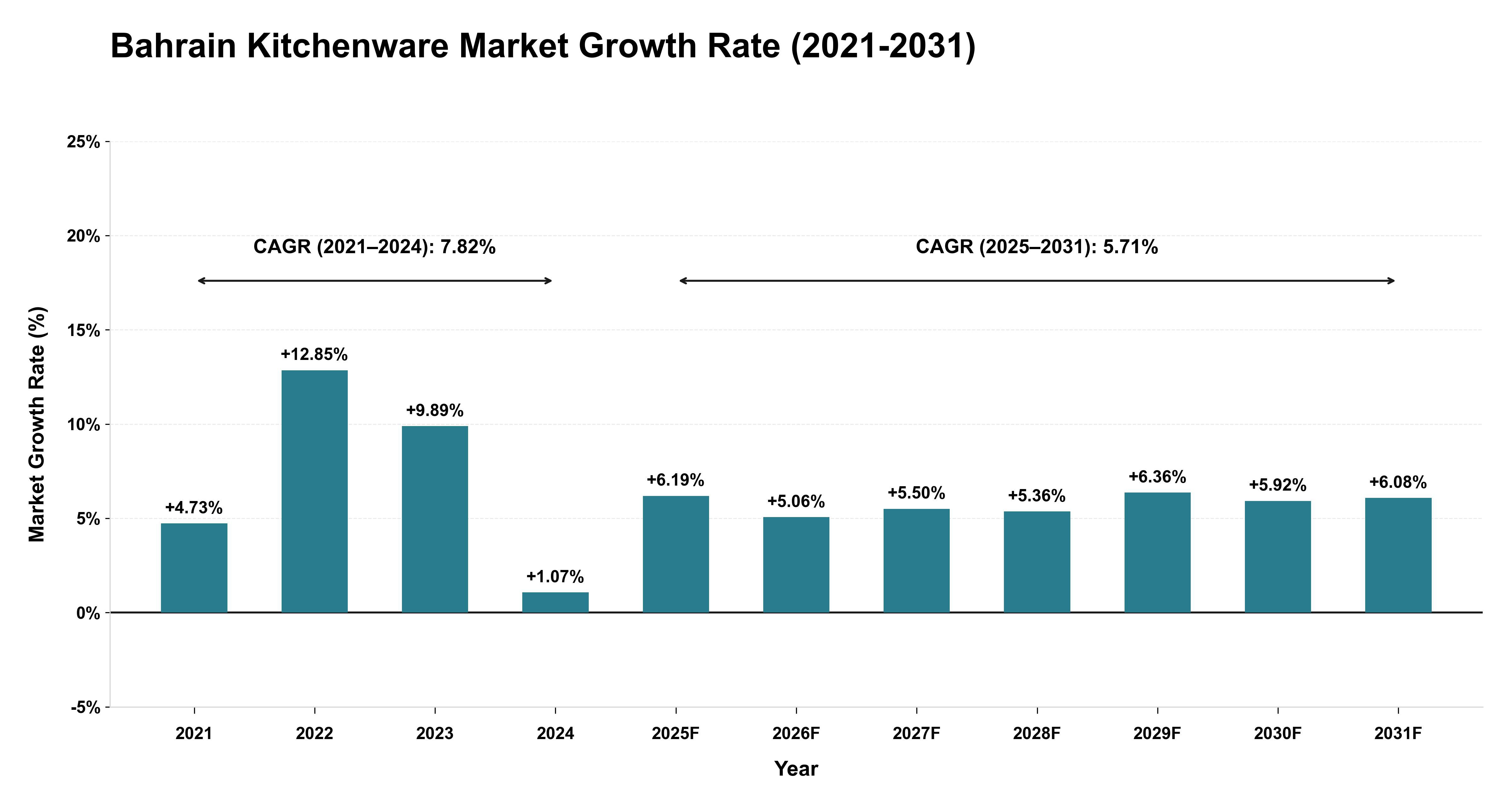
The Bahrain Kitchenware Market demonstrated a strong historical trend from 2021 to 2024, with a robust CAGR of 7.82%, driven by increased consumer spending due to rising disposable incomes and a preference for modern kitchenware products. However, in 2024, the market experienced a slight slowdown, growing at a rate of 1.07%, signaling potential saturation and market maturity. Looking ahead to the forecast period from 2025 to 2031, the market is anticipated to continue expanding at a more moderate pace, with a projected CAGR of 5.71%. This deceleration indicates a phase of stabilization following previous rapid growth, as the market adapts to evolving consumer preferences and competitive dynamics.
Bahrain Kitchenware Market Synopsis
The kitchenware market in Bahrain is growing with rising disposable incomes and consumer interest in modern cooking appliances and utensils. Stainless steel, ceramic, and non-stick cookware dominate the segment. Innovations in ergonomic design, induction compatibility, and multi-functional tools are meeting demand from both home cooks and the HoReCa sector.
Trends of the market
The kitchenware market in Bahrain is thriving, driven by a combination of cultural appreciation for culinary arts and the expansion of the hospitality sector. Consumers are increasingly seeking high-quality, durable, and aesthetically pleasing kitchen tools and appliances. There`s a noticeable trend towards multifunctional and space-saving designs, catering to modern urban living spaces. Additionally, with a growing awareness of health and environmental concerns, eco-friendly and non-toxic materials are becoming more popular among buyers.
Challenges of the market
The Kitchenware Market in Bahrain is influenced by lifestyle trends, expat populations, and hospitality sector expansion. From cookware to kitchen gadgets, product variety continues to grow. However, the market is highly competitive, with mass imports from Asia dominating shelves. Challenges include consumer price sensitivity, limited brand loyalty, and rising input costs for premium kitchenware. Import duties and logistics expenses further strain local distributors.
Investment opportunities in the Market
The kitchenware market in Bahrain is witnessing increased demand due to the growing number of households, rising disposable incomes, and the expanding foodservice industry. Investors can tap into this market by supplying innovative and durable kitchenware products, such as cookware, utensils, storage solutions, and appliances. Introducing high-quality, eco-friendly materials such as stainless steel, non-toxic plastics, and sustainable wood could appeal to environmentally conscious consumers. Additionally, focusing on smart kitchen appliances or luxury kitchenware can cater to higher-end markets.
Government Policy of the market
The Bahrain kitchenware market has experienced considerable growth in recent years, driven by increasing consumer interest in cooking and home improvement. The rising disposable income of consumers, along with a growing preference for stylish and functional kitchen products, has spurred the demand for a variety of kitchenware items, including cookware, kitchen gadgets, storage containers, and utensils. Additionally, the ongoing trend of urbanization and the growth of the hospitality sector, including restaurants and hotels, have further contributed to the market expansion. Government policies promoting innovation and domestic manufacturing also have a positive impact on the availability and affordability of kitchenware products in Bahrain.
Key Highlights of the Report:
- Bahrain Kitchenware Market Outlook
- Market Size of Bahrain Kitchenware Market, 2021
- Forecast of Bahrain Kitchenware Market, 2031
- Historical Data and Forecast of Bahrain Kitchenware Revenues & Volume for the Period 2018 - 2031
- Bahrain Kitchenware Market Trend Evolution
- Bahrain Kitchenware Market Drivers and Challenges
- Bahrain Kitchenware Price Trends
- Bahrain Kitchenware Porter's Five Forces
- Bahrain Kitchenware Industry Life Cycle
- Historical Data and Forecast of Bahrain Kitchenware Market Revenues & Volume By Product Type for the Period 2018 - 2031
- Historical Data and Forecast of Bahrain Kitchenware Market Revenues & Volume By Cookware for the Period 2018 - 2031
- Historical Data and Forecast of Bahrain Kitchenware Market Revenues & Volume By Bakeware for the Period 2018 - 2031
- Historical Data and Forecast of Bahrain Kitchenware Market Revenues & Volume By Others for the Period 2018 - 2031
- Historical Data and Forecast of Bahrain Kitchenware Market Revenues & Volume By End User for the Period 2018 - 2031
- Historical Data and Forecast of Bahrain Kitchenware Market Revenues & Volume By Residential Kitchen for the Period 2018 - 2031
- Historical Data and Forecast of Bahrain Kitchenware Market Revenues & Volume By Commercial Kitchens for the Period 2018 - 2031
- Historical Data and Forecast of Bahrain Kitchenware Market Revenues & Volume By Sales Channel for the Period 2018 - 2031
- Historical Data and Forecast of Bahrain Kitchenware Market Revenues & Volume By Online for the Period 2018 - 2031
- Historical Data and Forecast of Bahrain Kitchenware Market Revenues & Volume By Offline for the Period 2018 - 2031
- Bahrain Kitchenware Import Export Trade Statistics
- Market Opportunity Assessment By Product Type
- Market Opportunity Assessment By End User
- Market Opportunity Assessment By Sales Channel
- Bahrain Kitchenware Top Companies Market Share
- Bahrain Kitchenware Competitive Benchmarking By Technical and Operational Parameters
- Bahrain Kitchenware Company Profiles
- Bahrain Kitchenware Key Strategic Recommendations






































