Bahrain Lead Sulfate Market Size, Share & Growth Rate
The Bahrain Lead Sulfate Market was estimated at USD 1491 Million in 2025 and is projected to reach USD 2486 Million by 2032, growing at a CAGR of 7.6% from 2026 to 2032. This robust growth trajectory is primarily fueled by the burgeoning automotive sector, which remains the largest consumer of lead-acid batteries. Additionally, the rising demand for efficient energy storage solutions aligns with Bahrain's commitment to sustainable development, positioning lead sulfate as a critical component in this transition.
Bahrain Lead Sulfate Market Year-wise Growth Rate and Key Drivers
This graph highlights how the Bahrain Lead Sulfate Market has steadily grown over the years, supported by major growth factors.
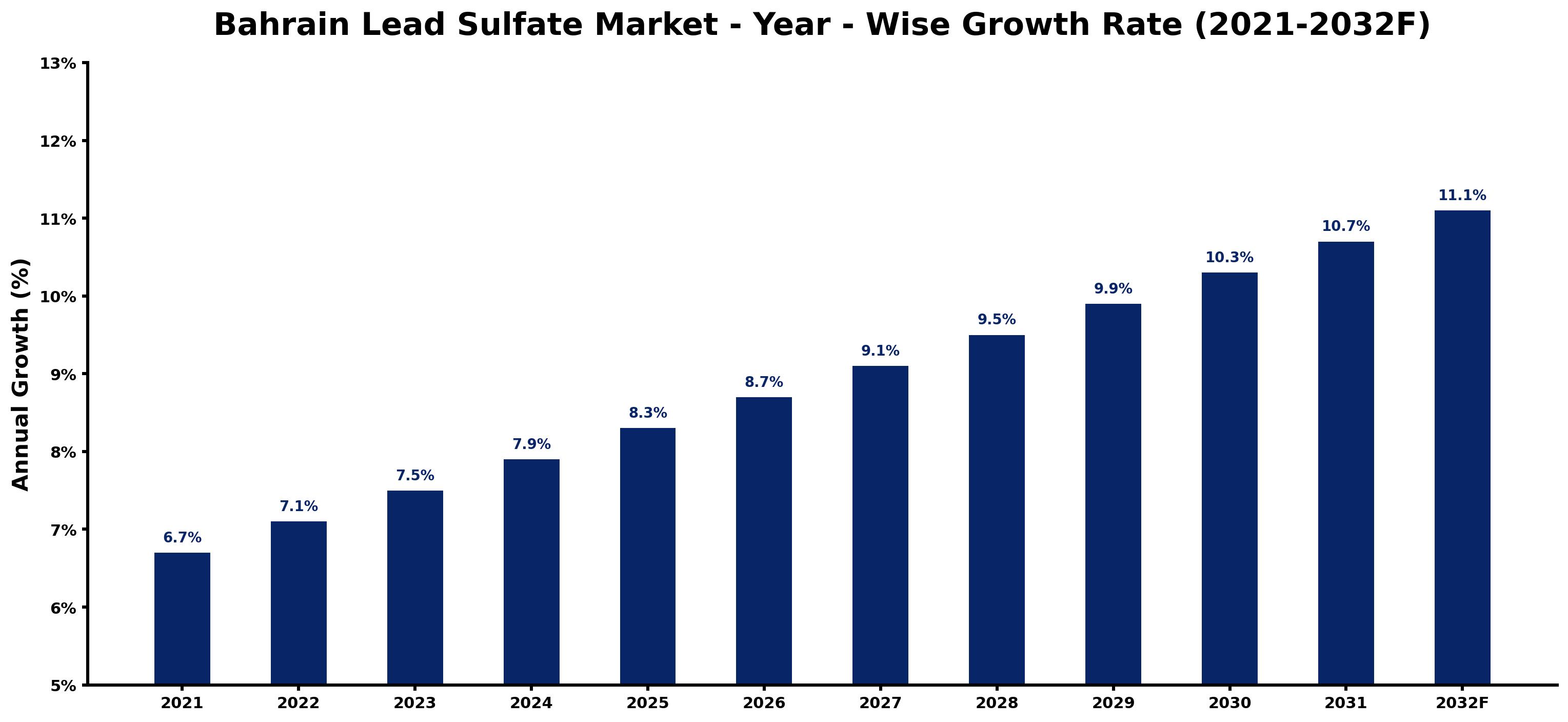
The table below presents the year‑wise growth rates along with the key drivers influencing the market
| Year | Growth Rate | Major Drivers |
| 2021 | 6.7% | Increased industrial battery production |
| 2022 | 7.1% | Growing renewable energy investments |
| 2023 | 7.5% | Rise in automotive manufacturing |
| 2024 | 7.9% | Expansion of energy storage solutions |
| 2025 | 8.3% | Demand from telecommunications sector |
| 2026 | 8.7% | Growth in electric vehicle market |
| 2027 | 9.1% | Surge in construction activities |
| 2028 | 9.5% | Increased demand for backup power |
| 2029 | 9.9% | Investment in infrastructure projects |
| 2030 | 10.3% | Rising consumer electronics production |
| 2031 | 10.7% | increased domestic production output |
| 2032 | 11.1% | growing emerging market penetration |
Note: Market size estimations and growth projections presented in this report are based on 6Wresearch's proprietary forecasting methodology, utilizing the latest available industry data, government publications, and primary research inputs.
Bahrain Lead Sulfate Market Synopsis
The lead sulfate market in Bahrain plays a pivotal role in the production of lead-acid batteries, integral for automotive and industrial energy storage. Given the countrys expanding automotive industry and infrastructure developments, the need for reliable energy sources is more pronounced than ever.
Moreover, lead sulfate's application extends beyond batteries; its use in pigments and the lead refining process further bolsters market stability. As environmental regulations tighten, there is a pressing need to innovate and adapt within this sector to sustain growth and mitigate risks.
Bahrain Lead Sulfate Market Key Takeaways
- The market is driven by the growing automotive sector and energy storage demands.
- Lead sulfate's applications in pigments enhance its market resilience.
- Government regulations pose both challenges and opportunities for innovation.
- Increased investment in electric vehicles is set to boost lead-acid battery demand.
- Market growth is closely tied to fluctuations in lead prices and environmental policies.
Evaluation of Restraints in Bahrain Lead Sulfate Market
Despite the favorable growth outlook, the Bahrain Lead Sulfate Market faces significant restraints. The transition toward alternative energy storage technologies, particularly lithium-ion batteries, poses a substantial threat as consumers and industries increasingly seek cleaner options. Furthermore, the hazardous nature of lead compounds has led to stricter regulatory frameworks, which can hinder production efficiency and elevate costs. This dual challenge of technological evolution and regulatory compliance requires stakeholders to adapt swiftly to remain competitive.
Bahrain Lead Sulfate Market Trends
Current trends in the Bahrain Lead Sulfate Market reflect a shift towards sustainability and efficiency. The surge in electric vehicle adoption is reshaping the landscape, driving demand for lead-acid batteries as a reliable energy source. Additionally, advances in battery recycling technologies are poised to improve resource efficiency and reduce environmental impact. Emerging applications of lead sulfate in specialty pigments and coatings further diversify the market, highlighting the need for innovation.
Bahrain Lead Sulfate Market Opportunities
Investment opportunities in the Bahrain Lead Sulfate Market are abundant, particularly in the realm of sustainable practices. The ongoing emphasis on renewable energy sources and the national agenda for expanding the electric vehicle market signify a ripe environment for stakeholders. Collaborations aimed at enhancing battery performance and lifecycle management present avenues for growth, while strategic investments in research and development can unlock new applications of lead sulfate across various sectors.
Government Initiatives in the Bahrain Lead Sulfate Market
The government of Bahrain is actively promoting initiatives to enhance the safety and environmental compliance of industries that utilize lead sulfate. This includes stringent regulations concerning the handling and disposal of lead compounds, as well as incentives for companies that adopt safer alternatives or innovate sustainable practices. Moreover, public investment in infrastructure projects aimed at enhancing energy efficiency aligns with national goals of sustainability, thereby supporting market growth.
Future Insights of the Bahrain Lead Sulfate Market
Looking ahead, the Bahrain Lead Sulfate Market is anticipated to expand significantly from 2026 to 2032, driven by ongoing advancements in the automotive and energy sectors. As the country increasingly prioritizes electric vehicle integration and renewable energy storage solutions, demand for lead-acid batteries is expected to rise accordingly. Moreover, ongoing research into the safe recycling of lead and innovation in battery technologies will play critical roles in sustaining market momentum in the coming years.
Bahrain Lead Sulfate Market Latest Developments (2025 - 2026)
Recent developments in the Bahrain Lead Sulfate Market indicate a notable increase in collaborations between government and private sectors aimed at addressing environmental challenges. Initiatives to improve battery recycling processes have gained traction, reflecting a shift towards circular economy principles. Additionally, the automotive sector is exploring partnerships focused on developing advanced lead-acid batteries that meet the evolving needs of electric vehicles and energy storage systems.
Bahrain Lead Sulfate Market - Key Attractiveness of the Report
- 10 Years of Market Numbers
- Historical Data Starting from 2022 to 2025
- Base Year: 2025
- Forecast Data until 2032
- Key Performance Indicators Impacting the Market
- Major Upcoming Developments and Projects
Key Highlights of the Report:
- Bahrain Lead Sulfate Market Outlook
- Market Size of Bahrain Lead Sulfate Market, 2025
- Forecast of Bahrain Lead Sulfate Market, 2032
- Historical Data and Forecast of Bahrain Lead Sulfate Revenues & Volume for the Period 2022-2032F
- Bahrain Lead Sulfate Market Trend Evolution
- Bahrain Lead Sulfate Market Drivers and Challenges
- Bahrain Lead Sulfate Price Trends
- Bahrain Lead Sulfate Porter's Five Forces
- Bahrain Lead Sulfate Industry Life Cycle
- Historical Data and Forecast of Bahrain Lead Sulfate Market Revenues & Volume By Product Type for the Period 2022-2032F
- Historical Data and Forecast of Bahrain Lead Sulfate Market Revenues & Volume By Type I for the Period 2022-2032F
- Historical Data and Forecast of Bahrain Lead Sulfate Market Revenues & Volume By Type II for the Period 2022-2032F
- Historical Data and Forecast of Bahrain Lead Sulfate Market Revenues & Volume By Application for the Period 2022-2032F
- Historical Data and Forecast of Bahrain Lead Sulfate Market Revenues & Volume By Application I for the Period 2022-2032F
- Historical Data and Forecast of Bahrain Lead Sulfate Market Revenues & Volume By Application II for the Period 2022-2032F
- Bahrain Lead Sulfate Import Export Trade Statistics
- Market Opportunity Assessment By Product Type
- Market Opportunity Assessment By Application
- Bahrain Lead Sulfate Top Companies Market Share
- Bahrain Lead Sulfate Competitive Benchmarking By Technical and Operational Parameters
- Bahrain Lead Sulfate Company Profiles
- Bahrain Lead Sulfate Key Strategic Recommendations






































