Bahrain Lubrication System Market Summary
The bahrain lubrication system market was estimated at USD 1233 Million in 2025 and is projected to reach USD 2244 Million by 2032, growing at a CAGR of 10.3% from 2026 to 2032.
Bahrain Lubrication System Market Year-wise Growth Rate and Key Drivers
This graph highlights how the Bahrain Lubrication System Market has steadily grown over the past five years, supported by major growth factors.
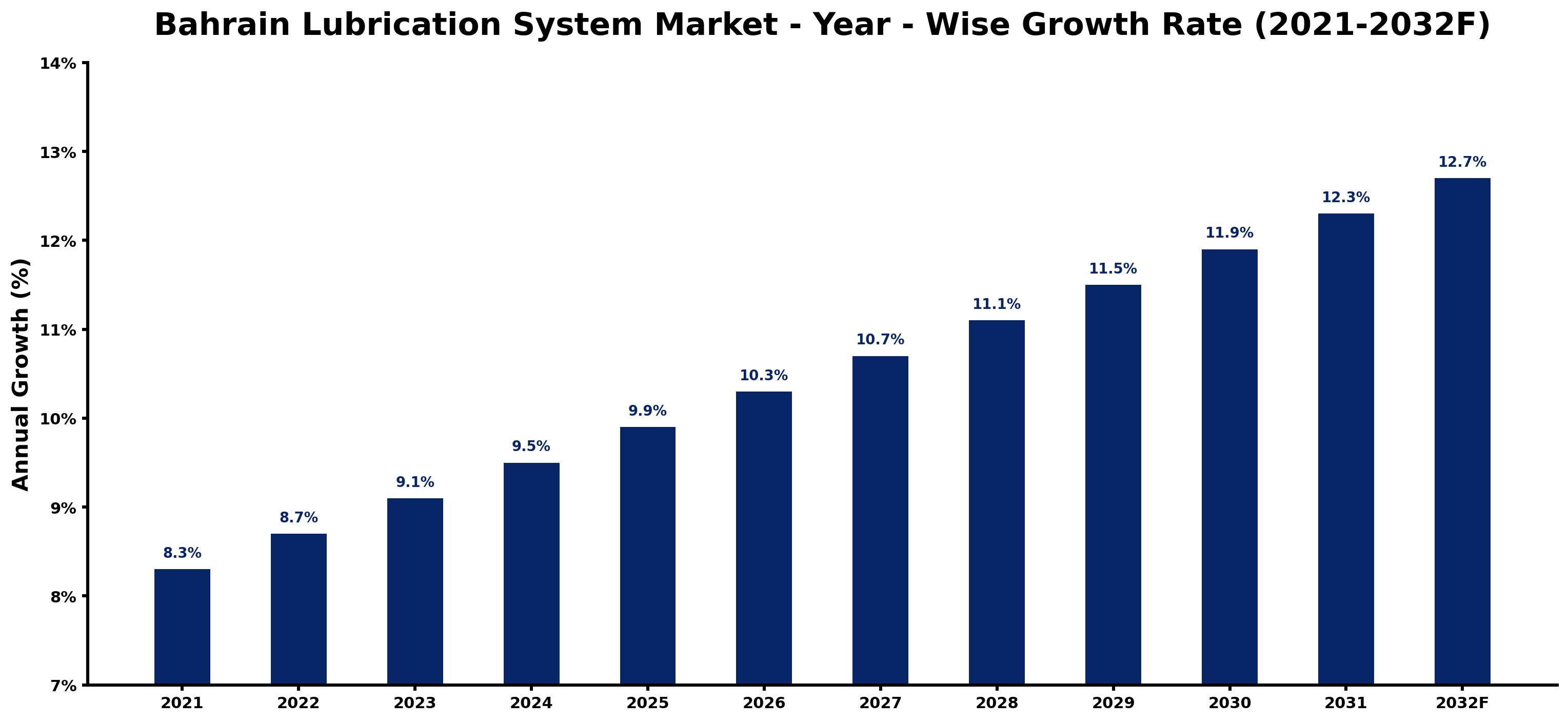
The table below presents the year wise growth rates along with the key drivers influencing the market
| Year | Growth Rate | Major Drivers |
| 2021 | 8.3% | Post-lockdown recovery spurred maintenance needs, boosting lubricant consumption across sectors. |
| 2022 | 8.7% | Local industries expanded, leading to higher demand for specialized lubrication solutions. |
| 2023 | 9.1% | Rising infrastructure projects increased lubricant applications in construction and transport sectors. |
| 2024 | 9.5% | Technological upgrades in machinery necessitated advanced lubrication systems for optimal performance. |
| 2025 | 9.9% | Sustainability trends prompted businesses to seek eco-friendly lubrication options and innovations. |
| 2026 | 10.3% | Increased automotive production in Bahrain heightened demand for high-performance lubricants. |
| 2027 | 10.7% | Emerging players entered the market, enhancing competition and diversifying product offerings. |
| 2028 | 11.1% | Regional economic diversification strategies expanded opportunities for lubricant suppliers and distributors. |
| 2029 | 11.5% | A growing service sector increased maintenance needs, further driving lubricant demand. |
| 2030 | 11.9% | Climate conditions highlighted the importance of efficient lubrication in extreme temperatures. |
| 2031 | 12.3% | Advancements in synthetic lubricants attracted industries looking for longer-lasting solutions. |
| 2032 | 12.7% | Market consolidation trends could streamline supply chains, leading to improved pricing strategies. |
Note - Market size estimations and growth projections presented in this report are based on 6Wresearch's advanced forecasting approach, validated with industry datasets as of June 2026.
Bahrain Lubrication System Market Synopsis
The Bahrain Lubrication System Market is projected to reach 10.3% and witness significant growth during the forecast period (2026-2032). This market serves a diverse array of sectors, including manufacturing, automotive, and power generation, each of which relies heavily on effective lubrication systems to ensure optimal machinery performance and longevity. The increasing focus on automation and centralized lubrication solutions is propelling market expansion, ultimately leading to higher efficiency and reduced maintenance costs across Bahrain's industrial landscape.
Bahrain Lubrication System Market Growth Drivers
Several factors are driving the growth of the Bahrain Lubrication System Market. First and foremost, the increasing demand for efficient machinery maintenance solutions in various industries fuels the need for advanced lubrication systems. As machinery becomes more complex, the necessity for high-performance lubrication solutions that can minimize friction and wear has become paramount.
- Industrial growth in sectors such as manufacturing and automotive is leading to a higher demand for lubrication systems that enhance machinery reliability and efficiency.
- With Bahrain's industrial base expanding, there is a concomitant increase in the usage of sophisticated machinery that requires advanced lubrication systems to operate optimally.
- The adoption of automated lubrication systems is on the rise, as these technologies provide precise control over lubrication, significantly enhancing operational efficiency.
- Growing awareness of the long-term cost benefits associated with reduced machinery downtime due to better lubrication practices is compelling businesses to invest in higher-quality lubrication systems.
- Additionally, the push for sustainability and reduced environmental impact is encouraging companies to shift towards eco-friendly lubrication products, further propelling market advancements.
Bahrain Lubrication System Market Challenges and Restraints
While the Bahrain Lubrication System Market is poised for growth, it also faces certain challenges that could impede its expansion. The region's heavy reliance on imported machinery and equipment poses a significant barrier to local production and innovation in the lubrication sector.
- The specialized nature of lubrication products needed across different industries necessitates complex supply chains, which can lead to inefficiencies and increased costs.
- Environmental regulations requiring manufacturers to adhere to sustainability standards can increase production costs and necessitate significant investment in research and development of eco-friendly lubrication solutions.
- The competition from alternative maintenance solutions may divert attention and resources away from lubrication technologies, creating further market difficulties.
- The need for constant innovation to meet evolving industry standards challenges manufacturers to stay ahead, requiring ongoing investment and strategic planning.
- Lastly, fluctuations in the global supply chain, especially in light of recent geopolitical events, can hinder the availability and pricing of lubrication system components, creating uncertainty in the market.
Bahrain Lubrication System Market Investment Opportunities
In light of the current trends and growth potential, numerous investment opportunities exist within the Bahrain Lubrication System Market. The increasing focus on automation technologies and high-performance lubrication solutions presents avenues for companies to engage in strategic initiatives.
- Investors can explore ventures in developing advanced lubrication solutions that cater specifically to the needs of Bahrain's expanding manufacturing and automotive sectors.
- As demand for automated lubrication systems grows, opportunities abound for businesses willing to innovate and produce proprietary technologies that enhance efficiency.
- Investment in research and development focused on sustainable lubrication technologies is vital, as the market begins to prioritize eco-friendly solutions.
- Supporting local manufacturing initiatives may unlock potential collaborations between investors and local industries, fostering mutual growth and reducing import reliance.
- Market players can benefit from establishing partnerships with regional businesses to enhance distribution and market reach, thus capitalizing on the growing demand for lubrication systems.
Bahrain Lubrication System Market Government Investment and Initiatives
The government of Bahrain plays a pivotal role in shaping the lubrication system market through various policies and initiatives aimed at fostering local production and innovation. Regulatory frameworks are established to ensure that all lubrication systems meet stringent safety and performance standards, promoting a competitive and reliable market environment.
- To support the local production of high-efficiency lubrication systems, the government offers tax incentives and funding for research into advanced lubrication technologies.
- Public spending initiatives aimed at enhancing industrial infrastructure are expected to improve overall efficiency, requiring robust lubrication systems across multiple sectors.
- Regulations on imported lubrication products ensure that ingredients and technologies adhere to international safety and environmental standards, bolstering market credibility.
- In addition, the Bahraini government encourages collaboration between academia and industry, promoting innovative solutions tailored to local industrial needs.
- Investment in training and workforce development is also a critical component, ensuring that the workforce is equipped with the necessary skills to support an advanced lubrication systems market.
Bahrain Lubrication System Market Latest Developments (May 2025 - June 2026)
The period from May 2025 to June 2026 has seen significant developments in the Bahrain Lubrication System Market, reflecting the evolving dynamics of industrial demands and technological advancements. The focus on automation is evident as more companies seek to implement automated lubrication systems that enhance precision and productivity.
- Technological advancements in lubrication products are emerging, with a notable shift towards high-performance solutions designed to operate under extreme conditions.
- Industry awareness programs emphasizing the importance of lubrication maintenance have been initiated, aimed at educating stakeholders about the benefits of investing in advanced systems.
- Increased collaboration between local industries and international partners is becoming commonplace, facilitating the exchange of knowledge and technology.
- The government's push for sustainability has spurred innovations in eco-friendly lubrication solutions, marking a trend towards more responsible production practices.
- Lastly, market players are increasingly focusing on digital solutions, utilizing IoT and data analytics to optimize lubrication processes and improve machinery reliability.
Bahrain Lubrication System Market - Key Attractiveness of the Report
- 10 Years of Market Numbers
- Historical Data Starting from 2022 to 2025
- Base Year: 2025
- Forecast Data until 2032
- Key Performance Indicators Impacting the Market
- Major Upcoming Developments and Projects
Key Highlights of the Report:
- Bahrain Lubrication System Market Outlook
- Market Size of Bahrain Lubrication System Market, 2025
- Forecast of Bahrain Lubrication System Market, 2032F
- Historical Data and Forecast of Bahrain Lubrication System Revenues & Volume for the Period 2022-2032F
- Bahrain Lubrication System Market Trend Evolution
- Bahrain Lubrication System Market Drivers and Challenges
- Bahrain Lubrication System Price Trends
- Bahrain Lubrication System Porter's Five Forces
- Bahrain Lubrication System Industry Life Cycle
- Historical Data and Forecast of Bahrain Lubrication System Market Revenues & Volume By Line Type for the Period 2022-2032F
- Historical Data and Forecast of Bahrain Lubrication System Market Revenues & Volume By Manual Lubrication Systems for the Period 2022-2032F
- Historical Data and Forecast of Bahrain Lubrication System Market Revenues & Volume By Automatic Lubrication Systems for the Period 2022-2032F
- Historical Data and Forecast of Bahrain Lubrication System Market Revenues & Volume By Product Type for the Period 2022-2032F
- Historical Data and Forecast of Bahrain Lubrication System Market Revenues & Volume By Single-Product Lubrication Systems for the Period 2022-2032F
- Historical Data and Forecast of Bahrain Lubrication System Market Revenues & Volume By Dual-Product Lubrication Systems for the Period 2022-2032F
- Historical Data and Forecast of Bahrain Lubrication System Market Revenues & Volume By Multi-Product Lubrication Systems for the Period 2022-2032F
- Historical Data and Forecast of Bahrain Lubrication System Market Revenues & Volume By Series Progressive for the Period 2022-2032F
- Historical Data and Forecast of Bahrain Lubrication System Market Revenues & Volume By Circulating Oil for the Period 2022-2032F
- Historical Data and Forecast of Bahrain Lubrication System Market Revenues & Volume By Oil & Air for the Period 2022-2032F
- Historical Data and Forecast of Bahrain Lubrication System Market Revenues & Volume By Application for the Period 2022-2032F
- Historical Data and Forecast of Bahrain Lubrication System Market Revenues & Volume By Cement Plants for the Period 2022-2032F
- Historical Data and Forecast of Bahrain Lubrication System Market Revenues & Volume By Steel Industry for the Period 2022-2032F
- Historical Data and Forecast of Bahrain Lubrication System Market Revenues & Volume By Mining & Mineral Processing for the Period 2022-2032F
- Historical Data and Forecast of Bahrain Lubrication System Market Revenues & Volume By Paper & Printing for the Period 2022-2032F
- Historical Data and Forecast of Bahrain Lubrication System Market Revenues & Volume By Automotive for the Period 2022-2032F
- Historical Data and Forecast of Bahrain Lubrication System Market Revenues & Volume By Industrial Machine & Machine Tools for the Period 2022-2032F
- Historical Data and Forecast of Bahrain Lubrication System Market Revenues & Volume By Construction Machines Machines for the Period 2022-2032F
- Bahrain Lubrication System Import Export Trade Statistics
- Market Opportunity Assessment By Line Type
- Market Opportunity Assessment By Product Type
- Market Opportunity Assessment By Application
- Bahrain Lubrication System Top Companies Market Share
- Bahrain Lubrication System Competitive Benchmarking By Technical and Operational Parameters
- Bahrain Lubrication System Company Profiles
- Bahrain Lubrication System Key Strategic Recommendations






































