Bahrain Managed Security Services Market Summary
The bahrain managed security services market was estimated at USD 645 Million in 2025 and is projected to reach USD 1124 Million by 2032, growing at a CAGR of 9.5% from 2026 to 2032.
Bahrain Managed Security Services Market Year-wise Growth Rate and Key Drivers
This graph highlights how the Bahrain Managed Security Services Market has steadily grown over the past five years, supported by major growth factors.
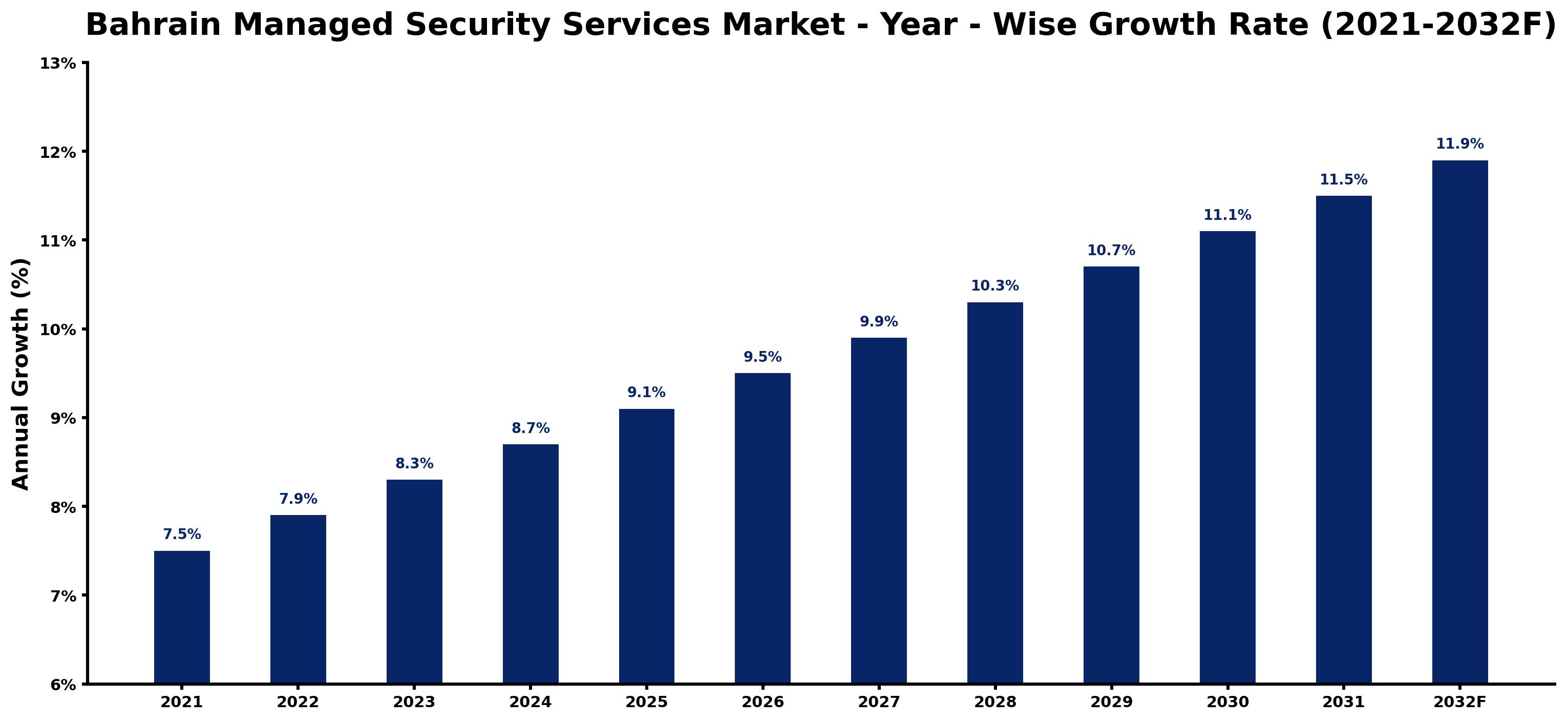
The table below presents the year wise growth rates along with the key drivers influencing the market
| Year | Growth Rate | Major Drivers |
| 2021 | 7.5% | Cybersecurity incidents escalate, highlighting the vulnerability of critical infrastructure and data. |
| 2022 | 7.9% | Local enterprises increasingly recognize the importance of robust cyber defense mechanisms. |
| 2023 | 8.3% | Global supply chain disruptions prompt heightened focus on information security measures. |
| 2024 | 8.7% | Increased investment from banks drives demand for comprehensive managed security services. |
| 2025 | 9.1% | Regional geopolitical tensions elevate the necessity for proactive threat monitoring solutions. |
| 2026 | 9.5% | Emerging technologies like AI present both challenges and opportunities for security enhancements. |
| 2027 | 9.9% | Telecom sector advancements require stringent security protocols for safeguarding customer data. |
| 2028 | 10.3% | Smart city initiatives in Bahrain demand integration of security in urban infrastructure projects. |
| 2029 | 10.7% | Corporate responsibility initiatives lead organizations to prioritize data protection strategies. |
| 2030 | 11.1% | Public awareness of data privacy issues becomes a catalyst for managed security services adoption. |
| 2031 | 11.5% | Innovations in cloud computing create new avenues for scalable security solutions and services. |
| 2032 | 11.9% | Cross-border collaborations enhance regional capabilities in providing advanced security frameworks. |
Note - Market size estimations and growth projections presented in this report are based on 6Wresearch's advanced forecasting approach, validated with industry datasets as of June 2026.
Bahrain Managed Security Services Market Synopsis
The Bahrain Managed Security Services Market is projected to reach 9.5% and witness significant growth during the forecast period (2026-2032). Driven by an increasing demand for cost-effective solutions, the market is experiencing a notable shift toward cloud-based services which offer multiple advantages, such as scalability and flexibility. The growth of mobile device usage and substantial investments in IT infrastructure are further adding to the momentum of managed security services within the region. Additionally, the Bahraini government's initiatives aimed at digitalizing the economy and enhancing cybersecurity measures are expected to bolster market development substantially.
Bahrain Managed Security Services Market Growth Drivers
Several factors are propelling the Bahrain Managed Security Services Market forward. Firstly, the persistent rise in cyber threats is creating an urgent need for businesses to adopt robust security measures. As more enterprises shift towards digital operations, the demand for effective managed security solutions continues to escalate. Secondly, the increasing acceptance and integration of cloud technologies have highlighted the need for advanced security services that can address unique challenges posed by cloud environments. Thirdly, the growing dependency on mobile platforms has necessitated the implementation of security solutions specifically designed for mobile devices.
Additionally, the continuous enhancement of IT frameworks across various sectors is contributing to the market's expansion. This evolution allows organizations to deploy sophisticated security measures tailored to their specific needs. Furthermore, Bahrain's supportive regulatory environment for digital transformation encourages businesses to invest in professional services that provide enhanced cybersecurity capabilities, thus further driving the market.
Bahrain Managed Security Services Market Trends and Opportunities
The Bahrain Managed Security Services Market is witnessing notable trends shaping its future. One significant trend is the increasing importance of Compliance as a Service. Organizations are actively seeking managed services that not only protect against cyber threats but also ensure compliance with local and international regulations. This trend presents several opportunities for service providers to offer specialized compliance-focused security solutions.
Another trend is the growing focus on Artificial Intelligence (AI) and Machine Learning (ML) in security services. These advanced technologies can enhance threat detection capabilities and response times, making them attractive options for businesses looking to bolster their cybersecurity measures. The infusion of AI and ML can lead to more predictive and adaptive security protocols, thus improving overall security postures.
Moreover, the rise of Managed Detection and Response (MDR) services signifies a shift toward proactive security management. This trend underscores the need for continuous monitoring and incident response, creating opportunities for providers to differentiate themselves through comprehensive service offerings.
Bahrain Managed Security Services Market Challenges and Restraints
Despite the promising growth of the Bahrain Managed Security Services Market, certain challenges could impede its progress. One notable restraint is the lack of awareness among enterprises regarding the importance of cyber threat protection. Many organizations still underestimate the potential risks, which can hinder investment in the necessary security measures.
Additionally, stringent laws and regulations concerning data storage and privacy present significant challenges for vendors operating in Bahrain. Compliance with these regulations can be resource-intensive and may dissuade potential service providers from entering the market. Furthermore, the rapid evolution of cyber threats necessitates that managed security services continuously adapt and innovate, which can strain resources and capabilities.
Bahrain Managed Security Services Market Government Investment and Initiatives
The Bahraini government's commitment to digitalization plays a pivotal role in the development of the managed security services market. Several initiatives have been launched to modernize the economic landscape and enhance national cybersecurity capabilities. Investments in digital infrastructure aim to create a more resilient economy, which in turn drives demand for sophisticated security services.
Government policies encouraging public-private partnerships foster a collaborative environment where security service providers can thrive. Additionally, initiatives aimed at raising awareness about cybersecurity among businesses and the public are crucial for promoting a security-first culture. This education helps organizations understand the risks associated with cyber threats and fosters a deeper appreciation for managed security services.
Bahrain Managed Security Services Market Latest Developments (May 2025 - June 2026)
Recent months have seen significant movements within the Bahrain Managed Security Services Market, reflecting the evolving landscape. Many organizations are prioritizing cybersecurity as a core component of their operational strategies, thereby driving demand for managed services that offer tailored security solutions. The continued adoption of advanced technologies is evident, as service providers enhance their offerings with AI-driven tools for threat detection and incident response.
Moreover, a growing trend toward risk management frameworks has emerged, enabling businesses to align their security efforts with overall organizational objectives. This development underscores the increasing recognition of cybersecurity as a business enabler rather than merely a compliance necessity. Looking ahead, the market is expected to further mature, with a greater emphasis on integrated security solutions that address the complexities of modern digital environments.
Bahrain Managed Security Services Market - Key Attractiveness of the Report
- 10 Years of Market Numbers
- Historical Data Starting from 2022 to 2025
- Base Year: 2025
- Forecast Data until 2032
- Key Performance Indicators Impacting the Market
- Major Upcoming Developments and Projects
Key Highlights of the Report:
- Bahrain Managed Security Services Market Outlook
- Market Size of Bahrain Managed Security Services Market, 2025
- Forecast of Bahrain Managed Security Services Market, 2032
- Historical Data and Forecast of Bahrain Managed Security Services Revenues & Volume for the Period 2022-2032
- Bahrain Managed Security Services Market Trend Evolution
- Bahrain Managed Security Services Market Drivers and Challenges
- Bahrain Managed Security Services Price Trends
- Bahrain Managed Security Services Porter's Five Forces
- Bahrain Managed Security Services Industry Life Cycle
- Historical Data and Forecast of Bahrain Managed Security Services Market Revenues & Volume By Type for the Period 2022-2032
- Historical Data and Forecast of Bahrain Managed Security Services Market Revenues & Volume By Unified threat management for the Period 2022-2032
- Historical Data and Forecast of Bahrain Managed Security Services Market Revenues & Volume By DDoS for the Period 2022-2032
- Historical Data and Forecast of Bahrain Managed Security Services Market Revenues & Volume By Managed SIEM for the Period 2022-2032
- Historical Data and Forecast of Bahrain Managed Security Services Market Revenues & Volume By Managed endpoint threat detection for the Period 2022-2032
- Historical Data and Forecast of Bahrain Managed Security Services Market Revenues & Volume By Managed two factor authentication for the Period 2022-2032
- Historical Data and Forecast of Bahrain Managed Security Services Market Revenues & Volume By Compliance management for the Period 2022-2032
- Historical Data and Forecast of Bahrain Managed Security Services Market Revenues & Volume By Vulnerability management for the Period 2022-2032
- Historical Data and Forecast of Bahrain Unified threat management Managed Security Services Market Revenues & Volume By Others for the Period 2022-2032
- Historical Data and Forecast of Bahrain Managed Security Services Market Revenues & Volume By Deployment for the Period 2022-2032
- Historical Data and Forecast of Bahrain Managed Security Services Market Revenues & Volume By Cloud-based for the Period 2022-2032
- Historical Data and Forecast of Bahrain Managed Security Services Market Revenues & Volume By On-premise for the Period 2022-2032
- Historical Data and Forecast of Bahrain Managed Security Services Market Revenues & Volume By Organization for the Period 2022-2032
- Historical Data and Forecast of Bahrain Managed Security Services Market Revenues & Volume By Small and medium enterprises for the Period 2022-2032
- Historical Data and Forecast of Bahrain Managed Security Services Market Revenues & Volume By Large enterprises for the Period 2022-2032
- Historical Data and Forecast of Bahrain Managed Security Services Market Revenues & Volume By Applications for the Period 2022-2032
- Historical Data and Forecast of Bahrain Managed Security Services Market Revenues & Volume By BFSI for the Period 2022-2032
- Historical Data and Forecast of Bahrain Managed Security Services Market Revenues & Volume By Government/defense for the Period 2022-2032
- Historical Data and Forecast of Bahrain Managed Security Services Market Revenues & Volume By Healthcare for the Period 2022-2032
- Historical Data and Forecast of Bahrain Managed Security Services Market Revenues & Volume By Manufacturing for the Period 2022-2032
- Historical Data and Forecast of Bahrain Managed Security Services Market Revenues & Volume By Telecom & IT for the Period 2022-2032
- Historical Data and Forecast of Bahrain Managed Security Services Market Revenues & Volume By Retail for the Period 2022-2032
- Historical Data and Forecast of Bahrain Managed Security Services Market Revenues & Volume By Others for the Period 2022-2032
- Bahrain Managed Security Services Import Export Trade Statistics
- Market Opportunity Assessment By Type
- Market Opportunity Assessment By Deployment
- Market Opportunity Assessment By Organization
- Market Opportunity Assessment By Applications
- Bahrain Managed Security Services Top Companies Market Share
- Bahrain Managed Security Services Competitive Benchmarking By Technical and Operational Parameters
- Bahrain Managed Security Services Company Profiles
- Bahrain Managed Security Services Key Strategic Recommendations






































