Bahrain Meat Packaging Market Summary
The bahrain meat packaging market was estimated at USD 1433 Million in 2025 and is projected to reach USD 2538 Million by 2032, growing at a CAGR of 9.8% from 2026 to 2032.
Bahrain Meat Packaging Market Year-wise Growth Rate and Key Drivers
This graph highlights how the Bahrain Meat Packaging Market has steadily grown over the past five years, supported by major growth factors.
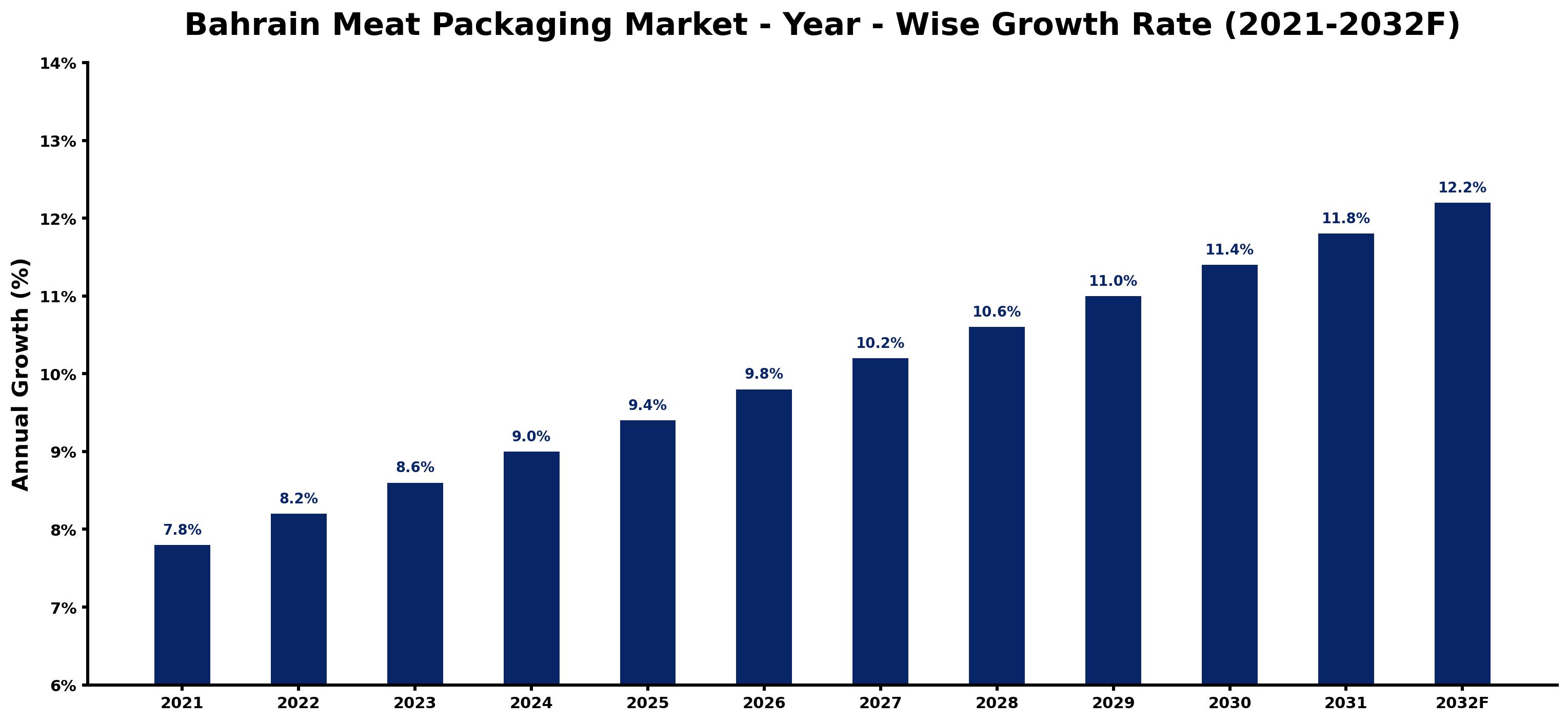
The table below presents the year wise growth rates along with the key drivers influencing the market
| Year | Growth Rate | Major Drivers |
| 2021 | 7.8% | Local culinary trends emphasize quality meat products, boosting packaging innovation. |
| 2022 | 8.2% | Consumer preferences shift towards sustainable packaging, influencing market dynamics significantly. |
| 2023 | 8.6% | E-commerce growth alters distribution channels, enhancing the reach of packaged meat. |
| 2024 | 9.0% | Increased health consciousness prompts demand for vacuum-sealed meat packaging solutions. |
| 2025 | 9.4% | Rising tourism encourages local producers to enhance packaging for international standards. |
| 2026 | 9.8% | Emerging private labels invest in unique packaging designs, appealing to younger consumers. |
| 2027 | 10.2% | Technological integration improves supply chain efficiency, benefiting meat packaging operations. |
| 2028 | 10.6% | Environmental concerns push producers towards biodegradable packaging materials in meat products. |
| 2029 | 11.0% | Collaborative ventures between local farms and packaging firms enhance product visibility. |
| 2030 | 11.4% | Consumer shifts towards organic products increase demand for transparent packaging solutions. |
| 2031 | 11.8% | Export opportunities expand as regional demand for Bahraini meat packaging rises. |
| 2032 | 12.2% | Evolution towards automation in packaging lines optimizes production rates and lowers costs. |
Note - Market size estimations and growth projections presented in this report are based on 6Wresearch's advanced forecasting approach, validated with industry datasets as of June 2026.
Bahrain Meat Packaging Market Synopsis
The Bahrain Meat Packaging Market is projected to reach 9.8% and witness significant growth during the forecast period (2026-2032). This market plays a crucial role in maintaining the integrity of the meat supply chain by ensuring that meat products remain fresh, safe, and suitable for consumption. With the escalating demand for both processed and fresh meat products, advanced packaging solutions that adhere to stringent health and safety standards have become increasingly vital.
Bahrain Meat Packaging Market Growth Drivers
Several factors are driving the growth of the Bahrain Meat Packaging Market. Firstly, the rising consumer preference for fresh and hygienically packed meat products has significantly impacted market dynamics. The demand for convenience and ready-to-eat meat options compels retailers to adopt effective packaging solutions to ensure product safety and quality. Additionally, the expansion of supermarkets and hypermarkets in Bahrain supports this shift, leading to increased need for innovative packaging.
- Consumer preferences are shifting towards meat products that are both fresh and hygienically packaged, resulting in a direct impact on the meat packaging market.
- The growing popularity of ready-to-eat and processed meat products is fueling demand for advanced packaging solutions that enhance convenience for consumers.
- Increased retail space, particularly through supermarkets and hypermarkets, is driving packaging innovations, as these venues require efficient and safe methods of displaying meat products.
- With a heightened awareness regarding food safety, consumers are more inclined to choose products with sophisticated packaging that indicates quality and compliance with safety standards.
- Trends towards sustainable and biodegradable packaging materials are gaining traction, reflecting a collective consumer and corporate shift towards environmentally conscious practices.
Bahrain Meat Packaging Market Challenges and Restraints
While there are numerous drivers propelling the Bahrain Meat Packaging Market, several challenges also persist. The sector faces stringent regulations concerning food safety and hygiene that can escalate production costs. The reliance on imported packaging materials poses additional challenges, as fluctuations in global supply chains can impact pricing and availability.
- Compliance with food safety and hygiene regulations is critical; however, meeting these standards often leads to increased production costs, creating a burden for local producers.
- The dependency on foreign suppliers for packaging materials introduces risks related to import costs and availability, which can hinder local market growth.
- Consumer demand is increasingly gravitating towards sustainable packaging, requiring companies to invest in innovative materials while balancing profitability.
- Imported meat products typically arrive pre-packaged, adding competitive pressure on local producers who must compete with established brands that already meet consumer packaging preferences.
- The need for continuous innovation in packaging technologies requires ongoing investment, which may pose a challenge for smaller firms or new entrants to the market.
Bahrain Meat Packaging Market Investment Opportunities
The evolving landscape of the Bahrain Meat Packaging Market presents diverse investment opportunities. A notable area for potential growth is the development of innovative, sustainable packaging solutions that preserve meat quality. As the demand for halal-certified packaged meat rises, investors may find value in establishing processing and packaging facilities designed to meet rigorous hygiene and quality standards.
- Investors can explore opportunities aimed at developing advanced packaging technologies that enhance the shelf life and freshness of meat products, catering to growing consumer demands.
- The increasing market for halal-certified meat products offers avenues for businesses that can ensure compliance with both health and religious standards through effective packaging.
- Establishing local packaging facilities can reduce reliance on imports, improving supply chain resilience while potentially lowering costs associated with transportation and tariffs.
- Promoting sustainable packaging practices through innovation can appeal to environmentally conscious consumers, aligning with broader global trends.
- Collaboration with local government initiatives may enhance investment prospects, as financial incentives for sustainable practices can help offset initial overhead costs.
Bahrain Meat Packaging Market Government Investment and Initiatives
Government investment and initiatives play a key role in shaping the Bahrain Meat Packaging Market. Policies that govern food safety and hygiene standards are implemented rigorously to ensure that all packaging complies with established regulations. The government supports the local meat packaging industry by providing financial incentives aimed at promoting sustainable practices and innovation.
- Regulatory frameworks are in place to ensure that meat packaging adheres to international food safety and quality standards, fostering consumer trust in local products.
- The government offers financial incentives to businesses that adopt sustainable packaging practices, encouraging investment in eco-friendly technologies.
- Public spending is directed towards enhancing the infrastructure related to meat processing and packaging, ensuring that facilities meet the latest health and safety requirements.
- Collaboration between the government and private sector can drive innovation in packaging solutions, aligning with Bahrain's commitment to sustainable development.
- Import regulations facilitate compliance with international standards, ensuring that any imported packaging materials meet the requisite safety and quality benchmarks.
Bahrain Meat Packaging Market Latest Developments (May 2025 - June 2026)
The period from May 2025 to June 2026 has seen significant developments within the Bahrain Meat Packaging Market, reflecting broader industry trends and evolving consumer demands. There has been an increased focus on adopting environmentally sustainable packaging materials, responding to consumer pressures for eco-friendly solutions.
- Manufacturers are investing in research and development to create packaging that is not only safe and efficient but also environmentally friendly, minimizing their carbon footprint.
- Retailers are increasingly prioritizing hygienic, ready-to-eat meat products, leading to a surge in demand for innovative packaging technologies that extend shelf life.
- Collaborations between local businesses and international suppliers have emerged, aiming to enhance the quality and sustainability of packaging solutions available in the market.
- Public awareness campaigns focused on food safety and hygiene have driven consumers to prefer products with more advanced packaging options, elevating standards across the market.
- Overall, ongoing changes in consumer purchasing behavior are prompting companies in Bahrain to adapt their packaging strategies significantly, aligning with modern retail environments.
Bahrain Meat Packaging Market - Key Attractiveness of the Report
- 10 Years of Market Numbers
- Historical Data Starting from 2022 to 2025
- Base Year: 2025
- Forecast Data until 2032
- Key Performance Indicators Impacting the Market
- Major Upcoming Developments and Projects
Key Highlights of the Report:
- Bahrain Meat Packaging Market Outlook
- Market Size of Bahrain Meat Packaging Market, 2025
- Forecast of Bahrain Meat Packaging Market, 2032F
- Historical Data and Forecast of Bahrain Meat Packaging Revenues & Volume for the Period 2022-2032F
- Bahrain Meat Packaging Market Trend Evolution
- Bahrain Meat Packaging Market Drivers and Challenges
- Bahrain Meat Packaging Price Trends
- Bahrain Meat Packaging Porter's Five Forces
- Bahrain Meat Packaging Industry Life Cycle
- Historical Data and Forecast of Bahrain Meat Packaging Market Revenues & Volume By Material Type for the Period 2022-2032F
- Historical Data and Forecast of Bahrain Meat Packaging Market Revenues & Volume By Plastic for the Period 2022-2032F
- Historical Data and Forecast of Bahrain Meat Packaging Market Revenues & Volume By Rigid? for the Period 2022-2032F
- Historical Data and Forecast of Bahrain Meat Packaging Market Revenues & Volume By Metal for the Period 2022-2032F
- Historical Data and Forecast of Bahrain Meat Packaging Market Revenues & Volume By Meat Type for the Period 2022-2032F
- Historical Data and Forecast of Bahrain Meat Packaging Market Revenues & Volume By Fresh and Frozen for the Period 2022-2032F
- Historical Data and Forecast of Bahrain Meat Packaging Market Revenues & Volume By Processed for the Period 2022-2032F
- Historical Data and Forecast of Bahrain Meat Packaging Market Revenues & Volume By Ready to Eat for the Period 2022-2032F
- Bahrain Meat Packaging Import Export Trade Statistics
- Market Opportunity Assessment By Material Type
- Market Opportunity Assessment By Meat Type
- Bahrain Meat Packaging Top Companies Market Share
- Bahrain Meat Packaging Competitive Benchmarking By Technical and Operational Parameters
- Bahrain Meat Packaging Company Profiles
- Bahrain Meat Packaging Key Strategic Recommendations






































