Bahrain Metal Recycling Market Summary
The bahrain metal recycling market was estimated at USD 823 Million in 2025 and is projected to reach USD 1380 Million by 2032, growing at a CAGR of 8.8% from 2026 to 2032.
Bahrain Metal Recycling Market Year-wise Growth Rate and Key Drivers
This graph highlights how the Bahrain Metal Recycling Market has steadily grown over the past five years, supported by major growth factors.
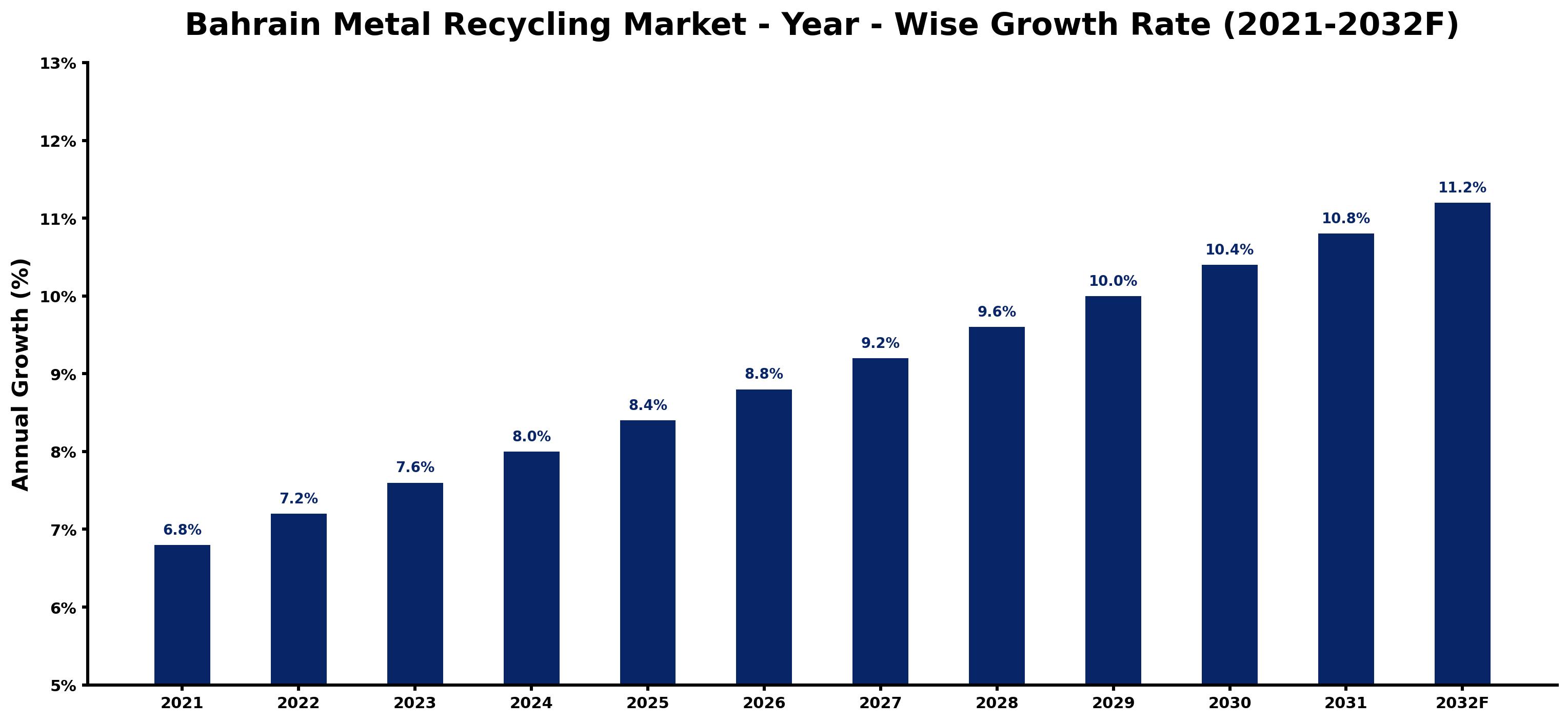
The table below presents the year wise growth rates along with the key drivers influencing the market
| Year | Growth Rate | Major Drivers |
| 2021 | 6.8% | Bahrain's focus on diversifying its economy creates opportunities for metal recycling ventures. |
| 2022 | 7.2% | Local industries increasingly recognize the value of recycled materials for production. |
| 2023 | 7.6% | The influx of construction projects requires sustainable sourcing of metal materials. |
| 2024 | 8.0% | E-waste recycling trends highlight Bahrain's potential for processing old electronics efficiently. |
| 2025 | 8.4% | Increased regional collaboration on environmental sustainability fosters metal recycling initiatives. |
| 2026 | 8.8% | Bahrain's investment in advanced sorting technology enhances recycling efficiency and output. |
| 2027 | 9.2% | Growing awareness of global supply chain vulnerabilities drives local recycling strategies. |
| 2028 | 9.6% | Transitioning to circular economies becomes a priority for Bahraini manufacturers and businesses. |
| 2029 | 10.0% | Emerging partnerships with international recyclers expand Bahrain's market presence regionally. |
| 2030 | 10.4% | Research into sustainable practices positions Bahrain as a leader in metal recycling technology. |
| 2031 | 10.8% | Consumer preferences shift towards eco-friendly products, boosting demand for recycled metals. |
| 2032 | 11.2% | Bahrain's economic diversification efforts culminate in a robust and resilient recycling sector. |
Note - Market size estimations and growth projections presented in this report are based on 6Wresearch's advanced forecasting approach, validated with industry datasets as of June 2026.
Bahrain Metal Recycling Market Synopsis
The Bahrain Metal Recycling Market is projected to reach 8.8% and witness significant growth during the forecast period (2026-2032). This growth is driven by escalating demand for sustainable waste management solutions and resource conservation practices in various industrial sectors. As Bahrain continues to focus on environmental sustainability, the adoption of advanced recycling technologies and processes becomes crucial for recovering valuable metals from waste materials.
Bahrain Metal Recycling Market Growth Drivers
The expansion of the Bahrain Metal Recycling Market can be attributed to several key drivers:
- The increasing emphasis on sustainable waste management practices highlights the need for efficient recycling systems that can mitigate environmental impact.
- Investment in advanced sorting and processing technologies enhances the ability to recover valuable metals from industrial scrap and end-of-life products.
- The global shift towards circular economy practices places added pressure on industries in Bahrain to adopt metal recycling and resource conservation measures.
- Supportive government regulations, alongside incentives for recycling activities, act as catalysts for market growth by encouraging participation from both industry stakeholders and the public.
- Heightened awareness of the environmental benefits associated with metal recycling, such as energy savings and reduced greenhouse gas emissions, further supports market demand.
Bahrain Metal Recycling Market Trends and Opportunities
Prominent trends are shaping the Bahrain Metal Recycling Market, presenting numerous opportunities for industry stakeholders:
- The integration of innovative technologies — such as artificial intelligence (AI) and machine learning in sorting processes — is expected to enhance operational efficiencies and promote higher recovery rates of recycled metals.
- There is a noticeable trend towards partnerships between public and private sectors aimed at improving collection infrastructures and recycling capabilities across Bahrain.
- With growing industrialization, opportunities for localized recycling facilities are increasing, thus reducing transportation costs and improving overall process efficiency.
- As consumer demand for sustainable products rises, businesses are increasingly considering recycled metals in their supply chains, creating significant avenues for market growth.
- The promotion of educational campaigns targeting businesses and consumers to raise awareness on the importance of metal recycling can lead to increased participation rates and enhance recycling efforts.
Bahrain Metal Recycling Market Challenges and Restraints
Despite the favorable outlook for the Bahrain Metal Recycling Market, several challenges must be addressed:
- The existing collection infrastructure is often inadequate, hindering efficient collection of recyclable materials and limiting accessibility for consumers and businesses.
- Technological advancements in recycling processes are crucial but require significant investment, which may deter smaller companies from participating in the market.
- Public awareness surrounding the benefits of recycling remains limited, potentially affecting participation rates and the overall success of recycling initiatives.
- Regulatory hurdles may exist, complicating compliance for businesses looking to engage in metal recycling activities.
- Competition from alternative materials poses a risk to the recycling industry, necessitating continuous improvement in the quality and cost-effectiveness of recycled metal products.
Bahrain Metal Recycling Market Government Investment and Initiatives
The government of Bahrain plays a pivotal role in shaping the landscape of the metal recycling market through various policies and initiatives:
- Significant investments in infrastructure development aimed at enhancing recycling capabilities and facilities across the country are underway.
- Regulations focused on promoting responsible waste management practices are designed to incentivize businesses to adopt recycling measures.
- Public awareness campaigns are being launched to educate the general population on the importance of recycling and environmental sustainability.
- Incentives, such as grants or subsidies, are being provided to encourage industry participation in metal recycling initiatives.
- Public-private partnerships are being established to address challenges related to collection infrastructure and improve recycling processes.
Bahrain Metal Recycling Market Latest Developments (May 2025 - June 2026)
In the period from May 2025 to June 2026, the Bahrain Metal Recycling Market exhibited several noteworthy developments:
- Innovations in recycling technologies are being adopted, enhancing the efficiency of metal recovery processes, thus contributing to sustainability goals.
- The government has initiated discussions with stakeholders to explore potential collaborations aimed at expanding recycling infrastructure and enhancing public participation.
- Efforts to improve regulatory frameworks are underway, promoting smoother operations for recycling companies and improving compliance mechanisms.
- Increased investments in recycling education initiatives have led to greater awareness among businesses and consumers regarding sustainable practices.
- The market has seen a rise in initiatives focused on the establishment of localized recycling centers, aimed at improving the convenience of recycling for residents and businesses.
Bahrain Metal Recycling Market - Key Attractiveness of the Report
- 10 Years of Market Numbers
- Historical Data Starting from 2022 to 2025
- Base Year: 2025
- Forecast Data until 2032
- Key Performance Indicators Impacting the Market
- Major Upcoming Developments and Projects
Key Highlights of the Report:
- Bahrain Metal Recycling Market Outlook
- Market Size of Bahrain Metal Recycling Market, 2025
- Forecast of Bahrain Metal Recycling Market, 2032
- Historical Data and Forecast of Bahrain Metal Recycling Revenues & Volume for the Period 2022-2032F
- Bahrain Metal Recycling Market Trend Evolution
- Bahrain Metal Recycling Market Drivers and Challenges
- Bahrain Metal Recycling Price Trends
- Bahrain Metal Recycling Porter's Five Forces
- Bahrain Metal Recycling Industry Life Cycle
- Historical Data and Forecast of Bahrain Metal Recycling Market Revenues & Volume By Metal Type for the Period 2022-2032F
- Historical Data and Forecast of Bahrain Metal Recycling Market Revenues & Volume By Ferrous Metal for the Period 2022-2032F
- Historical Data and Forecast of Bahrain Metal Recycling Market Revenues & Volume By Non-ferrous Metal for the Period 2022-2032F
- Historical Data and Forecast of Bahrain Metal Recycling Market Revenues & Volume By Scrap Types for the Period 2022-2032F
- Historical Data and Forecast of Bahrain Metal Recycling Market Revenues & Volume By Old Scrap for the Period 2022-2032F
- Historical Data and Forecast of Bahrain Metal Recycling Market Revenues & Volume By New Scrap for the Period 2022-2032F
- Historical Data and Forecast of Bahrain Metal Recycling Market Revenues & Volume By Equipment Types for the Period 2022-2032F
- Historical Data and Forecast of Bahrain Metal Recycling Market Revenues & Volume By Shears for the Period 2022-2032F
- Historical Data and Forecast of Bahrain Metal Recycling Market Revenues & Volume By Shredders for the Period 2022-2032F
- Historical Data and Forecast of Bahrain Metal Recycling Market Revenues & Volume By Briquette Machines for the Period 2022-2032F
- Historical Data and Forecast of Bahrain Metal Recycling Market Revenues & Volume By Granulating Machines for the Period 2022-2032F
- Historical Data and Forecast of Bahrain Metal Recycling Market Revenues & Volume By Others for the Period 2022-2032F
- Historical Data and Forecast of Bahrain Metal Recycling Market Revenues & Volume By End-users for the Period 2022-2032F
- Historical Data and Forecast of Bahrain Metal Recycling Market Revenues & Volume By Building & Construction for the Period 2022-2032F
- Historical Data and Forecast of Bahrain Metal Recycling Market Revenues & Volume By Packaging for the Period 2022-2032F
- Historical Data and Forecast of Bahrain Metal Recycling Market Revenues & Volume By Automotive for the Period 2022-2032F
- Historical Data and Forecast of Bahrain Metal Recycling Market Revenues & Volume By Industrial Machinery for the Period 2022-2032F
- Historical Data and Forecast of Bahrain Metal Recycling Market Revenues & Volume By Electronics & Electrical Equipment for the Period 2022-2032F
- Historical Data and Forecast of Bahrain Metal Recycling Market Revenues & Volume By Shipbuilding for the Period 2022-2032F
- Historical Data and Forecast of Bahrain Metal Recycling Market Revenues & Volume By Others for the Period 2022-2032F
- Bahrain Metal Recycling Import Export Trade Statistics
- Market Opportunity Assessment By Metal Type
- Market Opportunity Assessment By Scrap Types
- Market Opportunity Assessment By Equipment Types
- Market Opportunity Assessment By End-users
- Bahrain Metal Recycling Top Companies Market Share
- Bahrain Metal Recycling Competitive Benchmarking By Technical and Operational Parameters
- Bahrain Metal Recycling Company Profiles
- Bahrain Metal Recycling Key Strategic Recommendations






































