Bahrain Polyethylene (PE) Pipes and Tubes Market Summary
The bahrain polyethylene (pe) pipes and tubes market was estimated at USD 1107 Million in 2025 and is projected to reach USD 1939 Million by 2032, growing at a CAGR of 9.6% from 2026 to 2032.
Bahrain Polyethylene (PE) Pipes and Tubes Market Year-wise Growth Rate and Key Drivers
This graph highlights how the Bahrain Polyethylene (PE) Pipes and Tubes Market has steadily grown over the years, supported by major growth factors.
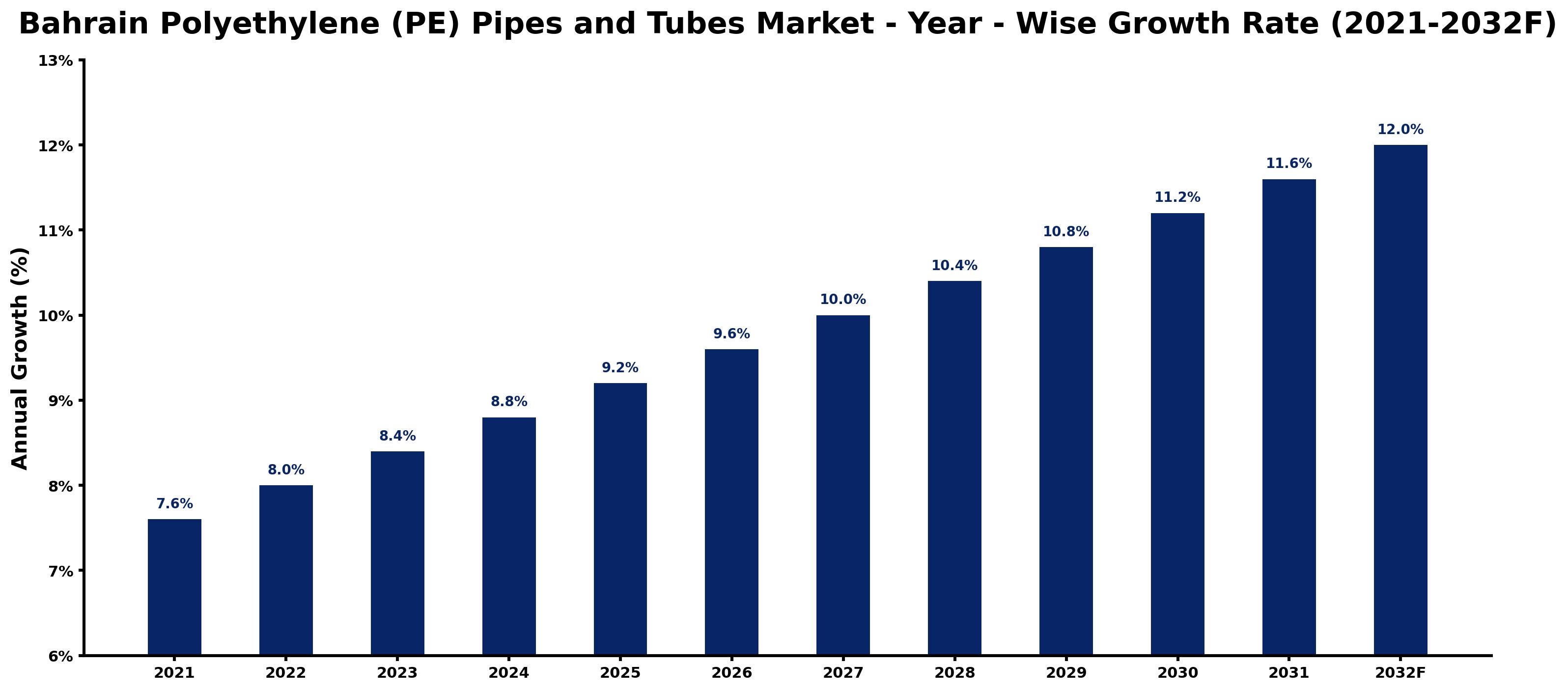
The table below presents the year wise growth rates along with the key drivers influencing the market
| Year | Growth Rate | Major Drivers |
| 2021 | 7.6% | Bahrain's construction sector rebounded, creating significant demand for durable polyethylene pipes. |
| 2022 | 8.0% | Infrastructure projects expanded, particularly in water management and irrigation systems. |
| 2023 | 8.4% | Local manufacturers increased production capacity, responding to heightened construction activity across GCC. |
| 2024 | 8.8% | Innovative installation techniques improved efficiency, attracting more contractors to polyethylene solutions. |
| 2025 | 9.2% | Sustainability trends emphasized recyclability, aligning with global shifts toward eco-friendly materials. |
| 2026 | 9.6% | Urbanization intensified, elevating the need for reliable plumbing and drainage systems nationwide. |
| 2027 | 10.0% | The petrochemical industry's expansion bolstered the availability of raw materials for pipe production. |
| 2028 | 10.4% | Regional collaborations enhanced supply chain dynamics, ensuring timely deliveries of polyethylene products. |
| 2029 | 10.8% | Emerging technologies in manufacturing introduced cost-effective solutions for polyethylene pipe production. |
| 2030 | 11.2% | Increased investments in renewable energy projects required specialized piping for various applications. |
| 2031 | 11.6% | Growing awareness of water conservation practices drove innovative pipeline infrastructure developments. |
| 2032 | 12.0% | Export opportunities surged as neighboring markets recognized Bahrain's quality pipe manufacturing capabilities. |
Note - Market size estimations and growth projections presented in this report are based on 6Wresearch's advanced forecasting approach, validated with industry datasets as of June 2026.
Bahrain Polyethylene (PE) Pipes and Tubes Market Synopsis
The Bahrain Polyethylene (PE) Pipes and Tubes Market is projected to reach 9.6% and witness significant growth during the forecast period (2026-2032). The expanding applications of PE pipes in construction, irrigation, and water supply systems are pivotal in this growth trajectory. Characterized by their resilience to corrosion, ease of installation, and cost-effectiveness, PE pipes are increasingly favored in Bahrain's infrastructure development endeavors. Furthermore, the heightened focus on sustainable practices is steering the demand for eco-friendly polyethylene solutions, thereby bolstering the prospects for this market.
Bahrain Polyethylene (PE) Pipes and Tubes Market Growth Drivers
The burgeoning demand for polyethylene pipes and tubes in Bahrain can be attributed to several key factors:
- The construction industry in Bahrain is undergoing rapid development, necessitating robust piping solutions for various applications, including water supply and gas distribution.
- PE pipes are increasingly recognized for their lightweight nature and flexibility, making them a preferred choice for projects that require versatile installation options.
- The durability of PE pipes, characterized by their long service life and resistance to corrosion, aligns well with the growing infrastructure needs of the region.
- Government initiatives aimed at modernizing water management systems have elevated the significance of PE pipes as a reliable and effective piping solution.
- Rising environmental awareness is encouraging stakeholders to pivot towards PE pipes as they are recyclable and carry a lesser ecological footprint compared to traditional materials.
Bahrain Polyethylene (PE) Pipes and Tubes Market Challenges and Restraints
Despite the favorable conditions, several challenges are constraining the growth of the Bahrain Polyethylene (PE) Pipes and Tubes Market:
- Fluctuating raw material prices, particularly those associated with crude oil, significantly impact the production costs of polyethylene, potentially hindering market growth.
- The market experiences tough competition from alternative materials such as PVC and metal, which present their own unique benefits in terms of pricing, durability, and ease of installation.
- Cyclical demand trends from key sectors like construction and agriculture introduce an element of unpredictability, influenced by overarching economic conditions.
- Heightened regulatory scrutiny surrounding environmental sustainability necessitates ongoing adaptations in production methods and material sourcing, demanding greater investment from stakeholders.
- Investment in research and development to enhance product offerings is crucial, yet it represents an additional layer of financial commitment for companies operating in this space.
Bahrain Polyethylene (PE) Pipes and Tubes Market Investment Opportunities
Given the current dynamics of the Bahrain Polyethylene (PE) Pipes and Tubes Market, several investment opportunities are emerging:
- With substantial ongoing infrastructure projects, particularly in water and gas supply, there is a promising avenue for investments focused on the production and distribution of PE pipes.
- The local market is witnessing an increasing demand for environmentally friendly materials, creating opportunities for businesses that can innovate and supply sustainable PE products.
- Investors have the potential to explore export opportunities to neighboring Gulf nations that require similar infrastructure solutions, thus expanding market reach.
- Government incentives aimed at enhancing utility systems support investors interested in developing local manufacturing capabilities for PE pipes.
- Collaborations with public and private entities engaged in infrastructure development can lead to mutually beneficial partnerships that drive market expansion.
Bahrain Polyethylene (PE) Pipes and Tubes Market Government Investment and Initiatives
The Bahrain government plays a critical role in shaping the polyethylene pipes and tubes market through various initiatives and policies. Investments in sustainable infrastructure development underscore the government's commitment to enhancing utility systems.
- There is a strong emphasis on promoting the use of PE pipes due to their durability and corrosion resistance, aligning with government objectives for water conservation and efficient resource management.
- Financial incentives are in place for local manufacturers of PE pipes, encouraging domestic production and reducing reliance on imported materials.
- Regulatory frameworks ensure that PE products meet stringent international safety and quality standards, fostering consumer confidence in these materials.
- Public spending on infrastructure projects continues to grow, reflecting the government's dedication to modernizing water management systems and expanding gas distribution networks.
- Investment in research and training programs related to sustainable practices is being prioritized, aiming to elevate local expertise in manufacturing and utilizing eco-friendly piping solutions.
Bahrain Polyethylene (PE) Pipes and Tubes Market Latest Developments (May 2025 - June 2026)
The Bahrain Polyethylene (PE) Pipes and Tubes Market has experienced notable shifts between May 2025 and June 2026, reflecting broader industry trends. A marked increase in construction activities has reinforced the demand for PE pipes, particularly in infrastructural projects aimed at enhancing water supply systems. Efforts toward sustainability have intensified, with multiple stakeholders committing to eco-friendly practices in both manufacturing and resource sourcing.
Furthermore, government initiatives promoting the efficiency of utility systems have resulted in increased public spending, positively impacting the adoption rates of PE products. Collaborations between governmental bodies and private enterprises focused on innovation in piping solutions have been evident, with a push toward integrating advanced technologies in production processes. This collective movement towards modernization and sustainability is expected to shape the market dynamics significantly in the upcoming years.
Bahrain Polyethylene (PE) Pipes and Tubes Market - Key Attractiveness of the Report
- 10 Years of Market Numbers
- Historical Data Starting from 2022 to 2025
- Base Year: 2025
- Forecast Data until 2032
- Key Performance Indicators Impacting the Market
- Major Upcoming Developments and Projects
Key Highlights of the Report:
- Bahrain Polyethylene (PE) Pipes and Tubes Market Outlook
- Market Size of Bahrain Polyethylene (PE) Pipes and Tubes Market, 2025
- Forecast of Bahrain Polyethylene (PE) Pipes and Tubes Market, 2032F
- Historical Data and Forecast of Bahrain Polyethylene (PE) Pipes and Tubes Revenues & Volume for the Period 2022-2032F
- Bahrain Polyethylene (PE) Pipes and Tubes Market Trend Evolution
- Bahrain Polyethylene (PE) Pipes and Tubes Market Drivers and Challenges
- Bahrain Polyethylene (PE) Pipes and Tubes Price Trends
- Bahrain Polyethylene (PE) Pipes and Tubes Porter's Five Forces
- Bahrain Polyethylene (PE) Pipes and Tubes Industry Life Cycle
- Historical Data and Forecast of Bahrain Polyethylene (PE) Pipes and Tubes Market Revenues & Volume By Type for the Period 2022-2032F
- Historical Data and Forecast of Bahrain Polyethylene (PE) Pipes and Tubes Market Revenues & Volume By High Density Polythene (HDPE) for the Period 2022-2032F
- Historical Data and Forecast of Bahrain Polyethylene (PE) Pipes and Tubes Market Revenues & Volume By Low Density Polythene (LDPE) for the Period 2022-2032F
- Historical Data and Forecast of Bahrain Polyethylene (PE) Pipes and Tubes Market Revenues & Volume By Linear Low Density Polythene (LLDPE) for the Period 2022-2032F
- Historical Data and Forecast of Bahrain Polyethylene (PE) Pipes and Tubes Market Revenues & Volume By Cross Link Polythene (PEX/XLPE) for the Period 2022-2032F
- Historical Data and Forecast of Bahrain Polyethylene (PE) Pipes and Tubes Market Revenues & Volume By Application for the Period 2022-2032F
- Historical Data and Forecast of Bahrain Polyethylene (PE) Pipes and Tubes Market Revenues & Volume By Industrial for the Period 2022-2032F
- Historical Data and Forecast of Bahrain Polyethylene (PE) Pipes and Tubes Market Revenues & Volume By Agriculture for the Period 2022-2032F
- Historical Data and Forecast of Bahrain Polyethylene (PE) Pipes and Tubes Market Revenues & Volume By Underwater And Municipal for the Period 2022-2032F
- Historical Data and Forecast of Bahrain Polyethylene (PE) Pipes and Tubes Market Revenues & Volume By Construction for the Period 2022-2032F
- Historical Data and Forecast of Bahrain Polyethylene (PE) Pipes and Tubes Market Revenues & Volume By Gas Extraction for the Period 2022-2032F
- Historical Data and Forecast of Bahrain Polyethylene (PE) Pipes and Tubes Market Revenues & Volume By Others for the Period 2022-2032F
- Bahrain Polyethylene (PE) Pipes and Tubes Import Export Trade Statistics
- Market Opportunity Assessment By Type
- Market Opportunity Assessment By Application
- Bahrain Polyethylene (PE) Pipes and Tubes Top Companies Market Share
- Bahrain Polyethylene (PE) Pipes and Tubes Competitive Benchmarking By Technical and Operational Parameters
- Bahrain Polyethylene (PE) Pipes and Tubes Company Profiles
- Bahrain Polyethylene (PE) Pipes and Tubes Key Strategic Recommendations






































