Bahrain Revolvers Market Size, Share & Growth Rate
The Bahrain Revolvers Market was estimated at USD 509 Million in 2025 and is projected to reach USD 853 Million by 2032, growing at a CAGR of 7.7% from 2026 to 2032. This growth trajectory is primarily driven by the ongoing demand from government and law enforcement agencies for reliable and effective defense tools. Furthermore, an increasing interest in sport shooting and historical collections also stimulates market expansion, as collectors seek both modern and vintage designs.
Bahrain Revolvers Market Year-wise Growth Rate and Key Drivers
This graph highlights how the Bahrain Revolvers Market has steadily grown over the years, supported by major growth factors.
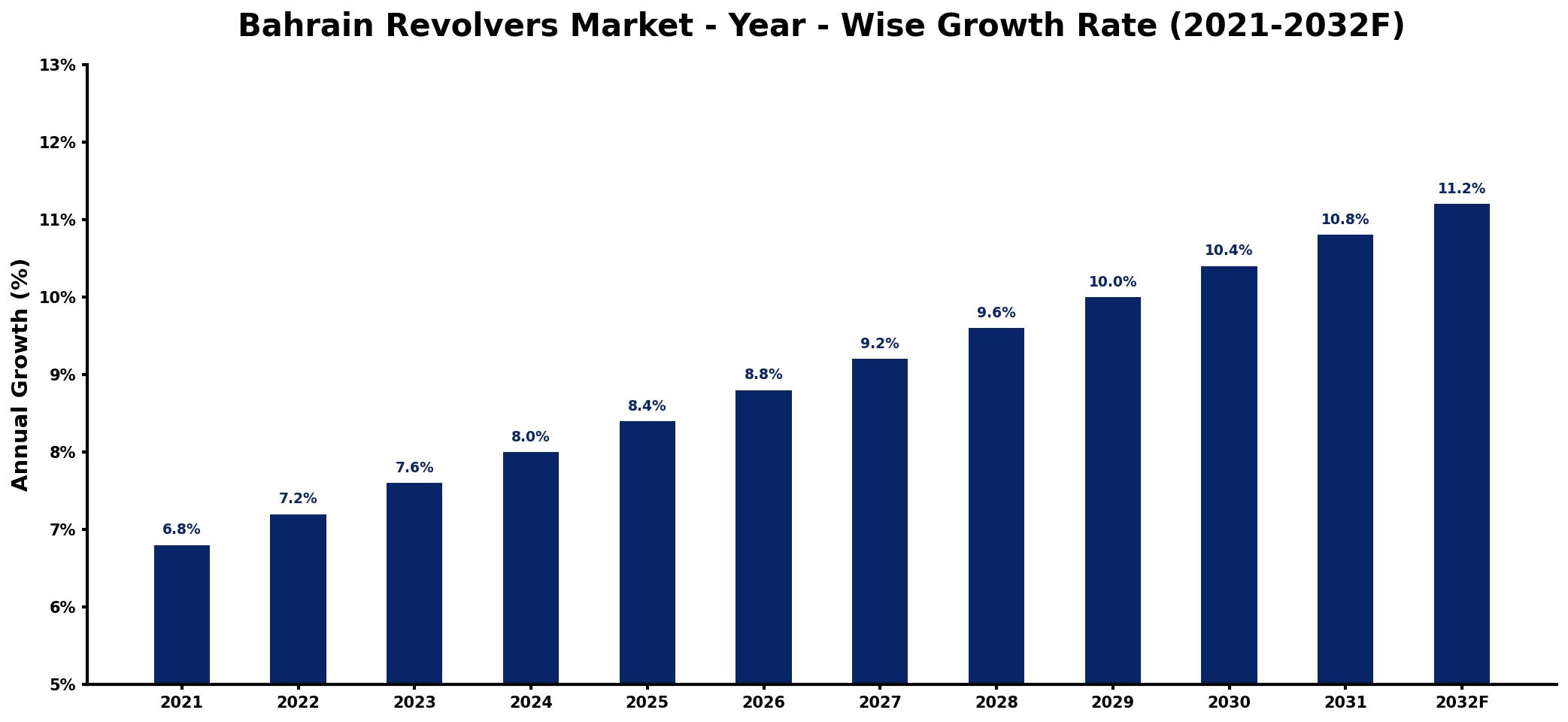
The table below presents the year‑wise growth rates along with the key drivers influencing the market
| Year | Growth Rate | Major Drivers |
| 2021 | 6.8% | Increased consumer interest firearms |
| 2022 | 7.2% | Rising investments in security services |
| 2023 | 7.6% | rising procurement volume requirements |
| 2024 | 8.0% | Expanding hunting and sport shooting |
| 2025 | 8.4% | Surge in private security demand |
| 2026 | 8.8% | Enhanced training programs availability |
| 2027 | 9.2% | Boost in firearm safety awareness |
| 2028 | 9.6% | Increased participation shooting sports |
| 2029 | 10.0% | Growth in military procurement contracts |
| 2030 | 10.4% | Rising demand personal protection equipment |
| 2031 | 10.8% | Expansion in firearm retail outlets |
| 2032 | 11.2% | expanding industrial usage applications |
Note: Market size estimations and growth projections presented in this report are based on 6Wresearch's proprietary forecasting methodology, utilizing the latest available industry data, government publications, and primary research inputs.
Bahrain Revolvers Market Synopsis
Recent years have seen a steady demand for revolvers in Bahrain, predominantly in security and law enforcement sectors. However, as semi-automatic pistols gain popularity, the revolvers market must adapt to shifting consumer preferences while maintaining its traditional stronghold in specific applications.
The landscape ahead indicates a potential resurgence in the appreciation for revolvers, especially as manufacturers innovate to enhance safety and performance. This may reinvigorate interest in revolvers among both professionals and enthusiasts, ensuring their relevance in Bahrain's diverse firearms market.
Bahrain Revolvers Market Key Takeaways
- The market is heavily reliant on government procurement and law enforcement contracts.
- Stringent regulations and licensing processes shape the operational framework for revolver sales.
- Consumer interest is diversifying towards vintage and precision-engineered revolvers.
- Technological advancements are prompting manufacturers to enhance safety features in revolvers.
- Investment opportunities exist for high-quality firearms and related accessories in private security sectors.
Evaluation of Restraints in Bahrain Revolvers Market
The Bahrain Revolvers Market operates under a highly regulated environment, limiting sales and ownership predominantly to law enforcement and military personnel. This regulatory framework, coupled with international arms control agreements, constrains the markets growth potential. Additionally, the rising preference for semi-automatic pistols and non-lethal self-defense alternatives poses significant competition, affecting consumer interest and demand for traditional revolvers.
Bahrain Revolvers Market Trends
A notable trend in the Bahrain Revolvers Market is the increasing focus on customization and precision engineering, as manufacturers strive to meet the specific needs of law enforcement and sport shooters. Additionally, there is a revival of interest in vintage revolvers, spurred by collectors and enthusiasts who value their historical significance and craftsmanship. These trends indicate a dual-market approach, where traditional values blend with modern technology to cater to a diverse consumer base.
Bahrain Revolvers Market Opportunities
The growing demand for revolvers in the private security and defense sectors presents lucrative investment opportunities. Companies can explore partnerships with manufacturers that specialize in high-precision firearms, ammunition, and tactical accessories. Moreover, as the market evolves, businesses that innovate in safety features and design could capitalize on emerging consumer preferences, positioning themselves as leaders in this niche segment.
Government Initiatives in the Bahrain Revolvers Market
Government policy in Bahrain maintains strict control over firearms, including revolvers. The Ministry of Interior oversees the licensing and regulation process, ensuring that firearms are utilized primarily for security purposes. Public spending in defense and law enforcement is anticipated to remain a priority, potentially fostering growth in market segments related to firearm technologies and accessories.
Future Insights of the Bahrain Revolvers Market
Looking towards 2026-2032, the Bahrain Revolvers Market is expected to navigate through the challenges posed by emerging firearm technologies while leveraging its longstanding reputation for reliability. The market may see innovations that enhance user experience and safety, making revolvers more appealing to both security personnel and collectors. As such, a balanced integration of modern design and historical appreciation could solidify the market's growth in the coming years.
Bahrain Revolvers Market Latest Developments (2025 - 2026)
In recent months, the Bahrain revolvers market has witnessed a shift towards enhanced customization options, with manufacturers responding to specific needs expressed by law enforcement agencies. Additionally, discussions around regulatory reforms aimed at increasing civilian access under certain conditions are gaining traction. These developments could reshape the market dynamics, encouraging innovation while preserving the necessary controls for public safety.
Bahrain Revolvers Market - Key Attractiveness of the Report
- 10 Years of Market Numbers
- Historical Data Starting from 2022 to 2025
- Base Year: 2025
- Forecast Data until 2032
- Key Performance Indicators Impacting the Market
- Major Upcoming Developments and Projects
Key Highlights of the Report:
- Bahrain Revolvers Market Outlook
- Market Size of Bahrain Revolvers Market, 2025
- Forecast of Bahrain Revolvers Market, 2032
- Historical Data and Forecast of Bahrain Revolvers Revenues & Volume for the Period 2022-2032F
- Bahrain Revolvers Market Trend Evolution
- Bahrain Revolvers Market Drivers and Challenges
- Bahrain Revolvers Price Trends
- Bahrain Revolvers Porter's Five Forces
- Bahrain Revolvers Industry Life Cycle
- Historical Data and Forecast of Bahrain Revolvers Market Revenues & Volume By Product Type for the Period 2022-2032F
- Historical Data and Forecast of Bahrain Revolvers Market Revenues & Volume By Semi Automatic Revolvers for the Period 2022-2032F
- Historical Data and Forecast of Bahrain Revolvers Market Revenues & Volume By Single and Double Action Revolvers for the Period 2022-2032F
- Historical Data and Forecast of Bahrain Revolvers Market Revenues & Volume By Applications for the Period 2022-2032F
- Historical Data and Forecast of Bahrain Revolvers Market Revenues & Volume By Civil for the Period 2022-2032F
- Historical Data and Forecast of Bahrain Revolvers Market Revenues & Volume By Military for the Period 2022-2032F
- Bahrain Revolvers Import Export Trade Statistics
- Market Opportunity Assessment By Product Type
- Market Opportunity Assessment By Applications
- Bahrain Revolvers Top Companies Market Share
- Bahrain Revolvers Competitive Benchmarking By Technical and Operational Parameters
- Bahrain Revolvers Company Profiles
- Bahrain Revolvers Key Strategic Recommendations






































