Bahrain Scissors and Shears Market Summary
The bahrain scissors and shears market was estimated at USD 1399 Million in 2025 and is projected to reach USD 2630 Million by 2032, growing at a CAGR of 10.9% from 2026 to 2032.
Bahrain Scissors and Shears Market Year-wise Growth Rate and Key Drivers
This graph highlights how the Bahrain Scissors and Shears Market has steadily grown over the past five years, supported by major growth factors.
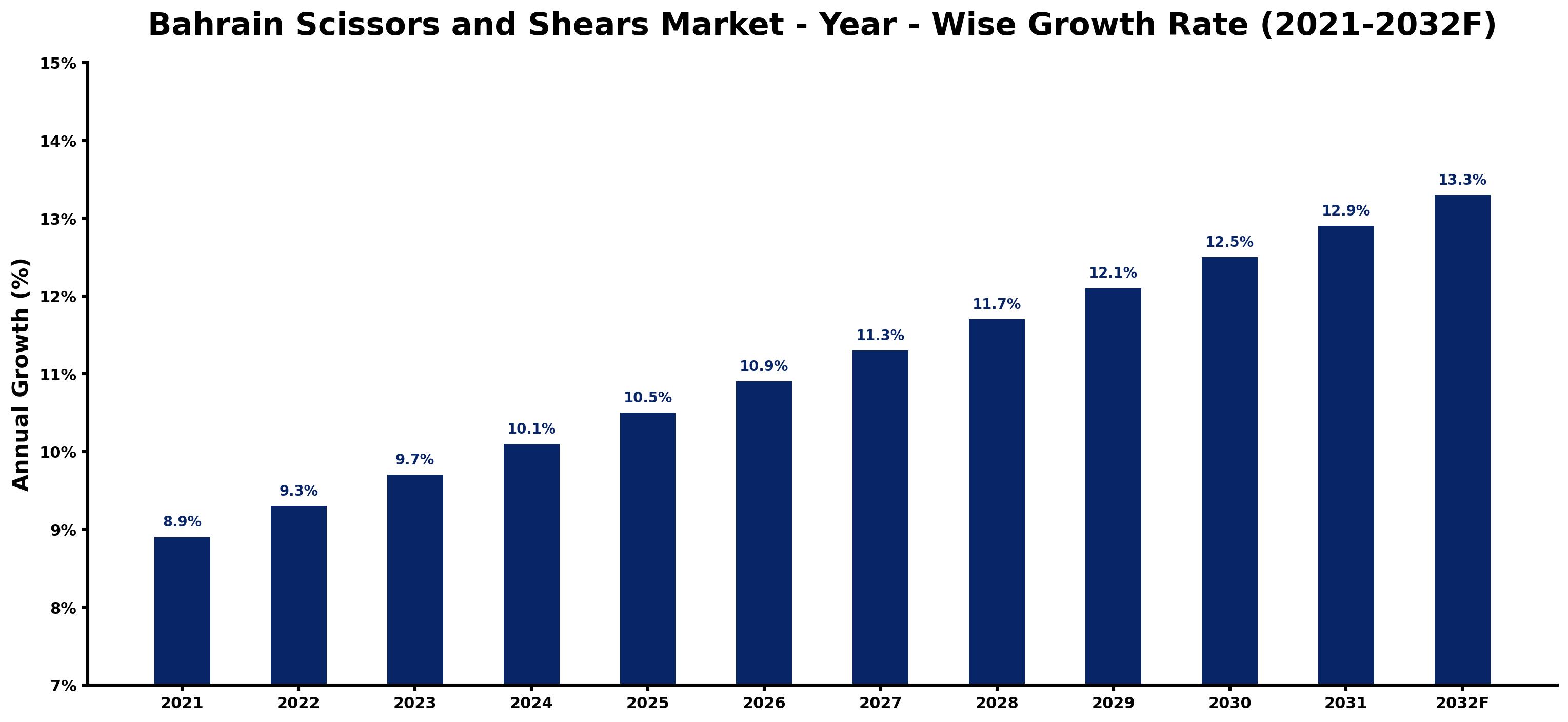
The table below presents the year wise growth rates along with the key drivers influencing the market
| Year | Growth Rate | Major Drivers |
| 2021 | 8.9% | Market recovery post-pandemic spurred demand for high-quality scissors and shears. |
| 2022 | 9.3% | Local artisans showcased traditional craftsmanship, increasing interest in locally made products. |
| 2023 | 9.7% | Retail expansion in Bahrain introduced specialized stores focused on scissors and shears. |
| 2024 | 10.1% | Online platforms gained popularity, allowing consumers diverse choices and competitive pricing. |
| 2025 | 10.5% | Increased participation in arts and crafts activities drove scissors and shears purchases. |
| 2026 | 10.9% | Emerging trends in hairdressing fueled demand for premium cutting tools among professionals. |
| 2027 | 11.3% | A growing expatriate population heightened interest in various cultural craftsmanship techniques. |
| 2028 | 11.7% | Sustainability trends encouraged brands to explore eco-friendly materials for scissors production. |
| 2029 | 12.1% | Collaborations with influencers boosted product visibility and consumer engagement significantly. |
| 2030 | 12.5% | The growing construction sector created demand for industrial-grade shears in Bahrain. |
| 2031 | 12.9% | Emerging crafting communities organized events, highlighting the importance of quality tools. |
| 2032 | 13.3% | Technological innovation in manufacturing processes improved the quality and durability of products. |
Note - Market size estimations and growth projections presented in this report are based on 6Wresearch's advanced forecasting approach, validated with industry datasets as of June 2026.
Bahrain Scissors and Shears Market Synopsis
The Bahrain Scissors and Shears Market is projected to reach 10.9% and witness significant growth during the forecast period (2026-2032). The market demonstrates steady development due to its integral role across various sectors, including textiles, healthcare, and household applications. Scissors and shears are essential cutting tools employed for diverse materials, ranging from fabric and paper to hair. The expansion of Bahrain's manufacturing and service industries is fostering an increasing demand for high-quality cutting tools, further influencing market dynamics.
Bahrain Scissors and Shears Market Growth Drivers
The growth of the Bahrain Scissors and Shears Market is primarily driven by several critical factors:
- The rising demand for high-quality cutting tools in various industries, notably textiles, crafting, and personal care, is supporting market expansion. As these industries flourish, the necessity for precision tools becomes more pronounced.
- Technological advancements in blade materials such as stainless steel and titanium coatings are enhancing product durability and sharpness. This evolution not only boosts performance but also attracts consumers seeking longevity and efficiency in their tools.
- Increased investment in the fashion and beauty sectors has elevated the requirement for specialized scissors and shears. These tools are vital for hairstyling, tailoring, and various crafting applications.
- The growing trend towards ergonomically designed tools caters to professionals and consumers alike, as users are increasingly prioritizing comfort and ease of use in their cutting instruments.
- As Bahrain continues to diversify its economy, the opportunities for scissors and shears in emerging sectors, including agriculture and construction, are likely to expand, further driving market growth.
Bahrain Scissors and Shears Market Trends and Opportunities
The Bahrain Scissors and Shears Market is experiencing notable trends that present potential opportunities for stakeholders:
- An increase in crafting and DIY activities has led to a heightened interest in high-quality scissors and shears among hobbyists. This trend offers immense potential for suppliers focusing on tailored products for specific applications.
- The rise of e-commerce platforms has created new distribution channels for scissors and shears, making it easier for consumers to access a wider range of products without geographical constraints.
- There is a growing preference for environmentally friendly materials and sustainable manufacturing processes in the cutting tools sector. This shift presents opportunities for brands to innovate and cater to eco-conscious consumers.
- Focus on education and skill development in Bahrain is fostering demand for stationery scissors, indicating a viable market for specialized products aimed at schools and educational institutions.
- Incorporating advanced features such as safety mechanisms and lightweight designs into scissors and shears will likely enhance user appeal, particularly for families and individuals concerned with safety and ease of handling.
Bahrain Scissors and Shears Market Challenges and Restraints
Despite its growth potential, the Bahrain Scissors and Shears Market faces several challenges:
- Local manufacturers are under significant pressure from imported products, particularly those from countries with lower production costs. This competition increases the challenge of maintaining competitive pricing without compromising on quality.
- The escalating costs of high-grade materials, especially stainless steel, are impacting production expenses, which can deter new entrants and challenge existing players to maintain profitability.
- To meet evolving consumer expectations, continual innovation in design and ergonomics is necessary, which can be financially burdensome, particularly for smaller companies.
- Fluctuations in demand from key industries, such as textiles and home improvement, contribute to market volatility, creating uncertainty for manufacturers and suppliers.
- Additionally, navigating regulatory standards for product safety and quality can pose a challenge, requiring firms to invest further in compliance and quality assurance measures.
Bahrain Scissors and Shears Market Investment Opportunities
Investment opportunities within the Bahrain Scissors and Shears Market are ripe for exploration:
- Investors may consider venturing into the production or import of specialized scissors and shears tailored for industrial applications, capitalizing on the growing manufacturing base in Bahrain.
- The focus on education and skill development opens avenues for investment in durable and ergonomic stationery scissors, suitable for schools and offices, which promise consistent demand.
- There is potential for investing in research and development for innovative designs that enhance the functionality and user experience of cutting tools.
- Opportunities also exist in establishing retail partnerships with e-commerce platforms to expand distribution and reach a broader audience interested in premium cutting tools.
- Moreover, the introduction of eco-friendly product lines could capture the attention of environmentally conscious consumers, thus enhancing brand loyalty and market share.
Bahrain Scissors and Shears Market Government Investment and Initiatives
The government of Bahrain plays a crucial role in shaping the scissors and shears market through various investment initiatives and policy frameworks:
- Policies regulating the import, sale, and use of scissors and shears ensure adherence to safety and performance standards, thereby safeguarding consumers and promoting quality.
- Tax incentives for small and medium-sized enterprises (SMEs) in the tools and hardware sector bolster local production efforts, encouraging entrepreneurs to establish manufacturing operations within the country.
- The government's focus on enhancing educational facilities and vocational training programs directly influences demand for quality stationery scissors, fostering a more skilled workforce.
- Initiatives aimed at supporting the local manufacturing base and reducing reliance on imports are pivotal for long-term market sustainability, particularly in the tools sector.
- Furthermore, public spending on infrastructure development may indirectly benefit the scissors and shears market by increasing demand in construction and related industries.
Bahrain Scissors and Shears Market Latest Developments (May 2025 - June 2026)
Between May 2025 and June 2026, the Bahrain Scissors and Shears Market witnessed several key developments reflecting the industry's direction:
- There has been a marked increase in the introduction of ergonomic designs within the product mix, responding to rising consumer demand for comfort and usability.
- Emerging trends in sustainability prompted various manufacturers to explore eco-friendly materials and manufacturing processes, enhancing product appeal in an environmentally conscious market.
- The expansion of online retail platforms facilitated increased accessibility of scissors and shears, allowing consumers to benefit from a more extensive selection of products.
- Industry stakeholders have begun prioritizing research and development to adapt to changing consumer needs, particularly focusing on durability and advanced functionality.
- Additionally, government initiatives aimed at supporting local manufacturing have gained momentum, potentially reshaping the competitive landscape of the market.
Bahrain Scissors and Shears Market - Key Attractiveness of the Report
- 10 Years of Market Numbers
- Historical Data Starting from 2022 to 2025
- Base Year: 2025
- Forecast Data until 2032
- Key Performance Indicators Impacting the Market
- Major Upcoming Developments and Projects
Key Highlights of the Report:
- Bahrain Scissors and Shears Market Outlook
- Market Size of Bahrain Scissors and Shears Market, 2025
- Forecast of Bahrain Scissors and Shears Market, 2032F
- Historical Data and Forecast of Bahrain Scissors and Shears Revenues & Volume for the Period 2022-2032F
- Bahrain Scissors and Shears Market Trend Evolution
- Bahrain Scissors and Shears Market Drivers and Challenges
- Bahrain Scissors and Shears Price Trends
- Bahrain Scissors and Shears Porter's Five Forces
- Bahrain Scissors and Shears Industry Life Cycle
- Historical Data and Forecast of Bahrain Scissors and Shears Market Revenues & Volume By Type for the Period 2022-2032F
- Historical Data and Forecast of Bahrain Scissors and Shears Market Revenues & Volume By Scissors for the Period 2022-2032F
- Historical Data and Forecast of Bahrain Scissors and Shears Market Revenues & Volume By Shears for the Period 2022-2032F
- Historical Data and Forecast of Bahrain Scissors and Shears Market Revenues & Volume By Application for the Period 2022-2032F
- Historical Data and Forecast of Bahrain Scissors and Shears Market Revenues & Volume By Residential for the Period 2022-2032F
- Historical Data and Forecast of Bahrain Scissors and Shears Market Revenues & Volume By Non-Residential for the Period 2022-2032F
- Bahrain Scissors and Shears Import Export Trade Statistics
- Market Opportunity Assessment By Type
- Market Opportunity Assessment By Application
- Bahrain Scissors and Shears Top Companies Market Share
- Bahrain Scissors and Shears Competitive Benchmarking By Technical and Operational Parameters
- Bahrain Scissors and Shears Company Profiles
- Bahrain Scissors and Shears Key Strategic Recommendations






































