Bahrain Spun Yarn Market Size, Share & Growth Rate
The Bahrain Spun Yarn Market was estimated at USD 392 Million in 2025 and is projected to reach USD 664 Million by 2032, growing at a CAGR of 7.8% from 2026 to 2032. This growth is largely fueled by increasing demand from garment manufacturers and home textile producers, driven by a rising interest in high-quality fabric products. Furthermore, the market's reliance on imports from established textile-producing nations will continue to shape its trajectory as local production capacities gradually evolve.
Bahrain Spun Yarn Market Year-wise Growth Rate and Key Drivers
This graph highlights how the Bahrain Spun Yarn Market has steadily grown over the years, supported by major growth factors.
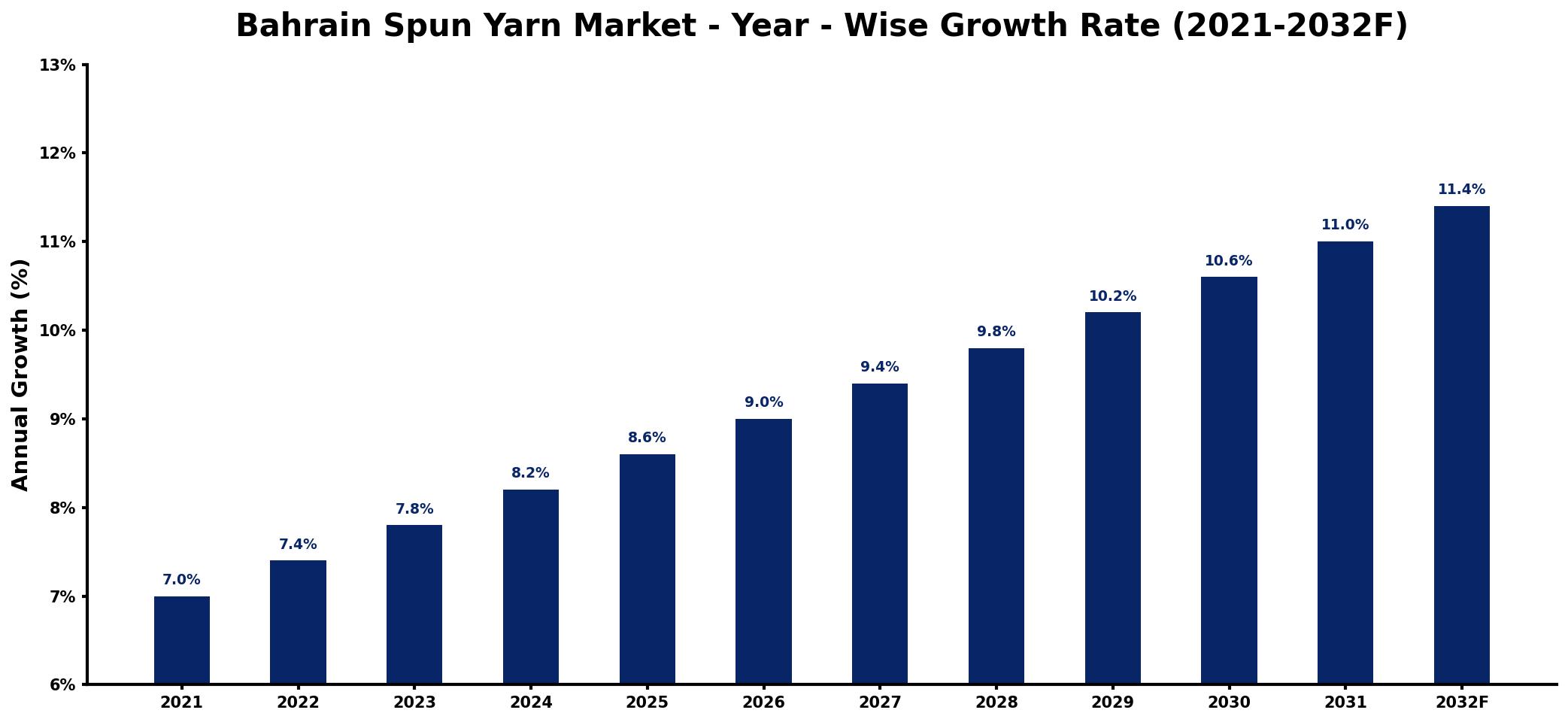
The table below presents the year‑wise growth rates along with the key drivers influencing the market
| Year | Growth Rate | Major Drivers |
| 2021 | 7.0% | Rising textile manufacturing investments |
| 2022 | 7.4% | Growing demand for sustainable fabrics |
| 2023 | 7.8% | Expansion of fashion retail sector |
| 2024 | 8.2% | Increased exports to regional markets |
| 2025 | 8.6% | Technological advancements in production |
| 2026 | 9.0% | Surge in home textile consumption |
| 2027 | 9.4% | Supportive government trade policies |
| 2028 | 9.8% | Emerging eco-friendly fabric trends |
| 2029 | 10.2% | Enhanced supply chain efficiencies |
| 2030 | 10.6% | improved raw material availability |
| 2031 | 11.0% | Rise in domestic production capacity |
| 2032 | 11.4% | Increased consumer awareness for quality |
Note: Market size estimations and growth projections presented in this report are based on 6Wresearch's proprietary forecasting methodology, utilizing the latest available industry data, government publications, and primary research inputs.
Bahrain Spun Yarn Market Synopsis
The most influential force currently shaping the Bahrain Spun Yarn Market is the demand for quality and versatile yarns, particularly those derived from cotton and polyester. As the local garment sector expands, these materials are increasingly favored for their adaptability in both traditional and modern clothing applications.
Moreover, Bahrain's strategic position for trade facilitates the import of essential raw materials. This dynamic has established a dependency on key suppliers from India, Pakistan, and China, highlighting a significant trend in the local markets structure and future sustainability.
Bahrain Spun Yarn Market Key Takeaways
- Spun yarns play a crucial role in Bahrain's textile imports for local garment production.
- The market is primarily driven by cotton and polyester yarns due to their cost-effectiveness.
- Recent advancements in spinning technology are influencing the quality and performance of spun yarns.
- Growing consumer preferences are prompting a shift towards organic and blended yarns.
- Bahrain's limited domestic production capacity creates a substantial reliance on imports.
Evaluation of Restraints in Bahrain Spun Yarn Market
The Bahrain Spun Yarn Market faces several significant constraints that inhibit its growth potential. Primarily, the lack of substantial local spinning capacity restricts production volumes, making the market heavily reliant on imported yarns. This situation not only escalates costs but also diminishes competitiveness against major textile producers globally. Additionally, Bahrains limited downstream processing infrastructure further exacerbates this issue, as it lacks the necessary weaving and knitting mills to utilize spun yarn locally. Furthermore, outdated machinery and a skills deficit in yarn grading and blending compound these challenges, highlighting an urgent need for modernization and expertise development.
Bahrain Spun Yarn Market Trends
Emerging trends within the Bahrain Spun Yarn Market indicate a growing demand for organic and blended yarns, reflecting a shift in consumer preferences towards sustainable and high-performance textiles. Innovations in spinning technology, particularly in ring and rotor spinning, are enhancing product quality and efficiency. Additionally, the increasing interest in value-added textiles, such as poly-cotton and cotton-viscose blends, is shaping product offerings. There is also a notable rise in the preference for comfort and breathability in fabrics, which is influencing the selection of fiber blends within the market.
Bahrain Spun Yarn Market Opportunities
Investment opportunities in the Bahrain Spun Yarn Market are becoming increasingly evident. The expanding garment manufacturing sector and home textiles industry present significant avenues for growth. Bahraini traders are experimenting with innovative yarn blends to meet rising consumer expectations, particularly in terms of comfort and environmental sustainability. Additionally, as regional trade connections strengthen, there is potential for greater import stability and quality assurance, further reinforcing Bahrain's position in the global textile supply chain.
Government Initiatives in the Bahrain Spun Yarn Market
The Bahrain government has implemented various policies aimed at revitalizing the spun yarn market under its broader textile manufacturing strategies. Initiatives include providing financial support for machinery upgrades and encouraging technology adoption within local industries. Compliance with quality and environmental standards is enforced to promote sustainability, particularly in water and dye usage. Furthermore, the government is fostering a circular economy for textiles, which emphasizes waste reduction and the recycling of yarn, aligning with national environmental objectives.
Future Insights of the Bahrain Spun Yarn Market
Looking ahead to 2026-2032, the Bahrain Spun Yarn Market is poised for steady growth driven by the increasing demand for quality fabrics in both domestic and export markets. The expected improvements in local spinning capabilities, coupled with advancements in production technologies, will likely enhance market competitiveness. As consumer preferences evolve, the market will see a continued emphasis on sustainable and innovative yarn options, positioning Bahrain as an emerging hub for spun yarn production in the region.
Bahrain Spun Yarn Market Latest Developments (2025 - 2026)
Recent developments in the Bahrain Spun Yarn Market indicate a heightened focus on technological upgrades and quality improvements among local producers. There is a notable trend of collaboration between local manufacturers and international suppliers to enhance product quality. Additionally, efforts to diversify raw material sources are underway, aiming to mitigate import dependency. The market is also witnessing an increased consumer interest in sustainable practices, encouraging manufacturers to explore eco-friendly alternatives in their production processes.
Bahrain Spun Yarn Market - Key Attractiveness of the Report
- 10 Years of Market Numbers
- Historical Data Starting from 2022 to 2025
- Base Year: 2025
- Forecast Data until 2032
- Key Performance Indicators Impacting the Market
- Major Upcoming Developments and Projects
Key Highlights of the Report:
- Bahrain Spun Yarn Market Outlook
- Market Size of Bahrain Spun Yarn Market, 2025
- Forecast of Bahrain Spun Yarn Market, 2032
- Historical Data and Forecast of Bahrain Spun Yarn Revenues & Volume for the Period 2022-2032F
- Bahrain Spun Yarn Market Trend Evolution
- Bahrain Spun Yarn Market Drivers and Challenges
- Bahrain Spun Yarn Price Trends
- Bahrain Spun Yarn Porter's Five Forces
- Bahrain Spun Yarn Industry Life Cycle
- Historical Data and Forecast of Bahrain Spun Yarn Market Revenues & Volume By Application for the Period 2022-2032F
- Historical Data and Forecast of Bahrain Spun Yarn Market Revenues & Volume By Textile for the Period 2022-2032F
- Historical Data and Forecast of Bahrain Spun Yarn Market Revenues & Volume By Healthcare for the Period 2022-2032F
- Historical Data and Forecast of Bahrain Spun Yarn Market Revenues & Volume By Home Furnishing for the Period 2022-2032F
- Historical Data and Forecast of Bahrain Spun Yarn Market Revenues & Volume By Others for the Period 2022-2032F
- Bahrain Spun Yarn Import Export Trade Statistics
- Market Opportunity Assessment By Application
- Bahrain Spun Yarn Top Companies Market Share
- Bahrain Spun Yarn Competitive Benchmarking By Technical and Operational Parameters
- Bahrain Spun Yarn Company Profiles
- Bahrain Spun Yarn Key Strategic Recommendations






































