Bahrain Viscose Filament Yarns Market Size, Share & Growth Rate
The Bahrain Viscose Filament Yarns Market was estimated at USD 1077 Million in 2025 and is projected to reach USD 2003 Million by 2032, growing at a CAGR of 9.3% from 2026 to 2032. This robust growth trajectory is driven by an increasing consumer preference for sustainable textiles and an expanding textile manufacturing sector. As Bahrain's fashion and home textiles industries pivot towards eco-friendly materials, the demand for high-quality viscose filament yarns is expected to surge, positioning this market as a focal point for investment and innovation.
Bahrain Viscose Filament Yarns Market Year-wise Growth Rate and Key Drivers
This graph highlights how the Bahrain Viscose Filament Yarns Market has steadily grown over the years, supported by major growth factors.
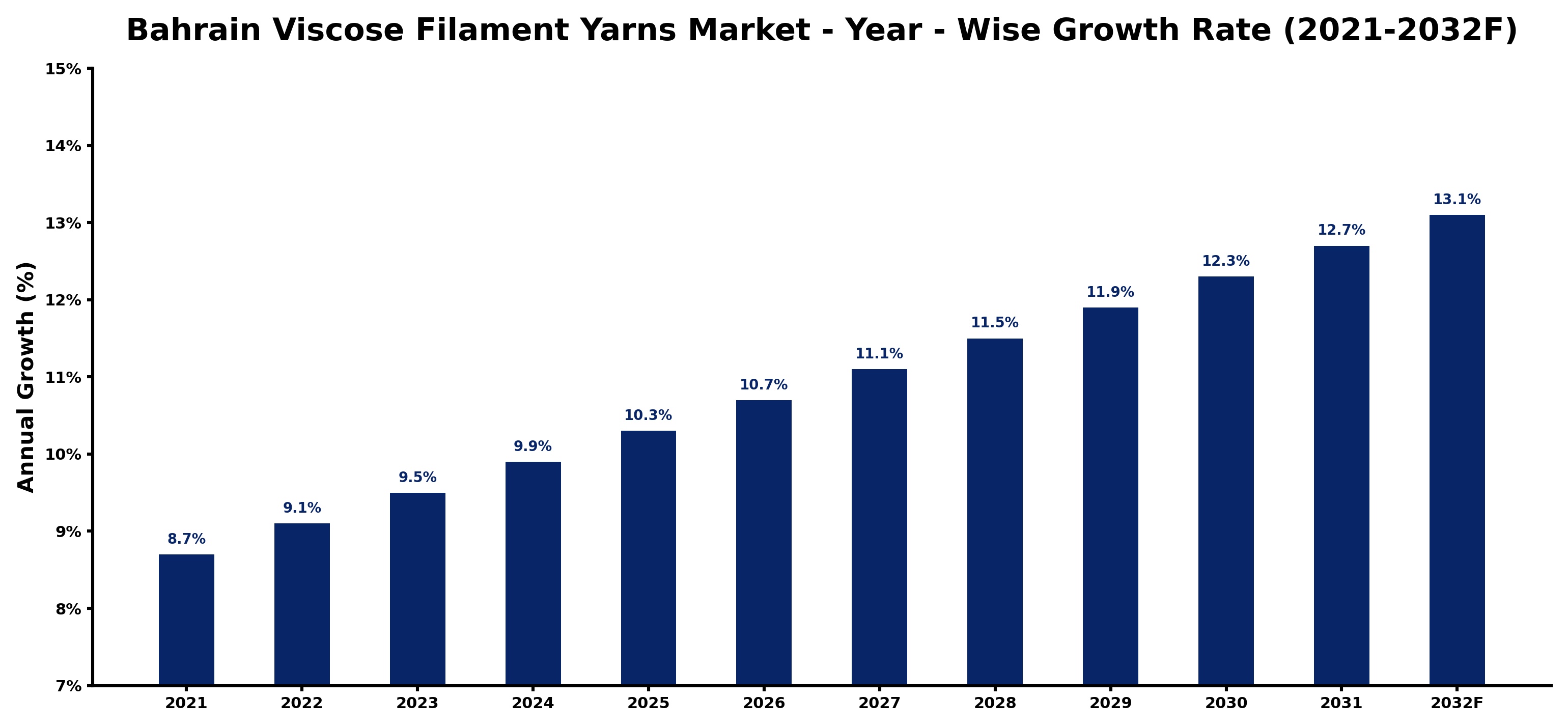
The table below presents the year‑wise growth rates along with the key drivers influencing the market
| Year | Growth Rate | Major Drivers |
| 2021 | 8.7% | New manufacturing investments boost local viscose filament yarn output |
| 2022 | 9.1% | Increased textile exports boost demand for viscose filament production |
| 2023 | 9.5% | Local textile manufacturers adopt advanced machinery for increased efficiency |
| 2024 | 9.9% | Export driven yarn manufacturers optimize operations for better capacity utilization |
| 2025 | 10.3% | Local textile manufacturers enhance production capacity for viscose yarn exports |
| 2026 | 10.7% | Infrastructure upgrades enhance viscose filament yarn production capabilities |
| 2027 | 11.1% | Improved manufacturing technology boosted efficiency in filament yarn production |
| 2028 | 11.5% | Local textile manufacturers scale operations to meet export demand |
| 2029 | 11.9% | Manufacturing investments boost local viscose filament yarn production capacity |
| 2030 | 12.3% | Revived textile manufacturing drives viscose filament yarn demand growth |
| 2031 | 12.7% | Investment in advanced textile machinery boosts filament yarn production efficiency |
| 2032 | 13.1% | Improved textile machinery investments boosted viscose filament yarn production |
Note - Market size estimations and growth projections presented in this report are based on 6Wresearch's advanced forecasting approach, validated with industry datasets as of June 2026.
Bahrain Viscose Filament Yarns Market Synopsis
The rising popularity of viscose filament yarns in Bahrain can be attributed to their silk-like texture and versatility in creating premium fabrics for both clothing and home textiles. Local designers and manufacturers are increasingly incorporating these yarns into their collections, appealing to consumers' growing consciousness regarding sustainability.
Moreover, the demand for biodegradable textiles is reshaping Bahrain's textile landscape, making viscose filament yarns a viable alternative to conventional synthetic fibers. This shift aligns with a broader global trend towards sustainable fashion, providing a solid foundation for market growth.
Bahrain Viscose Filament Yarns Market Key Takeaways
- The market is poised for significant growth fueled by the demand for sustainable textiles.
- Consumers' increasing environmental awareness is driving interest in high-quality fabrics.
- Bahrain's textile manufacturing sector is expanding, offering new opportunities for viscose yarn producers.
- Investment in premium fabrics and eco-friendly alternatives is on the rise.
- Government initiatives support local manufacturing and sustainability efforts in the textile industry.
Evaluation of Restraints in Bahrain Viscose Filament Yarns Market
Despite the positive outlook, the Bahrain Viscose Filament Yarns Market faces notable restraints. The relatively small scale of the local textile industry limits the overall demand for high-quality yarns. Furthermore, Bahrain's market is challenged by global competition from larger textile-producing nations, which can offer lower prices due to economies of scale. Additionally, environmental concerns associated with viscose production—specifically, the chemical processes involved—pose regulatory hurdles that can increase production costs and complicate market entry for new players.
Bahrain Viscose Filament Yarns Market Trends
Current trends in the Bahrain Viscose Filament Yarns Market are heavily influenced by the shifting landscape of consumer preferences towards sustainable and biodegradable materials. Brands are prioritizing the development of eco-friendly products, which boosts demand for viscose filament yarns. Moreover, advancements in textile manufacturing technology are enhancing the quality and range of applications for viscose yarns, making them more appealing to consumers and manufacturers alike.
Bahrain Viscose Filament Yarns Market Opportunities
Investment opportunities are abundant in the Bahrain Viscose Filament Yarns Market, particularly for businesses focused on supplying high-quality yarns to the fashion and home decor sectors. Companies can capitalize on the rising demand for sustainable textiles by offering viscose filament yarns as an alternative to synthetic fibers. Additionally, as the local market continues to grow, there's potential for establishing partnerships with designers and manufacturers to innovate and expand product lines.
Government Initiatives in the Bahrain Viscose Filament Yarns Market
The Bahraini government is actively promoting the growth of the textile and garment industries through supportive policies and initiatives. These include regulations that enhance the quality of textile raw materials and support for local manufacturing initiatives. By creating an environment conducive to growth, the government aims to bolster Bahrain's textile market, which in turn encourages the use of viscose filament yarns, aligning with sustainability objectives.
Future Insights of the Bahrain Viscose Filament Yarns Market
Looking ahead to 2026-2032, the Bahrain Viscose Filament Yarns Market is set to experience substantial growth driven by innovation and sustainability. As local manufacturers increasingly prioritize eco-friendly materials, viscose filament yarns will become integral to textile production. The interplay between consumer demand for premium fabrics and government support will further stimulate market expansion, positioning Bahrain as a noteworthy player in the regional textile landscape.
Bahrain Viscose Filament Yarns Market Latest Developments (May 2025 - June 2026)
Recent developments in the Bahrain Viscose Filament Yarns Market indicate a shift towards integrating more sustainable practices in textile production. Many manufacturers are exploring partnerships to enhance their sustainability initiatives, thus aligning with global eco-friendly trends. Additionally, innovations in production technology are expected to improve efficiency and product quality, thereby attracting greater investment in this sector.
Bahrain Viscose Filament Yarns Market - Key Attractiveness of the Report
- 10 Years of Market Numbers
- Historical Data Starting from 2022 to 2025
- Base Year: 2025
- Forecast Data until 2032
- Key Performance Indicators Impacting the Market
- Major Upcoming Developments and Projects
Key Highlights of the Report:
- Bahrain Viscose Filament Yarns Market Outlook
- Market Size of Bahrain Viscose Filament Yarns Market, 2025
- Forecast of Bahrain Viscose Filament Yarns Market, 2032
- Historical Data and Forecast of Bahrain Viscose Filament Yarns Revenues & Volume for the Period 2022-2032F
- Bahrain Viscose Filament Yarns Market Trend Evolution
- Bahrain Viscose Filament Yarns Market Drivers and Challenges
- Bahrain Viscose Filament Yarns Price Trends
- Bahrain Viscose Filament Yarns Porter's Five Forces
- Bahrain Viscose Filament Yarns Industry Life Cycle
- Historical Data and Forecast of Bahrain Viscose Filament Yarns Market Revenues & Volume By Type for the Period 2022-2032F
- Historical Data and Forecast of Bahrain Viscose Filament Yarns Market Revenues & Volume By Continuous for the Period 2022-2032F
- Historical Data and Forecast of Bahrain Viscose Filament Yarns Market Revenues & Volume By Semi-contunuous for the Period 2022-2032F
- Historical Data and Forecast of Bahrain Viscose Filament Yarns Market Revenues & Volume By Application for the Period 2022-2032F
- Historical Data and Forecast of Bahrain Viscose Filament Yarns Market Revenues & Volume By Garment industry for the Period 2022-2032F
- Historical Data and Forecast of Bahrain Viscose Filament Yarns Market Revenues & Volume By Auto industry for the Period 2022-2032F
- Historical Data and Forecast of Bahrain Viscose Filament Yarns Market Revenues & Volume By other for the Period 2022-2032F
- Bahrain Viscose Filament Yarns Import Export Trade Statistics
- Market Opportunity Assessment By Type
- Market Opportunity Assessment By Application
- Bahrain Viscose Filament Yarns Top Companies Market Share
- Bahrain Viscose Filament Yarns Competitive Benchmarking By Technical and Operational Parameters
- Bahrain Viscose Filament Yarns Company Profiles
- Bahrain Viscose Filament Yarns Key Strategic Recommendations






































