Bahrain Wall Lamps Market Summary
The bahrain wall lamps market was estimated at USD 655 Million in 2025 and is projected to reach USD 1129 Million by 2032, growing at a CAGR of 9.3% from 2026 to 2032.
Bahrain Wall Lamps Market Year-wise Growth Rate and Key Drivers
This graph highlights how the Bahrain Wall Lamps Market has steadily grown over the past five years, supported by major growth factors.
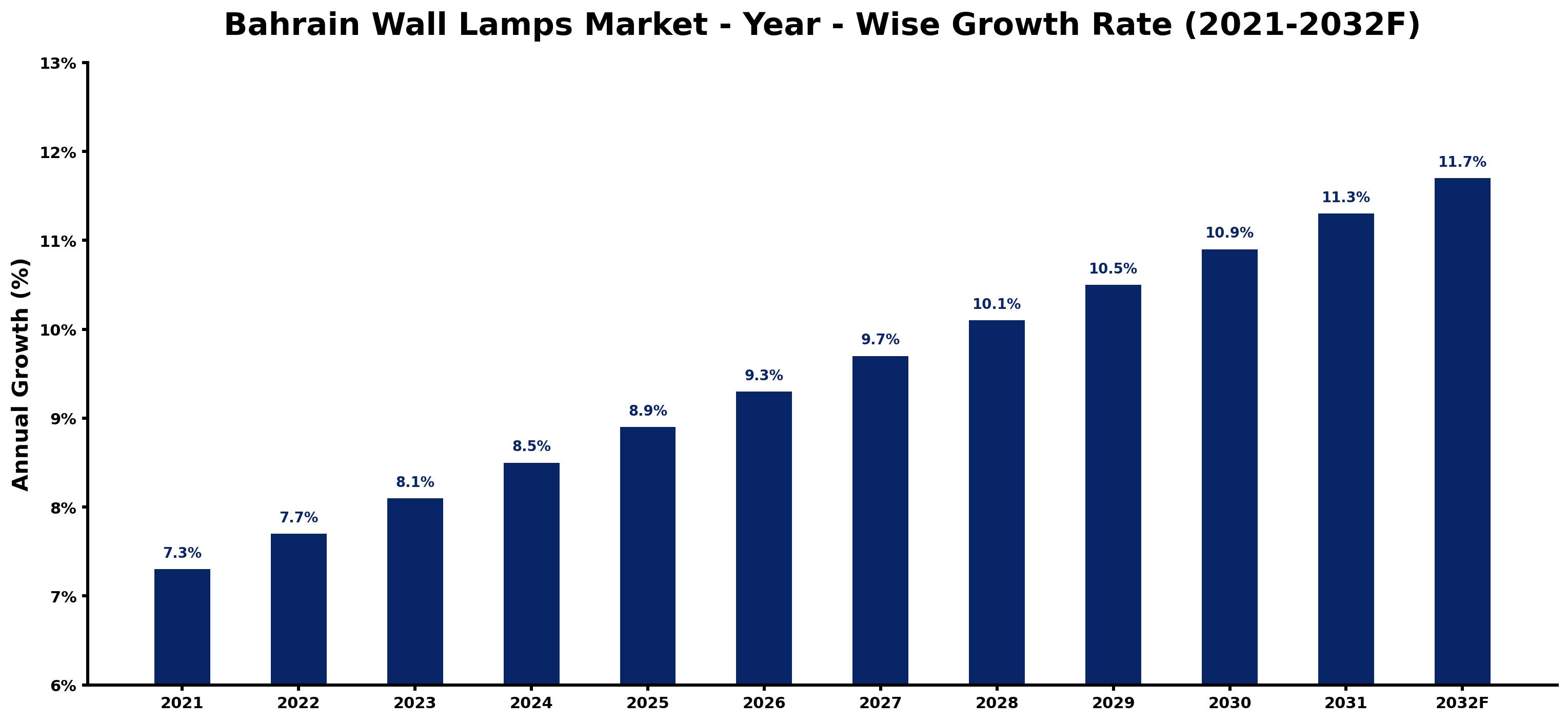
The table below presents the year wise growth rates along with the key drivers influencing the market
| Year | Growth Rate | Major Drivers |
| 2021 | 7.3% | Emerging home renovation trends boosted interest in decorative lighting solutions. |
| 2022 | 7.7% | E-commerce platforms expanded, enhancing accessibility to diverse wall lamp designs. |
| 2023 | 8.1% | Local artisans began offering bespoke lighting options, catering to niche markets. |
| 2024 | 8.5% | Smart home integration encouraged consumers to invest in connected lighting systems. |
| 2025 | 8.9% | Increasing disposable incomes among young professionals fueled upscale interior design projects. |
| 2026 | 9.3% | Sustainability movements prompted demand for energy-efficient LED wall lamps. |
| 2027 | 9.7% | Major construction projects in Bahrain created heightened demand for bulk lighting supplies. |
| 2028 | 10.1% | Tourism growth led to a surge in hospitality sector lighting upgrades. |
| 2029 | 10.5% | Cultural events and festivals showcased innovative light installations, sparking consumer interest. |
| 2030 | 10.9% | Urbanization trends continued, influencing modern design preferences for residential lighting. |
| 2031 | 11.3% | Technological advancements in smart lighting drove enthusiasm for customizable wall lamps. |
| 2032 | 11.7% | Collaborations with interior designers promoted high-end wall lamp collections to affluent buyers. |
Note - Market size estimations and growth projections presented in this report are based on 6Wresearch's advanced forecasting approach, validated with industry datasets as of June 2026.
Bahrain Wall Lamps Market Synopsis
The Bahrain Wall Lamps Market is projected to reach 9.3% and witness significant growth during the forecast period (2026-2032). This growth is primarily driven by the increasing focus on home decor and modern lighting solutions. As consumers become more discerning in their choices for residential and commercial spaces, the demand for innovative and stylish wall lamps is on the rise. The market is also witnessing a notable shift towards energy-efficient options, particularly LED wall lamps, which serve dual purposes of aesthetic enhancement and functionality.
Bahrain Wall Lamps Market Growth Drivers
Several factors are contributing to the growth of the Bahrain Wall Lamps Market. As modern design aesthetics emphasize both beauty and practicality, consumers increasingly seek wall lamps that complement their interior design while providing adequate lighting. Noteworthy drivers of the market include:
- Increased consumer awareness about energy efficiency is pushing the demand for LED wall lamps, which offer lower energy consumption and longer lifespans compared to traditional lighting options.
- The burgeoning smart home trend is influencing customer preferences, with smart wall lamps equipped with advanced features, such as remote control and automation, gaining popularity.
- Growth in the real estate sector, particularly in residential and hospitality segments, is generating demand for premium and decorative wall lamp designs.
- Architectural trends that incorporate integrated lighting solutions into design projects further foster the need for sophisticated wall lamps.
- Rising disposable incomes among consumers allow for greater spending on home improvement products, including stylish and modern lighting fixtures.
Bahrain Wall Lamps Market Challenges and Restraints
The Bahrain Wall Lamps Market, while poised for growth, faces specific challenges that could impact its trajectory. Consumer preferences are shifting towards modern, energy-efficient lighting solutions, compelling manufacturers to adapt and innovate continuously. Key challenges include:
- Increasing production costs associated with innovation in lighting technology can affect pricing strategies and profit margins.
- The market's high competitiveness, characterized by the presence of international brands, necessitates local manufacturers to differentiate themselves through unique designs and technologies.
- The relatively small scale of Bahrain's residential and commercial construction market limits overall demand, affecting large-scale production.
- Economic fluctuations can influence consumer spending patterns, specifically related to home improvement and renovation, posing risks for market stability.
- Regulatory compliance related to safety and energy efficiency standards can create barriers for new entrants into the market.
Bahrain Wall Lamps Market Investment Opportunities
Within the Bahrain Wall Lamps Market, various investment opportunities arise, driven by consumers' desire for stylish and energy-efficient solutions. Investors can focus on:
- Producing or distributing innovative wall lamp designs that align with modern interior aesthetics, capitalizing on increased consumer demand for unique products.
- Exploring collaborations with real estate developers and interior designers to integrate wall lamps into new projects, enhancing the overall appeal of residential and commercial spaces.
- Focusing on sustainable production practices to cater to the growing demand for environmentally friendly lighting solutions.
- Investing in smart wall lamp technologies that allow for greater customization and consumer engagement through app connectivity and energy management.
- Developing marketing strategies that highlight the long-term cost-saving benefits of energy-efficient wall lamps, appealing to a broader range of consumers.
Bahrain Wall Lamps Market Government Investment and Initiatives
Government policies play a vital role in shaping the Bahrain Wall Lamps Market, particularly through initiatives aimed at enhancing interior design and promoting energy efficiency. Relevant public spending and development plans include:
- Regulatory frameworks that mandate safety and efficiency standards for electrical products, ensuring quality and reliability in wall lamp offerings.
- Encouragement for the adoption of energy-efficient solutions aligns with Bahrain's sustainability goals, promoting the utilization of LED lighting technologies.
- Investment in infrastructure projects, particularly in hospitality and residential sectors, which stimulates demand for modern lighting fixtures, including wall lamps.
- Public campaigns that raise awareness about energy conservation, further driving consumers toward the adoption of energy-efficient lighting solutions.
- Support for local manufacturers through incentives or grants aimed at enhancing production capabilities and competitiveness in the market.
Bahrain Wall Lamps Market Latest Developments (May 2025 - June 2026)
Recent developments within the Bahrain Wall Lamps Market indicate a proactive shift towards innovation and sustainability. Manufacturers are increasingly launching new products that incorporate advanced technologies, such as smart lighting features and energy-saving capabilities. Concurrently, collaborations with local designers are yielding unique wall lamp designs that cater to contemporary aesthetic preferences. The market is also responding to the growing demand for sustainable products, with a noticeable increase in the availability of eco-friendly wall lamps made from recyclable materials. Furthermore, industry stakeholders are engaging in discussions regarding best practices for energy efficiency and sustainability, reflecting a collective commitment to improving the environmental impact of lighting solutions.
Bahrain Wall Lamps Market - Key Attractiveness of the Report
- 10 Years of Market Numbers
- Historical Data Starting from 2022 to 2025
- Base Year: 2025
- Forecast Data until 2032
- Key Performance Indicators Impacting the Market
- Major Upcoming Developments and Projects
Key Highlights of the Report:
- Bahrain Wall Lamps Market Outlook
- Market Size of Bahrain Wall Lamps Market, 2025
- Forecast of Bahrain Wall Lamps Market, 2032F
- Historical Data and Forecast of Bahrain Wall Lamps Revenues & Volume for the Period 2022-2032F
- Bahrain Wall Lamps Market Trend Evolution
- Bahrain Wall Lamps Market Drivers and Challenges
- Bahrain Wall Lamps Price Trends
- Bahrain Wall Lamps Porter's Five Forces
- Bahrain Wall Lamps Industry Life Cycle
- Historical Data and Forecast of Bahrain Wall Lamps Market Revenues & Volume By Types for the Period 2022-2032F
- Historical Data and Forecast of Bahrain Wall Lamps Market Revenues & Volume By Bronze for the Period 2022-2032F
- Historical Data and Forecast of Bahrain Wall Lamps Market Revenues & Volume By Plastic for the Period 2022-2032F
- Historical Data and Forecast of Bahrain Wall Lamps Market Revenues & Volume By Steel for the Period 2022-2032F
- Historical Data and Forecast of Bahrain Wall Lamps Market Revenues & Volume By Wood for the Period 2022-2032F
- Historical Data and Forecast of Bahrain Wall Lamps Market Revenues & Volume By Other for the Period 2022-2032F
- Historical Data and Forecast of Bahrain Wall Lamps Market Revenues & Volume By Applications for the Period 2022-2032F
- Historical Data and Forecast of Bahrain Wall Lamps Market Revenues & Volume By Commercial for the Period 2022-2032F
- Historical Data and Forecast of Bahrain Wall Lamps Market Revenues & Volume By Residential for the Period 2022-2032F
- Bahrain Wall Lamps Import Export Trade Statistics
- Market Opportunity Assessment By Types
- Market Opportunity Assessment By Applications
- Bahrain Wall Lamps Top Companies Market Share
- Bahrain Wall Lamps Competitive Benchmarking By Technical and Operational Parameters
- Bahrain Wall Lamps Company Profiles
- Bahrain Wall Lamps Key Strategic Recommendations






































