Bahrain Wood Processing Market Size, Share & Growth Rate
The Bahrain Wood Processing Market was estimated at USD 1217 Million in 2025 and is projected to reach USD 2120 Million by 2032, growing at a CAGR of 8.3% from 2026 to 2032. This robust growth trajectory is primarily driven by the expanding construction and furniture sectors within Bahrain, where there is an increasing demand for quality processed wood products. Furthermore, the industry's shift towards value-added services such as veneering and laminating reflects an adaptability that enhances competitiveness in both domestic and regional markets.
Bahrain Wood Processing Market Year-wise Growth Rate and Key Drivers
This graph highlights how the Bahrain Wood Processing Market has steadily grown over the years, supported by major growth factors.
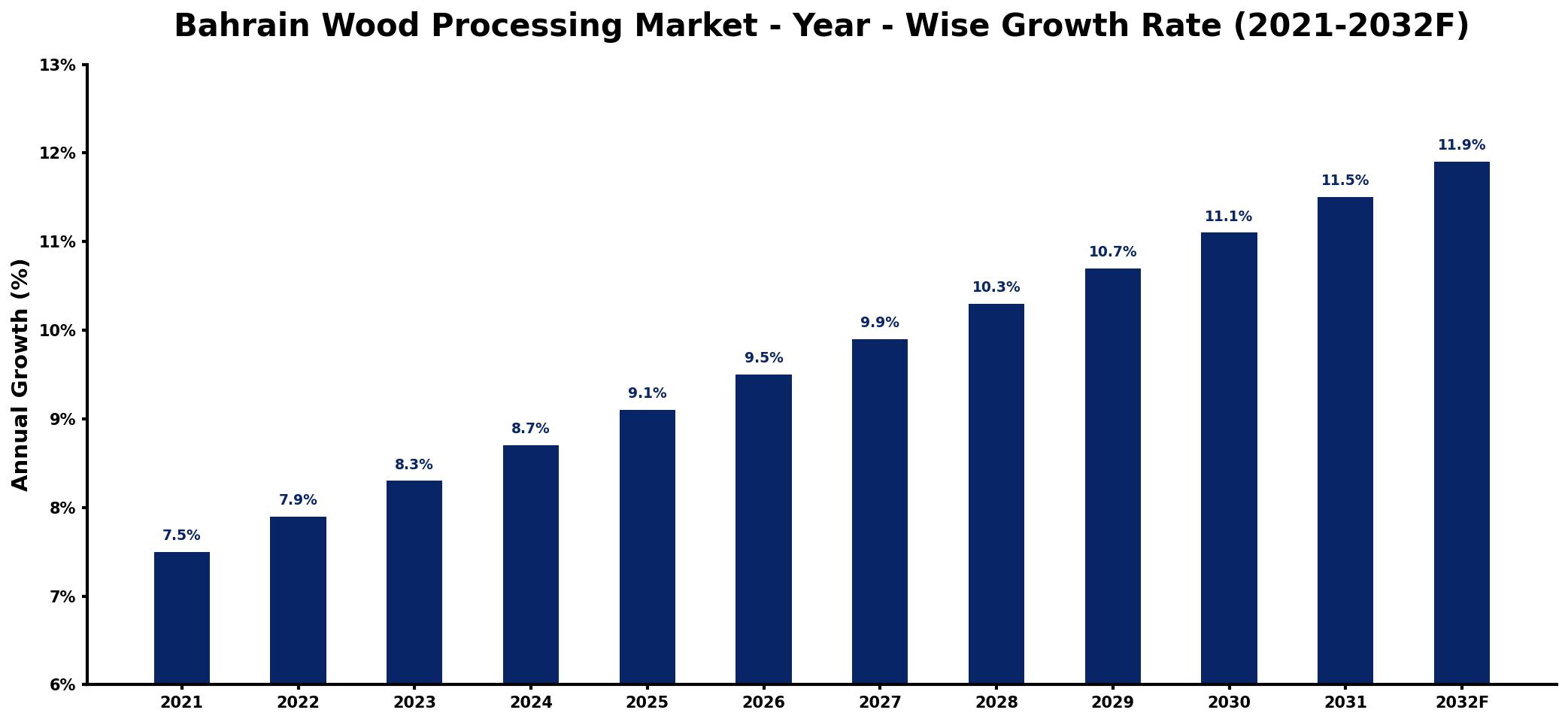
The table below presents the year‑wise growth rates along with the key drivers influencing the market
| Year | Growth Rate | Major Drivers |
| 2021 | 7.5% | Rising construction sector investments |
| 2022 | 7.9% | Increased furniture manufacturing demand |
| 2023 | 8.3% | Growth in interior design projects |
| 2024 | 8.7% | Surge in export opportunities |
| 2025 | 9.1% | Expansion of eco-friendly initiatives |
| 2026 | 9.5% | Higher consumer spending trends |
| 2027 | 9.9% | Development of smart home technologies |
| 2028 | 10.3% | Increase in tourism-related projects |
| 2029 | 10.7% | Growing demand for custom solutions |
| 2030 | 11.1% | Strengthening regional trade agreements |
| 2031 | 11.5% | Advancements in sustainable practices |
| 2032 | 11.9% | Emergence of innovative startups |
Note: Market size estimations and growth projections presented in this report are based on 6Wresearch's proprietary forecasting methodology, utilizing the latest available industry data, government publications, and primary research inputs.
Bahrain Wood Processing Market Synopsis
The wood processing market in Bahrain has demonstrated notable resilience despite limited local timber resources. Import dependencies define the landscape, yet the sector has capitalized on this by forging a strong network of woodworking businesses that contribute significantly to the economy. The future points toward a transition that favors more sustainable practices and innovation in processing techniques, promising both local benefit and export potential.
As the market matures, the focus on automation and value-added processing is expected to reshape production methodologies. Investments in eco-friendly technologies and sustainable sourcing strategies are not merely trends but essential shifts for companies striving to stay relevant and profitable in an increasingly competitive environment.
Bahrain Wood Processing Market Key Takeaways
- The market is heavily reliant on imported raw materials, leading to vulnerabilities in supply chains.
- Growing demand from the construction and furniture sectors is fueling market expansion.
- Investment in automation and sustainable practices is key to enhancing operational efficiency.
- Value-added processing techniques are gaining traction, catering to local and export markets.
- Government policies aimed at sustainability are shaping sourcing and processing dynamics.
Evaluation of Restraints in Bahrain Wood Processing Market
The Bahrain Wood Processing Market faces significant constraints due to a lack of local raw timber resources. This reliance on imports not only exposes the market to global price fluctuations but also complicates the supply chain, making it susceptible to disruptions. Furthermore, environmental regulations aimed at promoting sustainability create challenges for sourcing materials, placing additional pressure on operators. The relatively small scale of local manufacturing and construction activities further dampens demand for processed wood, resulting in a cautious investment climate for advanced processing facilities.
Bahrain Wood Processing Market Trends
Several key trends are influencing the Bahrain Wood Processing Market. Firstly, there is a noticeable shift toward automation in production, aimed at enhancing efficiency and reducing waste. Secondly, a growing emphasis on sustainability has spurred investments in eco-friendly wood treatment solutions. Additionally, the trend towards value-added processing, such as laminating and kiln-drying, is gaining momentum, enabling local businesses to meet both domestic demands and capitalize on re-export opportunities.
Bahrain Wood Processing Market Opportunities
The current landscape presents various growth opportunities within the wood processing sector. Establishing wood processing plants or forming partnerships with local manufacturers could be lucrative ventures, especially given the expanding construction and furniture markets. Furthermore, introducing innovative, sustainable practices in wood treatment and sourcing can significantly enhance competitive positioning. As demand for processed wood continues to rise, there lies an opportunity for businesses to diversify their offerings and cater to a broader audience.
Government Initiatives in the Bahrain Wood Processing Market
The government of Bahrain recognizes the importance of the wood processing sector as part of the broader economic fabric. Policies are in place that prioritize environmental conservation and resource efficiency, with oversight provided by the Ministry of Municipalities and Agriculture Affairs. These regulations not only ensure sustainable sourcing practices but also facilitate a controlled import and export environment for raw timber and processed wood. Such initiatives create an environment conducive to responsible growth in the wood processing industry.
Future Insights of the Bahrain Wood Processing Market
Looking ahead to 2026-2032, the Bahrain Wood Processing Market is poised for significant transformation. The anticipated growth in the construction and furniture sectors will drive demand for quality wood products. Additionally, the industry's commitment to sustainable practices and technological advancements will likely redefine processing capabilities. As manufacturers focus on value-added products, the market could emerge as a key regional hub for wood processing, particularly if operators can navigate the challenges associated with import dependencies and environmental regulations.
Bahrain Wood Processing Market Latest Developments (2025 - 2026)
Recent industry developments have reflected a growing interest in sustainable practices and automation technologies within the Bahrain Wood Processing Market. Initiatives aimed at improving the efficiency of wood processing plants are gaining traction, with several companies exploring partnerships to enhance their operational capabilities. Additionally, the local market is witnessing increased collaboration between businesses and government entities to ensure compliance with environmental regulations while promoting sustainable sourcing strategies.
Bahrain Wood Processing Market - Key Attractiveness of the Report
- 10 Years of Market Numbers
- Historical Data Starting from 2022 to 2025
- Base Year: 2025
- Forecast Data until 2032
- Key Performance Indicators Impacting the Market
- Major Upcoming Developments and Projects
Key Highlights of the Report:
- Bahrain Wood Processing Market Outlook
- Market Size of Bahrain Wood Processing Market, 2025
- Forecast of Bahrain Wood Processing Market, 2032
- Historical Data and Forecast of Bahrain Wood Processing Revenues & Volume for the Period 2022-2032F
- Bahrain Wood Processing Market Trend Evolution
- Bahrain Wood Processing Market Drivers and Challenges
- Bahrain Wood Processing Price Trends
- Bahrain Wood Processing Porter's Five Forces
- Bahrain Wood Processing Industry Life Cycle
- Historical Data and Forecast of Bahrain Wood Processing Market Revenues & Volume By Type for the Period 2022-2032F
- Historical Data and Forecast of Bahrain Wood Processing Market Revenues & Volume By Wood Chips for the Period 2022-2032F
- Historical Data and Forecast of Bahrain Wood Processing Market Revenues & Volume By Sawn Wood Lumber for the Period 2022-2032F
- Historical Data and Forecast of Bahrain Wood Processing Market Revenues & Volume By Others for the Period 2022-2032F
- Bahrain Wood Processing Import Export Trade Statistics
- Market Opportunity Assessment By Type
- Bahrain Wood Processing Top Companies Market Share
- Bahrain Wood Processing Competitive Benchmarking By Technical and Operational Parameters
- Bahrain Wood Processing Company Profiles
- Bahrain Wood Processing Key Strategic Recommendations






































