Bangladesh Aerosol Market Size, Share & Growth Rate
The Bangladesh Aerosol Market was estimated at USD 938 Million in 2025 and is projected to reach USD 1346 Million by 2032, growing at a CAGR of 5.3% from 2026 to 2032. This growth trajectory is primarily driven by an increasing demand for personal care and household aerosol products, reflecting a shift in consumer preferences towards convenience and hygiene. Urbanization and rising disposable incomes further bolster market expansion, as consumers seek innovative solutions that align with their busy lifestyles.
Bangladesh Aerosol Market Year-wise Growth Rate and Key Drivers
This graph highlights how the Bangladesh Aerosol Market has steadily grown over the years, supported by major growth factors.
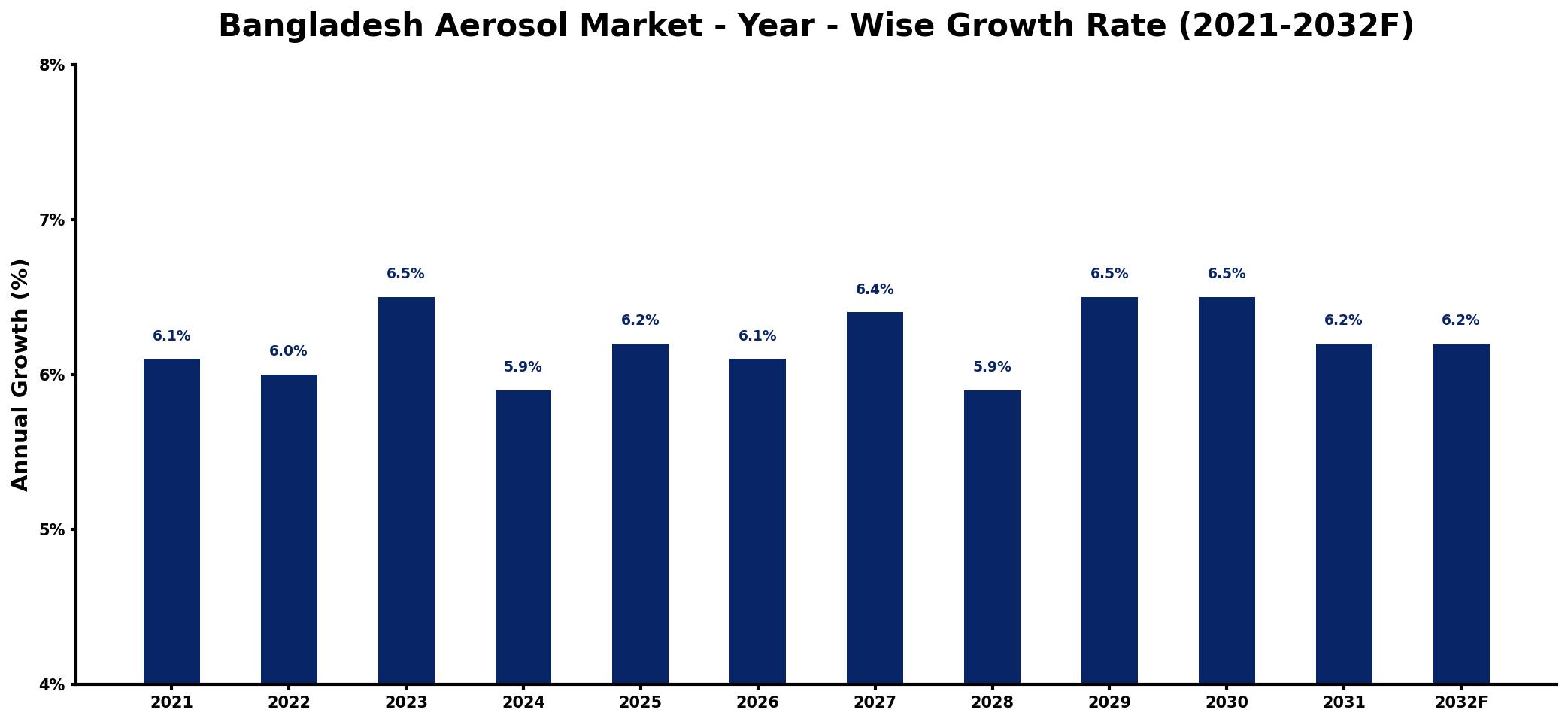
The table below presents the year‑wise growth rates along with the key drivers influencing the market
| Year | Growth Rate | Major Drivers |
| 2021 | 6.1% | Rising consumer health awareness |
| 2022 | 6.0% | Increased urban population density |
| 2023 | 6.5% | Growing demand for convenience products |
| 2024 | 5.9% | Expansion of retail distribution channels |
| 2025 | 6.2% | Surge in home cleaning trends |
| 2026 | 6.1% | Investment in sustainable packaging solutions |
| 2027 | 6.4% | Growth of personal care sector |
| 2028 | 5.9% | Emerging e-commerce platforms popularity |
| 2029 | 6.5% | Rising disposable income levels |
| 2030 | 6.5% | Increased focus on product innovation |
| 2031 | 6.2% | Growth in hospitality industry spending |
| 2032 | 6.2% | strengthening underlying market demand |
Note: Market size estimations and growth projections presented in this report are based on 6Wresearch's proprietary forecasting methodology, utilizing the latest available industry data, government publications, and primary research inputs.
Bangladesh Aerosol Market Synopsis
In recent years, the Bangladesh aerosol market has witnessed a remarkable surge, particularly in the personal care segment, encompassing deodorants, hair sprays, and air fresheners. The ongoing trends indicate a growing preference for aerosol packaging, not just for its convenience but also due to its perceived eco-friendliness.
Moreover, household products like insecticides and cleaning agents are gaining momentum, driven by heightened consumer awareness about hygiene. As lifestyles evolve, the market dynamics continue to transform, marked by a rising array of product offerings catering to diverse consumer needs.
Bangladesh Aerosol Market Key Takeaways
- Strong growth projected through 2032, fueled by urbanization and rising disposable incomes.
- Personal care products dominate, while household and industrial applications are gaining traction.
- Innovation in eco-friendly packaging and formulations is on the rise among manufacturers.
- Competitive landscape features both local and international players striving for market share.
- Awareness around hygiene and cleanliness continues to drive demand for disinfectants and sanitizers.
Evaluation of Restraints in Bangladesh Aerosol Market
The Bangladesh aerosol market faces several restraints that could impede its growth trajectory. Regulatory compliance, particularly concerning environmental standards and safety protocols, poses significant challenges for manufacturers. Intense competition between local and international players often leads to price wars, squeezing profit margins and making it difficult for companies to maintain sustainable operations. Additionally, infrastructural limitations in distribution and logistics complicate the market landscape, particularly when reaching remote areas. These factors necessitate strategic planning and investment in efficient supply chain solutions to mitigate impact.
Bangladesh Aerosol Market Trends
Emerging trends within the Bangladesh aerosol market reveal a strong consumer shift towards eco-friendly products. Manufacturers are increasingly focusing on developing sustainable aerosol formulations and packaging that resonate with the environmentally conscious consumer. Technological advancements in aerosol delivery systems are also enhancing product efficacy and safety. Moreover, the ongoing emphasis on hygiene, especially in a post-pandemic world, is driving a significant uptick in demand for aerosol sanitizers and disinfectants, further shaping market dynamics.
Bangladesh Aerosol Market Opportunities
The Bangladesh aerosol market presents substantial investment opportunities, particularly in the personal care and household product sectors. With a growing middle class and increasing disposable incomes, there is an evident demand for premium aerosol products. Investors may also benefit from collaborating with local manufacturers or establishing production facilities in Bangladesh, which is poised for industrial growth. The trend towards convenience and innovation offers a fertile ground for new entrants looking to introduce unique aerosol products into the market.
Government Initiatives in the Bangladesh Aerosol Market
The Bangladeshi government has implemented a regulatory framework aimed at ensuring the safe production and distribution of aerosol products while emphasizing environmental protection. Policies include strict guidelines for product registration and labeling, along with regulations to control harmful chemicals in aerosol formulations. The government also prioritizes responsible disposal practices for aerosol cans, supporting sustainable practices within the industry and fostering a safer market environment.
Future Insights of the Bangladesh Aerosol Market
Looking forward to the period between 2026 and 2032, the Bangladesh aerosol market is anticipated to grow steadily, underpinned by rising urbanization and changing consumer lifestyles. The expansion of the middle class, alongside heightened awareness regarding personal hygiene, will likely bolster demand for various aerosol applications. With an increasingly youthful population gravitating towards convenience, products such as air fresheners, deodorants, and insect repellents are expected to see an uptick in popularity, paving the way for both innovation and market growth.
Bangladesh Aerosol Market Latest Developments (2025 - 2026)
Recent developments within the Bangladesh aerosol market indicate a strong push towards innovation and sustainability. Companies are focusing on enhancing product formulations to meet the rising consumer demand for eco-friendly options. Additionally, there is a noted increase in partnerships aimed at improving distribution channels, particularly in underserved regions. The focus on health and hygiene continues to shape product development, leading to the introduction of new aerosol sanitization solutions.
Bangladesh Aerosol Market - Key Attractiveness of the Report
- 10 Years of Market Numbers
- Historical Data Starting from 2022 to 2025
- Base Year: 2025
- Forecast Data until 2032
- Key Performance Indicators Impacting the Market
- Major Upcoming Developments and Projects
Key Highlights of the Report:
- Bangladesh Aerosol Market Outlook
- Market Size of Bangladesh Aerosol Market, 2025
- Forecast of Bangladesh Aerosol Market, 2032
- Historical Data and Forecast of Bangladesh Aerosol Revenues & Volume for the Period 2022-2032F
- Bangladesh Aerosol Market Trend Evolution
- Bangladesh Aerosol Market Drivers and Challenges
- Bangladesh Aerosol Price Trends
- Bangladesh Aerosol Porter's Five Forces
- Bangladesh Aerosol Industry Life Cycle
- Historical Data and Forecast of Bangladesh Aerosol Market Revenues & Volume By Material for the Period 2022-2032F
- Historical Data and Forecast of Bangladesh Aerosol Market Revenues & Volume By Steel for the Period 2022-2032F
- Historical Data and Forecast of Bangladesh Aerosol Market Revenues & Volume By Aluminum for the Period 2022-2032F
- Historical Data and Forecast of Bangladesh Aerosol Market Revenues & Volume By Others for the Period 2022-2032F
- Historical Data and Forecast of Bangladesh Aerosol Market Revenues & Volume By Type for the Period 2022-2032F
- Historical Data and Forecast of Bangladesh Aerosol Market Revenues & Volume By Bag-In-Valve for the Period 2022-2032F
- Historical Data and Forecast of Bangladesh Aerosol Market Revenues & Volume By Standard for the Period 2022-2032F
- Historical Data and Forecast of Bangladesh Aerosol Market Revenues & Volume By Application for the Period 2022-2032F
- Historical Data and Forecast of Bangladesh Aerosol Market Revenues & Volume By Personal Care for the Period 2022-2032F
- Historical Data and Forecast of Bangladesh Aerosol Market Revenues & Volume By Household for the Period 2022-2032F
- Historical Data and Forecast of Bangladesh Aerosol Market Revenues & Volume By Automotive & Industrial for the Period 2022-2032F
- Historical Data and Forecast of Bangladesh Aerosol Market Revenues & Volume By Food for the Period 2022-2032F
- Historical Data and Forecast of Bangladesh Aerosol Market Revenues & Volume By Paints for the Period 2022-2032F
- Historical Data and Forecast of Bangladesh Aerosol Market Revenues & Volume By Medical for the Period 2022-2032F
- Historical Data and Forecast of Bangladesh Aerosol Market Revenues & Volume By Others for the Period 2022-2032F
- Bangladesh Aerosol Import Export Trade Statistics
- Market Opportunity Assessment By Material
- Market Opportunity Assessment By Type
- Market Opportunity Assessment By Application
- Bangladesh Aerosol Top Companies Market Share
- Bangladesh Aerosol Competitive Benchmarking By Technical and Operational Parameters
- Bangladesh Aerosol Company Profiles
- Bangladesh Aerosol Key Strategic Recommendations






































