Bangladesh Apiculture Market Size, Share & Growth Rate
The Bangladesh Apiculture Market was estimated at USD 524 Million in 2025 and is projected to reach USD 757 Million by 2032, growing at a CAGR of 5.4% from 2026 to 2032. This growth trajectory is primarily driven by a heightened consumer awareness regarding the health benefits of honey and other bee products, coupled with a notable shift towards organic and locally sourced foods. Furthermore, local beekeepers are increasingly adopting innovative practices that enhance honey yield and quality, thus responding effectively to rising market demands.
Bangladesh Apiculture Market Year-wise Growth Rate and Key Drivers
This graph highlights how the Bangladesh Apiculture Market has steadily grown over the years, supported by major growth factors.
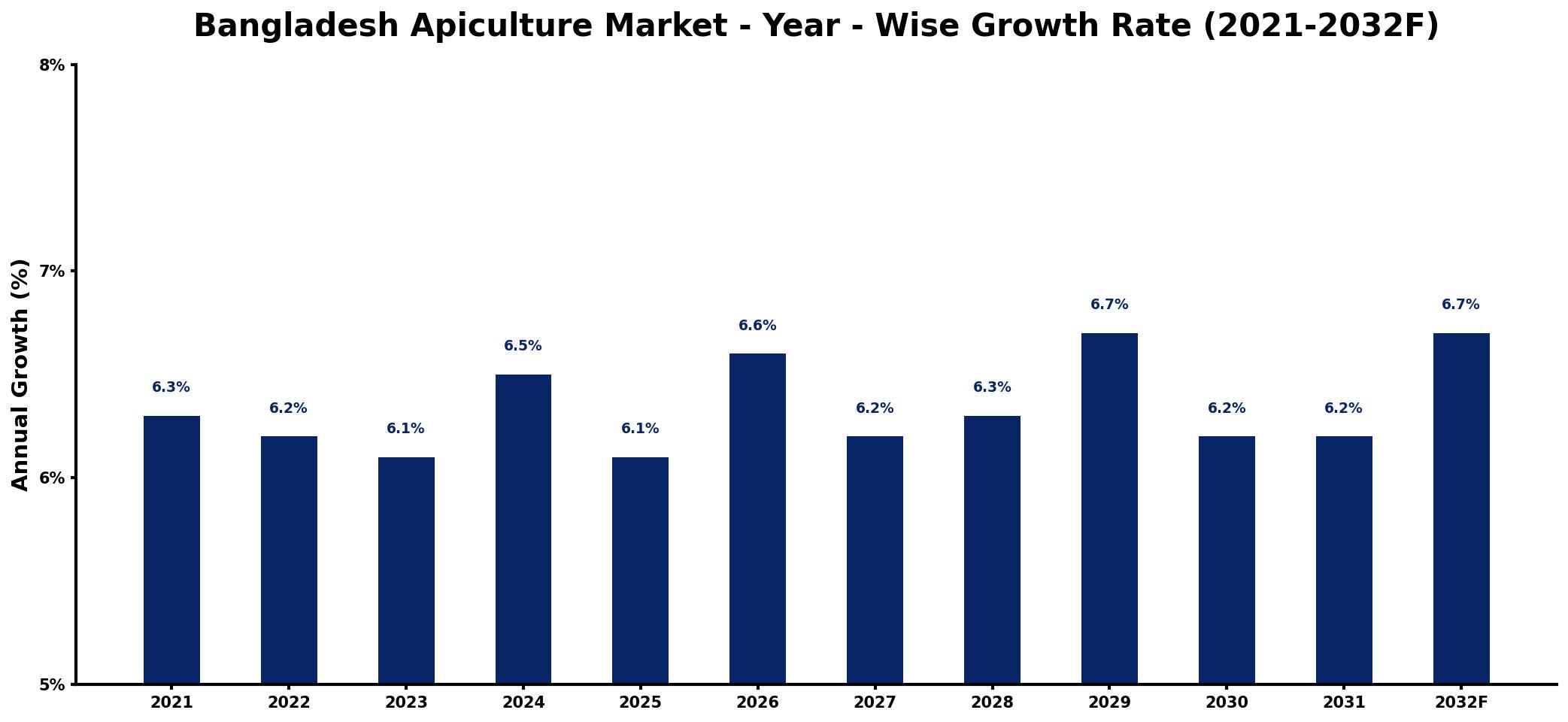
The table below presents the year‑wise growth rates along with the key drivers influencing the market
| Year | Growth Rate | Major Drivers |
| 2021 | 6.3% | Rising consumer health consciousness |
| 2022 | 6.2% | Growing organic farming practices |
| 2023 | 6.1% | Increased export market opportunities |
| 2024 | 6.5% | Expansion of local production facilities |
| 2025 | 6.1% | Surge in natural sweetener demand |
| 2026 | 6.6% | Investment in sustainable practices |
| 2027 | 6.2% | Enhanced distribution network efficiency |
| 2028 | 6.3% | Growing popularity of local products |
| 2029 | 6.7% | Emerging e-commerce sales channels |
| 2030 | 6.2% | Strengthened agricultural support programs |
| 2031 | 6.2% | Increase in urban gardening trends |
| 2032 | 6.7% | Diversification of agricultural investments |
Note: Market size estimations and growth projections presented in this report are based on 6Wresearch's proprietary forecasting methodology, utilizing the latest available industry data, government publications, and primary research inputs.
Bangladesh Apiculture Market Synopsis
In Bangladesh, the apiculture sector is thriving, buoyed by a cultural affinity for honey and an expanding market for natural sweeteners. The countrys favorable climate and rich biodiversity provide an ideal backdrop for beekeeping, encouraging both traditional and modern practices to flourish.
As awareness of the nutritional advantages of honey grows, consumers are increasingly seeking out high-quality, locally produced honey. This trend is supported by government initiatives aimed at promoting sustainable beekeeping as a viable source of income for rural populations, thereby bolstering the industry's growth.
Bangladesh Apiculture Market Key Takeaways
- The market is benefitting from increasing consumer demand for natural and organic products.
- Modern beekeeping techniques are being embraced by local practitioners to enhance production quality.
- Government support is pivotal in promoting apiculture as a sustainable livelihood.
- The favorable climate and diverse flora in Bangladesh contribute significantly to honey production potential.
- Export opportunities are beginning to emerge, signaling a potential for market expansion.
Evaluation of Restraints in Bangladesh Apiculture Market
Despite its promising outlook, the Bangladesh Apiculture Market encounters several significant restraints. Limited access to modern technology and inadequate training hinder many beekeepers from maximizing production efficiency and product quality. Additionally, the inconsistent quality standards across the market pose challenges for competitiveness both domestically and internationally. The ongoing impacts of climate change further complicate matters, affecting bee health and, subsequently, honey yields. These challenges necessitate focused interventions to unlock the markets full potential.
Bangladesh Apiculture Market Trends
Current trends indicate a notable shift towards the consumption of natural and organic honey, driven by increasing health consciousness among consumers. The rise of e-commerce platforms is also reshaping the market landscape, providing beekeepers with new avenues to reach consumers directly. Additionally, there is a growing recognition of the environmental role bees play in pollination, prompting initiatives aimed at conserving bee populations and habitats. These trends are not only fostering demand but also promoting a more sustainable apiculture ecosystem.
Bangladesh Apiculture Market Opportunities
The apiculture sector in Bangladesh presents numerous investment opportunities for stakeholders. With an ever-increasing demand for honey and other bee products, there is significant potential for investors to establish honey processing facilities and distribution networks. Engaging in partnerships with local beekeepers to implement advanced practices can also prove beneficial. Furthermore, as the government continues to support the apiculture industry through training and incentives, the overall investment climate is becoming increasingly favorable.
Government Initiatives in the Bangladesh Apiculture Market
The Bangladeshi government has implemented various initiatives aimed at enhancing the apiculture sector. This includes capacity-building programs for local beekeepers, promoting modern beekeeping techniques and equipment usage. Financial support and incentives are being offered to encourage the growth of the industry, alongside efforts to establish quality standards that ensure product safety and reliability. Additionally, governmental policies are focusing on sustainable practices that protect pollinator biodiversity, thus fostering a more resilient apiculture landscape.
Future Insights of the Bangladesh Apiculture Market
Looking ahead to 2026-2032, the Bangladesh Apiculture Market is poised for steady growth. The rising demand for natural sweeteners and health products is expected to persist, fueled by growing consumer preferences for organic options. Government initiatives will likely play a crucial role in addressing existing challenges, paving the way for advancements in hive management and honey processing. However, stakeholders will need to remain vigilant about environmental factors that might impact bee populations, ensuring a sustainable approach to growth.
Bangladesh Apiculture Market Latest Developments (2025 - 2026)
Recent developments in the Bangladesh Apiculture Market highlight an increasing focus on quality control and standardization within the industry. Efforts are underway to introduce better training programs that equip beekeepers with modern techniques and equipment. There is also a noticeable push towards organic certification for honey products, with various stakeholders engaging in initiatives that promote sustainable practices. As a result, the market is witnessing greater participation from both small-scale farmers and larger enterprises, reflecting a shift toward a more inclusive industry.
Bangladesh Apiculture Market - Key Attractiveness of the Report
- 10 Years of Market Numbers
- Historical Data Starting from 2022 to 2025
- Base Year: 2025
- Forecast Data until 2032
- Key Performance Indicators Impacting the Market
- Major Upcoming Developments and Projects
Key Highlights of the Report:
- Bangladesh Apiculture Market Outlook
- Market Size of Bangladesh Apiculture Market, 2025
- Forecast of Bangladesh Apiculture Market, 2032
- Historical Data and Forecast of Bangladesh Apiculture Revenues & Volume for the Period 2022-2032F
- Bangladesh Apiculture Market Trend Evolution
- Bangladesh Apiculture Market Drivers and Challenges
- Bangladesh Apiculture Price Trends
- Bangladesh Apiculture Porter's Five Forces
- Bangladesh Apiculture Industry Life Cycle
- Historical Data and Forecast of Bangladesh Apiculture Market Revenues & Volume By Product Type for the Period 2022-2032F
- Historical Data and Forecast of Bangladesh Apiculture Market Revenues & Volume By Honey for the Period 2022-2032F
- Historical Data and Forecast of Bangladesh Apiculture Market Revenues & Volume By Beeswax for the Period 2022-2032F
- Historical Data and Forecast of Bangladesh Apiculture Market Revenues & Volume By Live-bees for the Period 2022-2032F
- Historical Data and Forecast of Bangladesh Apiculture Market Revenues & Volume By Others for the Period 2022-2032F
- Historical Data and Forecast of Bangladesh Apiculture Market Revenues & Volume By Application for the Period 2022-2032F
- Historical Data and Forecast of Bangladesh Apiculture Market Revenues & Volume By Medical for the Period 2022-2032F
- Historical Data and Forecast of Bangladesh Apiculture Market Revenues & Volume By Food Beverages for the Period 2022-2032F
- Historical Data and Forecast of Bangladesh Apiculture Market Revenues & Volume By Cosmetics for the Period 2022-2032F
- Historical Data and Forecast of Bangladesh Apiculture Market Revenues & Volume By Others for the Period 2022-2032F
- Bangladesh Apiculture Import Export Trade Statistics
- Market Opportunity Assessment By Product Type
- Market Opportunity Assessment By Application
- Bangladesh Apiculture Top Companies Market Share
- Bangladesh Apiculture Competitive Benchmarking By Technical and Operational Parameters
- Bangladesh Apiculture Company Profiles
- Bangladesh Apiculture Key Strategic Recommendations






































