Bangladesh Apparel Accessories Market Size, Share & Growth Rate
The Bangladesh Apparel Accessories Market was estimated at USD 387 Million in 2025 and is projected to reach USD 536 Million by 2032, growing at a CAGR of 4.8% from 2026 to 2032. This growth trajectory is driven by an increasing global demand for high-quality, fashionable accessories, coupled with the countrys competitive manufacturing landscape and skilled labor force. Additionally, the push towards sustainable and eco-friendly products is shaping production strategies, creating further market opportunities.
Bangladesh Apparel Accessories Market Year-wise Growth Rate and Key Drivers
This graph highlights how the Bangladesh Apparel Accessories Market has steadily grown over the years, supported by major growth factors.
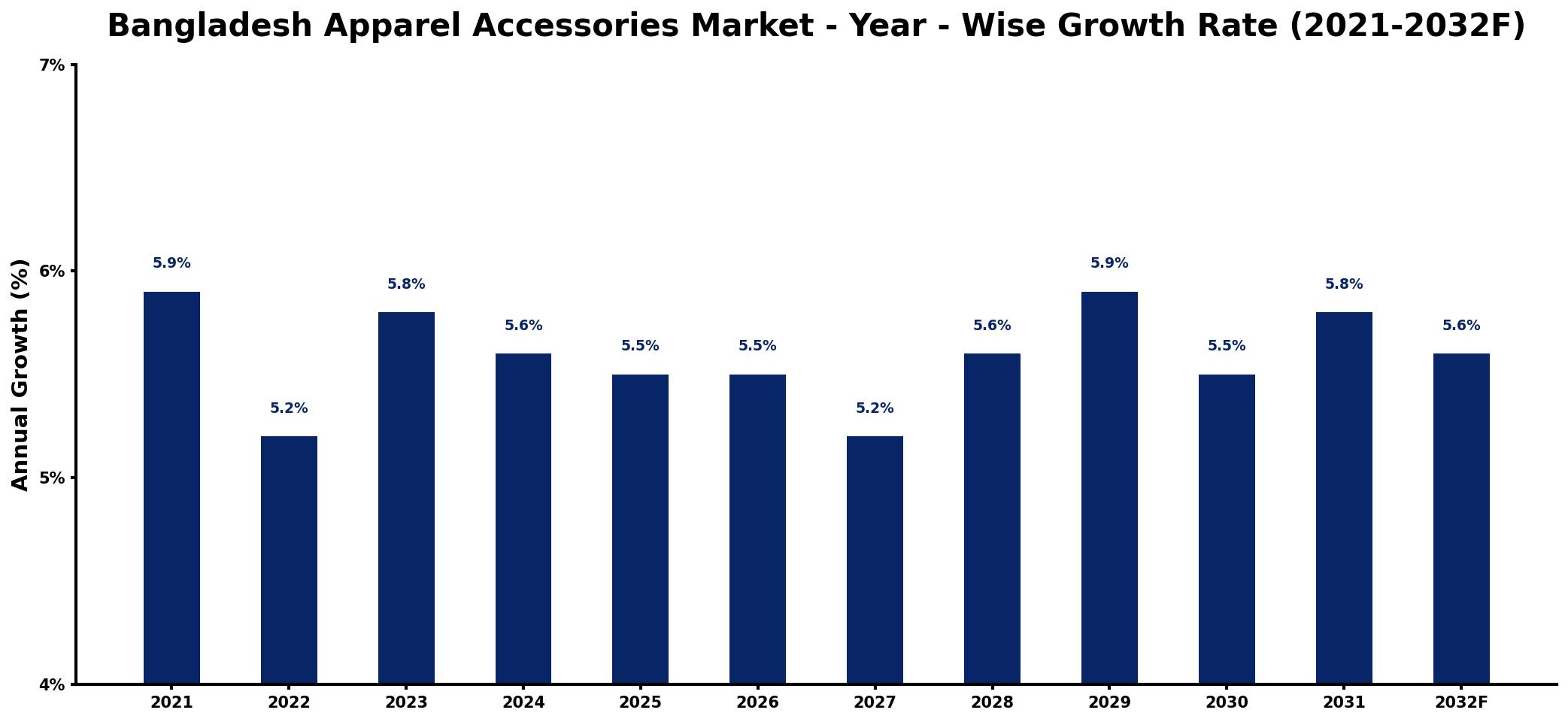
The table below presents the year‑wise growth rates along with the key drivers influencing the market
| Year | Growth Rate | Major Drivers |
| 2021 | 5.9% | Rising consumer demand for fashion |
| 2022 | 5.2% | Increased investment in production technologies |
| 2023 | 5.8% | Expansion of online retail channels |
| 2024 | 5.6% | Growth in export opportunities |
| 2025 | 5.5% | Emergence of sustainable production practices |
| 2026 | 5.5% | Boost in domestic manufacturing capacity |
| 2027 | 5.2% | Enhanced supply chain efficiencies |
| 2028 | 5.6% | increased pharmaceutical industry usage |
| 2029 | 5.9% | Diversification of product offerings |
| 2030 | 5.5% | Strengthening of international partnerships |
| 2031 | 5.8% | Increased focus on quality standards |
| 2032 | 5.6% | Expansion into new market segments |
Note: Market size estimations and growth projections presented in this report are based on 6Wresearch's proprietary forecasting methodology, utilizing the latest available industry data, government publications, and primary research inputs.
Bangladesh Apparel Accessories Market Synopsis
The demand for premium apparel accessories such as buttons, zippers, and labels is surging, making Bangladesh a strategic hub for global apparel supply chains. The country has developed specialized industrial zones that enhance production efficiency and quality control, allowing manufacturers to meet the evolving needs of international clients.
As consumers become increasingly aware of fashion's environmental footprint, the market is adapting by integrating sustainable materials into accessory production. This commitment to eco-consciousness, paired with a tradition of craftsmanship, positions Bangladesh as an appealing source for both affordability and quality.
Bangladesh Apparel Accessories Market Key Takeaways
- The market is witnessing a significant shift towards sustainable production practices.
- Customized and personalized accessories are becoming essential to consumer purchasing decisions.
- There is a marked increase in online shopping for apparel accessories, expanding market reach.
- Bangladesh's competitive labor market supports efficient and cost-effective manufacturing.
- Government initiatives are fostering ethical practices and enhancing industry standards.
Evaluation of Restraints in Bangladesh Apparel Accessories Market
Despite its advantages, the Bangladesh Apparel Accessories Market encounters considerable restraints. The intense competition from other low-cost manufacturing nations poses a challenge to maintaining market share. Furthermore, fluctuations in raw material prices can disrupt production costs and timelines. Compliance with international labor standards is a persistent concern, as is the industry's overall vulnerability to global economic downturns and changing trade regulations. Manufacturers must also navigate the complexities of environmental regulations, requiring continuous innovation to remain relevant.
Bangladesh Apparel Accessories Market Trends
Current trends in the Bangladesh Apparel Accessories Market include an increasing focus on sustainability, with many companies seeking to utilize organic and recycled materials in their products. Customization is another significant trend, as consumers increasingly desire accessories that reflect their individual styles. The rise of e-commerce is transforming how consumers engage with the market, offering wider selections and unparalleled convenience. Additionally, digital technology is influencing production processes and marketing strategies, enhancing overall efficiency.
Bangladesh Apparel Accessories Market Opportunities
The market presents substantial investment opportunities, particularly in the production of trendy accessories such as scarves, belts, and jewelry. With the global demand for affordable and stylish accessories continuing to rise, Bangladeshs manufacturing capabilities offer a strategic advantage. Investors can capitalize on the nations reputation for quality and cost-efficiency, making it an ideal location for expanding accessory production. The focus on sustainability also opens new avenues for innovation and branding.
Government Initiatives in the Bangladesh Apparel Accessories Market
Government policies aimed at enhancing the Bangladesh Apparel Accessories Market are geared towards promoting sustainable manufacturing practices and ensuring worker rights. Initiatives such as the National Tripartite Plan of Action focus on improving safety standards in the ready-made garment sector. Moreover, the Bangladesh Garment Manufacturers and Exporters Association collaborates with governmental bodies to establish industry regulations that maintain compliance with international standards, incentivizing innovation and skill development within the sector.
Future Insights of the Bangladesh Apparel Accessories Market
Looking ahead, the Bangladesh Apparel Accessories Market is poised for consistent growth between 2026 and 2032, driven by an expanding middle-class population and increasing disposable income. As international retailers continue to recognize Bangladesh as a manufacturing hub for quality apparel accessories, the market's growth is expected to accelerate. A continued emphasis on personalization and sustainability will further align production with consumer values, ensuring that Bangladesh remains a key player in the global apparel accessories landscape.
Bangladesh Apparel Accessories Market Latest Developments (2025 - 2026)
In recent months, the Bangladesh Apparel Accessories Market has seen a shift towards adopting advanced manufacturing technologies to improve efficiency and quality. Companies are increasingly integrating sustainable practices into their production processes, responding to consumer demand for eco-friendly products. The online retail sector has also expanded significantly, with more brands establishing a digital presence to cater to evolving shopping behaviors. These trends reflect the industry's agility in adapting to market dynamics and consumer preferences.
Bangladesh Apparel Accessories Market - Key Attractiveness of the Report
- 10 Years of Market Numbers
- Historical Data Starting from 2022 to 2025
- Base Year: 2025
- Forecast Data until 2032
- Key Performance Indicators Impacting the Market
- Major Upcoming Developments and Projects
Key Highlights of the Report:
- Bangladesh Apparel Accessories Market Outlook
- Market Size of Bangladesh Apparel Accessories Market, 2025
- Forecast of Bangladesh Apparel Accessories Market, 2032
- Historical Data and Forecast of Bangladesh Apparel Accessories Revenues & Volume for the Period 2022-2032F
- Bangladesh Apparel Accessories Market Trend Evolution
- Bangladesh Apparel Accessories Market Drivers and Challenges
- Bangladesh Apparel Accessories Price Trends
- Bangladesh Apparel Accessories Porter's Five Forces
- Bangladesh Apparel Accessories Industry Life Cycle
- Historical Data and Forecast of Bangladesh Apparel Accessories Market Revenues & Volume By Product for the Period 2022-2032F
- Historical Data and Forecast of Bangladesh Apparel Accessories Market Revenues & Volume By Belts for the Period 2022-2032F
- Historical Data and Forecast of Bangladesh Apparel Accessories Market Revenues & Volume By Handbags for the Period 2022-2032F
- Historical Data and Forecast of Bangladesh Apparel Accessories Market Revenues & Volume By Scarves for the Period 2022-2032F
- Historical Data and Forecast of Bangladesh Apparel Accessories Market Revenues & Volume By Eye wear for the Period 2022-2032F
- Historical Data and Forecast of Bangladesh Apparel Accessories Market Revenues & Volume By Jewelry for the Period 2022-2032F
- Historical Data and Forecast of Bangladesh Apparel Accessories Market Revenues & Volume By Neckties for the Period 2022-2032F
- Historical Data and Forecast of Bangladesh Apparel Accessories Market Revenues & Volume By Gloves for the Period 2022-2032F
- Historical Data and Forecast of Bangladesh Belts Apparel Accessories Market Revenues & Volume By Others for the Period 2022-2032F
- Historical Data and Forecast of Bangladesh Apparel Accessories Market Revenues & Volume By Demographic for the Period 2022-2032F
- Historical Data and Forecast of Bangladesh Apparel Accessories Market Revenues & Volume By Men for the Period 2022-2032F
- Historical Data and Forecast of Bangladesh Apparel Accessories Market Revenues & Volume By Women for the Period 2022-2032F
- Historical Data and Forecast of Bangladesh Apparel Accessories Market Revenues & Volume By Children for the Period 2022-2032F
- Historical Data and Forecast of Bangladesh Apparel Accessories Market Revenues & Volume By Price for the Period 2022-2032F
- Historical Data and Forecast of Bangladesh Apparel Accessories Market Revenues & Volume By Economical Apparel Accessories for the Period 2022-2032F
- Historical Data and Forecast of Bangladesh Apparel Accessories Market Revenues & Volume By Mid-range Apparel Accessories for the Period 2022-2032F
- Historical Data and Forecast of Bangladesh Apparel Accessories Market Revenues & Volume By Premium Apparel Accessories for the Period 2022-2032F
- Historical Data and Forecast of Bangladesh Apparel Accessories Market Revenues & Volume By Super-premium Apparel Accessories for the Period 2022-2032F
- Historical Data and Forecast of Bangladesh Apparel Accessories Market Revenues & Volume By Sales Channel for the Period 2022-2032F
- Historical Data and Forecast of Bangladesh Apparel Accessories Market Revenues & Volume By Apparel Accessories Sold through Modern Trade for the Period 2022-2032F
- Historical Data and Forecast of Bangladesh Apparel Accessories Market Revenues & Volume By Apparel Accessories Sold at Franchise Outlets for the Period 2022-2032F
- Historical Data and Forecast of Bangladesh Apparel Accessories Market Revenues & Volume By Apparel Accessories Sold at Specialty Stores for the Period 2022-2032F
- Historical Data and Forecast of Bangladesh Apparel Accessories Market Revenues & Volume By Others for the Period 2022-2032F
- Bangladesh Apparel Accessories Import Export Trade Statistics
- Market Opportunity Assessment By Product
- Market Opportunity Assessment By Demographic
- Market Opportunity Assessment By Price
- Market Opportunity Assessment By Sales Channel
- Bangladesh Apparel Accessories Top Companies Market Share
- Bangladesh Apparel Accessories Competitive Benchmarking By Technical and Operational Parameters
- Bangladesh Apparel Accessories Company Profiles
- Bangladesh Apparel Accessories Key Strategic Recommendations






































