Bangladesh Armored Vehicle Market Size, Share & Growth Rate
The Bangladesh Armored Vehicle Market was estimated at USD 465 Million in 2025 and is projected to reach USD 628 Million by 2032, growing at a CAGR of 4.4% from 2026 to 2032. This growth trajectory is primarily propelled by escalating security threats and the subsequent modernization initiatives undertaken by the armed forces. As Bangladesh places greater emphasis on enhancing its defense capabilities, the demand for advanced armored vehicles across various sectors, including law enforcement and border security, is set to rise significantly.
Bangladesh Armored Vehicle Market Year-wise Growth Rate and Key Drivers
This graph highlights how the Bangladesh Armored Vehicle Market has steadily grown over the years, supported by major growth factors.
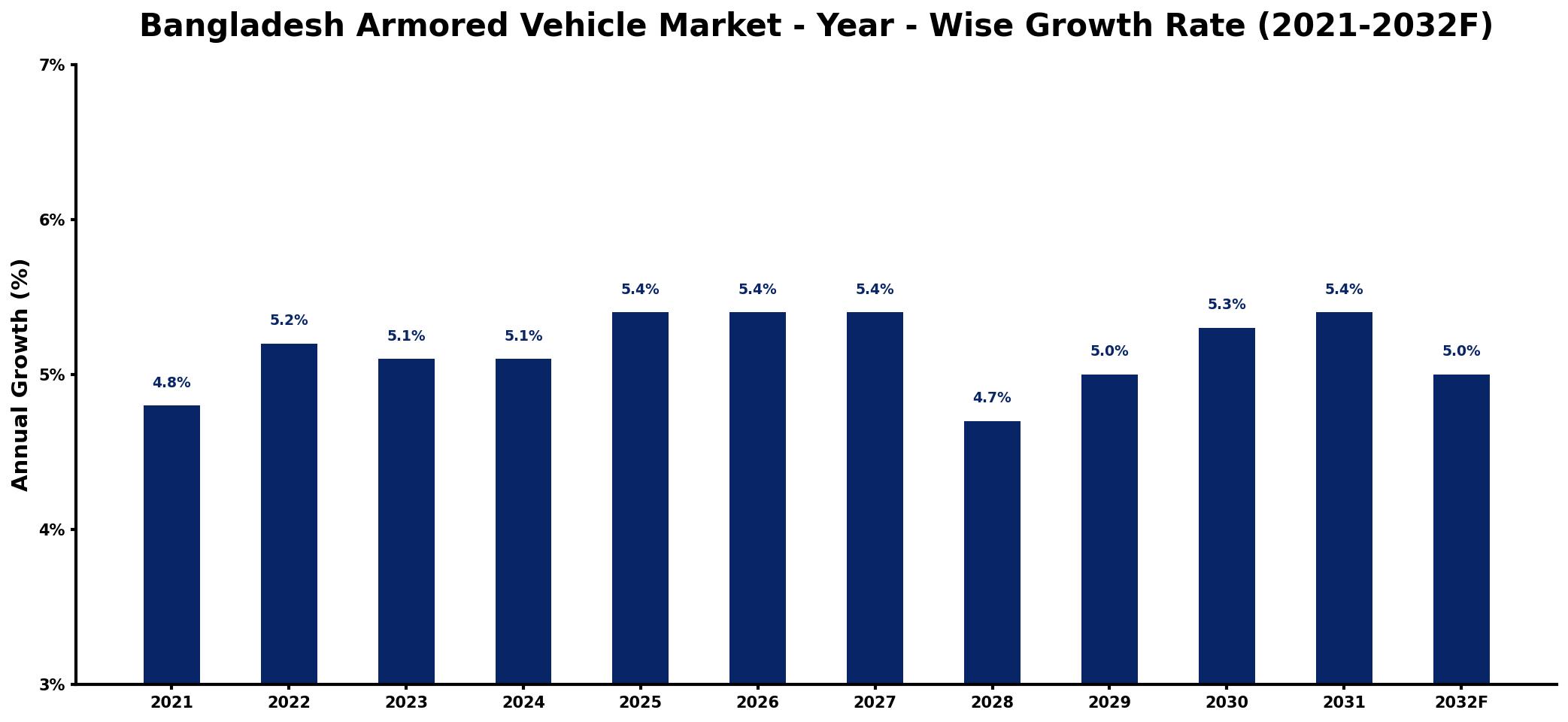
The table below presents the year‑wise growth rates along with the key drivers influencing the market
| Year | Growth Rate | Major Drivers |
| 2021 | 4.8% | Increased government defense spending |
| 2022 | 5.2% | Rising demand for security solutions |
| 2023 | 5.1% | Expansion of private security sector |
| 2024 | 5.1% | Growing regional geopolitical tensions |
| 2025 | 5.4% | Investment in defense modernization projects |
| 2026 | 5.4% | Enhanced focus on disaster response |
| 2027 | 5.4% | Strengthened law enforcement capabilities |
| 2028 | 4.7% | Emerging threats driving procurement |
| 2029 | 5.0% | Development of local manufacturing facilities |
| 2030 | 5.3% | Improved logistics and supply chains |
| 2031 | 5.4% | Collaborations with international partners |
| 2032 | 5.0% | Increased focus on urban safety |
Note: Market size estimations and growth projections presented in this report are based on 6Wresearch's proprietary forecasting methodology, utilizing the latest available industry data, government publications, and primary research inputs.
Bangladesh Armored Vehicle Market Synopsis
The increasing need for protection against rising security concerns has led to a significant demand for armored personnel carriers and other specialized vehicles in Bangladesh. The emphasis on securing high-profile individuals and assets is driving procurement strategies, with advanced technology being a key focal point in vehicle specifications.
Moreover, ongoing military modernization efforts emphasize integrating cutting-edge technology into the local defense manufacturing sector. This dynamic reflects the government's commitment to bolstering national security through both domestic production and strategic partnerships with international manufacturers.
Bangladesh Armored Vehicle Market Key Takeaways
- The market is anticipated to grow steadily due to increased defense budgets and focus on modernization.
- Urban warfare and security operations are leading to a shift towards lighter and more agile armored vehicles.
- Technological advancements are driving the development of vehicles with enhanced protection and customization capabilities.
- Public-private partnerships are becoming essential for meeting the demand for advanced armored vehicles.
- Investors are encouraged to explore opportunities in supplying specialized armored vehicles tailored for various applications.
Evaluation of Restraints in Bangladesh Armored Vehicle Market
Despite the promising growth of the Bangladesh Armored Vehicle Market, several restraints hamper its full potential. Limited defense budget allocations often hinder the timely procurement of modern armored vehicles, impacting operational readiness. Additionally, bureaucratic obstacles can delay the acquisition process, causing frustrations among stakeholders. Furthermore, while domestic manufacturers are making strides, the technological capabilities of local producers may not yet meet the advanced standards required for modern armored vehicles, leading to a reliance on costly imports.
Bangladesh Armored Vehicle Market Trends
The market is currently witnessing notable trends, such as a shift towards vehicles designed for urban mobility and operational flexibility. Increased interest in modular designs is allowing for easier customization of vehicles to suit various mission profiles. Additionally, the incorporation of advanced materials is enhancing survivability, making armored vehicles more effective against contemporary threats. These trends reflect a broader push towards innovation within the sector, aligning with global advancements in defense technology.
Bangladesh Armored Vehicle Market Opportunities
Investment opportunities abound in the Bangladesh Armored Vehicle Market, driven by increasing security needs. The demand for armored personnel carriers, specialized transport vehicles, and advanced technology integrations offers avenues for investors. Collaboration with local manufacturers for production and maintenance contracts can yield significant returns. Furthermore, as the government prioritizes national security and defense development, engaging in public sector projects may provide lucrative long-term benefits.
Government Initiatives in the Bangladesh Armored Vehicle Market
The Bangladesh government has instituted regulations governing the import and acquisition of armored vehicles, primarily to safeguard national security. All imports require clearance from the Ministry of Home Affairs, ensuring vehicles meet specific technical criteria. Additionally, the government actively promotes local manufacturing capabilities through tax incentives and support programs, aiming to bolster domestic production and mitigate reliance on imports.
Future Insights of the Bangladesh Armored Vehicle Market
Looking ahead to 2026-2032, the Bangladesh Armored Vehicle Market is poised for consistent expansion. As defense budgets continue to rise, the demand for advanced armored vehicles is expected to escalate, particularly in response to evolving security threats. The interplay of regional geopolitical tensions and border disputes will likely drive further investment in defense capabilities, positioning the market for robust growth. Additionally, advancements in technology, such as enhanced communication systems and lightweight materials, will continue to shape the future landscape of this sector.
Bangladesh Armored Vehicle Market Latest Developments (2025 - 2026)
Recent developments indicate a strong push towards collaboration between local manufacturers and international suppliers to enhance the local defense production capabilities. Efforts are being made to streamline procurement processes, enabling more efficient acquisition of modern armored vehicles. Additionally, there is an increasing focus on research and development initiatives aimed at advancing the technological capabilities of domestic armored vehicle production. These trends signal a commitment to strengthening the national defense infrastructure while fostering innovation.
Bangladesh Armored Vehicle Market - Key Attractiveness of the Report
- 10 Years of Market Numbers
- Historical Data Starting from 2022 to 2025
- Base Year: 2025
- Forecast Data until 2032
- Key Performance Indicators Impacting the Market
- Major Upcoming Developments and Projects
Key Highlights of the Report:
- Bangladesh Armored Vehicle Market Outlook
- Market Size of Bangladesh Armored Vehicle Market, 2025
- Forecast of Bangladesh Armored Vehicle Market, 2032
- Historical Data and Forecast of Bangladesh Armored Vehicle Revenues & Volume for the Period 2022-2032F
- Bangladesh Armored Vehicle Market Trend Evolution
- Bangladesh Armored Vehicle Market Drivers and Challenges
- Bangladesh Armored Vehicle Price Trends
- Bangladesh Armored Vehicle Porter's Five Forces
- Bangladesh Armored Vehicle Industry Life Cycle
- Historical Data and Forecast of Bangladesh Armored Vehicle Market Revenues & Volume By Platform for the Period 2022-2032F
- Historical Data and Forecast of Bangladesh Armored Vehicle Market Revenues & Volume By Combat Vehicles for the Period 2022-2032F
- Historical Data and Forecast of Bangladesh Armored Vehicle Market Revenues & Volume By Combat Support Vehicles for the Period 2022-2032F
- Historical Data and Forecast of Bangladesh Armored Vehicle Market Revenues & Volume By Unmanned Armored Ground Vehicles for the Period 2022-2032F
- Historical Data and Forecast of Bangladesh Armored Vehicle Market Revenues & Volume By Mobility for the Period 2022-2032F
- Historical Data and Forecast of Bangladesh Armored Vehicle Market Revenues & Volume By Wheeled for the Period 2022-2032F
- Historical Data and Forecast of Bangladesh Armored Vehicle Market Revenues & Volume By Tracked for the Period 2022-2032F
- Historical Data and Forecast of Bangladesh Armored Vehicle Market Revenues & Volume By System for the Period 2022-2032F
- Historical Data and Forecast of Bangladesh Armored Vehicle Market Revenues & Volume By Engine for the Period 2022-2032F
- Historical Data and Forecast of Bangladesh Armored Vehicle Market Revenues & Volume By Drive System for the Period 2022-2032F
- Historical Data and Forecast of Bangladesh Armored Vehicle Market Revenues & Volume By Ballistic Armor for the Period 2022-2032F
- Historical Data and Forecast of Bangladesh Armored Vehicle Market Revenues & Volume By Turret Drives for the Period 2022-2032F
- Historical Data and Forecast of Bangladesh Armored Vehicle Market Revenues & Volume By Ammunition Handling System for the Period 2022-2032F
- Historical Data and Forecast of Bangladesh Armored Vehicle Market Revenues & Volume By Fire Control Systems (FCS) for the Period 2022-2032F
- Historical Data and Forecast of Bangladesh Armored Vehicle Market Revenues & Volume By Armaments for the Period 2022-2032F
- Historical Data and Forecast of Bangladesh Armored Vehicle Market Revenues & Volume By Countermeasure System for the Period 2022-2032F
- Bangladesh Armored Vehicle Import Export Trade Statistics
- Market Opportunity Assessment By Platform
- Market Opportunity Assessment By Mobility
- Market Opportunity Assessment By System
- Bangladesh Armored Vehicle Top Companies Market Share
- Bangladesh Armored Vehicle Competitive Benchmarking By Technical and Operational Parameters
- Bangladesh Armored Vehicle Company Profiles
- Bangladesh Armored Vehicle Key Strategic Recommendations






































