Bangladesh Artificial Intelligence Platform Market Size & Growth Rate (2026-2032)
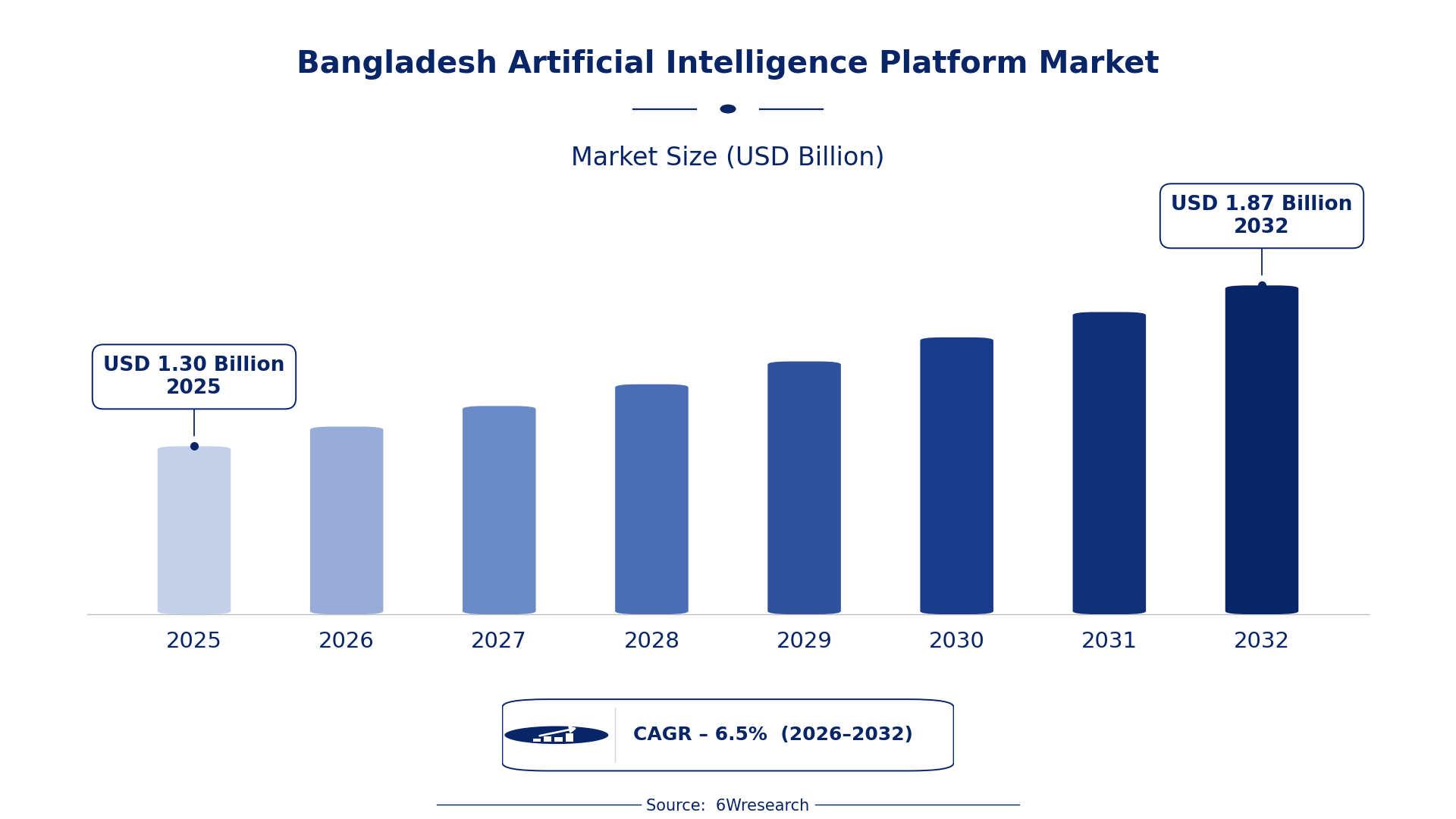
The Bangladesh Artificial Intelligence Platform Market was estimated at USD 1305 Million in 2025 and is projected to reach USD 1867 Million by 2032, growing at a CAGR of 6.5% from 2026 to 2032.
Bangladesh Artificial Intelligence Platform Market Synopsis
The demand for artificial intelligence platforms in Bangladesh is surging as various sectors, including healthcare and finance, increasingly adopt AI technologies to enhance operational efficiency. Companies are recognizing that AI solutions can drive innovation, significantly improving customer experiences and decision-making processes.
This market is being fueled by a combination of government initiatives aimed at digital transformation and a growing pool of local startups eager to innovate. The presence of machine learning, natural language processing, and computer vision capabilities is becoming more pronounced, establishing a fertile ground for AI applications across industries.
Bangladesh Artificial Intelligence Platform Market Year-wise Growth Rate and Key Drivers
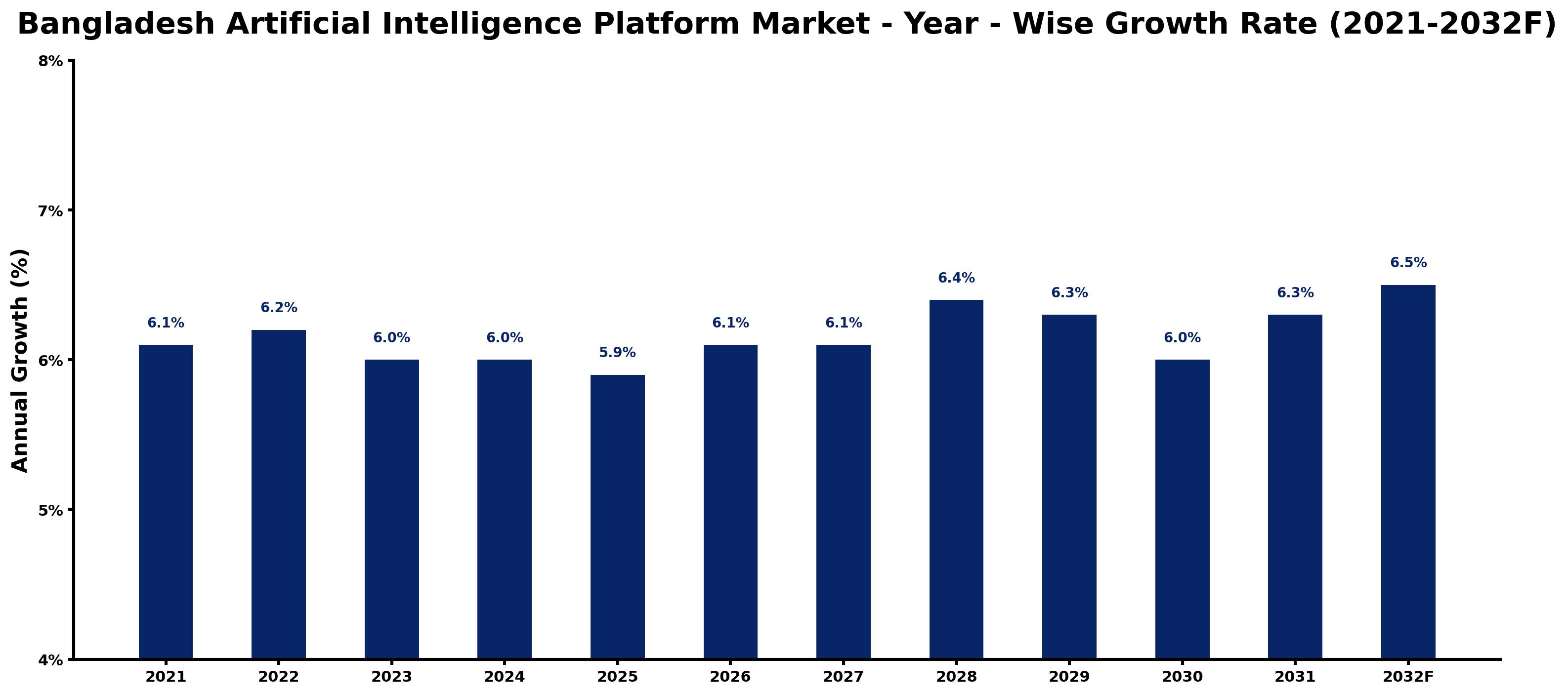
This graph illustrates the annual growth rates of the Bangladesh Artificial Intelligence Platform Market from 2021 to 2032, highlighting a steady upward trajectory and projected expansion over the forecast period.
The table below presents the year‑wise growth rates along with the key drivers influencing the market
| Year | Growth Rate | Major Drivers |
| 2021 | 6.1% | Government's Vision 2021 promoting digital technology adoption |
| 2022 | 6.2% | Increased local startup funding for AI innovation projects |
| 2023 | 6.0% | Collaboration between universities and tech firms for AI research |
| 2024 | 6.0% | National Artificial Intelligence Strategy fostering market investment |
| 2025 | 5.9% | Rising interest in AI-driven agriculture solutions for farmers |
| 2026 | 6.1% | Strong mobile internet growth enhancing AI platform accessibility |
| 2027 | 6.1% | Integration of AI in government services improving efficiency |
| 2028 | 6.4% | Emergence of AI-focused educational programs in universities |
| 2029 | 6.3% | Increasing use of AI chatbots in local customer service |
| 2030 | 6.0% | Support from Bangladesh Digital Government initiative for AI tools |
| 2031 | 6.3% | Growing interest in AI for fintech solutions in Bangladesh |
| 2032 | 6.5% | Regulatory framework for AI solutions encouraging market confidence |
Note: Market size estimations and growth projections presented in this report are based on 6Wresearch's proprietary forecasting methodology, utilizing the latest available industry data, government publications, and primary research inputs.
Bangladesh Artificial Intelligence Platform Market Key Takeaways
Below are some of the specific key takeaways from the market, including:
- Rapid growth in AI adoption across healthcare, finance, and retail sectors.
- Government support through policies and initiatives promotes AI integration.
- Ongoing development of advanced AI capabilities such as predictive analytics.
- Local startups are actively creating tailored AI solutions for businesses.
- Increased focus on AI education and training to address skill shortages.
Evaluation of Restraints in Bangladesh Artificial Intelligence Platform Market
Despite the promising growth, the Bangladesh Artificial Intelligence Platform Market faces notable restraints. A significant challenge is the shortage of skilled AI professionals, which limits the implementation of innovative solutions. on top of that, inadequate infrastructure hampers the development and deployment of AI technologies. Many businesses remain unaware of AI's potential, leading to slower adoption rates and reluctance to invest. Addressing these barriers will be essential for unlocking the market's full potential.
Bangladesh Artificial Intelligence Platform Market Trends
The market is currently witnessing several trends shaping demand for AI platforms. There is a marked increase in the need for natural language processing and image recognition capabilities, driven by applications in customer service and data analytics. Additionally, the push for automation in business processes is prompting companies to explore AI-driven solutions that optimize efficiency and reduce costs. Collaboration between technology firms and academic institutions is also fostering an environment conducive to innovation in AI.
Bangladesh Artificial Intelligence Platform Market Opportunities
Opportunities abound for AI platform providers in Bangladesh, particularly for those willing to develop customized solutions for local businesses. Areas such as operational optimization, enhanced customer engagement, and data-driven decision-making present significant growth prospects. With the government emphasizing digital transformation, there is potential for partnerships that align technology with public sector objectives. This alignment can pave the way for innovative applications that address local challenges.
Government Initiatives in the Bangladesh Artificial Intelligence Platform Market
The Bangladeshi government is taking proactive steps to cultivate an environment for AI development. Emphasizing AI's role in economic growth, the government has established frameworks that encourage collaboration between academia and industry. This strategic focus on public policy is essential for the market's growth, as it addresses both infrastructure needs and skill development.
- A national AI strategy developed in 2024 aims to provide a framework for AI adoption across sectors.
- Currently ongoing is a digital infrastructure upgrade program designed to enhance connectivity and data access for AI applications.
- Recent initiatives include funding opportunities for startups focused on AI technologies launched in early 2025.
- Plans for a collaborative research initiative involving universities and tech companies are set to commence in mid-2026.
- A regulatory review process is underway to streamline policies impacting AI deployment and integration.
Future Insights of the Bangladesh Artificial Intelligence Platform Market
Looking ahead to 2026-2032, the Bangladesh Artificial Intelligence Platform Market is expected to continue its upward trajectory. The increasing demand for automation and intelligent solutions will drive further investment in AI technologies. The government’s ongoing commitment to digital transformation and initiatives to bolster education in AI will likely yield a more skilled workforce. As businesses recognize the strategic advantages of AI, the landscape will evolve to support more innovative applications, solidifying Bangladesh's position in the AI sector.
Bangladesh Artificial Intelligence Platform Market Latest Developments
Recent developments in the Bangladesh Artificial Intelligence Platform Market reflect a dynamic shift towards innovation and collaboration. Over the past year, companies have begun to ramp up efforts in AI technology deployment, resulting in notable advancements across various sectors.
- A leading tech company launched an AI-driven analytics platform in Q1 2025, aimed at enhancing business intelligence capabilities.
- In early 2025, a partnership between a local university and tech firms was established to develop AI curricula, which is currently underway.
- Upcoming initiatives include a pilot project scheduled for late 2026 that will implement AI solutions in public health systems.
- A technology firm announced an expansion of its AI services into the e-commerce sector, with plans to begin in mid-2025.
- A major upgrade to existing AI infrastructure is expected to begin by early 2026, enhancing processing capabilities for local businesses.
Bangladesh Artificial Intelligence Platform Market - Key Attractiveness of the Report
- 10 Years of Market Numbers
- Historical Data Starting from 2022 to 2025
- Base Year: 2025
- Forecast Data until 2032
- Key Performance Indicators Impacting the Market
- Major Upcoming Developments and Projects
Key Highlights of the Report:
- Bangladesh Artificial Intelligence Platform Market Outlook
- Market Size of Bangladesh Artificial Intelligence Platform Market, 2025
- Forecast of Bangladesh Artificial Intelligence Platform Market, 2032
- Historical Data and Forecast of Bangladesh Artificial Intelligence Platform Revenues & Volume for the Period 2022-2032F
- Bangladesh Artificial Intelligence Platform Market Trend Evolution
- Bangladesh Artificial Intelligence Platform Market Drivers and Challenges
- Bangladesh Artificial Intelligence Platform Price Trends
- Bangladesh Artificial Intelligence Platform Porter's Five Forces
- Bangladesh Artificial Intelligence Platform Industry Life Cycle
- Historical Data and Forecast of Bangladesh Artificial Intelligence Platform Market Revenues & Volume By Component for the Period 2022-2032F
- Historical Data and Forecast of Bangladesh Artificial Intelligence Platform Market Revenues & Volume By Tools for the Period 2022-2032F
- Historical Data and Forecast of Bangladesh Artificial Intelligence Platform Market Revenues & Volume By Services for the Period 2022-2032F
- Historical Data and Forecast of Bangladesh Artificial Intelligence Platform Market Revenues & Volume By Application for the Period 2022-2032F
- Historical Data and Forecast of Bangladesh Artificial Intelligence Platform Market Revenues & Volume By Forecasts and prescriptive models for the Period 2022-2032F
- Historical Data and Forecast of Bangladesh Artificial Intelligence Platform Market Revenues & Volume By Chatbots for the Period 2022-2032F
- Historical Data and Forecast of Bangladesh Artificial Intelligence Platform Market Revenues & Volume By Speech recognition for the Period 2022-2032F
- Historical Data and Forecast of Bangladesh Artificial Intelligence Platform Market Revenues & Volume By Text recognition for the Period 2022-2032F
- Historical Data and Forecast of Bangladesh Artificial Intelligence Platform Market Revenues & Volume By Others for the Period 2022-2032F
- Historical Data and Forecast of Bangladesh Artificial Intelligence Platform Market Revenues & Volume By Deployment Mode for the Period 2022-2032F
- Historical Data and Forecast of Bangladesh Artificial Intelligence Platform Market Revenues & Volume By Cloud for the Period 2022-2032F
- Historical Data and Forecast of Bangladesh Artificial Intelligence Platform Market Revenues & Volume By On-Premises for the Period 2022-2032F
- Historical Data and Forecast of Bangladesh Artificial Intelligence Platform Market Revenues & Volume By Tools for the Period 2022-2032F
- Historical Data and Forecast of Bangladesh Artificial Intelligence Platform Market Revenues & Volume By NLP for the Period 2022-2032F
- Historical Data and Forecast of Bangladesh Artificial Intelligence Platform Market Revenues & Volume By ML for the Period 2022-2032F
- Bangladesh Artificial Intelligence Platform Import Export Trade Statistics
- Market Opportunity Assessment By Component
- Market Opportunity Assessment By Application
- Market Opportunity Assessment By Deployment Mode
- Market Opportunity Assessment By Tools
- Bangladesh Artificial Intelligence Platform Top Companies Market Share
- Bangladesh Artificial Intelligence Platform Competitive Benchmarking By Technical and Operational Parameters
- Bangladesh Artificial Intelligence Platform Company Profiles
- Bangladesh Artificial Intelligence Platform Key Strategic Recommendations






































