Bangladesh Asphalt Market Summary
The bangladesh asphalt market was estimated at USD 251 Million in 2025 and is projected to reach USD 341 Million by 2032, growing at a CAGR of 5.3% from 2026 to 2032.
Bangladesh Asphalt Market Year-wise Growth Rate and Key Drivers
This graph highlights how the Bangladesh Asphalt Market has steadily grown over the past five years, supported by major growth factors.
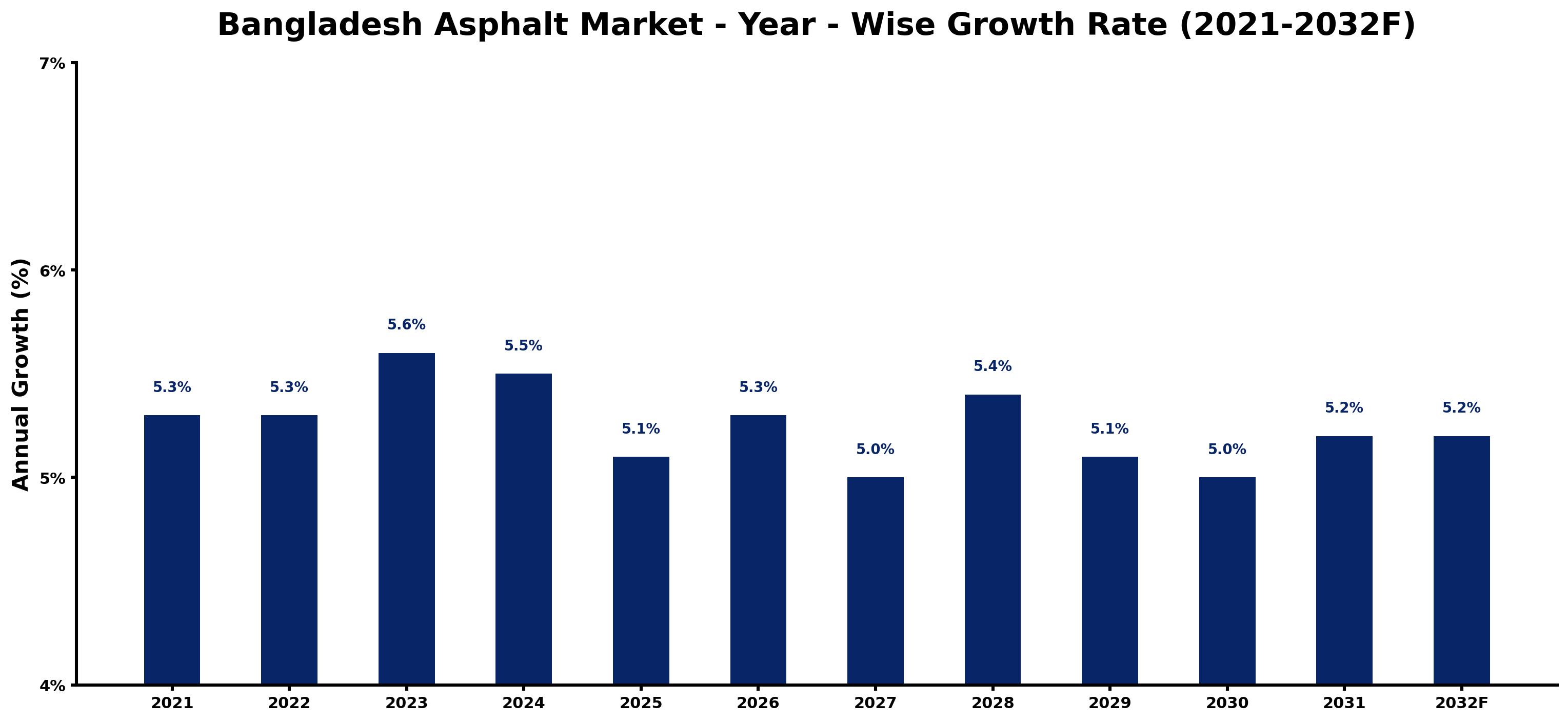
The table below presents the year wise growth rates along with the key drivers influencing the market
| Year | Growth Rate | Major Drivers |
| 2021 | 5.3% | Post-pandemic infrastructure projects began revitalizing the construction sector in Bangladesh. |
| 2022 | 5.3% | International investment influx strengthened the country's asphalt production capabilities and efficiency. |
| 2023 | 5.6% | Urbanization trends led to increased demand for road construction and maintenance. |
| 2024 | 5.5% | Major public-private partnerships emerged, enhancing asphalt supply chain resiliency and innovation. |
| 2025 | 5.1% | Technological improvements in asphalt recycling have optimized material usage in construction. |
| 2026 | 5.3% | Regional infrastructure projects, like Dhaka's metro expansion, spurred significant asphalt consumption growth. |
| 2027 | 5.0% | Increased vehicle ownership rates necessitated the development of more extensive road networks. |
| 2028 | 5.4% | Climate adaptation projects prompted investment in sustainable asphalt technologies and practices. |
| 2029 | 5.1% | Evolving construction standards drove demand for higher-quality asphalt products in urban areas. |
| 2030 | 5.0% | Collaboration between local governments and private contractors improved project execution timelines. |
| 2031 | 5.2% | Emerging trends in smart city development influenced modern asphalt application techniques. |
| 2032 | 5.2% | Bangladesh's integration into regional economic frameworks enhanced cross-border asphalt market dynamics. |
Note - Market size estimations and growth projections presented in this report are based on 6Wresearch's advanced forecasting approach, validated with industry datasets as of June 2026.
Bangladesh Asphalt Market Synopsis
The Bangladesh Asphalt Market is projected to reach 5.3% and witness significant growth during the forecast period (2026-2032). This growth is primarily attributed to the increasing infrastructure development initiatives undertaken by the government, which have catalyzed the demand for asphalt in road construction and maintenance. Moreover, the emphasis on enhancing transportation networks continues to solidify asphalt's role in various construction projects across the country.
Bangladesh Asphalt Market Growth Drivers
The Bangladesh Asphalt Market is experiencing growth driven by multiple factors that are reshaping the landscape of construction within the nation. Firstly, rapid urbanization has led to increasing traffic congestion, prompting significant investments in road infrastructure. Secondly, government-led initiatives aimed at improving the quality and extent of the transportation network are fostering a favorable environment for asphalt demand. Thirdly, mega projects like the Padma Bridge and the Dhaka Elevated Expressway are pushing for extensive asphalt use for their completion. Additionally, the shift towards sustainable practices, including the usage of recycled materials in asphalt production, is gaining momentum, appealing to both manufacturers and contractors. Lastly, the overall economic growth in Bangladesh is stimulating construction activities, further elevating the need for asphalt products.
Bangladesh Asphalt Market Trends and Opportunities
In the context of the Bangladesh Asphalt Market, notable trends are emerging that signal opportunities for stakeholders. The adoption of warm mix asphalt is becoming prevalent, owing to its environmental benefits and cost-efficiency compared to traditional methods. The demand for higher-quality materials that ensure durability and longevity in road construction is also increasing. Moreover, contractors are increasingly embracing innovative asphalt application technologies that enhance performance and reduce project timelines. There is also a rising focus on sustainable practices that prioritize environmentally friendly production methods, opening avenues for investment in green technologies. Given the growing emphasis on infrastructure by the Bangladeshi government, there are promising prospects for businesses that align with these evolving market demands.
Bangladesh Asphalt Market Challenges and Restraints
Despite its potential, the Bangladesh Asphalt Market faces several challenges that could impede growth. One of the primary concerns is the reliability of supply chains, which can result in delays that affect project timelines. Additionally, inconsistency in the quality of asphalt products has raised durability issues, prompting calls for improved quality control measures. Limited technological advancements within the industry are also hindering efficiency and performance improvements. Furthermore, government regulations affecting the importation and distribution of asphalt can introduce obstacles for market participants. Lastly, environmental concerns regarding asphalt production and application processes necessitate a focus on sustainable practices to reduce the industry's ecological footprint.
Bangladesh Asphalt Market Investment Opportunities
Investment opportunities within the Bangladesh Asphalt Market are quite promising, given the ongoing infrastructural development in the country. Establishing asphalt manufacturing plants can be a lucrative avenue for investors seeking to meet the rising demand for quality asphalt. Moreover, there is potential for investments in distribution networks aimed at enhancing logistics for asphalt supply to construction companies across various regions. Strategic partnerships with local contractors and government agencies responsible for infrastructure projects can also provide competitive advantages and facilitate market entry. As the government continues to prioritize transportation network enhancements, investing in this sector could yield attractive long-term returns.
Bangladesh Asphalt Market Government Investment and Initiatives
The Bangladeshi government has implemented a series of policies aimed at supporting the asphalt market and fostering sustainable growth. These include the establishment of quality standards for asphalt products, ensuring that all materials used in construction meet safety and durability benchmarks. There is a pronounced effort by the government to promote the utilization of environmentally friendly asphalt materials that mitigate the ecological impact of road construction. Initiatives to streamline licensing and permitting processes for asphalt manufacturers are also in place, which facilitate smoother business operations. The government's infrastructure development plans signal a commitment to enhancing road networks, indicating a positive trajectory for the asphalt market. Overall, these investments and initiatives reflect a strategic approach to bolster the asphalt industry while adhering to regulatory standards.
Bangladesh Asphalt Market Latest Developments (May 2025 - June 2026)
In the timeframe from May 2025 to June 2026, several significant developments have occurred within the Bangladesh Asphalt Market. Industry players have increasingly sought to innovate their product offerings, focusing on sustainable materials and more efficient production methods. The government has initiated new funding programs aimed at enhancing road infrastructure, emphasizing environmentally friendly practices in asphalt production. Additionally, there has been a noticeable increase in collaboration between local manufacturers and international firms, aimed at technology transfer and skill development in asphalt production. Ongoing training programs for contractors on best practices in asphalt application have also been implemented, which aligns with the government's commitment to improving overall road quality. These developments highlight the dynamic nature of the market, underscoring the importance of adaptability in addressing evolving industry demands.
Bangladesh Asphalt Market - Key Attractiveness of the Report
- 10 Years of Market Numbers
- Historical Data Starting from 2022 to 2025
- Base Year: 2025
- Forecast Data until 2032
- Key Performance Indicators Impacting the Market
- Major Upcoming Developments and Projects
Key Highlights of the Report:
- Bangladesh Asphalt Market Outlook
- Market Size of Bangladesh Asphalt Market, 2025
- Forecast of Bangladesh Asphalt Market, 2032F
- Historical Data and Forecast of Bangladesh Asphalt Revenues & Volume for the Period 2022-2032F
- Bangladesh Asphalt Market Trend Evolution
- Bangladesh Asphalt Market Drivers and Challenges
- Bangladesh Asphalt Price Trends
- Bangladesh Asphalt Porter's Five Forces
- Bangladesh Asphalt Industry Life Cycle
- Historical Data and Forecast of Bangladesh Asphalt Market Revenues & Volume By Type for the Period 2022-2032F
- Historical Data and Forecast of Bangladesh Asphalt Market Revenues & Volume By Paving Petroleum Asphalt for the Period 2022-2032F
- Historical Data and Forecast of Bangladesh Asphalt Market Revenues & Volume By Industrial Petroleum Asphalt for the Period 2022-2032F
- Historical Data and Forecast of Bangladesh Asphalt Market Revenues & Volume By Others for the Period 2022-2032F
- Historical Data and Forecast of Bangladesh Asphalt Market Revenues & Volume By Application for the Period 2022-2032F
- Historical Data and Forecast of Bangladesh Asphalt Market Revenues & Volume By Paving for the Period 2022-2032F
- Historical Data and Forecast of Bangladesh Asphalt Market Revenues & Volume By Roofing for the Period 2022-2032F
- Historical Data and Forecast of Bangladesh Asphalt Market Revenues & Volume By Others for the Period 2022-2032F
- Bangladesh Asphalt Import Export Trade Statistics
- Market Opportunity Assessment By Type
- Market Opportunity Assessment By Application
- Bangladesh Asphalt Top Companies Market Share
- Bangladesh Asphalt Competitive Benchmarking By Technical and Operational Parameters
- Bangladesh Asphalt Company Profiles
- Bangladesh Asphalt Key Strategic Recommendations






































