Bangladesh Auto Parts And Accessories Market Size, Share & Growth Rate
The Bangladesh Auto Parts And Accessories Market was estimated at USD 154 Million in 2025 and is projected to reach USD 201 Million by 2032, growing at a CAGR of 3.9% from 2026 to 2032. This robust growth trajectory is underpinned by an increasing number of vehicles on the roads and a significant rise in the demand for aftermarket products. As the middle class expands and urbanization accelerates, consumers are more inclined to invest in vehicle customization and performance upgrades, further fueling market expansion.
Bangladesh Auto Parts And Accessories Market Year-wise Growth Rate and Key Drivers
This graph highlights how the Bangladesh Auto Parts And Accessories Market has steadily grown over the years, supported by major growth factors.
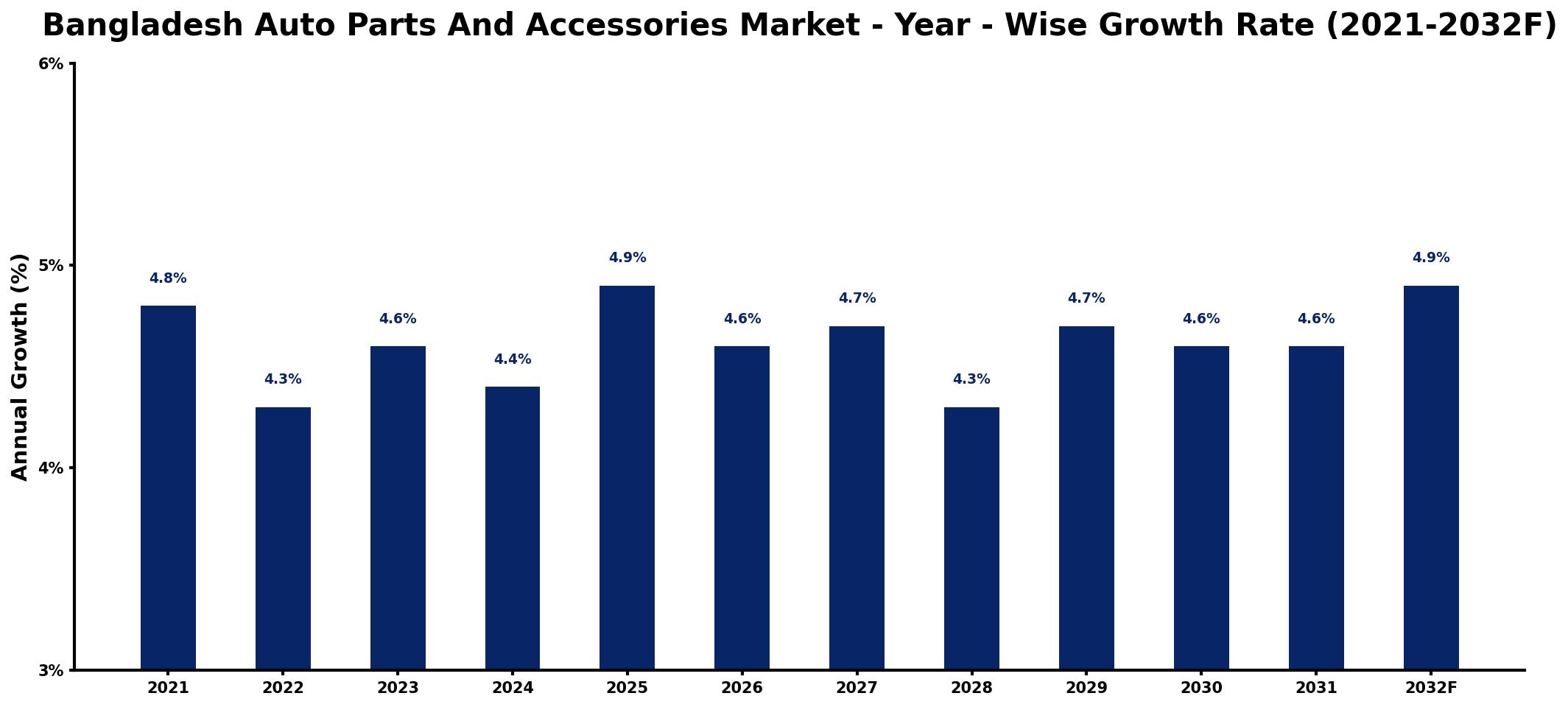
The table below presents the year‑wise growth rates along with the key drivers influencing the market
| Year | Growth Rate | Major Drivers |
| 2021 | 4.8% | Rising consumer vehicle ownership |
| 2022 | 4.3% | Growing demand for electric vehicles |
| 2023 | 4.6% | Increased foreign investment influx |
| 2024 | 4.4% | Expansion of logistics infrastructure |
| 2025 | 4.9% | Surge in local manufacturing capacity |
| 2026 | 4.6% | Higher disposable income levels |
| 2027 | 4.7% | Technological advancements in production |
| 2028 | 4.3% | Strengthened supply chain networks |
| 2029 | 4.7% | Growing popularity of ride-sharing |
| 2030 | 4.6% | Increased urbanization trends observed |
| 2031 | 4.6% | rising demand from electronics |
| 2032 | 4.9% | Rising focus on sustainability initiatives |
Note: Market size estimations and growth projections presented in this report are based on 6Wresearch's proprietary forecasting methodology, utilizing the latest available industry data, government publications, and primary research inputs.
Bangladesh Auto Parts And Accessories Market Synopsis
Currently, the Bangladesh auto parts and accessories market is thriving, driven by the burgeoning vehicle ownership among the populace. This trend is catalyzed by improved road infrastructure and an expanding economy, both of which have heightened demand for both basic and advanced auto parts.
Moreover, vehicle owners in Bangladesh are increasingly opting for customized features and upgrades, leading to a surge in sales of aftermarket accessories. Eco-conscious consumers are also leaning towards energy-efficient auto parts, aligning with the country's sustainability goals, thereby reshaping the landscape of this market.
Bangladesh Auto Parts And Accessories Market Key Takeaways
- The market is experiencing steady growth, driven by rising vehicle ownership and disposable incomes.
- There is a noticeable shift towards aftermarket customization and performance enhancements among consumers.
- Eco-friendly and energy-efficient parts are gaining traction, reflecting a growing sustainability focus.
- The influx of digital technologies enhances vehicle safety and user experience through smart accessories.
- Investment opportunities abound in manufacturing, distribution, and innovative automotive technologies.
Evaluation of Restraints in Bangladesh Auto Parts And Accessories Market
Despite its potential, the Bangladesh auto parts and accessories market grapples with significant constraints. One of the most pressing issues is the prevalence of counterfeit products, which compromise safety and vehicle performance. The lack of standardization exacerbates the challenge, as consumers often struggle to distinguish between authentic and substandard parts. Additionally, the underdeveloped distribution network creates logistical hurdles, delaying access to required auto parts and hindering overall market efficiency.
Bangladesh Auto Parts And Accessories Market Trends
Several key trends are shaping the Bangladesh auto parts and accessories market. Firstly, the demand for aftermarket parts is soaring as consumers increasingly seek vehicle customization options. Components such as alloy wheels and body kits are particularly popular among younger drivers looking to enhance aesthetics and performance.
Moreover, there's a notable pivot towards eco-friendly products, particularly in light of global sustainability trends. This includes components tailored for electric vehicles, which are expected to become more mainstream. Additionally, the incorporation of smart technologies into vehicles is creating a new category of connected accessories that improve safety and convenience, further driving market demand.
Bangladesh Auto Parts And Accessories Market Opportunities
The Bangladesh auto parts and accessories market is ripe with investment opportunities. There is a growing need for high-quality, affordable auto parts, paving the way for local manufacturing facilities to meet domestic demand. Moreover, the introduction of innovative technologies such as electric vehicle components and smart automotive solutions can cater to the evolving needs of consumers. Collaborating with local manufacturers offers a strategic advantage for international investors looking to establish a foothold in this dynamic market, leveraging Bangladeshs strategic location for potential exports.
Government Initiatives in the Bangladesh Auto Parts And Accessories Market
The Bangladeshi government has put several initiatives in place to nurture the auto parts and accessories market. These include reducing import duties on raw materials to incentivize local production, as well as offering tax breaks and subsidies aimed at attracting foreign investment. Additionally, the establishment of industrial zones specifically for the auto parts sector provides essential infrastructure and resources, promoting both growth and quality enhancement in the industry.
Future Insights of the Bangladesh Auto Parts And Accessories Market
Looking ahead to 2026-2032, the Bangladesh auto parts and accessories market is anticipated to sustain its growth momentum. The rise in vehicle ownership coupled with a burgeoning middle class indicates a long-term demand for replacement parts, particularly as the existing vehicle fleet ages. Moreover, technological advancements, including the shift towards electric vehicles and the integration of connected car technology, will likely open new avenues for auto parts manufacturers and suppliers, positioning them well within an evolving automotive landscape.
Bangladesh Auto Parts And Accessories Market Latest Developments (2025 - 2026)
In recent months, the Bangladesh auto parts and accessories market has been experiencing significant momentum, marked by an increasing focus on digital technologies. New players are emerging with innovative smart accessories, enhancing vehicle functionalities. Additionally, collaborations between local manufacturers and international firms are on the rise, aimed at elevating quality standards and expanding the product range available to consumers.
Bangladesh Auto Parts And Accessories Market - Key Attractiveness of the Report
- 10 Years of Market Numbers
- Historical Data Starting from 2022 to 2025
- Base Year: 2025
- Forecast Data until 2032
- Key Performance Indicators Impacting the Market
- Major Upcoming Developments and Projects
Key Highlights of the Report:
- Bangladesh Auto Parts And Accessories Market Outlook
- Market Size of Bangladesh Auto Parts And Accessories Market, 2025
- Forecast of Bangladesh Auto Parts And Accessories Market, 2032
- Historical Data and Forecast of Bangladesh Auto Parts And Accessories Revenues & Volume for the Period 2022-2032F
- Bangladesh Auto Parts And Accessories Market Trend Evolution
- Bangladesh Auto Parts And Accessories Market Drivers and Challenges
- Bangladesh Auto Parts And Accessories Price Trends
- Bangladesh Auto Parts And Accessories Porter's Five Forces
- Bangladesh Auto Parts And Accessories Industry Life Cycle
- Historical Data and Forecast of Bangladesh Auto Parts And Accessories Market Revenues & Volume By Product for the Period 2022-2032F
- Historical Data and Forecast of Bangladesh Auto Parts And Accessories Market Revenues & Volume By Driveline & Powertrain for the Period 2022-2032F
- Historical Data and Forecast of Bangladesh Auto Parts And Accessories Market Revenues & Volume By Interiors & Exteriors for the Period 2022-2032F
- Historical Data and Forecast of Bangladesh Auto Parts And Accessories Market Revenues & Volume By Electronics for the Period 2022-2032F
- Historical Data and Forecast of Bangladesh Auto Parts And Accessories Market Revenues & Volume By Bodies & Chassis for the Period 2022-2032F
- Historical Data and Forecast of Bangladesh Auto Parts And Accessories Market Revenues & Volume By Wheel & Tires for the Period 2022-2032F
- Historical Data and Forecast of Bangladesh Auto Parts And Accessories Market Revenues & Volume By Others for the Period 2022-2032F
- Historical Data and Forecast of Bangladesh Auto Parts And Accessories Market Revenues & Volume By Application for the Period 2022-2032F
- Historical Data and Forecast of Bangladesh Auto Parts And Accessories Market Revenues & Volume By OEMs for the Period 2022-2032F
- Historical Data and Forecast of Bangladesh Auto Parts And Accessories Market Revenues & Volume By Aftermarket for the Period 2022-2032F
- Bangladesh Auto Parts And Accessories Import Export Trade Statistics
- Market Opportunity Assessment By Product
- Market Opportunity Assessment By Application
- Bangladesh Auto Parts And Accessories Top Companies Market Share
- Bangladesh Auto Parts And Accessories Competitive Benchmarking By Technical and Operational Parameters
- Bangladesh Auto Parts And Accessories Company Profiles
- Bangladesh Auto Parts And Accessories Key Strategic Recommendations






































