Bangladesh Automotive Aftermarket Market Size, Share & Growth Rate
The Bangladesh Automotive Aftermarket Market was estimated at USD 398 Million in 2025 and is projected to reach USD 555 Million by 2032, growing at a CAGR of 4.9% from 2026 to 2032. This growth trajectory is primarily driven by the increasing vehicle population on the roads, coupled with rising disposable incomes among consumers. Additionally, a growing urban middle class is expected to fuel demand for maintenance and customization services, further enhancing market dynamics.
Bangladesh Automotive Aftermarket Market Year-wise Growth Rate and Key Drivers
This graph highlights how the Bangladesh Automotive Aftermarket Market has steadily grown over the years, supported by major growth factors.
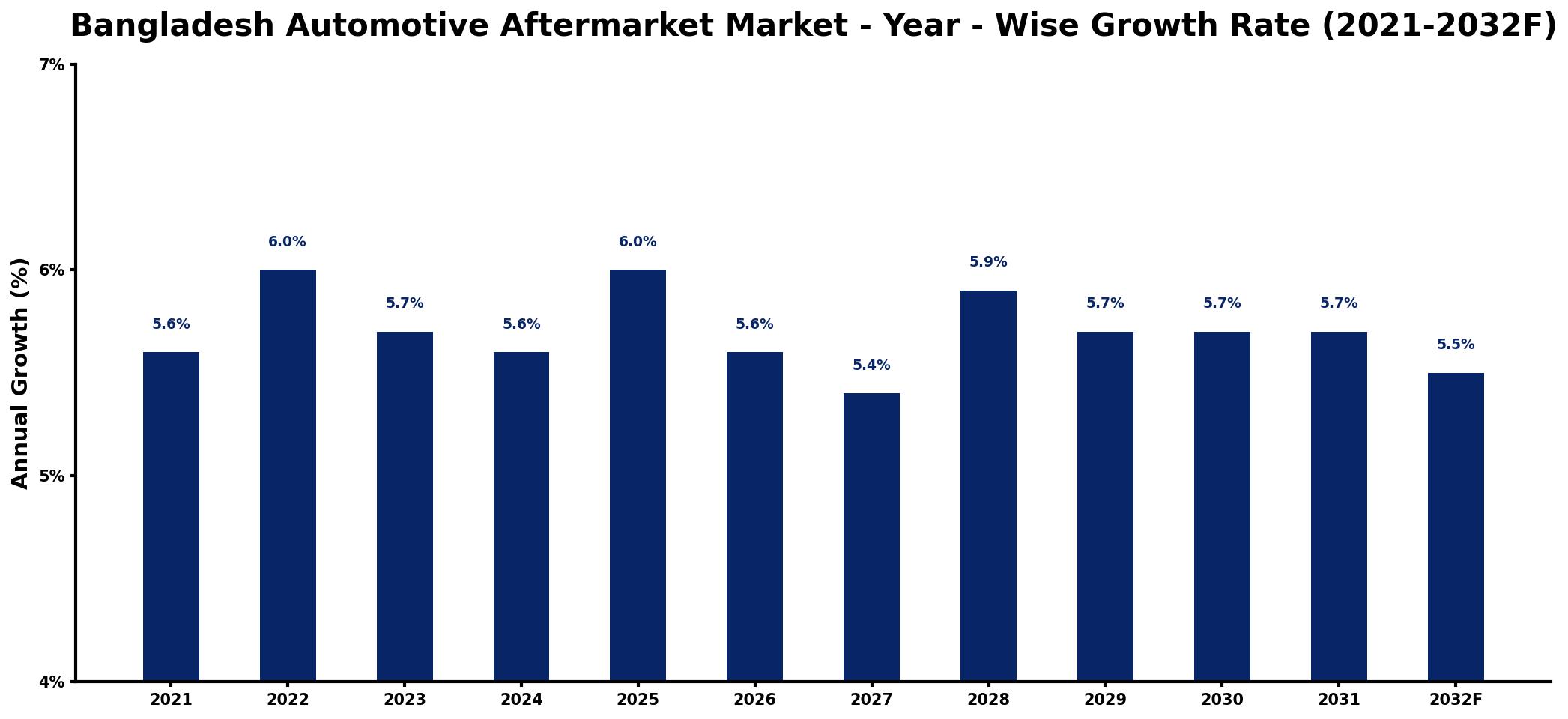
The table below presents the year‑wise growth rates along with the key drivers influencing the market
| Year | Growth Rate | Major Drivers |
| 2021 | 5.6% | Rising disposable income levels |
| 2022 | 6.0% | Increased vehicle ownership rates |
| 2023 | 5.7% | Growing urban population density |
| 2024 | 5.6% | Expansion of transportation infrastructure |
| 2025 | 6.0% | Surge in e-commerce logistics |
| 2026 | 5.6% | Investments in renewable energy |
| 2027 | 5.4% | Technological advancements in mobility |
| 2028 | 5.9% | Higher consumer spending patterns |
| 2029 | 5.7% | Strengthening supply chain networks |
| 2030 | 5.7% | Increased focus on sustainability |
| 2031 | 5.7% | Growth in ride-sharing services |
| 2032 | 5.5% | Development of new financing options |
Note: Market size estimations and growth projections presented in this report are based on 6Wresearch's proprietary forecasting methodology, utilizing the latest available industry data, government publications, and primary research inputs.
Bangladesh Automotive Aftermarket Market Synopsis
The Bangladesh automotive aftermarket is witnessing an upsurge in demand for spare parts and repair services, largely driven by the increasing number of vehicles. As more individuals acquire vehicles, the necessity for maintenance and replacement components becomes imperative, creating a fertile ground for aftermarket growth.
The market is characterized by an evolving competitive landscape where both local and international brands vie for market share. This competition results in a diverse array of products and services, ranging from affordable options to premium offerings, catering to the varied needs of vehicle owners across the country.
Bangladesh Automotive Aftermarket Market Key Takeaways
- The market is set to grow significantly due to the rising number of vehicles and increased consumer spending.
- Digital platforms are becoming increasingly popular for purchasing aftermarket products, enhancing convenience for consumers.
- Customization and personalization of vehicles are emerging as key trends in consumer preferences.
- Investment opportunities are abundant, especially in eco-friendly and innovative automotive solutions.
- The government is actively implementing policies to improve product quality and consumer protection in the aftermarket sector.
Evaluation of Restraints in Bangladesh Automotive Aftermarket Market
While the Bangladesh automotive aftermarket holds considerable promise, several restraints hinder its full potential. The prevalence of counterfeit parts poses significant challenges, impacting both vehicle safety and consumer satisfaction. Moreover, the absence of standardized regulations can lead to varying product quality, making it difficult for consumers to identify reliable options. Limited awareness regarding the advantages of genuine products further complicates the landscape, as many buyers opt for cheaper alternatives without understanding the associated risks. Additionally, the fragmentation of the market, characterized by numerous small-scale retailers, complicates pricing and service consistency, presenting hurdles for customer decision-making.
Bangladesh Automotive Aftermarket Market Trends
Several key trends are shaping the Bangladesh automotive aftermarket landscape. A notable shift towards personalization is evident, as consumers increasingly seek unique car accessories and customization options to reflect their personal style. Moreover, the rising popularity of online shopping for aftermarket products is transforming traditional purchasing methods, enabling consumers to access a wider range of options with greater convenience. Environmental considerations are also taking center stage, with a growing demand for eco-friendly products that minimize the automotive sector's carbon footprint. Digital marketing strategies are evolving, enabling brands to effectively reach and engage target audiences.
Bangladesh Automotive Aftermarket Market Opportunities
Investment opportunities in the Bangladesh automotive aftermarket are robust, driven by the expanding vehicle population and a rising need for spare parts and maintenance services. Establishing efficient distribution networks for aftermarket products is a promising avenue for growth. Furthermore, specialized repair and maintenance centers, particularly those focusing on eco-friendly solutions, are gaining traction. As consumers become more conscious of sustainability, investments in green aftermarket products and services present lucrative possibilities for businesses aiming to align with emerging consumer preferences.
Government Initiatives in the Bangladesh Automotive Aftermarket Market
The Bangladesh government is taking proactive steps to regulate and enhance the automotive aftermarket sector. Policies aimed at establishing standards for spare parts and auto repair workshops are being implemented to ensure the quality and safety of products offered. Additionally, initiatives promoting the use of genuine parts and authorized service centers help bolster consumer trust in the aftermarket. The government is also focused on enforcing regulations surrounding the disposal of hazardous materials to promote environmental sustainability, ensuring that the automotive sector operates responsibly.
Future Insights of the Bangladesh Automotive Aftermarket Market
Looking ahead to 2026-2032, the Bangladesh automotive aftermarket is expected to experience substantial growth, fueled by a rising middle class and increasing disposable incomes. The growing preference for customization will drive demand for various aftermarket products and services. Furthermore, advancements in technology will likely enhance supply chain efficiencies and customer experiences, positioning market players who prioritize innovation favorably in a competitive landscape. Overall, the future is promising for businesses looking to capitalize on the evolving needs of vehicle owners in Bangladesh.
Bangladesh Automotive Aftermarket Market Latest Developments (2025 - 2026)
In recent months, the Bangladesh automotive aftermarket has seen increased activity focusing on the introduction of sustainable products and services. Market participants are leveraging online platforms for the distribution of aftermarket goods, which is becoming a critical component of business strategies. Additionally, many companies are exploring strategic partnerships to enhance their product offerings and improve service delivery. This trend reflects a broader commitment to meeting the rising expectations of consumers, particularly in areas such as vehicle customization and eco-friendliness.
Bangladesh Automotive Aftermarket Market - Key Attractiveness of the Report
- 10 Years of Market Numbers
- Historical Data Starting from 2022 to 2025
- Base Year: 2025
- Forecast Data until 2032
- Key Performance Indicators Impacting the Market
- Major Upcoming Developments and Projects
Key Highlights of the Report:
- Bangladesh Automotive Aftermarket Market Outlook
- Market Size of Bangladesh Automotive Aftermarket Market, 2025
- Forecast of Bangladesh Automotive Aftermarket Market, 2032
- Historical Data and Forecast of Bangladesh Automotive Aftermarket Revenues & Volume for the Period 2022-2032F
- Bangladesh Automotive Aftermarket Market Trend Evolution
- Bangladesh Automotive Aftermarket Market Drivers and Challenges
- Bangladesh Automotive Aftermarket Price Trends
- Bangladesh Automotive Aftermarket Porter's Five Forces
- Bangladesh Automotive Aftermarket Industry Life Cycle
- Historical Data and Forecast of Bangladesh Automotive Aftermarket Market Revenues & Volume By Replacement Parts for the Period 2022-2032F
- Historical Data and Forecast of Bangladesh Automotive Aftermarket Market Revenues & Volume By Tire for the Period 2022-2032F
- Historical Data and Forecast of Bangladesh Automotive Aftermarket Market Revenues & Volume By Battery for the Period 2022-2032F
- Historical Data and Forecast of Bangladesh Automotive Aftermarket Market Revenues & Volume By Brake Parts for the Period 2022-2032F
- Historical Data and Forecast of Bangladesh Automotive Aftermarket Market Revenues & Volume By Filters for the Period 2022-2032F
- Historical Data and Forecast of Bangladesh Automotive Aftermarket Market Revenues & Volume By Body parts for the Period 2022-2032F
- Historical Data and Forecast of Bangladesh Automotive Aftermarket Market Revenues & Volume By Lighting & Electronic Components for the Period 2022-2032F
- Historical Data and Forecast of Bangladesh Automotive Aftermarket Market Revenues & Volume By Wheels for the Period 2022-2032F
- Historical Data and Forecast of Bangladesh Tire Automotive Aftermarket Market Revenues & Volume By Exhaust components for the Period 2022-2032F
- Historical Data and Forecast of Bangladesh Automotive Aftermarket Market Revenues & Volume By Distribution Channel for the Period 2022-2032F
- Historical Data and Forecast of Bangladesh Automotive Aftermarket Market Revenues & Volume By Retailers for the Period 2022-2032F
- Historical Data and Forecast of Bangladesh Automotive Aftermarket Market Revenues & Volume By Wholesalers & Distributors for the Period 2022-2032F
- Historical Data and Forecast of Bangladesh Automotive Aftermarket Market Revenues & Volume By Service Channel for the Period 2022-2032F
- Historical Data and Forecast of Bangladesh Automotive Aftermarket Market Revenues & Volume By DIY (Do it Yourself) for the Period 2022-2032F
- Historical Data and Forecast of Bangladesh Automotive Aftermarket Market Revenues & Volume By DIFM (Do it for Me) for the Period 2022-2032F
- Historical Data and Forecast of Bangladesh Automotive Aftermarket Market Revenues & Volume By OE (Delegating to OEM??s) for the Period 2022-2032F
- Historical Data and Forecast of Bangladesh Automotive Aftermarket Market Revenues & Volume By Certification for the Period 2022-2032F
- Historical Data and Forecast of Bangladesh Automotive Aftermarket Market Revenues & Volume By Genuine Parts for the Period 2022-2032F
- Historical Data and Forecast of Bangladesh Automotive Aftermarket Market Revenues & Volume By Certified Parts for the Period 2022-2032F
- Historical Data and Forecast of Bangladesh Automotive Aftermarket Market Revenues & Volume By Uncertified Parts for the Period 2022-2032F
- Bangladesh Automotive Aftermarket Import Export Trade Statistics
- Market Opportunity Assessment By Replacement Parts
- Market Opportunity Assessment By Distribution Channel
- Market Opportunity Assessment By Service Channel
- Market Opportunity Assessment By Certification
- Bangladesh Automotive Aftermarket Top Companies Market Share
- Bangladesh Automotive Aftermarket Competitive Benchmarking By Technical and Operational Parameters
- Bangladesh Automotive Aftermarket Company Profiles
- Bangladesh Automotive Aftermarket Key Strategic Recommendations






































