Bangladesh Automotive collision repair Market Size, Share & Growth Rate
The Bangladesh Automotive collision repair Market was estimated at USD 973 Million in 2025 and is projected to reach USD 1668 Million by 2032, growing at a CAGR of 8.0% from 2026 to 2032. This growth trajectory is primarily fueled by the increasing number of vehicles on the roads, which naturally escalates the demand for repair services following accidents. Moreover, rising disposable incomes and enhanced consumer awareness regarding vehicle maintenance are further driving the need for efficient and quality collision repair solutions across the nation.
Bangladesh Automotive collision repair Market Year-wise Growth Rate and Key Drivers
This graph highlights how the Bangladesh Automotive collision repair Market has steadily grown over the years, supported by major growth factors.
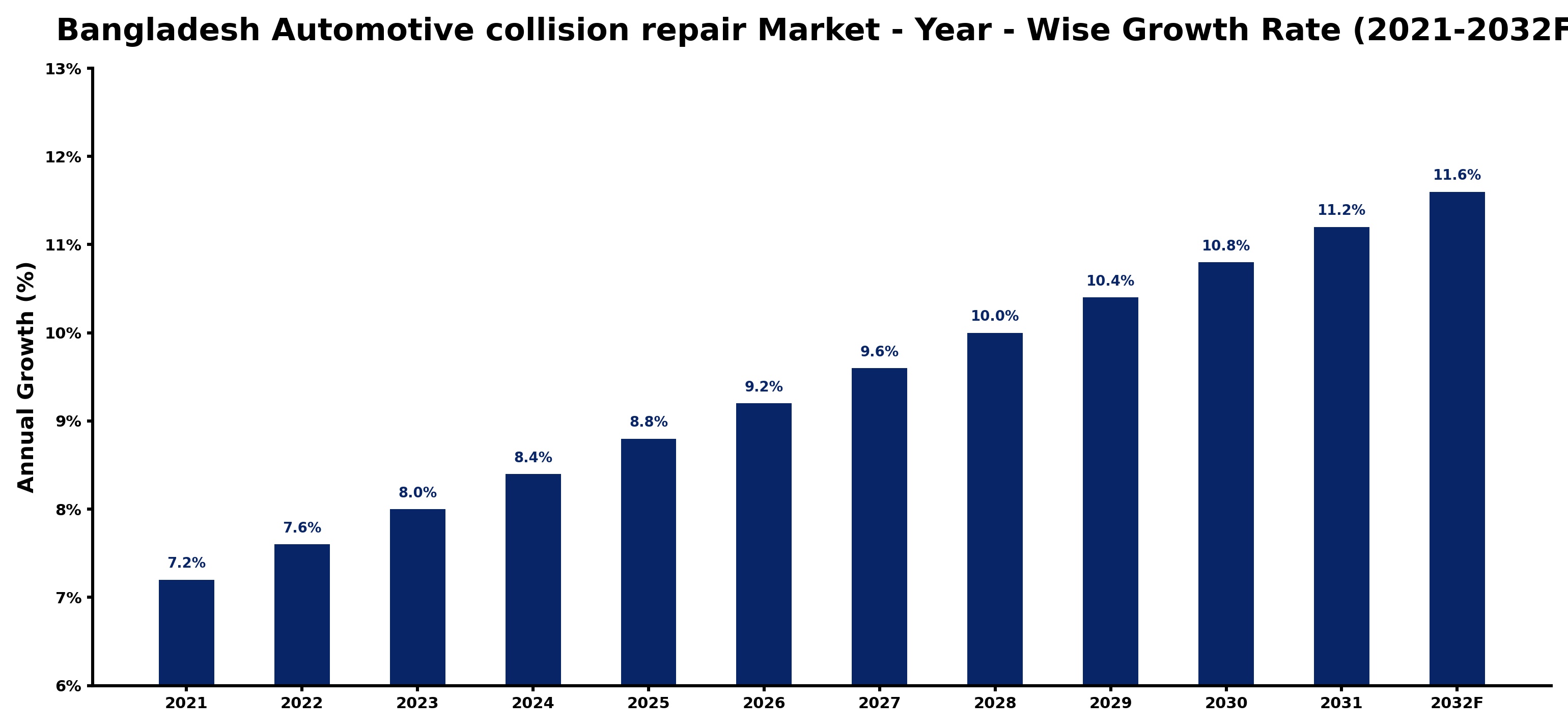
The table below presents the year‑wise growth rates along with the key drivers influencing the market
| Year | Growth Rate | Major Drivers |
| 2021 | 7.2% | Rising vehicle ownership rates |
| 2022 | 7.6% | Increased demand for repairs |
| 2023 | 8.0% | Technological advancements in repairs |
| 2024 | 8.4% | Expansion of service centers |
| 2025 | 8.8% | Growing insurance coverage options |
| 2026 | 9.2% | Enhanced customer service standards |
| 2027 | 9.6% | Increased awareness of safety |
| 2028 | 10.0% | Government regulations supporting repairs |
| 2029 | 10.4% | Emergence of electric vehicles |
| 2030 | 10.8% | Investment in training programs |
| 2031 | 11.2% | Collaboration with automotive manufacturers |
| 2032 | 11.6% | Sustainability initiatives driving innovation |
Note - Market size estimations and growth projections presented in this report are based on 6Wresearch’s advanced forecasting approach, validated with industry datasets as of June 2026.
Bangladesh Automotive collision repair Market Synopsis
In recent years, the Bangladesh automotive collision repair market has gained momentum, propelled by urbanization and a rapid rise in vehicle ownership. As road accidents become increasingly common, repair shops are witnessing an uptick in demand for their services. Looking ahead, the market is poised for robust growth as consumers gravitate towards advanced repair solutions, emphasizing quality and eco-friendliness.
While the current landscape shows promising potential, it is not without its challenges. The market is transitioning towards incorporating sophisticated technologies and customer-centric services that cater to evolving consumer expectations. This shift will be crucial in maintaining competitiveness in an environment that is increasingly focused on sustainability and technological advancement.
Bangladesh Automotive collision repair Market Key Takeaways
- The market is expected to see substantial growth driven by vehicle proliferation and rising accident rates.
- Technological advancements are being integrated into repair processes, enhancing service quality and efficiency.
- Consumer preferences are shifting towards eco-friendly repair options, impacting service offerings.
- Specialized services are emerging, such as paintless dent repair and alloy wheel repair, reflecting changing consumer expectations.
- Government regulations continue to shape the market, promoting safety and environmental considerations in repair practices.
Evaluation of Restraints in Bangladesh Automotive collision repair Market
Despite the positive growth indicators, the Bangladesh automotive collision repair market faces notable restraints. A lack of standardization and regulation has led to varying service quality across repair shops, resulting in inconsistent customer experiences. The market also struggles with a shortage of skilled technicians, making it difficult for repair facilities to meet the demands for advanced services. Additionally, the limited availability of genuine spare parts can adversely affect repair outcomes, reducing consumer trust and satisfaction over time.
Bangladesh Automotive collision repair Market Trends
The automotive collision repair market in Bangladesh is witnessing several noteworthy trends. Advanced technologies such as computerized diagnostic tools and paint-matching systems are becoming commonplace, enabling higher quality repairs with reduced turnaround times. Eco-friendly repair practices are gaining traction, pushing shops to adopt sustainable materials and methods. Furthermore, the demand for customized and specialized services is on the rise, with consumers increasingly seeking tailored repair solutions that exceed traditional service offerings.
Bangladesh Automotive collision repair Market Opportunities
Investors looking into the Bangladesh automotive collision repair market will find ample opportunities as vehicle ownership expands. Modernizing existing repair facilities with cutting-edge technology can significantly enhance service quality and attract a broader customer base. Additionally, the growing interest in eco-friendly repair options presents a viable pathway for innovation and differentiation. Collaborative ventures with insurance companies for streamlined claims processes can also unlock new avenues for growth.
Government Initiatives in the Bangladesh Automotive collision repair Market
The Bangladeshi government has introduced various policies aimed at regulating the automotive collision repair industry. These policies include establishing safety standards for repair facilities and licensing requirements for technicians to ensure a baseline level of service quality. Moreover, the government is promoting fair competition and environmental sustainability in repair practices, underscoring its commitment to enhancing industry standards while addressing consumer safety and environmental concerns.
Future Insights of the Bangladesh Automotive collision repair Market
Looking ahead to 2026-2032, the Bangladesh automotive collision repair market is projected to continue its upward trajectory, fueled by ongoing urbanization and increasing vehicle ownership. As consumers become more conscious of vehicle maintenance, the demand for high-quality repair services will escalate. Continued advancements in technology and a focus on sustainable practices will further shape the future of this market, presenting opportunities for innovative service delivery and enhanced customer satisfaction.
Bangladesh Automotive collision repair Market Latest Developments (May 2025 - June 2026)
Recent developments within the Bangladesh automotive collision repair market indicate a shift towards adopting advanced technologies for vehicle repair. An increasing number of shops are incorporating eco-friendly practices to cater to the growing demand for sustainable repair solutions. There has also been a noticeable focus on improving the transparency of pricing and service offerings, aimed at building consumer trust and enhancing overall satisfaction in repair services.
Bangladesh Automotive collision repair Market - Key Attractiveness of the Report
- 10 Years of Market Numbers
- Historical Data Starting from 2022 to 2025
- Base Year: 2025
- Forecast Data until 2032
- Key Performance Indicators Impacting the Market
- Major Upcoming Developments and Projects
Key Highlights of the Report:
- Bangladesh Automotive collision repair Market Outlook
- Market Size of Bangladesh Automotive collision repair Market, 2025
- Forecast of Bangladesh Automotive collision repair Market, 2032
- Historical Data and Forecast of Bangladesh Automotive collision repair Revenues & Volume for the Period 2022-2032F
- Bangladesh Automotive collision repair Market Trend Evolution
- Bangladesh Automotive collision repair Market Drivers and Challenges
- Bangladesh Automotive collision repair Price Trends
- Bangladesh Automotive collision repair Porter's Five Forces
- Bangladesh Automotive collision repair Industry Life Cycle
- Historical Data and Forecast of Bangladesh Automotive collision repair Market Revenues & Volume By Vehicle Type for the Period 2022-2032F
- Historical Data and Forecast of Bangladesh Automotive collision repair Market Revenues & Volume By Light-duty for the Period 2022-2032F
- Historical Data and Forecast of Bangladesh Automotive collision repair Market Revenues & Volume By Heavy-duty for the Period 2022-2032F
- Historical Data and Forecast of Bangladesh Automotive collision repair Market Revenues & Volume By Product for the Period 2022-2032F
- Historical Data and Forecast of Bangladesh Automotive collision repair Market Revenues & Volume By Paints & coatings for the Period 2022-2032F
- Historical Data and Forecast of Bangladesh Automotive collision repair Market Revenues & Volume By Consumables for the Period 2022-2032F
- Historical Data and Forecast of Bangladesh Automotive collision repair Market Revenues & Volume By Spare parts for the Period 2022-2032F
- Historical Data and Forecast of Bangladesh Automotive collision repair Market Revenues & Volume By Service Channel for the Period 2022-2032F
- Historical Data and Forecast of Bangladesh Automotive collision repair Market Revenues & Volume By DIY for the Period 2022-2032F
- Historical Data and Forecast of Bangladesh Automotive collision repair Market Revenues & Volume By DIFM for the Period 2022-2032F
- Historical Data and Forecast of Bangladesh Automotive collision repair Market Revenues & Volume By OE for the Period 2022-2032F
- Bangladesh Automotive collision repair Import Export Trade Statistics
- Market Opportunity Assessment By Vehicle Type
- Market Opportunity Assessment By Product
- Market Opportunity Assessment By Service Channel
- Bangladesh Automotive collision repair Top Companies Market Share
- Bangladesh Automotive collision repair Competitive Benchmarking By Technical and Operational Parameters
- Bangladesh Automotive collision repair Company Profiles
- Bangladesh Automotive collision repair Key Strategic Recommendations






































