Bangladesh Automotive Drive Shaft Market Size, Share & Growth Rate
The Bangladesh Automotive Drive Shaft Market was estimated at USD 374 Million in 2025 and is projected to reach USD 503 Million by 2032, growing at a CAGR of 4.3% from 2026 to 2032. This growth trajectory is primarily fueled by an increasing number of automobiles on the roads, driven by a rising population and growing disposable incomes. Moreover, the governments emphasis on infrastructure development and the expansion of the middle class are critical factors propelling the automotive sector, thereby increasing the demand for drive shafts.
Bangladesh Automotive Drive Shaft Market Year-wise Growth Rate and Key Drivers
This graph highlights how the Bangladesh Automotive Drive Shaft Market has steadily grown over the years, supported by major growth factors.
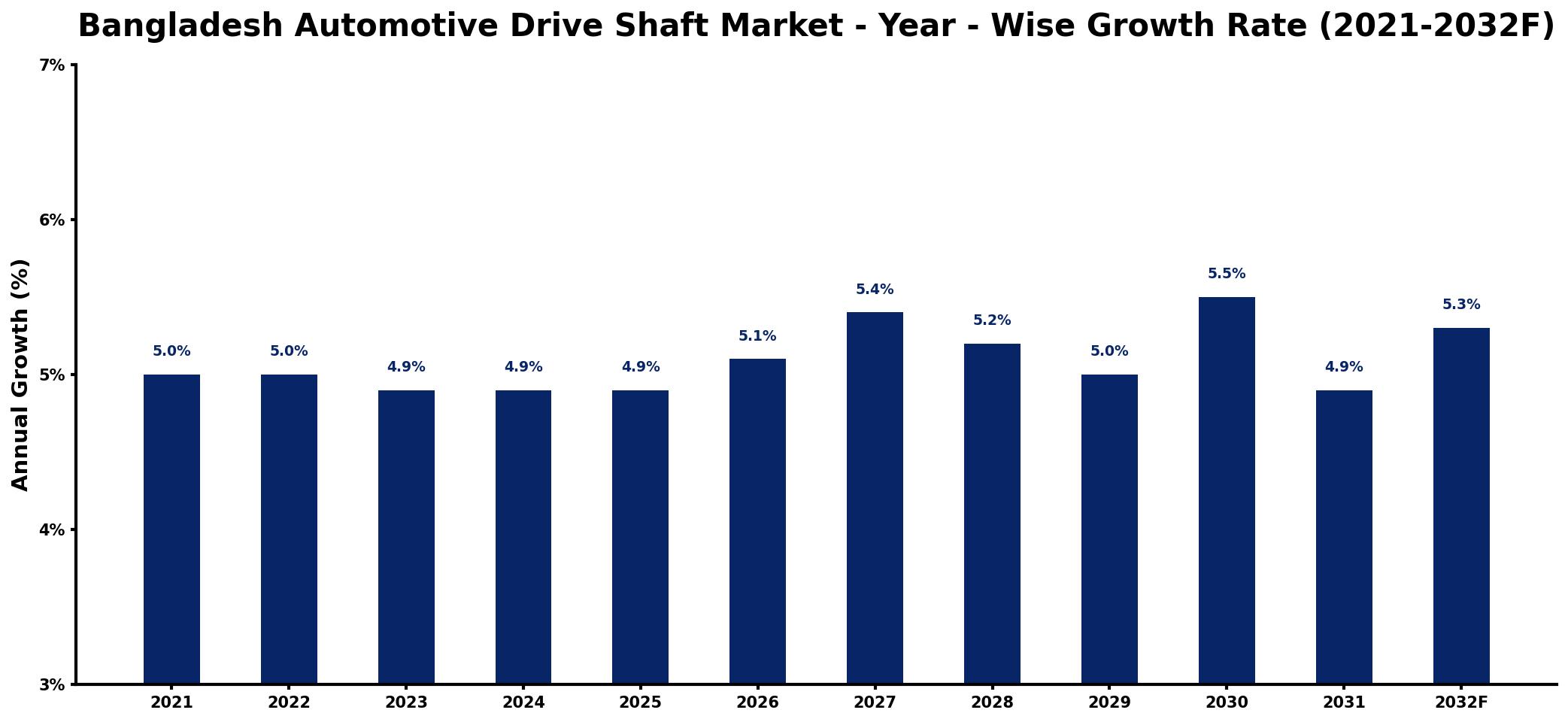
The table below presents the year‑wise growth rates along with the key drivers influencing the market
| Year | Growth Rate | Major Drivers |
| 2021 | 5.0% | Rising vehicle production rates |
| 2022 | 5.0% | Investments in manufacturing facilities |
| 2023 | 4.9% | Growth in transportation sector |
| 2024 | 4.9% | Increase in export opportunities |
| 2025 | 4.9% | Expansion of local suppliers |
| 2026 | 5.1% | Technological advancements in production |
| 2027 | 5.4% | Surge in electric vehicle adoption |
| 2028 | 5.2% | Government incentives for manufacturers |
| 2029 | 5.0% | Growing demand for infrastructure |
| 2030 | 5.5% | increased pharmaceutical industry usage |
| 2031 | 4.9% | Strengthening of local market dynamics |
| 2032 | 5.3% | Emergence of new industry players |
Note: Market size estimations and growth projections presented in this report are based on 6Wresearch's proprietary forecasting methodology, utilizing the latest available industry data, government publications, and primary research inputs.
Bangladesh Automotive Drive Shaft Market Synopsis
The Bangladesh Automotive Drive Shaft Market is witnessing a dynamic phase of growth as local automotive production ramps up and consumer demand rises. This increase is largely attributed to favorable demographic trends and improvements in living standards, creating a burgeoning market for vehicles. As a result, the drive shaft segment is poised to benefit significantly from this expansion.
In addition, manufacturers are prioritizing product innovations that cater to the evolving needs of consumers, including lightweight designs for enhanced fuel efficiency and sustainability. This strategic focus not only meets market demand but also aligns with global trends towards environmentally friendly automotive solutions, making the sector highly competitive.
Bangladesh Automotive Drive Shaft Market Key Takeaways
- Strong market growth driven by increased automobile production and consumer demand.
- Adoption of lightweight materials like carbon fiber and aluminum for drive shaft manufacturing.
- Strategic innovations focused on improving durability and fuel efficiency.
- Emerging opportunities in electric vehicle drive shafts aligned with market trends.
- Government policies promoting local manufacturing and reducing import dependency.
Evaluation of Restraints in Bangladesh Automotive Drive Shaft Market
Despite its potential, the Bangladesh Automotive Drive Shaft Market faces substantial constraints that could hinder growth. The prevalence of counterfeit products undermines trust in genuine manufacturers, posing a significant challenge for industry stakeholders. Additionally, the market grapples with a shortage of skilled labor and advanced technology, which limits production capabilities and innovation. Financial constraints faced by both consumers and manufacturers further complicate market expansion efforts. Moreover, heavy reliance on imported raw materials amplifies production costs, restricting the competitiveness of domestic producers.
Bangladesh Automotive Drive Shaft Market Trends
Several emerging trends are significantly shaping the Bangladesh Automotive Drive Shaft Market. A pronounced shift towards lightweight drive shafts is evident as manufacturers seek to enhance fuel efficiency and reduce vehicle emissions. The adoption of advanced materials, particularly carbon fiber and aluminum, is becoming increasingly popular. Concurrently, as the electric vehicle segment gains traction, theres a noticeable demand for drive shafts tailored to electric powertrains. Research and development investments are rising as stakeholders aim to innovate drive shaft technologies that fulfill the demands for greater durability, strength, and environmental sustainability.
Bangladesh Automotive Drive Shaft Market Opportunities
The Bangladesh Automotive Drive Shaft Market presents myriad investment opportunities in the context of its expanding automotive sector. Prospective investors can consider establishing manufacturing facilities for drive shafts, not only to cater to domestic needs but also to explore export possibilities. The government's commitment to fostering the automotive industry, paired with incentives for local production, makes forming strategic partnerships particularly appealing. Additionally, investing in R&D initiatives aimed at developing innovative drive shaft technologies that comply with global sustainability standards offers another promising avenue for growth.
Government Initiatives in the Bangladesh Automotive Drive Shaft Market
Government policies are increasingly favorable towards the Bangladesh Automotive Drive Shaft Market, with a clear focus on boosting local manufacturing capabilities. Various incentives, such as tax breaks and subsidies, are designed to support domestic manufacturers in the automotive sector. Stringent quality control regulations ensure the safety and reliability of drive shafts produced within the country. Furthermore, initiatives encouraging research and development aim to elevate the technological standards of local manufacturers, ultimately bolstering the industry's global competitiveness.
Future Insights of the Bangladesh Automotive Drive Shaft Market
Looking ahead to 2026-2032, the Bangladesh Automotive Drive Shaft Market is anticipated to continue its steady growth trajectory. The increasing production of automobiles, especially commercial vehicles, alongside burgeoning infrastructure investments, will enhance market demand significantly. Technological innovations in manufacturing processes and materials will likely lead to improved product performance and sustainability. However, factors such as fluctuating raw material costs and stricter emissions regulations may impose challenges. Overall, the market is poised for robust expansion, presenting ample opportunities for stakeholders across the automotive supply chain.
Bangladesh Automotive Drive Shaft Market Latest Developments (2025 - 2026)
Recent developments in the Bangladesh Automotive Drive Shaft Market indicate a strategic shift towards sustainability and innovation. Manufacturers are increasingly exploring lightweight materials for drive shafts to comply with environmental regulations and consumer preferences. There has been a notable uptick in research collaborations focusing on developing advanced drive shaft technologies suited for the growing electric vehicle segment, reflecting an industry-wide commitment to modernization.
Bangladesh Automotive Drive Shaft Market - Key Attractiveness of the Report
- 10 Years of Market Numbers
- Historical Data Starting from 2022 to 2025
- Base Year: 2025
- Forecast Data until 2032
- Key Performance Indicators Impacting the Market
- Major Upcoming Developments and Projects
Key Highlights of the Report:
- Bangladesh Automotive Drive Shaft Market Outlook
- Market Size of Bangladesh Automotive Drive Shaft Market, 2025
- Forecast of Bangladesh Automotive Drive Shaft Market, 2032
- Historical Data and Forecast of Bangladesh Automotive Drive Shaft Revenues & Volume for the Period 2022-2032F
- Bangladesh Automotive Drive Shaft Market Trend Evolution
- Bangladesh Automotive Drive Shaft Market Drivers and Challenges
- Bangladesh Automotive Drive Shaft Price Trends
- Bangladesh Automotive Drive Shaft Porter's Five Forces
- Bangladesh Automotive Drive Shaft Industry Life Cycle
- Historical Data and Forecast of Bangladesh Automotive Drive Shaft Market Revenues & Volume By Design Type for the Period 2022-2032F
- Historical Data and Forecast of Bangladesh Automotive Drive Shaft Market Revenues & Volume By Hollow Shaft for the Period 2022-2032F
- Historical Data and Forecast of Bangladesh Automotive Drive Shaft Market Revenues & Volume By Solid Shaft for the Period 2022-2032F
- Historical Data and Forecast of Bangladesh Automotive Drive Shaft Market Revenues & Volume By Position Type for the Period 2022-2032F
- Historical Data and Forecast of Bangladesh Automotive Drive Shaft Market Revenues & Volume By Rear Axle for the Period 2022-2032F
- Historical Data and Forecast of Bangladesh Automotive Drive Shaft Market Revenues & Volume By Front Axle for the Period 2022-2032F
- Historical Data and Forecast of Bangladesh Automotive Drive Shaft Market Revenues & Volume By Vehicle Type for the Period 2022-2032F
- Historical Data and Forecast of Bangladesh Automotive Drive Shaft Market Revenues & Volume By Passenger Cars for the Period 2022-2032F
- Historical Data and Forecast of Bangladesh Automotive Drive Shaft Market Revenues & Volume By Commercial Vehicles for the Period 2022-2032F
- Bangladesh Automotive Drive Shaft Import Export Trade Statistics
- Market Opportunity Assessment By Design Type
- Market Opportunity Assessment By Position Type
- Market Opportunity Assessment By Vehicle Type
- Bangladesh Automotive Drive Shaft Top Companies Market Share
- Bangladesh Automotive Drive Shaft Competitive Benchmarking By Technical and Operational Parameters
- Bangladesh Automotive Drive Shaft Company Profiles
- Bangladesh Automotive Drive Shaft Key Strategic Recommendations






































