Bangladesh Automotive Engine Market Size, Share & Growth Rate
The Bangladesh Automotive Engine Market was estimated at USD 329 Million in 2025 and is projected to reach USD 458 Million by 2032, growing at a CAGR of 4.8% from 2026 to 2032. This growth trajectory is driven by increasing disposable incomes and a burgeoning middle-class population that favors compact and fuel-efficient vehicles. Additionally, ongoing infrastructure development projects are further stimulating demand for both passenger and commercial vehicles in the region.
Bangladesh Automotive Engine Market Year-wise Growth Rate and Key Drivers
This graph highlights how the Bangladesh Automotive Engine Market has steadily grown over the years, supported by major growth factors.
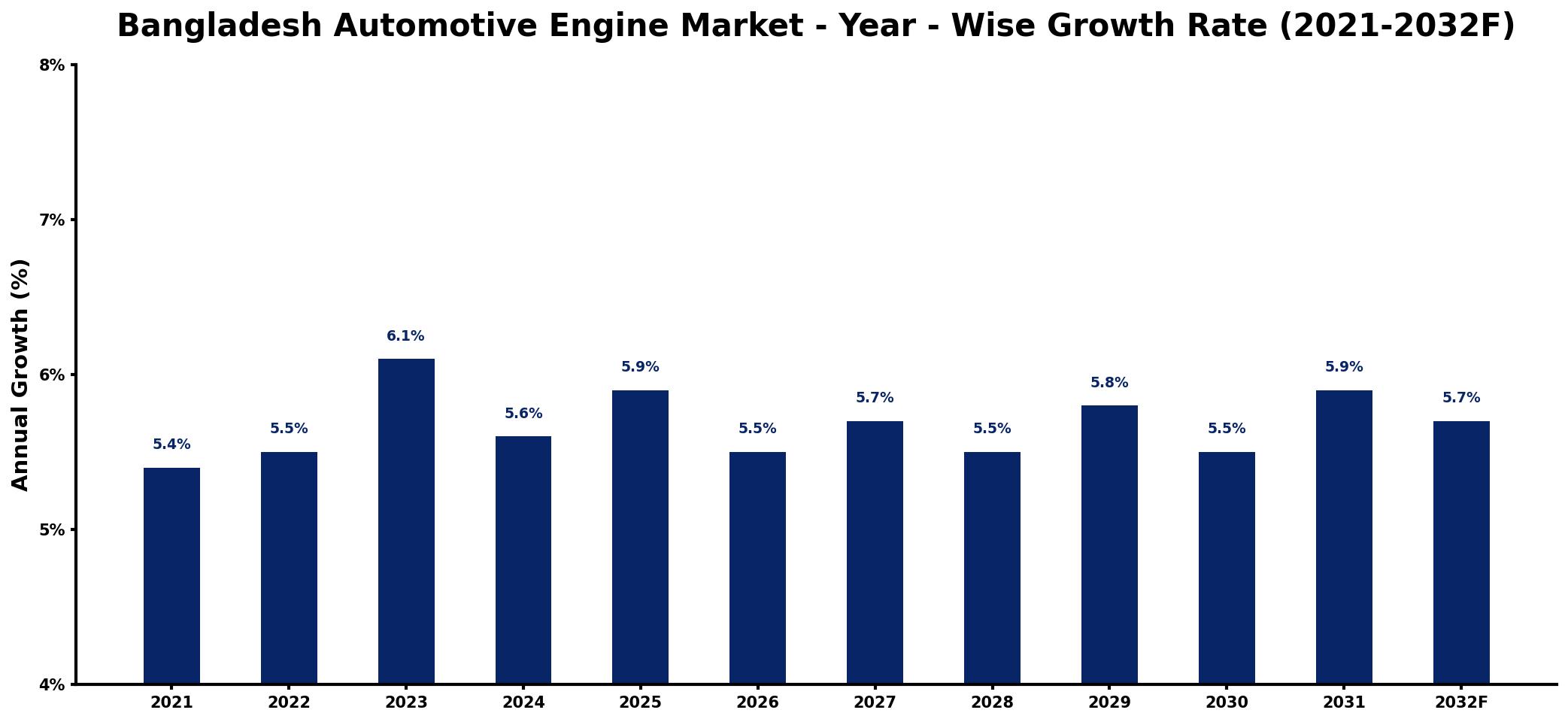
The table below presents the year‑wise growth rates along with the key drivers influencing the market
| Year | Growth Rate | Major Drivers |
| 2021 | 5.4% | Rising fuel efficiency standards |
| 2022 | 5.5% | Increased public transportation investments |
| 2023 | 6.1% | Expansion of renewable energy sources |
| 2024 | 5.6% | Growing urbanization and infrastructure |
| 2025 | 5.9% | Surge in electric vehicle adoption |
| 2026 | 5.5% | Enhanced manufacturing capabilities emerging |
| 2027 | 5.7% | Strengthened regulatory support initiatives |
| 2028 | 5.5% | Boost in logistics and distribution |
| 2029 | 5.8% | Investment in clean technology innovation |
| 2030 | 5.5% | Development of skilled workforce training |
| 2031 | 5.9% | Rise in consumer demand sustainability |
| 2032 | 5.7% | Advancements in hybrid technology integration |
Note: Market size estimations and growth projections presented in this report are based on 6Wresearch's proprietary forecasting methodology, utilizing the latest available industry data, government publications, and primary research inputs.
Bangladesh Automotive Engine Market Synopsis
In recent years, the Bangladesh Automotive Engine Market has gained momentum, supported by an expanding consumer base and evolving preferences for energy-efficient vehicles. However, looking ahead, the market is poised for significant transformation as the shift toward hybrid and electric engines gains traction, aligning with global sustainability trends.
Current demand is predominantly for small capacity engines, reflecting consumer desires for compactness and fuel efficiency. Yet, as the regulatory landscape evolves, there will likely be a stronger push for advanced engine technologies and stricter emission standards, further altering the market dynamics.
Bangladesh Automotive Engine Market Key Takeaways
- Steady market growth supported by rising disposable incomes and urbanization.
- Increasing preference for compact and fuel-efficient vehicles, particularly in the two-wheeler segment.
- Shifts toward hybrid and electric engine technologies are being spurred by regulatory changes.
- Key investment opportunities lie in research and development for advanced engine technologies.
- Government policies are promoting local manufacturing and adoption of sustainable practices in the automotive sector.
Evaluation of Restraints in Bangladesh Automotive Engine Market
Despite promising growth prospects, the Bangladesh Automotive Engine Market faces notable restraints that can inhibit its expansion. The limited adoption of advanced technologies creates a gap in performance and efficiency, while inadequate infrastructure hampers the effective distribution and servicing of vehicles. High import duties on automotive components further inflate costs, placing additional strain on manufacturers and consumers alike. Moreover, the dominance of used and reconditioned engines indicates consumer preference for cheaper alternatives, which can undermine new engine sales. These factors, coupled with fluctuating fuel prices and evolving government policies on emissions, contribute to an uncertain market environment.
Bangladesh Automotive Engine Market Trends
Current trends in the Bangladesh Automotive Engine Market reflect a broader global shift toward sustainability and efficiency. As emission regulations become more stringent, there is a marked increase in consumer interest in hybrid and electric engines. Automakers are also embracing technology such as turbocharging to enhance performance without sacrificing fuel economy. Furthermore, a trend toward engine downsizing is emerging, where smaller engines are designed to deliver adequate power, aligning with consumer preferences for fuel efficiency while meeting regulatory standards.
Bangladesh Automotive Engine Market Opportunities
Investors and manufacturers should focus on the growing demand for electric and hybrid vehicles, as government incentives for sustainable practices are becoming more prevalent. There is a significant opportunity to innovate in engine technologies, addressing the needs for cleaner alternatives that meet both consumer expectations and regulatory demands. Additionally, establishing local manufacturing plants or partnerships with domestic manufacturers presents a lucrative avenue for expanding market reach, not only within Bangladesh but potentially for export to neighboring markets as well.
Government Initiatives in the Bangladesh Automotive Engine Market
The Bangladeshi government has implemented various policies aimed at fostering growth in the automotive engine market. Import duties and taxes are structured to encourage local manufacturing, significantly supporting the domestic automotive industry. Furthermore, the government promotes the adoption of environmentally friendly engines, offering incentives for the production of electric and hybrid vehicles to combat pollution. Regulations are also in place to ensure that automotive engines meet safety and quality standards, thereby enhancing overall market competitiveness and consumer trust.
Future Insights of the Bangladesh Automotive Engine Market
The future of the Bangladesh Automotive Engine Market appears optimistic, with steady growth expected through 2032. Urbanization and increasing disposable incomes will likely lead to heightened demand for automobiles, thus driving the need for various automotive engines. As the government intensifies its focus on the automotive sector and the promotion of electric vehicles, the market will see significant technological advancements that will enhance performance and sustainability. However, the sector must navigate challenges such as fluctuating raw material costs and evolving regulatory landscapes to fully capitalize on emerging opportunities.
Bangladesh Automotive Engine Market Latest Developments (2025 - 2026)
In recent months, the automotive engine sector in Bangladesh has been actively adapting to changing market dynamics and consumer preferences. Industry stakeholders are increasingly focusing on enhancing fuel efficiency and exploring hybrid engine options in response to heightened environmental concerns. Additionally, local manufacturers are ramping up their R&D efforts to innovate in engine design, preparing for upcoming regulatory changes that prioritize emissions reductions. Overall, there is a palpable shift towards sustainability, aligning with global automotive trends.
Bangladesh Automotive Engine Market - Key Attractiveness of the Report
- 10 Years of Market Numbers
- Historical Data Starting from 2022 to 2025
- Base Year: 2025
- Forecast Data until 2032
- Key Performance Indicators Impacting the Market
- Major Upcoming Developments and Projects
Key Highlights of the Report:
- Bangladesh Automotive Engine Market Outlook
- Market Size of Bangladesh Automotive Engine Market, 2025
- Forecast of Bangladesh Automotive Engine Market, 2032
- Historical Data and Forecast of Bangladesh Automotive Engine Revenues & Volume for the Period 2022-2032F
- Bangladesh Automotive Engine Market Trend Evolution
- Bangladesh Automotive Engine Market Drivers and Challenges
- Bangladesh Automotive Engine Price Trends
- Bangladesh Automotive Engine Porter's Five Forces
- Bangladesh Automotive Engine Industry Life Cycle
- Historical Data and Forecast of Bangladesh Automotive Engine Market Revenues & Volume By Placement Type for the Period 2022-2032F
- Historical Data and Forecast of Bangladesh Automotive Engine Market Revenues & Volume By In-line Engine for the Period 2022-2032F
- Historical Data and Forecast of Bangladesh Automotive Engine Market Revenues & Volume By W Engine for the Period 2022-2032F
- Historical Data and Forecast of Bangladesh Automotive Engine Market Revenues & Volume By V-Type for the Period 2022-2032F
- Historical Data and Forecast of Bangladesh Automotive Engine Market Revenues & Volume By Vehicle Type for the Period 2022-2032F
- Historical Data and Forecast of Bangladesh Automotive Engine Market Revenues & Volume By Passenger Car for the Period 2022-2032F
- Historical Data and Forecast of Bangladesh Automotive Engine Market Revenues & Volume By Commercial Vehicle for the Period 2022-2032F
- Historical Data and Forecast of Bangladesh Automotive Engine Market Revenues & Volume By Fuel Type for the Period 2022-2032F
- Historical Data and Forecast of Bangladesh Automotive Engine Market Revenues & Volume By Gasoline for the Period 2022-2032F
- Historical Data and Forecast of Bangladesh Automotive Engine Market Revenues & Volume By Diesel for the Period 2022-2032F
- Historical Data and Forecast of Bangladesh Automotive Engine Market Revenues & Volume By Other Fuel Types for the Period 2022-2032F
- Bangladesh Automotive Engine Import Export Trade Statistics
- Market Opportunity Assessment By Placement Type
- Market Opportunity Assessment By Vehicle Type
- Market Opportunity Assessment By Fuel Type
- Bangladesh Automotive Engine Top Companies Market Share
- Bangladesh Automotive Engine Competitive Benchmarking By Technical and Operational Parameters
- Bangladesh Automotive Engine Company Profiles
- Bangladesh Automotive Engine Key Strategic Recommendations






































