Bangladesh Automotive Reversing Radar Market Size, Share & Growth Rate
The Bangladesh Automotive Reversing Radar Market was estimated at USD 1470 Million in 2025 and is projected to reach USD 2705 Million by 2032, growing at a CAGR of 9.1% from 2026 to 2032. This significant growth is primarily driven by the increasing urban population density, which has led to more congested roads and a heightened awareness of pedestrian and cyclist safety. Additionally, the rising adoption of SUVs and pickup trucks equipped with advanced parking assistance features is contributing to a robust demand for reversing radar systems across the region.
Bangladesh Automotive Reversing Radar Market Year-wise Growth Rate and Key Drivers
This graph highlights how the Bangladesh Automotive Reversing Radar Market has steadily grown over the years, supported by major growth factors.
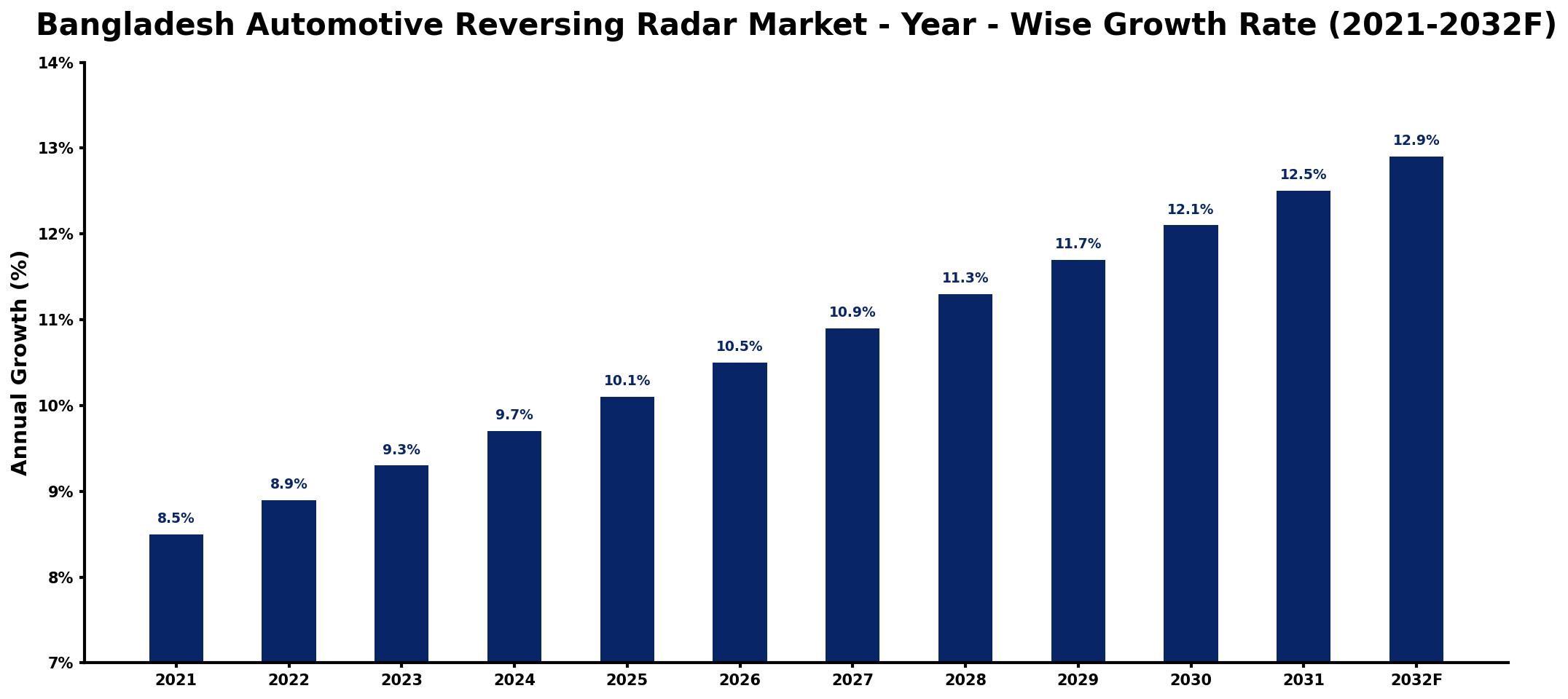
The table below presents the year‑wise growth rates along with the key drivers influencing the market
| Year | Growth Rate | Major Drivers |
| 2021 | 8.5% | Rising consumer safety awareness |
| 2022 | 8.9% | Increased vehicle production rates |
| 2023 | 9.3% | Growth in urban vehicle ownership |
| 2024 | 9.7% | strengthening underlying market demand |
| 2025 | 10.1% | Enhanced infrastructure development initiatives |
| 2026 | 10.5% | Surge in vehicle export opportunities |
| 2027 | 10.9% | Growing demand for luxury vehicles |
| 2028 | 11.3% | Increased focus on road safety |
| 2029 | 11.7% | Expansion of smart city projects |
| 2030 | 12.1% | Rising popularity of electric vehicles |
| 2031 | 12.5% | Increased government regulatory support |
| 2032 | 12.9% | Emerging market for aftermarket solutions |
Note: Market size estimations and growth projections presented in this report are based on 6Wresearch's proprietary forecasting methodology, utilizing the latest available industry data, government publications, and primary research inputs.
Bangladesh Automotive Reversing Radar Market Synopsis
The automotive reversing radar market in Bangladesh is experiencing a surge in demand, especially in urban areas where parking and maneuvering pose significant challenges for drivers. The advent of this technology not only enhances the safety of vehicle occupants but also increases the safety of pedestrians and cyclists, critical in densely populated cities.
As the government recognizes the essential role that reversing radar systems play in improving road safety, initiatives are being established to promote their incorporation in new vehicle models. This concerted push for technology adoption aims to reduce accidents, thereby transforming how Bangladeshi drivers approach parking and reversing tasks.
Bangladesh Automotive Reversing Radar Market Key Takeaways
- The market is set to nearly double its value between 2025 and 2032, reflecting a strong growth trajectory.
- Urbanization and increased vehicle ownership are significant factors driving market expansion.
- Government initiatives are fostering awareness and adoption of reversing radar systems in new vehicles.
- Consumer demand is increasingly influenced by safety concerns, particularly regarding vulnerable road users.
- Technological advancements in sensor accuracy and integration are enhancing the appeal of reversing radar systems.
Evaluation of Restraints in Bangladesh Automotive Reversing Radar Market
Despite its promising growth, the Bangladesh automotive reversing radar market faces several constraints. One of the primary issues is the limited infrastructure to support the widespread adoption of reversing radar systems, particularly in terms of parking spaces equipped with complementary technology. Furthermore, concerns regarding the reliability and accuracy of these systems in varying weather conditions can deter potential consumers. The absence of regulatory standards for the implementation of reversing radar systems also presents challenges, as manufacturers and consumers navigate a market that lacks uniform guidelines.
Bangladesh Automotive Reversing Radar Market Trends
Current trends within the Bangladesh automotive reversing radar market highlight a shift towards advanced driver-assistance systems (ADAS) as essential features in new vehicle models. Increasing consumer preference for vehicles equipped with state-of-the-art safety technologies is propelling manufacturers to innovate and offer integrated solutions. Additionally, the rising popularity of electric and hybrid vehicles in urban settings is prompting a reevaluation of parking solutions, further driving the demand for reversing radar systems. Enhanced connectivity features, such as integration with smartphones for real-time alerts, are also gaining traction among tech-savvy consumers.
Bangladesh Automotive Reversing Radar Market Opportunities
There are significant growth opportunities within the Bangladesh automotive reversing radar market, particularly for companies focusing on retrofitting existing vehicles. With the government's initiatives to promote awareness and provide subsidies for technology adoption, manufacturers can tap into the large pool of older vehicles that lack modern safety features. Additionally, partnerships with automotive manufacturers to create bundled packages that include reversing radar systems in new vehicles present a lucrative pathway for expansion. The rise of e-commerce and delivery services also indicates a growing demand for commercial vehicle safety technologies, creating a broader market for reversing radar systems.
Government Initiatives in the Bangladesh Automotive Reversing Radar Market
The government of Bangladesh is actively promoting the adoption of reversing radar systems as a crucial component of vehicle safety. Initiatives include mandates for new vehicle models to incorporate these systems, aimed at reducing accidents associated with reversing. Public awareness campaigns are being launched to educate drivers on the benefits of reversing radars, while subsidies are being offered to encourage the retrofitting of existing vehicles. These actions signify a commitment to enhancing road safety and minimizing the risks associated with urban driving.
Future Insights of the Bangladesh Automotive Reversing Radar Market
Looking ahead to 2026-2032, the Bangladesh automotive reversing radar market is poised for significant advancements. With urbanization continuing to rise, the demand for safety technologies will likely escalate, prompting more manufacturers to invest in reversing radar systems. As technological innovations improve system reliability and reduce costs, consumer acceptance will increase, further bolstering market growth. The integration of artificial intelligence to enhance obstacle detection and response times will also shape the future landscape of this market.
Bangladesh Automotive Reversing Radar Market Latest Developments (2025 - 2026)
Recent developments in the Bangladesh automotive reversing radar market include an uptick in collaborations between technology providers and automotive manufacturers. Companies are working towards refining sensor technologies to enhance accuracy and user experience. Meanwhile, awareness initiatives by the government are gaining momentum, aiming to increase public knowledge of the benefits and functionalities of reversing radar systems. Efforts to standardize installation practices are also in progress, indicating a shift towards more structured market growth.
Bangladesh Automotive Reversing Radar Market - Key Attractiveness of the Report
- 10 Years of Market Numbers
- Historical Data Starting from 2022 to 2025
- Base Year: 2025
- Forecast Data until 2032
- Key Performance Indicators Impacting the Market
- Major Upcoming Developments and Projects
Key Highlights of the Report:
- Bangladesh Automotive Reversing Radar Market Outlook
- Market Size of Bangladesh Automotive Reversing Radar Market, 2025
- Forecast of Bangladesh Automotive Reversing Radar Market, 2032
- Historical Data and Forecast of Bangladesh Automotive Reversing Radar Revenues & Volume for the Period 2022-2032F
- Bangladesh Automotive Reversing Radar Market Trend Evolution
- Bangladesh Automotive Reversing Radar Market Drivers and Challenges
- Bangladesh Automotive Reversing Radar Price Trends
- Bangladesh Automotive Reversing Radar Porter's Five Forces
- Bangladesh Automotive Reversing Radar Industry Life Cycle
- Historical Data and Forecast of Bangladesh Automotive Reversing Radar Market Revenues & Volume By Type for the Period 2022-2032F
- Historical Data and Forecast of Bangladesh Automotive Reversing Radar Market Revenues & Volume By Ultrasonic for the Period 2022-2032F
- Historical Data and Forecast of Bangladesh Automotive Reversing Radar Market Revenues & Volume By Electromagnetic for the Period 2022-2032F
- Historical Data and Forecast of Bangladesh Automotive Reversing Radar Market Revenues & Volume By Application for the Period 2022-2032F
- Historical Data and Forecast of Bangladesh Automotive Reversing Radar Market Revenues & Volume By Passenger Vehicle for the Period 2022-2032F
- Historical Data and Forecast of Bangladesh Automotive Reversing Radar Market Revenues & Volume By Commercial Vehicle for the Period 2022-2032F
- Bangladesh Automotive Reversing Radar Import Export Trade Statistics
- Market Opportunity Assessment By Type
- Market Opportunity Assessment By Application
- Bangladesh Automotive Reversing Radar Top Companies Market Share
- Bangladesh Automotive Reversing Radar Competitive Benchmarking By Technical and Operational Parameters
- Bangladesh Automotive Reversing Radar Company Profiles
- Bangladesh Automotive Reversing Radar Key Strategic Recommendations






































