Bangladesh Biomimetic Materials Market Size, Share & Growth Rate
The Bangladesh Biomimetic Materials Market was estimated at USD 446 Million in 2025 and is projected to reach USD 621 Million by 2032, growing at a CAGR of 4.8% from 2026 to 2032. This robust growth is underpinned by heightened research and development activities, particularly in sectors like healthcare and construction, which are increasingly adopting materials that emulate natures efficiencies. The burgeoning awareness of sustainability among manufacturers and consumers alike has propelled the demand for biomimetic solutions that offer both environmental benefits and enhanced performance.
Bangladesh Biomimetic Materials Market Year-wise Growth Rate and Key Drivers
This graph highlights how the Bangladesh Biomimetic Materials Market has steadily grown over the years, supported by major growth factors.
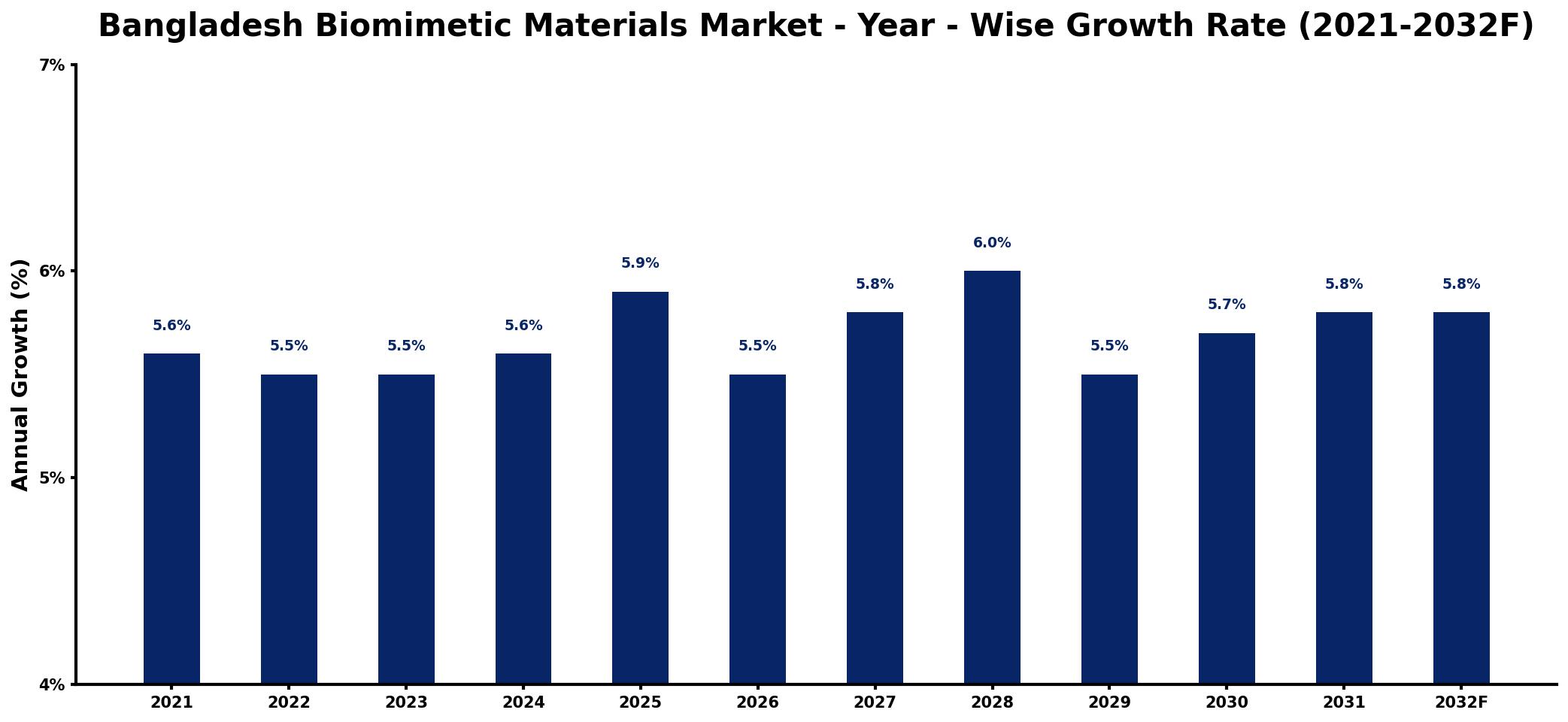
The table below presents the year‑wise growth rates along with the key drivers influencing the market
| Year | Growth Rate | Major Drivers |
| 2021 | 5.6% | Rising demand in construction sector |
| 2022 | 5.5% | Increased investment in renewable energy |
| 2023 | 5.5% | Growing interest in sustainable design |
| 2024 | 5.6% | Expansion of eco-friendly packaging solutions |
| 2025 | 5.9% | Advancements in healthcare technology applications |
| 2026 | 5.5% | Surge in automotive industry innovations |
| 2027 | 5.8% | Growth in consumer electronics market |
| 2028 | 6.0% | Development of smart textiles industry |
| 2029 | 5.5% | Increase in government sustainability initiatives |
| 2030 | 5.7% | increased production capacity utilization |
| 2031 | 5.8% | Rising consumer awareness for sustainability |
| 2032 | 5.8% | Emergence of biophilic design trends |
Note: Market size estimations and growth projections presented in this report are based on 6Wresearch's proprietary forecasting methodology, utilizing the latest available industry data, government publications, and primary research inputs.
Bangladesh Biomimetic Materials Market Synopsis
Recent momentum in the Bangladesh Biomimetic Materials Market highlights a growing acceptance of innovative solutions that draw inspiration from nature. As industries increasingly recognize the ecological and practical advantages of these materials, the market is set on a trajectory that combines environmental consciousness with technological advancement. However, despite this positive shift, significant barriers still exist that hinder widespread adoption.
The future of the market appears promising, driven by government initiatives and a focus on sustainable development. As investments in biomimetic research continue to rise, the potential for applications in diverse sectors such as automotive, healthcare, and construction expands significantly, positioning Bangladesh as a noteworthy player in the global biomimetic materials landscape.
Bangladesh Biomimetic Materials Market Key Takeaways
- The market is projected to grow significantly, reaching USD 621 Million by 2032.
- Research and development activities are key drivers for innovation in biomimetic materials.
- Government support enhances market opportunities, aligning with sustainability trends.
- Awareness and education are critical for overcoming adoption barriers.
- Investment in environmentally friendly solutions is on the rise across various sectors.
Evaluation of Restraints in Bangladesh Biomimetic Materials Market
Despite the encouraging growth trajectory, the Bangladesh Biomimetic Materials Market faces several constraints that impede its progress. A significant barrier is the limited awareness among stakeholders regarding the advantages and practical applications of biomimetic materials. This lack of understanding often leads to hesitancy in adoption, particularly in traditional industries such as construction and agriculture. Additionally, the initial high costs associated with the development and production of these advanced materials present a financial hurdle for manufacturers and researchers. To truly harness the potential of biomimicry, there is a pressing need for educational initiatives and collaborative efforts among industry players and academia.
Bangladesh Biomimetic Materials Market Trends
The demand for sustainable and eco-friendly materials inspired by natural processes is reshaping the Bangladesh Biomimetic Materials Market. Current trends emphasize the development of materials with enhanced durability, flexibility, and biodegradability, offering solutions that are both innovative and practical. Industries are increasingly exploring biomimetic designs that promise improved efficiency and reduced environmental impact. Furthermore, the construction sector is witnessing a notable interest in biomimetic materials, leading to advancements that could redefine building practices in an eco-conscious framework.
Bangladesh Biomimetic Materials Market Opportunities
The Bangladesh Biomimetic Materials Market is ripe with investment opportunities, particularly in sectors such as healthcare and environmental sustainability. As companies seek to enhance medical devices with biomimetic features or create sustainable building materials, there is a significant avenue for innovation. Investors can leverage the growing demand for eco-friendly solutions by focusing on research and development, manufacturing, and the distribution of these materials. Collaborative efforts between industry and research institutions also promise to unlock further growth and technological advancements.
Government Initiatives in the Bangladesh Biomimetic Materials Market
The Bangladeshi government actively promotes the adoption of biomimetic materials through various initiatives aimed at supporting research and development. Funding has been allocated by the Ministry of Science and Technology to encourage projects focusing on biomimicry. Additionally, the Ministry of Industries provides incentives for companies to embrace sustainable practices, including the utilization of biomimetic materials. These initiatives reflect a commitment to fostering innovation and environmental sustainability across industries.
Future Insights of the Bangladesh Biomimetic Materials Market
Looking ahead, the Bangladesh Biomimetic Materials Market is positioned for substantial growth through 2032. Continued advancements in technology, coupled with an increasing focus on sustainability, are expected to fuel demand across various sectors. Collaborations with international partners and local research institutions are likely to drive innovation, leading to the development of more advanced biomimetic solutions. As awareness of environmental issues rises, the adoption of nature-inspired materials is anticipated to become more mainstream, solidifying Bangladeshs role in the global biomimetic materials landscape.
Bangladesh Biomimetic Materials Market Latest Developments (2025 - 2026)
In recent months, the Bangladesh Biomimetic Materials Market has witnessed significant industry movements toward sustainable innovation. Various stakeholders are investing in R&D to enhance the properties of biomimetic materials, particularly in the healthcare and construction sectors. This growing focus on environmentally friendly solutions has led to increased interest in partnerships between academia and industry, which promise to facilitate the development of cutting-edge biomimetic technologies.
Bangladesh Biomimetic Materials Market - Key Attractiveness of the Report
- 10 Years of Market Numbers
- Historical Data Starting from 2022 to 2025
- Base Year: 2025
- Forecast Data until 2032
- Key Performance Indicators Impacting the Market
- Major Upcoming Developments and Projects
Key Highlights of the Report:
- Bangladesh Biomimetic Materials Market Outlook
- Market Size of Bangladesh Biomimetic Materials Market, 2025
- Forecast of Bangladesh Biomimetic Materials Market, 2032
- Historical Data and Forecast of Bangladesh Biomimetic Materials Revenues & Volume for the Period 2022-2032F
- Bangladesh Biomimetic Materials Market Trend Evolution
- Bangladesh Biomimetic Materials Market Drivers and Challenges
- Bangladesh Biomimetic Materials Price Trends
- Bangladesh Biomimetic Materials Porter's Five Forces
- Bangladesh Biomimetic Materials Industry Life Cycle
- Historical Data and Forecast of Bangladesh Biomimetic Materials Market Revenues & Volume By Material for the Period 2022-2032F
- Historical Data and Forecast of Bangladesh Biomimetic Materials Market Revenues & Volume By Biomimetic Polymers for the Period 2022-2032F
- Historical Data and Forecast of Bangladesh Biomimetic Materials Market Revenues & Volume By Biomimetic Ceramics & Glass for the Period 2022-2032F
- Historical Data and Forecast of Bangladesh Biomimetic Materials Market Revenues & Volume By Biomimetic Metals & Alloys for the Period 2022-2032F
- Historical Data and Forecast of Bangladesh Biomimetic Materials Market Revenues & Volume By Others for the Period 2022-2032F
- Historical Data and Forecast of Bangladesh Biomimetic Materials Market Revenues & Volume By Application for the Period 2022-2032F
- Historical Data and Forecast of Bangladesh Biomimetic Materials Market Revenues & Volume By Medical for the Period 2022-2032F
- Historical Data and Forecast of Bangladesh Biomimetic Materials Market Revenues & Volume By Automotive for the Period 2022-2032F
- Historical Data and Forecast of Bangladesh Biomimetic Materials Market Revenues & Volume By Defense for the Period 2022-2032F
- Historical Data and Forecast of Bangladesh Biomimetic Materials Market Revenues & Volume By Electronics for the Period 2022-2032F
- Historical Data and Forecast of Bangladesh Biomimetic Materials Market Revenues & Volume By Others for the Period 2022-2032F
- Bangladesh Biomimetic Materials Import Export Trade Statistics
- Market Opportunity Assessment By Material
- Market Opportunity Assessment By Application
- Bangladesh Biomimetic Materials Top Companies Market Share
- Bangladesh Biomimetic Materials Competitive Benchmarking By Technical and Operational Parameters
- Bangladesh Biomimetic Materials Company Profiles
- Bangladesh Biomimetic Materials Key Strategic Recommendations






































