Bangladesh Breast Implant Market Size, Share & Growth Rate
The Bangladesh Breast Implant Market was estimated at USD 441 Million in 2025 and is projected to reach USD 601 Million by 2032, growing at a CAGR of 4.5% from 2026 to 2032. This upward trajectory is largely driven by increased disposable income and a burgeoning middle class, both of which are propelling the demand for cosmetic enhancements. Additionally, as cultural perceptions shift and more women embrace cosmetic procedures, the market is well-positioned for sustained growth.
Bangladesh Breast Implant Market Year-wise Growth Rate and Key Drivers
This graph highlights how the Bangladesh Breast Implant Market has steadily grown over the years, supported by major growth factors.
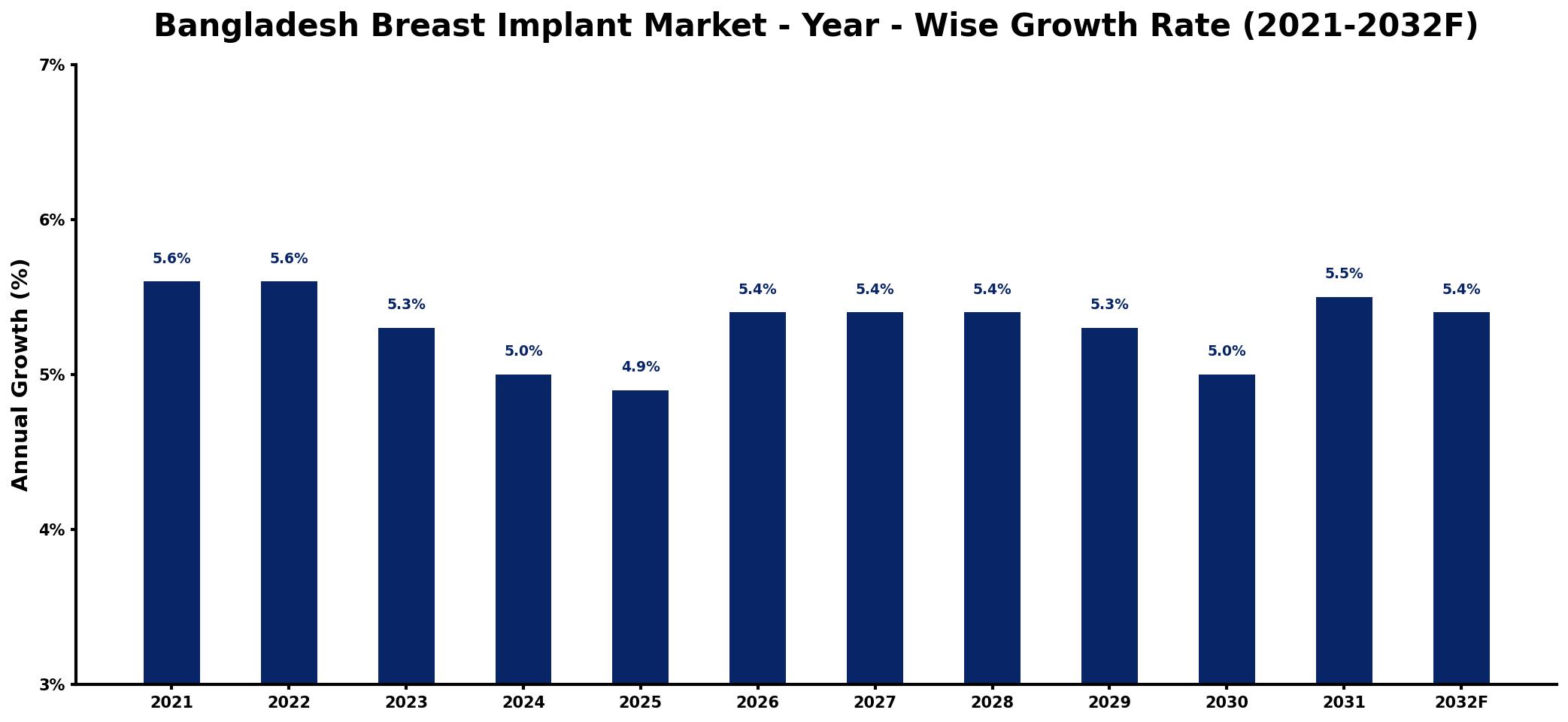
The table below presents the year‑wise growth rates along with the key drivers influencing the market
| Year | Growth Rate | Major Drivers |
| 2021 | 5.6% | Rising cosmetic surgery popularity |
| 2022 | 5.6% | Increased disposable income levels |
| 2023 | 5.3% | Growing awareness of aesthetics |
| 2024 | 5.0% | Expanding beauty industry investments |
| 2025 | 4.9% | Surge in social media influence |
| 2026 | 5.4% | Advancements in surgical techniques |
| 2027 | 5.4% | Emerging trends in body positivity |
| 2028 | 5.4% | Higher demand for personalized services |
| 2029 | 5.3% | Increased focus on wellness tourism |
| 2030 | 5.0% | Growth in aesthetic education programs |
| 2031 | 5.5% | Enhanced marketing strategies implementation |
| 2032 | 5.4% | Wider availability of financing options |
Note: Market size estimations and growth projections presented in this report are based on 6Wresearch's proprietary forecasting methodology, utilizing the latest available industry data, government publications, and primary research inputs.
Bangladesh Breast Implant Market Synopsis
The Bangladesh Breast Implant Market is on a promising growth path, characterized by an increasing acceptance of cosmetic surgery within society. This trend is particularly evident among urban populations, where changing social norms are encouraging more women to consider breast augmentation as a viable option for enhancing their self-image.
In this evolving market, silicone implants are leading the way due to their natural feel and aesthetic appeal. As manufacturers strive to meet the rising consumer expectations, both local and international players are introducing innovative products that prioritize safety, quality, and natural appearance, setting the stage for future advancements.
Bangladesh Breast Implant Market Key Takeaways
- The market is primarily driven by increasing disposable income and changing societal attitudes toward cosmetic surgery.
- Silicone implants dominate due to their perceived natural look and feel compared to saline options.
- There is a notable demand for smaller, more natural-shaped implants as patients prioritize subtle enhancements.
- Growing awareness and education about breast augmentation procedures are essential for market expansion.
- Investment opportunities abound, especially in urban centers where aesthetic procedures are gaining traction.
Evaluation of Restraints in Bangladesh Breast Implant Market
Despite the promising prospects, several significant constraints hinder the growth of the Bangladesh breast implant market. Cultural taboos surrounding cosmetic surgeries persist, often leading to stigma that affects women's willingness to pursue such procedures. Moreover, access to quality healthcare facilities remains limited, particularly in rural regions, resulting in disparities in the availability of breast augmentation services. The lack of trained professionals further exacerbates concerns over the safety and quality of procedures, as many potential patients are deterred by these uncertainties.
Bangladesh Breast Implant Market Trends
Current trends highlight a clear shift towards natural aesthetics, with patients increasingly opting for implants that enhance their appearance subtly rather than making dramatic changes. This evolving preference is pushing manufacturers to focus on producing smaller, more anatomically shaped implants that mimic the natural breast contour. Additionally, patient safety is becoming a priority, leading to a rising demand for FDA-approved implants and advanced surgical techniques that aim to enhance outcomes and minimize complications.
Bangladesh Breast Implant Market Opportunities
As the acceptance of cosmetic procedures grows, numerous investment opportunities are emerging in the Bangladesh breast implant market. Manufacturers and healthcare providers can capitalize on the increasing demand for high-quality implants and aesthetic procedures. Strategic partnerships with local clinics and educational initiatives aimed at dispelling myths around cosmetic surgery can further enhance market reach. Moreover, the expanding middle-class population opens new avenues for affordable cosmetic enhancements, which can significantly propel market growth.
Government Initiatives in the Bangladesh Breast Implant Market
The Bangladeshi government has taken steps to regulate the breast implant market to ensure the safety and quality of medical devices. The Directorate General of Drug Administration (DGDA) plays a pivotal role in overseeing the manufacturing, import, and distribution processes. Moreover, initiatives have been implemented to guarantee that healthcare providers are adequately trained in the administration of breast augmentation procedures. Such regulations aim to enhance patient safety and foster trust within the cosmetic surgery sector.
Future Insights of the Bangladesh Breast Implant Market
Looking ahead, the Bangladesh Breast Implant Market is poised for steady growth from 2026 to 2032. The ongoing shifts in societal attitudes and increasing awareness surrounding cosmetic procedures are likely to bolster demand. Additionally, continued advancements in surgical technologies will not only enhance the safety of breast augmentation but also make it more accessible to a broader demographic. While regulatory challenges and cultural factors may impact growth, the overall outlook remains positive, driven by evolving consumer preferences and an expanding healthcare infrastructure.
Bangladesh Breast Implant Market Latest Developments (2025 - 2026)
Recent developments in the Bangladesh breast implant market reflect a growing emphasis on innovation and quality. Clinics are increasingly adopting advanced techniques to improve surgical outcomes and patient satisfaction. Furthermore, heightened regulatory scrutiny is fostering a culture of safety and quality assurance within the industry. As awareness campaigns and educational programs gain traction, more women are becoming informed about their options, potentially leading to increased demand for breast augmentation services.
Bangladesh Breast Implant Market - Key Attractiveness of the Report
- 10 Years of Market Numbers
- Historical Data Starting from 2022 to 2025
- Base Year: 2025
- Forecast Data until 2032
- Key Performance Indicators Impacting the Market
- Major Upcoming Developments and Projects
Key Highlights of the Report:
- Bangladesh Breast Implant Market Outlook
- Market Size of Bangladesh Breast Implant Market, 2025
- Forecast of Bangladesh Breast Implant Market, 2032
- Historical Data and Forecast of Bangladesh Breast Implant Revenues & Volume for the Period 2022-2032F
- Bangladesh Breast Implant Market Trend Evolution
- Bangladesh Breast Implant Market Drivers and Challenges
- Bangladesh Breast Implant Price Trends
- Bangladesh Breast Implant Porter's Five Forces
- Bangladesh Breast Implant Industry Life Cycle
- Historical Data and Forecast of Bangladesh Breast Implant Market Revenues & Volume By Product Type for the Period 2022-2032F
- Historical Data and Forecast of Bangladesh Breast Implant Market Revenues & Volume By Silicone Breast Implants for the Period 2022-2032F
- Historical Data and Forecast of Bangladesh Breast Implant Market Revenues & Volume By Saline Breast Implants for the Period 2022-2032F
- Historical Data and Forecast of Bangladesh Breast Implant Market Revenues & Volume By Application for the Period 2022-2032F
- Historical Data and Forecast of Bangladesh Breast Implant Market Revenues & Volume By Cosmetic Surger for the Period 2022-2032F
- Historical Data and Forecast of Bangladesh Breast Implant Market Revenues & Volume By Reconstructive Surgery for the Period 2022-2032F
- Historical Data and Forecast of Bangladesh Breast Implant Market Revenues & Volume By Shape for the Period 2022-2032F
- Historical Data and Forecast of Bangladesh Breast Implant Market Revenues & Volume By Round Breast Implants for the Period 2022-2032F
- Historical Data and Forecast of Bangladesh Breast Implant Market Revenues & Volume By Anatomical Breast Implants for the Period 2022-2032F
- Historical Data and Forecast of Bangladesh Breast Implant Market Revenues & Volume By End User for the Period 2022-2032F
- Historical Data and Forecast of Bangladesh Breast Implant Market Revenues & Volume By Hospitals for the Period 2022-2032F
- Historical Data and Forecast of Bangladesh Breast Implant Market Revenues & Volume By Cosmetology Clinics for the Period 2022-2032F
- Bangladesh Breast Implant Import Export Trade Statistics
- Market Opportunity Assessment By Product Type
- Market Opportunity Assessment By Application
- Market Opportunity Assessment By Shape
- Market Opportunity Assessment By End User
- Bangladesh Breast Implant Top Companies Market Share
- Bangladesh Breast Implant Competitive Benchmarking By Technical and Operational Parameters
- Bangladesh Breast Implant Company Profiles
- Bangladesh Breast Implant Key Strategic Recommendations






































