Bangladesh Cellulose Acetate Fiber Market Size, Share & Growth Rate
The Bangladesh Cellulose Acetate Fiber Market was estimated at USD 304 Million in 2025 and is projected to reach USD 407 Million by 2032, growing at a CAGR of 4.3% from 2026 to 2032. This growth trajectory can be attributed to the increasing demand for sustainable textile solutions amidst global environmental concerns. As textile manufacturers in Bangladesh seek to differentiate their offerings, cellulose acetate fibers are becoming a preferred choice due to their biodegradable nature and desirable properties.
Bangladesh Cellulose Acetate Fiber Market Year-wise Growth Rate and Key Drivers
This graph highlights how the Bangladesh Cellulose Acetate Fiber Market has steadily grown over the years, supported by major growth factors.
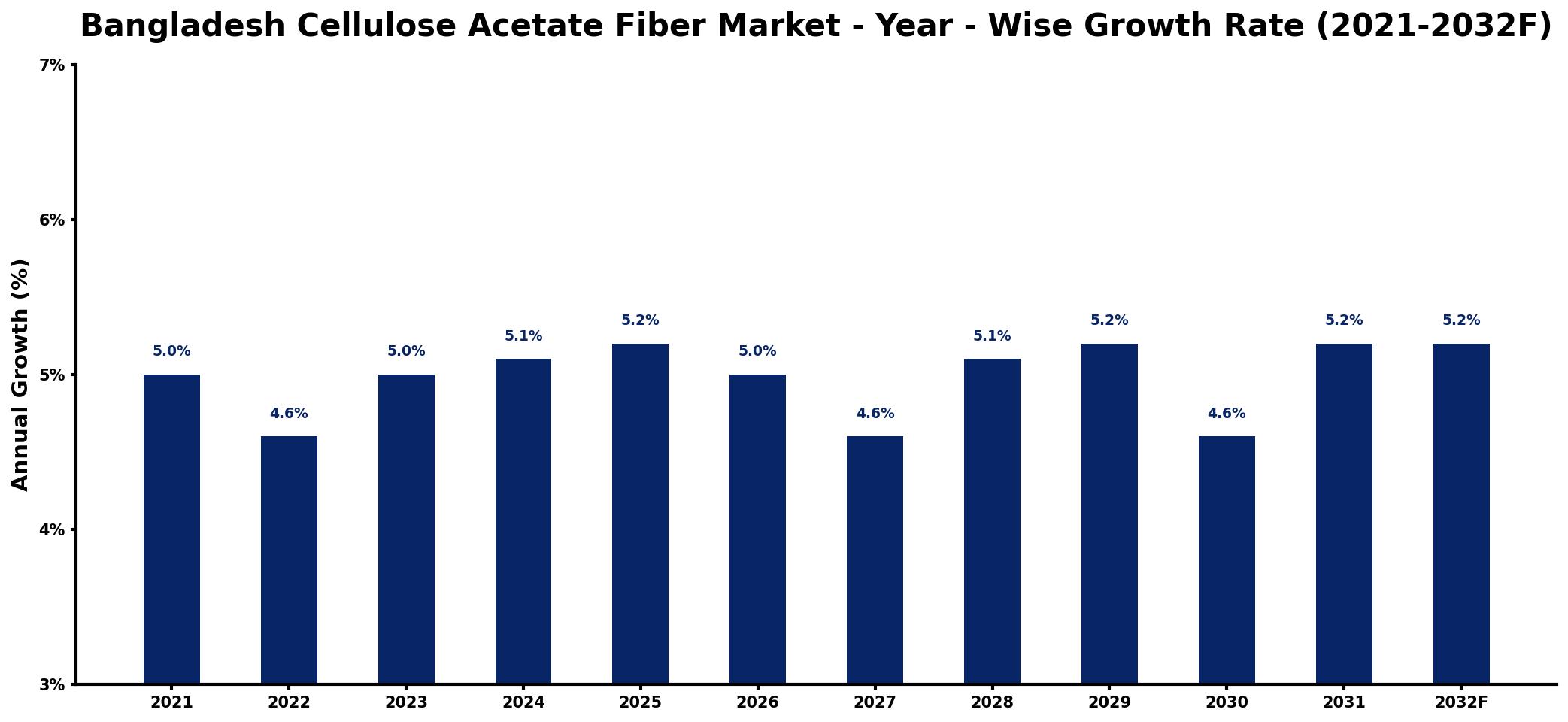
The table below presents the year‑wise growth rates along with the key drivers influencing the market
| Year | Growth Rate | Major Drivers |
| 2021 | 5.0% | Rising textile manufacturing activities |
| 2022 | 4.6% | Increased demand from fashion industry |
| 2023 | 5.0% | Growing consumer preference for sustainability |
| 2024 | 5.1% | Expansion of domestic production facilities |
| 2025 | 5.2% | Increase in export opportunities globally |
| 2026 | 5.0% | Development of innovative applications |
| 2027 | 4.6% | Higher investment in research initiatives |
| 2028 | 5.1% | Strengthening supply chain networks |
| 2029 | 5.2% | Boost in eco-friendly product offerings |
| 2030 | 4.6% | Emergence of new market players |
| 2031 | 5.2% | Enhanced collaboration with international partners |
| 2032 | 5.2% | Adoption of advanced manufacturing technologies |
Note: Market size estimations and growth projections presented in this report are based on 6Wresearch's proprietary forecasting methodology, utilizing the latest available industry data, government publications, and primary research inputs.
Bangladesh Cellulose Acetate Fiber Market Synopsis
In recent years, Bangladesh's textile industry has made a pronounced shift towards incorporating eco-friendly materials, with cellulose acetate fibers leading the charge. These fibers, sourced from renewable wood pulp, not only provide a luxurious feel but also align with the rising consumer preference for environmentally sustainable products.
This market is witnessing a dynamic transformation, underpinned by the growing awareness of sustainability among manufacturers and consumers alike. The natural softness, breathability, and compatibility of cellulose acetate fibers with other textiles are enhancing their appeal in apparel, home textiles, and various industrial applications.
Bangladesh Cellulose Acetate Fiber Market Key Takeaways
- The market is projected to reach USD 407 Million by 2032, driven by sustainability trends.
- Eco-friendly cellulose acetate fibers are increasingly favored over traditional synthetic options.
- Investments in production efficiency are critical for addressing fluctuating raw material prices.
- Collaboration among industry stakeholders is essential to elevate quality standards.
- Government incentives bolster local production and enhance technological advancements.
Evaluation of Restraints in Bangladesh Cellulose Acetate Fiber Market
Despite the promising growth prospects, the Bangladesh Cellulose Acetate Fiber Market faces several restraints. One of the primary challenges is the volatility of raw material prices, which can hinder production planning and cost control. Moreover, competition from cheaper synthetic fibers poses a significant threat, making it essential for cellulose acetate manufacturers to effectively communicate the long-term benefits of their products.
There is also a pressing need to enhance consumer awareness regarding the advantages of cellulose acetate fibers. Many potential buyers remain uninformed about their eco-friendliness and performance benefits. Additionally, the market is hampered by inconsistencies in quality standards and insufficient production infrastructure, necessitating concerted efforts to elevate the overall market landscape.
Bangladesh Cellulose Acetate Fiber Market Trends
A prominent trend within the Bangladesh Cellulose Acetate Fiber Market is the commitment to sustainable production processes. Manufacturers are increasingly adopting waste management strategies and harnessing renewable energy to minimize their environmental impact. Concurrently, there is a growing emphasis on research and development, aiming to create innovative fiber blends that respond to the evolving demands of consumers.
The trend towards conscious consumerism is also driving up demand for high-quality cellulose acetate fibers, which are recognized for their softness, breathability, and overall durability. This increasing awareness is catalyzing a shift in the textile landscape towards greener alternatives.
Bangladesh Cellulose Acetate Fiber Market Opportunities
The Bangladesh Cellulose Acetate Fiber Market is rife with opportunities for investors. With rising global demand for eco-friendly products, cellulose acetate fibers serve as a biodegradable and renewable alternative, gaining favor among environmentally conscious consumers. The increasing integration of cellulose acetate into textile manufacturing processes presents a lucrative avenue for growth.
Furthermore, the government's proactive stance on promoting sustainability within the textile sector enhances the appeal for investment. With policy support aimed at improving production capabilities and fostering innovation, stakeholders can capitalize on the growing demand for sustainable fibers in Bangladesh.
Government Initiatives in the Bangladesh Cellulose Acetate Fiber Market
The Bangladeshi government has implemented various initiatives to boost the cellulose acetate fiber market, focusing on sustainability and local production. Financial incentives, tax breaks, and subsidies have been introduced to attract investment in this sector. Moreover, the government enforces regulations aimed at maintaining quality standards while ensuring environmental sustainability.
Additionally, support for research and development initiatives signifies the governments commitment to enhancing the technological capabilities of local manufacturers, ultimately increasing their competitiveness on a global scale.
Future Insights of the Bangladesh Cellulose Acetate Fiber Market
Looking forward to 2026-2032, the Bangladesh Cellulose Acetate Fiber Market is set to thrive as consumer preferences continue to shift towards sustainable and eco-conscious textiles. The ongoing awareness of environmental impacts associated with synthetic fibers is expected to further amplify demand for cellulose acetate fibers derived from renewable resources.
With the textile industry in Bangladesh poised for significant growth, manufacturers will increasingly seek to innovate and incorporate cellulose acetate fibers into their products. This evolving landscape positions the market for substantial expansion, driven by both domestic and international demands.
Bangladesh Cellulose Acetate Fiber Market Latest Developments (2025 - 2026)
In recent months, the Bangladesh Cellulose Acetate Fiber Market has seen notable advancements in sustainable production techniques. Manufacturers have been exploring new methodologies aimed at reducing waste and enhancing energy efficiency. Additionally, partnerships among industry stakeholders are being formed to promote best practices in quality control and innovation.
Simultaneously, efforts to raise consumer awareness about the benefits of cellulose acetate fibers are gaining momentum, with campaigns focusing on their environmental advantages and high-quality attributes. These developments signify a strengthening commitment towards a more sustainable textile industry in Bangladesh.
Bangladesh Cellulose Acetate Fiber Market - Key Attractiveness of the Report
- 10 Years of Market Numbers
- Historical Data Starting from 2022 to 2025
- Base Year: 2025
- Forecast Data until 2032
- Key Performance Indicators Impacting the Market
- Major Upcoming Developments and Projects
Key Highlights of the Report:
- Bangladesh Cellulose Acetate Fiber Market Outlook
- Market Size of Bangladesh Cellulose Acetate Fiber Market, 2025
- Forecast of Bangladesh Cellulose Acetate Fiber Market, 2032
- Historical Data and Forecast of Bangladesh Cellulose Acetate Fiber Revenues & Volume for the Period 2022-2032F
- Bangladesh Cellulose Acetate Fiber Market Trend Evolution
- Bangladesh Cellulose Acetate Fiber Market Drivers and Challenges
- Bangladesh Cellulose Acetate Fiber Price Trends
- Bangladesh Cellulose Acetate Fiber Porter's Five Forces
- Bangladesh Cellulose Acetate Fiber Industry Life Cycle
- Historical Data and Forecast of Bangladesh Cellulose Acetate Fiber Market Revenues & Volume By Type for the Period 2022-2032F
- Historical Data and Forecast of Bangladesh Cellulose Acetate Fiber Market Revenues & Volume By Plastic for the Period 2022-2032F
- Historical Data and Forecast of Bangladesh Cellulose Acetate Fiber Market Revenues & Volume By Fiber for the Period 2022-2032F
- Historical Data and Forecast of Bangladesh Cellulose Acetate Fiber Market Revenues & Volume By Application for the Period 2022-2032F
- Historical Data and Forecast of Bangladesh Cellulose Acetate Fiber Market Revenues & Volume By Photographic Films for the Period 2022-2032F
- Historical Data and Forecast of Bangladesh Cellulose Acetate Fiber Market Revenues & Volume By Cigarette Filters for the Period 2022-2032F
- Historical Data and Forecast of Bangladesh Cellulose Acetate Fiber Market Revenues & Volume By Tapes & Labels for the Period 2022-2032F
- Historical Data and Forecast of Bangladesh Cellulose Acetate Fiber Market Revenues & Volume By Textiles & Apparel for the Period 2022-2032F
- Bangladesh Cellulose Acetate Fiber Import Export Trade Statistics
- Market Opportunity Assessment By Type
- Market Opportunity Assessment By Application
- Bangladesh Cellulose Acetate Fiber Top Companies Market Share
- Bangladesh Cellulose Acetate Fiber Competitive Benchmarking By Technical and Operational Parameters
- Bangladesh Cellulose Acetate Fiber Company Profiles
- Bangladesh Cellulose Acetate Fiber Key Strategic Recommendations






































