Bangladesh Cigarette Market Size, Share & Growth Rate
The Bangladesh Cigarette Market was estimated at USD 274 Million in 2025 and is projected to reach USD 343 Million by 2032, growing at a CAGR of 3.3% from 2026 to 2032. This growth trajectory is primarily driven by a substantial consumer base, including a large population of smokers who remain price-sensitive amidst economic fluctuations. Although health concerns are rising, the comparatively low cost of cigarettes ensures steady demand, particularly among lower-income segments.
Bangladesh Cigarette Market Year-wise Growth Rate and Key Drivers
This graph highlights how the Bangladesh Cigarette Market has steadily grown over the years, supported by major growth factors.
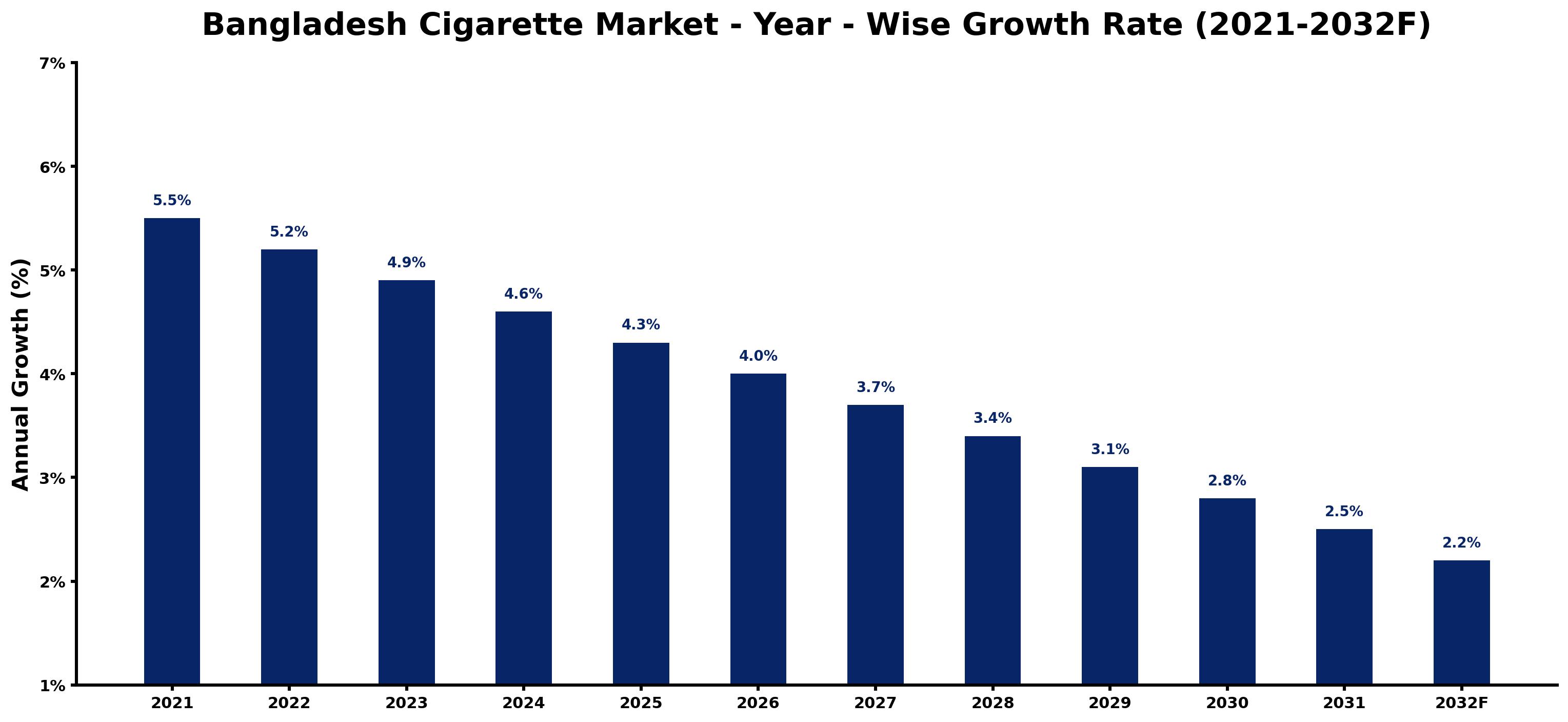
The table below presents the year‑wise growth rates along with the key drivers influencing the market
| Year | Growth Rate | Major Drivers |
| 2021 | 5.5% | Growing renewable energy integration projects |
| 2022 | 5.2% | Expansion of transportation and logistics networks |
| 2023 | 4.9% | Growing renewable energy integration projects |
| 2024 | 4.6% | Government infrastructure modernization initiatives |
| 2025 | 4.3% | Increasing industrial infrastructure investments |
| 2026 | 4.0% | Technology transition toward sustainable alternatives |
| 2027 | 3.7% | Technology transition toward sustainable alternatives |
| 2028 | 3.4% | Technology transition toward sustainable alternatives |
| 2029 | 3.1% | Increasing shift toward cleaner alternatives |
| 2030 | 2.8% | Growing adoption of energy efficient systems |
| 2031 | 2.5% | Increasing shift toward cleaner alternatives |
| 2032 | 2.2% | Increasing shift toward cleaner alternatives |
Note - Market size estimations and growth projections presented in this report are based on 6Wresearch's advanced forecasting approach, validated with industry datasets as of June 2026.
Bangladesh Cigarette Market Synopsis
In Bangladesh, the cigarette market is marked by a pronounced demand for affordable cigarette options, making it particularly appealing to the budget-conscious consumer. The ongoing economic pressures are pushing many towards lower-priced brands, which are thriving despite increasing regulations on tobacco use.
Additionally, a cultural inclination towards social smoking has established cigarettes as a prominent part of social interactions in various communities. However, as awareness regarding health impacts grows, there's a noticeable shift towards alternative products, hinting at evolving consumer preferences.
Bangladesh Cigarette Market Key Takeaways
- The market continues to grow, driven by affordability and a significant smoker population.
- Health awareness campaigns are gradually shifting consumer preferences towards alternative products.
- Government regulations are tightening, which affects marketing strategies and product availability.
- Flavored and menthol cigarette segments are gaining popularity among younger consumers.
- Despite challenges, opportunities for investment remain robust in the lower-priced segments.
Evaluation of Restraints in Bangladesh Cigarette Market
The Bangladesh cigarette market is hindered by a combination of stringent government regulations and an increasing public health consciousness. Policies such as graphic health warnings and advertising bans have created a challenging landscape for marketers. Additionally, the rise of illicit tobacco trade and counterfeit products not only undermines legitimate brands but also complicates revenue generation through taxation. The persistent efforts by the government to curb smoking further dilute market opportunities, leaving established players to navigate these multifaceted constraints carefully.
Bangladesh Cigarette Market Trends
Current trends in the Bangladesh cigarette market highlight a significant pivot towards economy and mid-range products as consumers become increasingly price-sensitive. Furthermore, there's a budding interest in flavored cigarettes among younger demographics, which presents new avenues for brand differentiation. Also, a gradual shift towards healthier alternatives, such as e-cigarettes and vaping products, is noteworthy. These trends reflect a blend of traditional smoking habits and a burgeoning awareness of health issues associated with tobacco consumption.
Bangladesh Cigarette Market Opportunities
Investment opportunities in the Bangladesh cigarette market are substantial, particularly in the production and distribution of lower-priced and flavored cigarette options. With a youthful demographic showing evolving preferences, there is a distinct chance to capitalize on this emerging trend. Collaborating with established distributors or investing in local manufacturers can also yield significant returns. However, navigating the regulatory landscape and understanding consumer behavior will be crucial to harness these opportunities successfully.
Government Initiatives in the Bangladesh Cigarette Market
The Bangladesh government has adopted rigorous tobacco control measures, including imposing graphic health warnings and enforcing a ban on tobacco advertising and sponsorship. These policies are aimed at reducing tobacco consumption and promoting public health. Furthermore, tax increases on tobacco products are part of broader efforts to discourage smoking while simultaneously generating funding for health-related initiatives. Despite these initiatives, the challenge of counteracting the illicit tobacco market remains a significant focus for policymakers.
Future Insights of the Bangladesh Cigarette Market
Looking ahead to 2026-2032, the Bangladesh cigarette market is poised for a complex evolution. While the number of smokers remains substantial, the combination of heightened health awareness and stringent regulations is likely to impact consumption patterns. The anticipated growth will depend on how effectively the market adapts to these changes while continuing to meet the demands of price-sensitive consumers. Additionally, the expansion of the flavored and premium segments may provide fresh avenues for growth, albeit against a backdrop of increasing health consciousness.
Bangladesh Cigarette Market Latest Developments (May 2025 - June 2026)
Recent developments in the Bangladesh cigarette market reflect ongoing adjustments to regulatory frameworks and shifting consumer preferences. Companies are increasingly investing in product innovation, focusing on flavored varieties to attract younger consumers. At the same time, the enforcement of stricter regulations on packaging and advertising has prompted brands to rethink their marketing strategies, aiming for compliance while maintaining visibility in an evolving landscape.
Bangladesh Cigarette Market - Key Attractiveness of the Report
- 10 Years of Market Numbers
- Historical Data Starting from 2022 to 2025
- Base Year: 2025
- Forecast Data until 2032
- Key Performance Indicators Impacting the Market
- Major Upcoming Developments and Projects
Key Highlights of the Report:
- Bangladesh Cigarette? Market Outlook
- Market Size of Bangladesh Cigarette? Market, 2025
- Forecast of Bangladesh Cigarette? Market, 2032
- Historical Data and Forecast of Bangladesh Cigarette? Revenues & Volume for the Period 2022-2032F
- Bangladesh Cigarette? Market Trend Evolution
- Bangladesh Cigarette? Market Drivers and Challenges
- Bangladesh Cigarette? Price Trends
- Bangladesh Cigarette? Porter's Five Forces
- Bangladesh Cigarette? Industry Life Cycle
- Historical Data and Forecast of Bangladesh Cigarette? Market Revenues & Volume By Type for the Period 2022-2032F
- Historical Data and Forecast of Bangladesh Cigarette? Market Revenues & Volume By Light for the Period 2022-2032F
- Historical Data and Forecast of Bangladesh Cigarette? Market Revenues & Volume By Medium for the Period 2022-2032F
- Historical Data and Forecast of Bangladesh Cigarette? Market Revenues & Volume By Others for the Period 2022-2032F
- Historical Data and Forecast of Bangladesh Cigarette? Market Revenues & Volume By Distribution Channel for the Period 2022-2032F
- Historical Data and Forecast of Bangladesh Cigarette? Market Revenues & Volume By Tobacco Shops for the Period 2022-2032F
- Historical Data and Forecast of Bangladesh Cigarette? Market Revenues & Volume By Supermarket and Hypermarkets for the Period 2022-2032F
- Historical Data and Forecast of Bangladesh Cigarette? Market Revenues & Volume By Convenience Stores for the Period 2022-2032F
- Historical Data and Forecast of Bangladesh Cigarette? Market Revenues & Volume By Online Stores for the Period 2022-2032F
- Historical Data and Forecast of Bangladesh Cigarette? Market Revenues & Volume By Others for the Period 2022-2032F
- Bangladesh Cigarette? Import Export Trade Statistics
- Market Opportunity Assessment By Type
- Market Opportunity Assessment By Distribution Channel
- Bangladesh Cigarette? Top Companies Market Share
- Bangladesh Cigarette? Competitive Benchmarking By Technical and Operational Parameters
- Bangladesh Cigarette? Company Profiles
- Bangladesh Cigarette? Key Strategic Recommendations






































