Bangladesh Cocoa and Chocolate Market Growth Rate
According to 6Wresearch internal database and industry insights, the Bangladesh Cocoa and Chocolate Market is growing at a compound annual growth rate (CAGR) of 7.3% during the forecast period (2026-2032).
Bangladesh Cocoa and Chocolate Market Year-wise Growth Rate and Key Drivers
This graph illustrates the annual growth rates of the Bangladesh Cocoa and Chocolate Market from 2022 to 2032, highlighting stable industrial expansion, infrastructure-driven demand, and increasing adoption of precision finishing solutions.
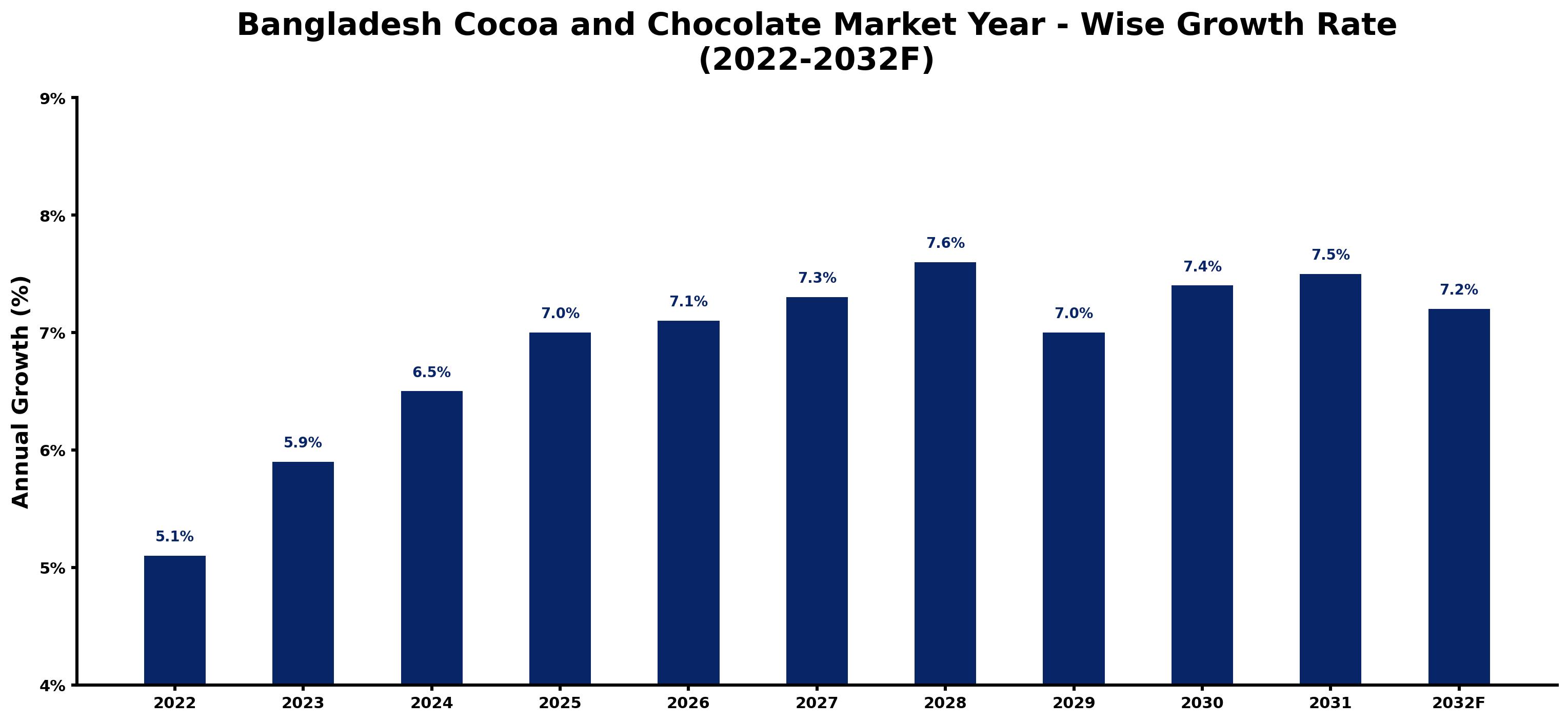
The following table summarizes the historical and forecasted growth rates of the Bangladesh Cocoa and Chocolate Market, along with the rationale behind each year’s performance.
| Year | Estimated Growth | Market Rationale |
| 2022 | 5.1% | Recovery in consumer spending and reopening of retail channels supported demand for cocoa and chocolate products. |
| 2023 | 5.9% | Rising urbanization, expanding supermarket chains, and growing preference for packaged confectionery boosted sales. |
| 2024 | 6.5% | Increasing disposable income and premium chocolate launches encouraged higher consumption across urban households. |
| 2025 | 7% | Growth in modern retail, e-commerce, and seasonal gifting demand strengthened the chocolate market. |
| 2026 | 7.1% | Rising demand for premium and imported chocolate products supported steady market expansion. |
| 2027 | 7.3% | Expansion of organized retail and increasing product availability across tier-II cities drove growth. |
| 2028 | 7.6% | Growing young population, westernized food preferences, and innovation in chocolate variants accelerated demand. |
| 2029 | 7% | Elevated cocoa prices, import cost inflation, and price-sensitive consumer behavior slightly moderated market growth. |
| 2030 | 7.4% | Recovery in consumer confidence and broader product portfolios supported stronger market performance. |
| 2031 | 7.5% | Increasing investments by confectionery brands and expansion of online grocery platforms boosted sales. |
| 2032 | 7.2% | Sustained demand for premium chocolates, gifting culture, and improved distribution networks maintained healthy market growth. |
Topics Covered in the Bangladesh Cocoa and Chocolate Market Report
The Bangladesh Cocoa and Chocolate Market report thoroughly covers the market by types, applications, nature, and distribution channels. The market report provides an unbiased and detailed analysis of ongoing market trends, opportunities/high growth areas, and market drivers, which would help stakeholders devise and align their market strategies according to the current and future market dynamics.
Bangladesh Cocoa and Chocolate Market Highlights
| Report Name | Bangladesh Cocoa and Chocolate Market |
| Forecast Period | 2026-2032 |
| CAGR | 7.3% |
| Growing Sector | E-commerce |
Bangladesh Cocoa and Chocolate Market Synopsis
The Bangladesh Cocoa and Chocolate Market will show substantial growth as more people want to buy chocolate products especially premium and organic chocolate products. The market expansion results from rising disposable incomes and changing consumer preferences and increasing chocolate demand in both urban and rural areas. The accessibility of chocolate products to consumers is being improved through the development of e-commerce platforms. The market will continue to grow as international brands and local brands establish their operations throughout Bangladesh.
Evaluation of Growth Drivers in the Bangladesh Cocoa and Chocolate Market
Below mentioned are some growth drivers and their impact on market dynamics:
| Drivers | Primary Segments Affected | Why It Matters |
| Economic Growth | All Segments | Rising disposable incomes in urban areas are expanding the consumer base. |
| E-commerce Expansion | Distribution Channel | Online sales platforms boost product accessibility and convenience. |
| Health Conscious Trends | By Type (Dark Chocolate, Milk Chocolate, Organic) | The consumers are demanding more of healthy cocoa chocolate products. |
| Demand for Premium Products | By Type (Dark Chocolate, Milk Chocolate) | Growing interest in high-quality and artisanal chocolate products. |
| Sustainable and Ethical Sourcing | By Nature (Organic) | The ethical sourcing of cocoa increases demand for organic and fair-trade products. |
The Bangladesh Cocoa and Chocolate Market is projected to grow significantly with a CAGR of 7.3% during the forecast period of 2026-2032. The Bangladesh Cocoa and Chocolate Market develops as urbanization and rising disposable incomes create demand for premium and organic chocolate products. The market is expected to have significant growth as more people prefer health-conscious options, which include dark and sugar-free chocolates. Also, e-commerce expansion, which provides customers with easy access to products, helps businesses reach more customers. Moreover, growth of international chocolate brands, together with better understanding of sustainable and ethical sourcing practices, is driving both domestic consumption and export possibilities.
Evaluation of Restraints in the Bangladesh Cocoa and Chocolate Market
Below mentioned are some major restraints and their influence on market dynamics:
| Restraints | Primary Segments Affected | What This Means |
| Religious Sensitivities | All Segments | Limits demand for chocolate products with certain ingredients like alcohol. |
| Limited Domestic Cocoa Production | By Type (Dark Chocolate, Milk Chocolate) | More reliance on imports increases costs and affects pricing. |
| Price Fluctuations of Cocoa Beans | All Segments | It basically makes instability in chocolate production costs. |
| Competition from Alternative Sweets | By Type (Filled Chocolate, Milk Chocolate) | More demand for local sweets lower chocolate consumption. |
| Import Regulations | By Type (Dark Chocolate, Milk Chocolate) | Import duties on cocoa and chocolate affect pricing and supply. |
Bangladesh Cocoa and Chocolate Market Challenges
The Bangladesh Cocoa and Chocolate Market faces several challenges in its path of growth. As local cocoa production remains restricted, which forces manufacturers to rely on imported cocoa. The consumption of specific chocolate products faces obstacles as of religious and cultural sensitivities. The chocolate segment Development faces its primary challenge from competition with local sweets and other confectionery products. The price fluctuations of raw cocoa materials create pricing and production cost uncertainty, which makes it impossible for manufacturers to establish long-term business plans.
Bangladesh Cocoa and Chocolate Market Trends
Some major trends contributing to the Bangladesh Cocoa And Chocolate Market Growth are the following:
- E-commerce Expansion: The online retail platforms are expected to have consistent growth due to them providing ease of accessibility and a wide range of product offerings.
- Ethical and Sustainable Sourcing: There is growing consumer demand for ethically sourced, organic, and fair-trade chocolates due to the increased awareness of sustainability.
- International Brand Penetration: There is growing demand among consumers for international chocolate brands due to the rise of premium products.
Investment Opportunities in the Bangladesh Cocoa and Chocolate Market
Here are some investment opportunities in the Bangladesh Cocoa and Chocolate Industry:
- Sustainable Cocoa Production: Increased investments in sustainable and organic cocoa farming practices will provide to the growing demand for eco-friendly and ethical chocolate products.
- E-commerce Platforms for Chocolates: Increased partnerships with online retail platforms is expected to increase the market expansion by providing ease of accessibility and home delivery services.
- Expanding Production Facilities: Expanding domestic chocolate manufacturing and processing capacity would decrease dependency on imports and increase production volumes.
Top 5 Leading Players in the Bangladesh Cocoa and Chocolate Market
Here are some top companies contributing to Bangladesh Cocoa and Chocolate Market Share:
1. Mondelez Bangladesh Ltd.
| Company Name | Mondelez Bangladesh Ltd. |
| Headquarters | Dhaka, Bangladesh |
| Established | 1996 |
| Website | Click Here |
Description: Mondelez Bangladesh Ltd. produces and markets a wide range of chocolate products, including milk, dark, and filled chocolates, focusing on quality and innovative offerings.
2. Nestlé Bangladesh
| Company Name | Nestlé Bangladesh |
| Headquarters | Dhaka, Bangladesh |
| Established | 1998 |
| Website | Click Here |
Description: Nestlé Bangladesh manufactures and distributes popular chocolate products, including premium and functional chocolates, with emphasis on taste, safety, and nutrition.
3. Ritter Sport Bangladesh
| Company Name | Ritter Sport Bangladesh |
| Headquarters | Dhaka, Bangladesh |
| Established | 2010 |
| Website | Click Here |
Description: Ritter Sport Bangladesh specializes in premium chocolate products, offering unique flavors and organic variants to cater to discerning consumers.
4. Kraft Foods Bangladesh
| Company Name | Kraft Foods Bangladesh |
| Headquarters | Dhaka, Bangladesh |
| Established | 2005 |
| Website | Click Here |
Description: Kraft Foods Bangladesh provides a diverse portfolio of chocolate products, focusing on milk and filled chocolate variants for the local market.
5. Sweet Treats Bangladesh
| Company Name | Sweet Treats Bangladesh |
| Headquarters | Chittagong, Bangladesh |
| Established | 2012 |
| Website | - |
Description: Sweet Treats Bangladesh produces premium, organic, and flavored chocolates targeting urban consumers and retail chains across the country.
Government Regulations Introduced in the Bangladesh Cocoa and Chocolate Market
According to Bangladeshi government data, The Bangladesh Food Safety Authority (BFSA) regulates cocoa and chocolate production to ensure food safety, hygiene, and quality standards. Compliance with labeling, additive restrictions, and import regulations is mandatory. Initiatives that promote domestic cocoa farming and sustainable supply chains contribute to market expansion. Collaboration between industry stakeholders and government bodies promotes quality standards, encourages exports, and enhances consumer confidence in chocolate.
Future Insights of the Bangladesh Cocoa and Chocolate Market
The Bangladesh Cocoa and Chocolate Market shows positive prospects as upcoming years will bring strong market expansion. The market growth is driven by three factors which include rising demand for premium chocolate products and e-commerce platform expansion and government programs that assist the chocolate industry. The increasing demand for organic and sustainable chocolates creates opportunities which enable businesses to develop new products and expand their operations. The market will continue to grow as urbanization in Bangladesh increases and people gain more spending power which will boost both domestic demand and export activities.
Market Segmentation Analysis
The report offers a comprehensive study of the subsequent market segments and their leading categories.
Dark Chocolate to Dominate the Market – By Type
According to Ritika Kalra, Senior Research Analyst, 6Wresearch, dark chocolate dominates the market due to its growing demand among health-conscious consumers seeking lower sugar, high-antioxidant products. This trend is increasingly supported by consumers’ awareness of health benefits.
Food & Beverage to Dominate the Market – By Application
The food and beverage segment reaches market leadership as chocolate gets used extensively in snacks and confectioneries and beverages. The sectors experience growth as consumers increasingly demand premium chocolates.
Organic to Dominate the Market – By Nature
The organic chocolate segment experiences rapid growth as consumers want products that have sustainable and ethically produced ingredients. The organic chocolate market expands as more people become aware of health and environmental issues which attract environmentally conscious consumers.
E-commerce to Dominate the Market – By Distribution Channel
E-commerce has become the quickest expanding distribution channel as online shopping platforms provide customers with convenient shopping options. The accessibility of e-commerce platforms together with their home delivery services has created a significant impact on chocolate sales growth throughout Bangladesh.
Key attractiveness of the report
- 10 Years Market Numbers.
- Historical Data Starting from 2022 to 2025.
- Base Year: 2025
- Forecast Data until 2032.
- Key Performance Indicators Impacting the Market.
- Major Upcoming Developments and Projects.
Key Highlights of the Report:
- Bangladesh Coco Coir Market Outlook
- Market Size of Bangladesh Coco Coir Market, 2025
- Forecast of Bangladesh Coco Coir Market, 2032
- Historical Data and Forecast of Bangladesh Coco Coir Revenues & Volume for the Period 2022 - 2032
- Bangladesh Coco Coir Market Trend Evolution
- Bangladesh Coco Coir Market Drivers and Challenges
- Bangladesh Coco Coir Price Trends
- Bangladesh Coco Coir Porter's Five Forces
- Bangladesh Coco Coir Industry Life Cycle
- Historical Data and Forecast of Bangladesh Coco Coir Market Revenues & Volume By Product for the Period 2022 - 2032
- Historical Data and Forecast of Bangladesh Coco Coir Market Revenues & Volume By Coco Coir Grow Bags for the Period 2022 - 2032
- Historical Data and Forecast of Bangladesh Coco Coir Market Revenues & Volume By Bales for the Period 2022 - 2032
- Historical Data and Forecast of Bangladesh Coco Coir Market Revenues & Volume By Coir Material for the Period 2022 - 2032
- Historical Data and Forecast of Bangladesh Coco Coir Market Revenues & Volume By Open Tops for the Period 2022 - 2032
- Historical Data and Forecast of Bangladesh Coco Coir Market Revenues & Volume By Blends & Loose Substrate for the Period 2022 - 2032
- Historical Data and Forecast of Bangladesh Coco Coir Market Revenues & Volume By Others for the Period 2022 - 2032
- Historical Data and Forecast of Bangladesh Coco Coir Market Revenues & Volume By Application for the Period 2022 - 2032
- Historical Data and Forecast of Bangladesh Coco Coir Market Revenues & Volume By Rope & Cordage for the Period 2022 - 2032
- Historical Data and Forecast of Bangladesh Coco Coir Market Revenues & Volume By Coco Nets & Twines for the Period 2022 - 2032
- Historical Data and Forecast of Bangladesh Coco Coir Market Revenues & Volume By Stitched Mats for the Period 2022 - 2032
- Historical Data and Forecast of Bangladesh Coco Coir Market Revenues & Volume By Coconut Meals for the Period 2022 - 2032
- Historical Data and Forecast of Bangladesh Coco Coir Market Revenues & Volume By Husk for the Period 2022 - 2032
- Historical Data and Forecast of Bangladesh Coco Coir Market Revenues & Volume By Others for the Period 2022 - 2032
- Historical Data and Forecast of Bangladesh Coco Coir Market Revenues & Volume By Consumer for the Period 2022 - 2032
- Historical Data and Forecast of Bangladesh Coco Coir Market Revenues & Volume By Green Houses for the Period 2022 - 2032
- Historical Data and Forecast of Bangladesh Coco Coir Market Revenues & Volume By Sellers for the Period 2022 - 2032
- Bangladesh Coco Coir Import Export Trade Statistics
- Market Opportunity Assessment By Product
- Market Opportunity Assessment By Application
- Market Opportunity Assessment By Consumer
- Bangladesh Coco Coir Top Companies Market Share
- Bangladesh Coco Coir Competitive Benchmarking By Technical and Operational Parameters
- Bangladesh Coco Coir Company Profiles
- Bangladesh Coco Coir Key Strategic Recommendations
Market Covered
The report offers a comprehensive study of the subsequent market segments:
By Type
- Dark Chocolate
- Milk Chocolate
- Filled Chocolate
- White Chocolate
By Application
- Food & Beverage
- Cosmetics
- Pharmaceuticals
By Nature
- Conventional
- Organic
By Distribution Channel
- Offline
- E-Commerce






































