Bangladesh Content Services Platforms Market Size & Growth Rate (2026-2032)
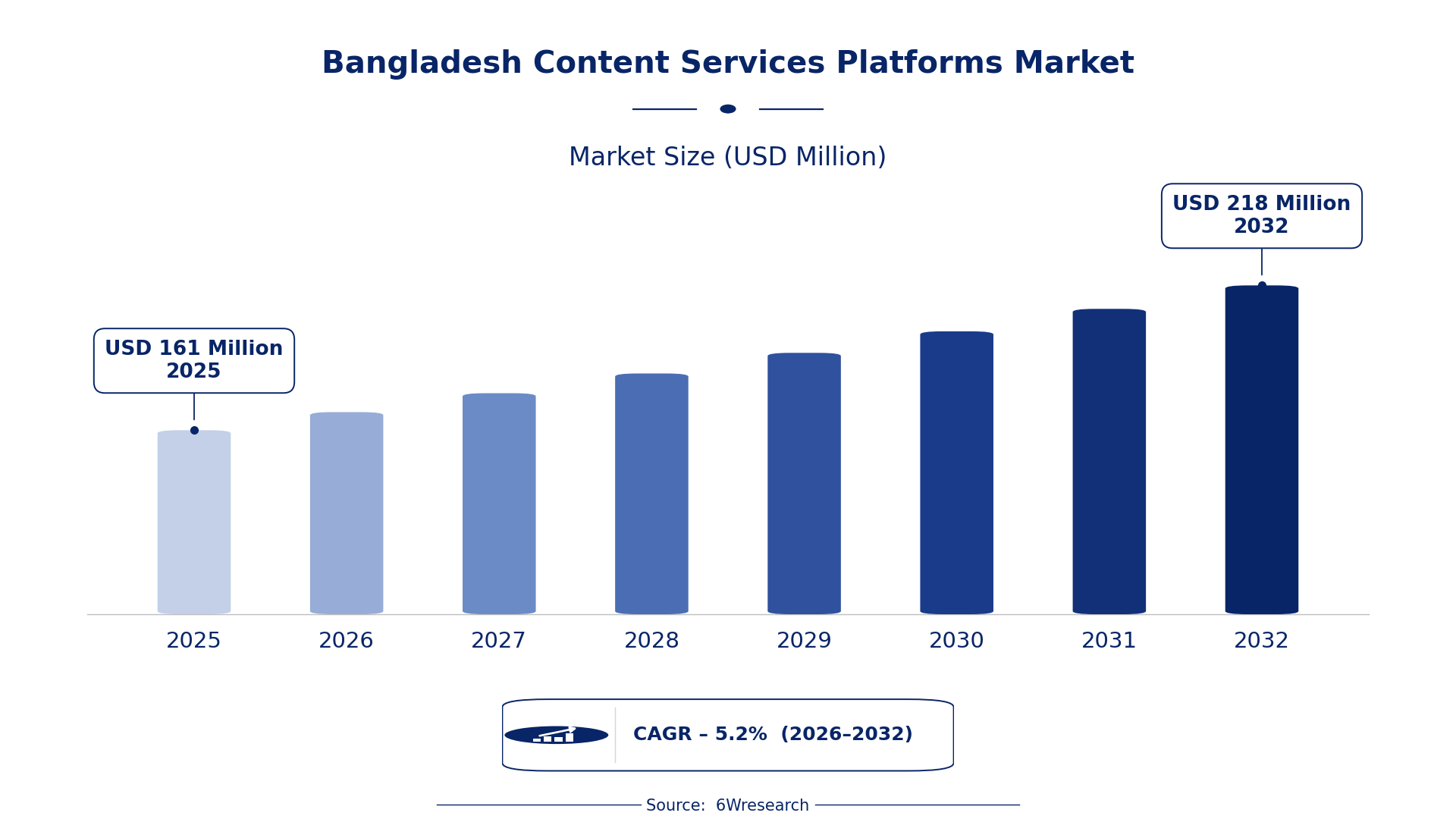
The Bangladesh Content Services Platforms Market was estimated at USD 161 Million in 2025 and is projected to reach USD 218 Million by 2032, growing at a CAGR of 5.2% from 2026 to 2032.
Bangladesh Content Services Platforms Market Synopsis
As organizations in Bangladesh increasingly focus on digital transformation, the demand for Content Services Platforms (CSPs) is on the rise. Businesses are adopting CSPs to enhance their ability to manage, collaborate, and streamline content across various channels, which is vital in the current competitive environment.
CSPs cater to a variety of sectors, providing functionalities that include document management, workflow automation, and content integration. The emphasis on operational efficiency is driving organizations to seek solutions that not only improve productivity but also elevate customer experiences through effective content delivery.
Bangladesh Content Services Platforms Market Year-wise Growth Rate and Key Drivers
This graph illustrates the annual growth rates of the Bangladesh Content Services Platforms Market from 2021 to 2032, highlighting a steady upward trajectory and projected expansion over the forecast period.
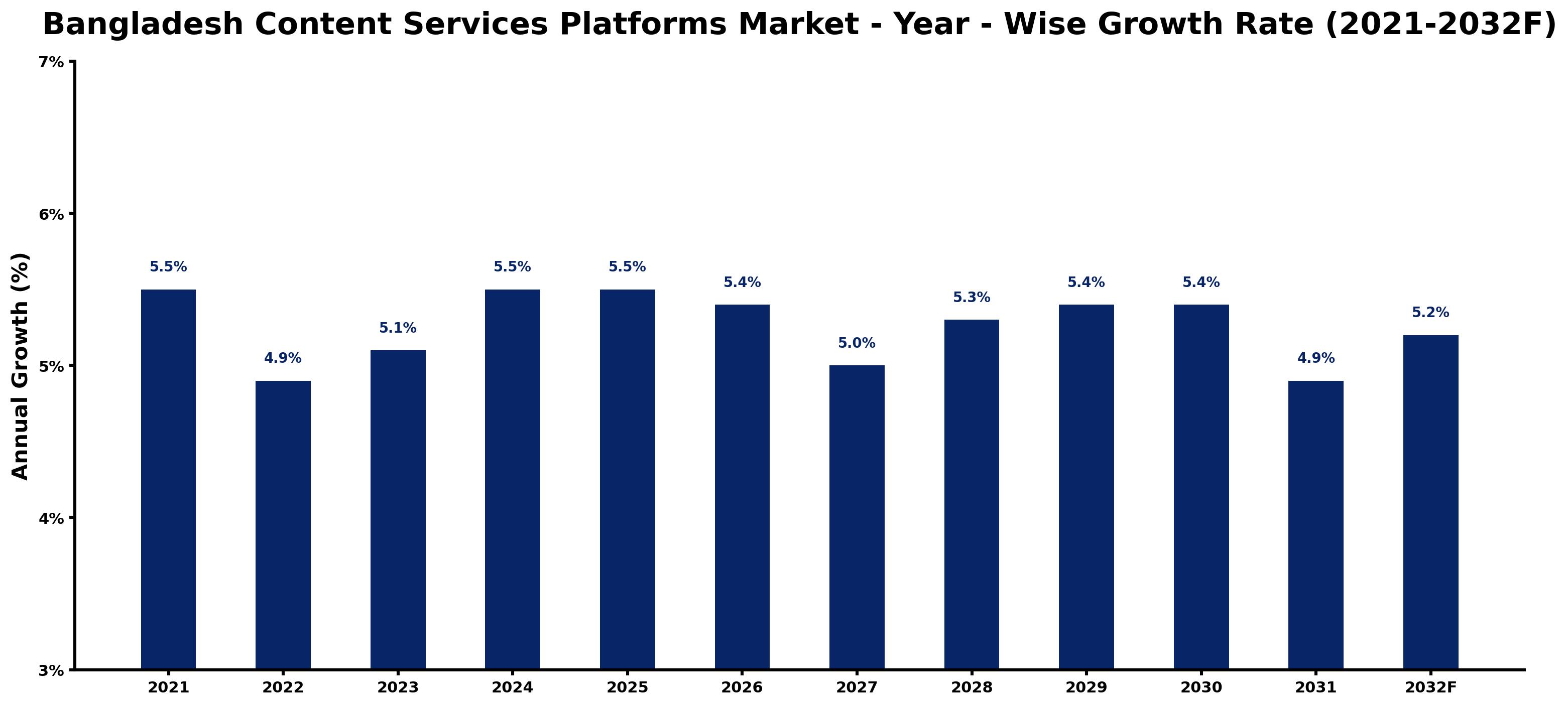
The table below presents the year‑wise growth rates along with the key drivers influencing the market
| Year | Growth Rate | Major Drivers |
| 2021 | 5.5% | Rise of mobile internet penetration drives content access. |
| 2022 | 4.9% | Increased youth population fosters demand for digital content. |
| 2023 | 5.1% | Government initiatives support local content creation sectors. |
| 2024 | 5.5% | Growing e-commerce boosts demand for diverse content platforms. |
| 2025 | 5.5% | Surge in smartphone usage enhances content consumption rates. |
| 2026 | 5.4% | Digital literacy programs increase user engagement with platforms. |
| 2027 | 5.0% | Local film industry growth spurs content platform investments. |
| 2028 | 5.3% | Rise in online education platforms increases content offerings. |
| 2029 | 5.4% | More streaming options attract diverse consumer demographics. |
| 2030 | 5.4% | Improving internet speeds drive higher content consumption. |
| 2031 | 4.9% | Increased investment in digital infrastructure supports service expansion. |
| 2032 | 5.2% | Regulatory support for media diversity enhances platform growth. |
Note: Market size estimations and growth projections presented in this report are based on 6Wresearch's proprietary forecasting methodology, utilizing the latest available industry data, government publications, and primary research inputs.
Bangladesh Content Services Platforms Market Key Takeaways
Below are some of the specific key takeaways from the market, including:
- The market is experiencing steady growth as organizations prioritize integrated content management solutions.
- Robust content governance and workflow automation are essential features that organizations seek in CSPs.
- Challenges like fragmented digital content landscapes hinder the widespread adoption of CSPs.
- Government policies are increasingly supportive of initiatives that promote interoperability and cloud-based services.
- Opportunities exist for innovative CSP offerings tailored to local market needs.
Evaluation of Restraints in Bangladesh Content Services Platforms Market
Despite the positive trajectory of the Content Services Platforms market, several factors are restricting its growth. Chief among these is the fragmented nature of content management practices within organizations. Many businesses struggle to synchronize their content creation and distribution efforts across multiple platforms, leading to inefficiencies. Additionally, limited interoperability between existing systems complicates the adoption of CSP solutions, leaving companies grappling with outdated processes. Security concerns around data protection and compliance further deter organizations from fully embracing these platforms.
Bangladesh Content Services Platforms Market Trends
A notable trend in the Bangladesh Content Services Platforms market is the shift towards cloud-based solutions. Companies are increasingly recognizing the benefits of flexibility and scalability that cloud platforms offer. on top of that, the growing emphasis on data analytics and AI integration within CSPs is transforming how organizations manage their content, enabling them to derive actionable insights from their data. Collaboration tools are also evolving, allowing remote teams to work more efficiently and ensuring that content is delivered promptly.
Bangladesh Content Services Platforms Market Opportunities
The Bangladesh Content Services Platforms market presents significant growth opportunities, particularly for vendors focusing on localized solutions that address specific industry needs. Companies that integrate advanced analytics and machine learning capabilities into their CSP offerings can differentiate themselves from competitors. Additionally, as more organizations embark on digital transformation journeys, there is a rising demand for training and support services that help businesses maximize their CSP investments.
Government Initiatives in the Bangladesh Content Services Platforms Market
Government policies are playing a crucial role in shaping the Bangladesh Content Services Platforms market. The focus on promoting digital infrastructure and fostering innovation is driving initiatives that encourage the adoption of content services platforms across sectors. The government is not only supporting the development of interoperability standards but is also incentivizing organizations to transition to cloud-based content solutions.
- A recently completed initiative focused on establishing a national digital infrastructure, enhancing connectivity for CSP usage across various sectors.
- A current program aimed at providing training and resources for small and medium enterprises (SMEs) to adopt content management solutions effectively.
- A planned public-private partnership expected to launch in 2026 to develop a comprehensive framework for CSP interoperability.
- Ongoing regulatory efforts to streamline compliance and security standards for content management systems, encouraging trust in digital platforms.
- A future initiative targeting the education sector, aiming to integrate content services platforms into academic institutions by 2028.
Future Insights of the Bangladesh Content Services Platforms Market
Looking ahead to 2026-2032, the Bangladesh Content Services Platforms market is set for a period of steady expansion. As more businesses recognize the need for efficient content management solutions, CSP adoption will likely accelerate. The integration of advanced technologies such as artificial intelligence and machine learning will further enhance the capabilities of CSPs, enabling organizations to optimize their content processes. As digital transformation initiatives gain traction, expect to see a surge in demand for solutions that can seamlessly connect disparate content sources and provide enhanced user experiences.
Bangladesh Content Services Platforms Market Latest Developments
In the past year, the Bangladesh Content Services Platforms market has seen notable developments reflecting the growing interest in integrated content solutions. Companies are increasingly investing in innovative technologies to enhance their offerings and meet rising customer expectations. The shift towards digitalization is evident as organizations seek solutions that can streamline their operations.
- A major technology vendor launched a new cloud-based CSP solution in early 2025, targeting SMEs to enhance their content management capabilities.
- An ongoing partnership between regional firms aims to develop an integrated content ecosystem, expected to deliver results by mid-2026.
- A rollout of enhanced data security features for CSPs is currently underway, addressing growing concerns over compliance and data protection.
- Upcoming in Q3 2026, a comprehensive training program will be introduced to support organizations in effectively utilizing CSPs.
- A recently announced initiative is set to integrate AI capabilities into existing CSP solutions, with implementation planned by early 2027.
Bangladesh Content Services Platforms Market - Key Attractiveness of the Report
- 10 Years of Market Numbers
- Historical Data Starting from 2022 to 2025
- Base Year: 2025
- Forecast Data until 2032
- Key Performance Indicators Impacting the Market
- Major Upcoming Developments and Projects
Key Highlights of the Report:
- Bangladesh Content Services Platforms Market Outlook
- Market Size of Bangladesh Content Services Platforms Market, 2025
- Forecast of Bangladesh Content Services Platforms Market, 2032
- Historical Data and Forecast of Bangladesh Content Services Platforms Revenues & Volume for the Period 2022-2032F
- Bangladesh Content Services Platforms Market Trend Evolution
- Bangladesh Content Services Platforms Market Drivers and Challenges
- Bangladesh Content Services Platforms Price Trends
- Bangladesh Content Services Platforms Porter's Five Forces
- Bangladesh Content Services Platforms Industry Life Cycle
- Historical Data and Forecast of Bangladesh Content Services Platforms Market Revenues & Volume By Business Function for the Period 2022-2032F
- Historical Data and Forecast of Bangladesh Content Services Platforms Market Revenues & Volume By Human Resource for the Period 2022-2032F
- Historical Data and Forecast of Bangladesh Content Services Platforms Market Revenues & Volume By Sales and Marketing for the Period 2022-2032F
- Historical Data and Forecast of Bangladesh Content Services Platforms Market Revenues & Volume By Accounting and Legal for the Period 2022-2032F
- Historical Data and Forecast of Bangladesh Content Services Platforms Market Revenues & Volume By Procurement and Supply Chain Management for the Period 2022-2032F
- Historical Data and Forecast of Bangladesh Content Services Platforms Market Revenues & Volume By Deployment Mode for the Period 2022-2032F
- Historical Data and Forecast of Bangladesh Content Services Platforms Market Revenues & Volume By Cloud for the Period 2022-2032F
- Historical Data and Forecast of Bangladesh Content Services Platforms Market Revenues & Volume By On-premises for the Period 2022-2032F
- Historical Data and Forecast of Bangladesh Content Services Platforms Market Revenues & Volume By Enterprise Size for the Period 2022-2032F
- Historical Data and Forecast of Bangladesh Content Services Platforms Market Revenues & Volume By Large Enterprises for the Period 2022-2032F
- Historical Data and Forecast of Bangladesh Content Services Platforms Market Revenues & Volume By SMEs for the Period 2022-2032F
- Historical Data and Forecast of Bangladesh Content Services Platforms Market Revenues & Volume By Vertical for the Period 2022-2032F
- Historical Data and Forecast of Bangladesh Content Services Platforms Market Revenues & Volume By Banking, Financial Services, and Insurance for the Period 2022-2032F
- Historical Data and Forecast of Bangladesh Content Services Platforms Market Revenues & Volume By Retail and Consumer Goods for the Period 2022-2032F
- Historical Data and Forecast of Bangladesh Content Services Platforms Market Revenues & Volume By Energy and Utilities for the Period 2022-2032F
- Historical Data and Forecast of Bangladesh Content Services Platforms Market Revenues & Volume By Government and Public Sector for the Period 2022-2032F
- Historical Data and Forecast of Bangladesh Content Services Platforms Market Revenues & Volume By Healthcare and Life Sciences for the Period 2022-2032F
- Historical Data and Forecast of Bangladesh Content Services Platforms Market Revenues & Volume By IT and ITeS for the Period 2022-2032F
- Historical Data and Forecast of Bangladesh Content Services Platforms Market Revenues & Volume By Manufacturing for the Period 2022-2032F
- Bangladesh Content Services Platforms Import Export Trade Statistics
- Market Opportunity Assessment By Business Function
- Market Opportunity Assessment By Deployment Mode
- Market Opportunity Assessment By Enterprise Size
- Market Opportunity Assessment By Vertical
- Bangladesh Content Services Platforms Top Companies Market Share
- Bangladesh Content Services Platforms Competitive Benchmarking By Technical and Operational Parameters
- Bangladesh Content Services Platforms Company Profiles
- Bangladesh Content Services Platforms Key Strategic Recommendations






































