Bangladesh Conveyors Systems Market Size, Share & Growth Rate
The Bangladesh Conveyors Systems Market was estimated at USD 1015 Million in 2025 and is projected to reach USD 1458 Million by 2032, growing at a CAGR of 5.3% from 2026 to 2032. This upward trajectory is largely fueled by the countrys rapid industrialization across sectors such as textiles, automotive, and food processing, where efficiency in material handling is paramount. As companies strive to enhance productivity and reduce operational costs, the adoption of advanced conveyor systems is becoming increasingly critical.
Bangladesh Conveyors Systems Market Year-wise Growth Rate and Key Drivers
This graph highlights how the Bangladesh Conveyors Systems Market has steadily grown over the years, supported by major growth factors.
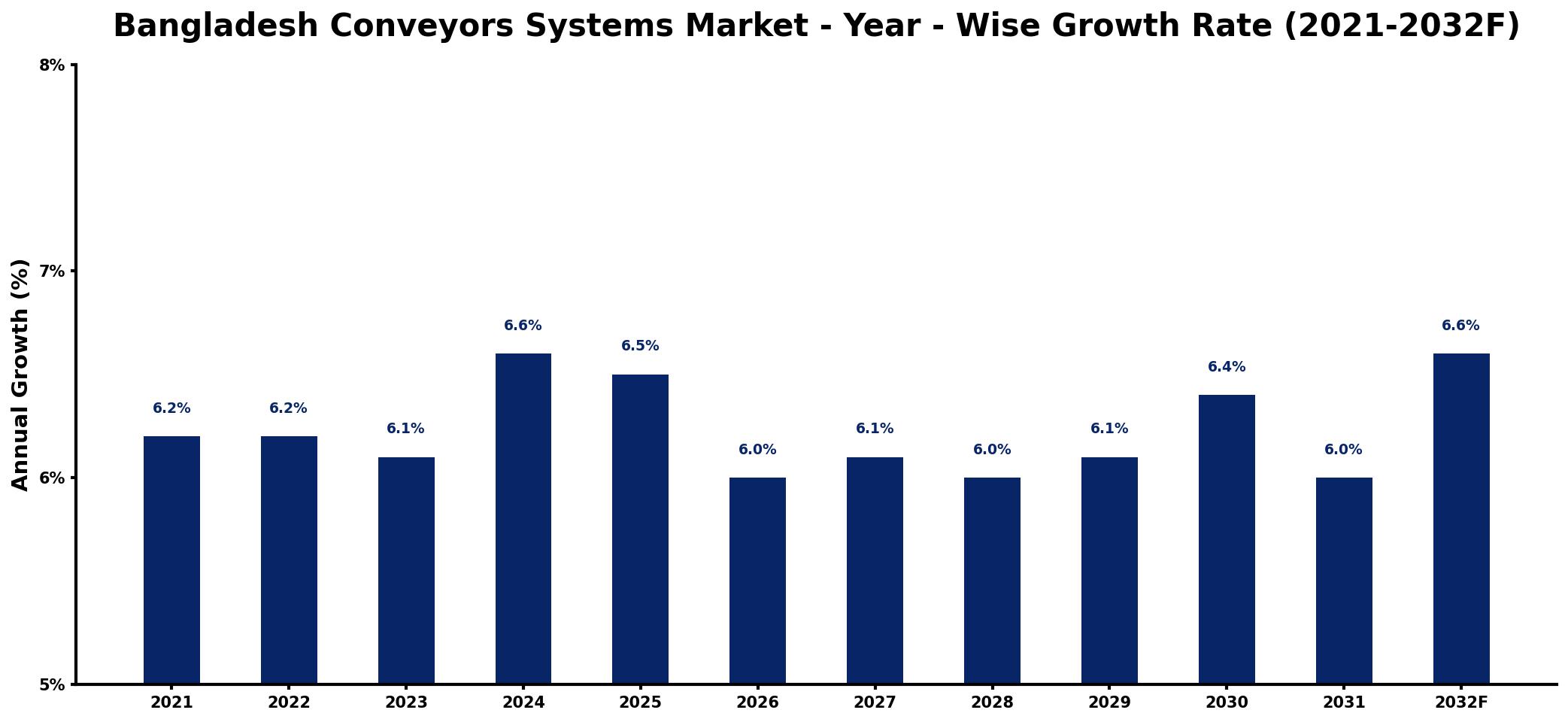
The table below presents the year‑wise growth rates along with the key drivers influencing the market
| Year | Growth Rate | Major Drivers |
| 2021 | 6.2% | Manufacturing sector demand increase |
| 2022 | 6.2% | E-commerce logistics expansion growth |
| 2023 | 6.1% | Infrastructure development projects rising |
| 2024 | 6.6% | Automated solutions investment surge |
| 2025 | 6.5% | Retail distribution network enhancement |
| 2026 | 6.0% | Food processing industry advancement |
| 2027 | 6.1% | Pharmaceutical supply chain optimization |
| 2028 | 6.0% | Warehouse automation technology adoption |
| 2029 | 6.1% | Construction material handling efficiency |
| 2030 | 6.4% | Recycling industry capacity expansion |
| 2031 | 6.0% | Agricultural production facility upgrades |
| 2032 | 6.6% | Export market competitiveness improvement |
Note: Market size estimations and growth projections presented in this report are based on 6Wresearch's proprietary forecasting methodology, utilizing the latest available industry data, government publications, and primary research inputs.
Bangladesh Conveyors Systems Market Synopsis
The most compelling force currently shaping the Bangladesh Conveyors Systems Market is the escalating demand for automation. Industries are recognizing the need to upgrade their material handling processes to remain competitive and meet consumer expectations.
In addition, government initiatives aimed at bolstering industrial growth and infrastructure development are enhancing the overall investment landscape. The convergence of these factors is setting the stage for sustained market expansion, providing ample opportunities for stakeholders.
Bangladesh Conveyors Systems Market Key Takeaways
- Rapid industrialization and infrastructure development are key drivers of market growth.
- The shift towards automated and energy-efficient conveyor systems is gaining momentum.
- Modular conveyor systems are becoming increasingly popular for their flexibility and customization capabilities.
- Government incentives are encouraging the adoption of conveyor technologies across various sectors.
- Companies are focusing on innovative solutions to optimize material handling and operational efficiency.
Evaluation of Restraints in Bangladesh Conveyors Systems Market
Despite the promising outlook, several restraints hinder the markets growth. Intense competition from both domestic and foreign entities often leads to pricing pressures, affecting profit margins. Additionally, fluctuations in raw material costs pose a challenge for manufacturers aiming to maintain cost-effectiveness. In certain regions, inadequate infrastructure and transportation facilities create bottlenecks, limiting distribution efficiency. Furthermore, a shortage of skilled labor in the area of installation and maintenance of conveyor systems adds another layer of complexity, preventing companies from realizing their full potential.
Bangladesh Conveyors Systems Market Trends
Current trends indicate a growing preference for automated conveyor systems that enhance reliability and speed, driven by the need for greater efficiency. Moreover, sustainability is becoming a focal point, leading to increased investment in energy-efficient technologies. The integration of IoT in conveyor systems is also emerging, enabling real-time monitoring and predictive maintenance, thereby improving operational performance. Furthermore, the demand for modular systems allows businesses to scale operations efficiently, adapting to changing market dynamics.
Bangladesh Conveyors Systems Market Opportunities
The Bangladesh Conveyors Systems Market offers substantial investment opportunities, particularly in sectors experiencing rapid growth like manufacturing and logistics. Companies that specialize in advanced conveyor technologies, including automation and modular systems, are well-positioned to thrive. Additionally, as the government promotes the establishment of Special Economic Zones and the "Made in Bangladesh" campaign, the potential for lucrative ventures expands, attracting both local and foreign investments into the market.
Government Initiatives in the Bangladesh Conveyors Systems Market
The Bangladeshi government is actively promoting the growth of the conveyors systems market through various policies and initiatives. These include regulations aimed at ensuring safety standards in the design and installation of conveyor systems, as well as incentives for industries to adopt modern material handling technologies. The government is also focused on infrastructure development to facilitate smoother operations and transport logistics, further enhancing the market's potential.
Future Insights of the Bangladesh Conveyors Systems Market
Looking ahead to 2026-2032, the Bangladesh Conveyors Systems Market is poised for significant growth. The ongoing industrialization efforts and increasing emphasis on automation are set to drive demand for more efficient material handling solutions. Furthermore, advancements in technology, particularly in IoT and AI, are likely to revolutionize the way conveyor systems operate, resulting in more intelligent and responsive production environments. As the government continues to bolster infrastructure and attract foreign investments, the landscape for the conveyors systems market will only become more promising.
Bangladesh Conveyors Systems Market Latest Developments (2025 - 2026)
Recently, industry activities have centered around the adoption of smart conveyor technologies that integrate IoT capabilities for real-time data analytics. This move towards digitization is expected to enhance operational efficiencies. Additionally, several initiatives are being launched to train skilled labor specifically for conveyor system installation and maintenance, addressing one of the major challenges faced by the sector. As companies pivot towards sustainability, there is also a notable uptick in interest regarding energy-efficient conveyor solutions, indicating a shifting focus toward environmentally responsible practices.
Bangladesh Conveyors Systems Market - Key Attractiveness of the Report
- 10 Years of Market Numbers
- Historical Data Starting from 2022 to 2025
- Base Year: 2025
- Forecast Data until 2032
- Key Performance Indicators Impacting the Market
- Major Upcoming Developments and Projects
Key Highlights of the Report:
- Bangladesh Conveyors Systems Market Outlook
- Market Size of Bangladesh Conveyors Systems Market, 2025
- Forecast of Bangladesh Conveyors Systems Market, 2032
- Historical Data and Forecast of Bangladesh Conveyors Systems Revenues & Volume for the Period 2022-2032F
- Bangladesh Conveyors Systems Market Trend Evolution
- Bangladesh Conveyors Systems Market Drivers and Challenges
- Bangladesh Conveyors Systems Price Trends
- Bangladesh Conveyors Systems Porter's Five Forces
- Bangladesh Conveyors Systems Industry Life Cycle
- Historical Data and Forecast of Bangladesh Conveyors Systems Market Revenues & Volume By Type for the Period 2022-2032F
- Historical Data and Forecast of Bangladesh Conveyors Systems Market Revenues & Volume By Roller for the Period 2022-2032F
- Historical Data and Forecast of Bangladesh Conveyors Systems Market Revenues & Volume By Flat Belt for the Period 2022-2032F
- Historical Data and Forecast of Bangladesh Conveyors Systems Market Revenues & Volume By Wheel for the Period 2022-2032F
- Historical Data and Forecast of Bangladesh Conveyors Systems Market Revenues & Volume By Vertical for the Period 2022-2032F
- Historical Data and Forecast of Bangladesh Conveyors Systems Market Revenues & Volume By Others for the Period 2022-2032F
- Historical Data and Forecast of Bangladesh Conveyors Systems Market Revenues & Volume By Location for the Period 2022-2032F
- Historical Data and Forecast of Bangladesh Conveyors Systems Market Revenues & Volume By In-floor for the Period 2022-2032F
- Historical Data and Forecast of Bangladesh Conveyors Systems Market Revenues & Volume By On-floor for the Period 2022-2032F
- Historical Data and Forecast of Bangladesh Conveyors Systems Market Revenues & Volume By Overhead for the Period 2022-2032F
- Historical Data and Forecast of Bangladesh Conveyors Systems Market Revenues & Volume By Load for the Period 2022-2032F
- Historical Data and Forecast of Bangladesh Conveyors Systems Market Revenues & Volume By Unit Load for the Period 2022-2032F
- Historical Data and Forecast of Bangladesh Conveyors Systems Market Revenues & Volume By Bulk Load for the Period 2022-2032F
- Historical Data and Forecast of Bangladesh Conveyors Systems Market Revenues & Volume By Application for the Period 2022-2032F
- Historical Data and Forecast of Bangladesh Conveyors Systems Market Revenues & Volume By Food & Beverages for the Period 2022-2032F
- Historical Data and Forecast of Bangladesh Conveyors Systems Market Revenues & Volume By Pharmaceuticals for the Period 2022-2032F
- Historical Data and Forecast of Bangladesh Conveyors Systems Market Revenues & Volume By Supply chain & Logistics for the Period 2022-2032F
- Historical Data and Forecast of Bangladesh Conveyors Systems Market Revenues & Volume By Manufacturing for the Period 2022-2032F
- Historical Data and Forecast of Bangladesh Conveyors Systems Market Revenues & Volume By Mining for the Period 2022-2032F
- Historical Data and Forecast of Bangladesh Conveyors Systems Market Revenues & Volume By Others for the Period 2022-2032F
- Bangladesh Conveyors Systems Import Export Trade Statistics
- Market Opportunity Assessment By Type
- Market Opportunity Assessment By Location
- Market Opportunity Assessment By Load
- Market Opportunity Assessment By Application
- Bangladesh Conveyors Systems Top Companies Market Share
- Bangladesh Conveyors Systems Competitive Benchmarking By Technical and Operational Parameters
- Bangladesh Conveyors Systems Company Profiles
- Bangladesh Conveyors Systems Key Strategic Recommendations






































