Bangladesh Cultured Meat Market Size, Share & Growth Rate
The Bangladesh Cultured Meat Market was estimated at USD 347 Million in 2025 and is projected to reach USD 489 Million by 2032, growing at a CAGR of 5.0% from 2026 to 2032. This growth is primarily driven by rising consumer awareness of health and sustainability, coupled with a pressing need to address food security in a country facing rapid population growth. As technological advancements continue to lower production costs and improve product quality, cultured meat is expected to gain broader acceptance among Bangladesh's evolving consumer base.
Bangladesh Cultured Meat Market Year-wise Growth Rate and Key Drivers
This graph highlights how the Bangladesh Cultured Meat Market has steadily grown over the years, supported by major growth factors.
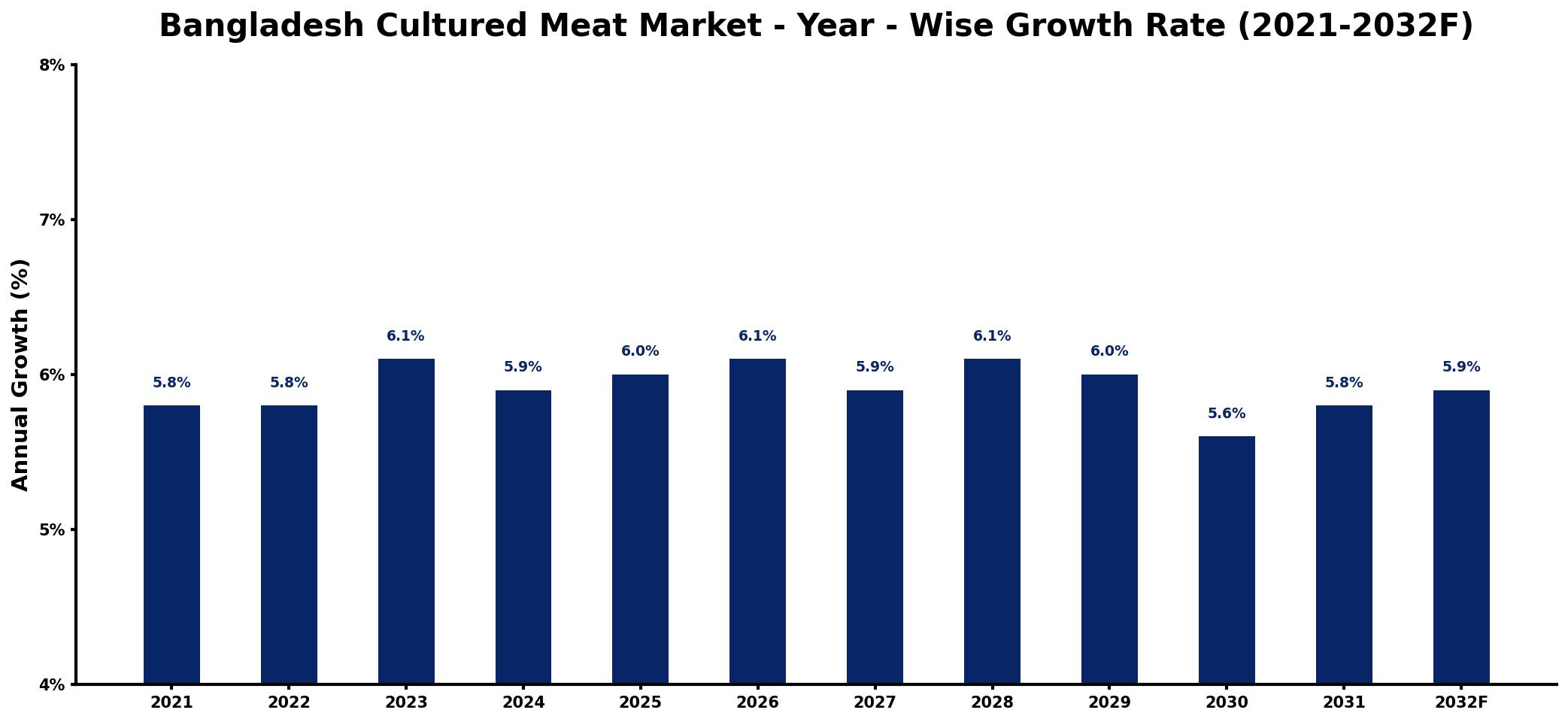
The table below presents the year‑wise growth rates along with the key drivers influencing the market
| Year | Growth Rate | Major Drivers |
| 2021 | 5.8% | Rising consumer health consciousness |
| 2022 | 5.8% | Increased investment in technology |
| 2023 | 6.1% | Growing demand for alternatives |
| 2024 | 5.9% | Expansion of distribution networks |
| 2025 | 6.0% | Enhanced sustainability initiatives adopted |
| 2026 | 6.1% | Supportive regulatory environment established |
| 2027 | 5.9% | Emergence of new market players |
| 2028 | 6.1% | Innovation in production methods |
| 2029 | 6.0% | Strengthening supply chain partnerships |
| 2030 | 5.6% | Broadening consumer awareness campaigns |
| 2031 | 5.8% | Partnerships with food service providers |
| 2032 | 5.9% | Rising interest in ethical sourcing |
Note: Market size estimations and growth projections presented in this report are based on 6Wresearch's proprietary forecasting methodology, utilizing the latest available industry data, government publications, and primary research inputs.
Bangladesh Cultured Meat Market Synopsis
The most significant force currently shaping the Bangladesh Cultured Meat Market is the heightened consumer demand for sustainable protein sources. In light of environmental concerns and the rising costs associated with traditional livestock farming, more consumers are gravitating towards lab-grown alternatives that promise a lower ecological footprint and greater efficiency.
Moreover, advances in cellular agriculture technology are fostering a new wave of innovation, enhancing the market's viability. As investment in research and development increases, stakeholders are better positioned to address regulatory challenges and consumer hesitancies, paving the way for a robust market landscape.
Bangladesh Cultured Meat Market Key Takeaways
- The market is projected to experience steady growth driven by increasing awareness of sustainable food practices.
- Technological advancements in cellular agriculture are key to enhancing production efficiency.
- Consumer perceptions of cultured meat are gradually shifting towards acceptance, influenced by health and environmental factors.
- Government initiatives aimed at fostering innovation in food technology will play a pivotal role in market expansion.
- Investment in research and development is crucial for overcoming existing production scalability challenges.
Evaluation of Restraints in Bangladesh Cultured Meat Market
While the Bangladesh Cultured Meat Market holds significant promise, it also faces notable restraints that could hinder its potential. Consumer acceptance remains a critical challenge, as many individuals are still unfamiliar with lab-grown products and harbor concerns about their safety and taste. Additionally, the current regulatory environment for novel food products is not fully equipped to address the unique characteristics of cultured meat, leading to potential delays in market entry and consumer adoption. Efforts to educate the public and adapt regulatory frameworks will be essential in overcoming these barriers and facilitating a smoother transition to mainstream acceptance.
Bangladesh Cultured Meat Market Trends
A noticeable trend in the Bangladesh Cultured Meat Market is the increasing interest in health-focused and environmentally friendly products. More consumers are prioritizing their well-being and considering the impact of their food choices on the environment. This shift is encouraging companies to innovate and introduce a wider variety of cultured meat products that align with these values. Furthermore, collaborations between startups and research institutions are becoming more common, allowing for rapid advancements in production technologies and broader consumer education efforts.
Bangladesh Cultured Meat Market Opportunities
Opportunities for growth in the Bangladesh Cultured Meat Market are abundant, particularly in the realm of technology-driven production methods. Innovations that significantly lower production costs and enhance product quality can position businesses favorably in the market. Additionally, partnerships with educational and agricultural institutions can lead to improved public understanding of cultured meat, stimulating demand. Exploring export potential for cultured meat to international markets also represents a lucrative opportunity for local producers as they scale operations.
Government Initiatives in the Bangladesh Cultured Meat Market
The Bangladesh government has begun to recognize the importance of sustainable food solutions and is taking steps to support the development of the cultured meat sector. Initiatives include research grants aimed at fostering innovation in agricultural technologies and creating an enabling environment for startups focused on cellular agriculture. Public spending on food technology and agricultural innovation programs is expected to stimulate market growth and accelerate the adoption of cultured meat products in the coming years.
Future Insights of the Bangladesh Cultured Meat Market
Looking ahead to 2026-2032, the Bangladesh Cultured Meat Market is expected to evolve significantly as technological advancements continue to reshape the landscape. A greater emphasis on sustainability and health consciousness among consumers will drive further adoption of cultured meat products. Additionally, as regulatory frameworks adapt to accommodate novel food technologies, the market may witness increased scalability, enabling producers to meet the growing demand efficiently. With the right investments and public support, the cultured meat sector is poised to play a critical role in addressing food security challenges while promoting environmental sustainability.
Bangladesh Cultured Meat Market Latest Developments (2025 - 2026)
Recent developments in the Bangladesh Cultured Meat Market have indicated a heightened focus on consumer education and outreach. Initiatives aimed at demystifying lab-grown meat have gained traction, with various stakeholders hosting workshops and public tastings to enhance acceptance. Simultaneously, advancements in production technology are being reported, suggesting that businesses are increasingly capable of producing cultured meat at lower costs while maintaining quality. These developments signal a readiness to tackle existing barriers to entry and a commitment to driving the market forward.
Bangladesh Cultured Meat Market - Key Attractiveness of the Report
- 10 Years of Market Numbers
- Historical Data Starting from 2022 to 2025
- Base Year: 2025
- Forecast Data until 2032
- Key Performance Indicators Impacting the Market
- Major Upcoming Developments and Projects
Key Highlights of the Report:
- Bangladesh Cultured Meat Market Outlook
- Market Size of Bangladesh Cultured Meat Market, 2025
- Forecast of Bangladesh Cultured Meat Market, 2032
- Historical Data and Forecast of Bangladesh Cultured Meat Revenues & Volume for the Period 2022-2032F
- Bangladesh Cultured Meat Market Trend Evolution
- Bangladesh Cultured Meat Market Drivers and Challenges
- Bangladesh Cultured Meat Price Trends
- Bangladesh Cultured Meat Porter's Five Forces
- Bangladesh Cultured Meat Industry Life Cycle
- Historical Data and Forecast of Bangladesh Cultured Meat Market Revenues & Volume By Product Type for the Period 2022-2032F
- Historical Data and Forecast of Bangladesh Cultured Meat Market Revenues & Volume By Poultry for the Period 2022-2032F
- Historical Data and Forecast of Bangladesh Cultured Meat Market Revenues & Volume By Beef for the Period 2022-2032F
- Historical Data and Forecast of Bangladesh Cultured Meat Market Revenues & Volume By Seafood for the Period 2022-2032F
- Historical Data and Forecast of Bangladesh Cultured Meat Market Revenues & Volume By Pork for the Period 2022-2032F
- Historical Data and Forecast of Bangladesh Cultured Meat Market Revenues & Volume By Duck for the Period 2022-2032F
- Historical Data and Forecast of Bangladesh Cultured Meat Market Revenues & Volume By End-Use for the Period 2022-2032F
- Historical Data and Forecast of Bangladesh Cultured Meat Market Revenues & Volume By Nuggets for the Period 2022-2032F
- Historical Data and Forecast of Bangladesh Cultured Meat Market Revenues & Volume By Burgers for the Period 2022-2032F
- Historical Data and Forecast of Bangladesh Cultured Meat Market Revenues & Volume By Meatballs for the Period 2022-2032F
- Historical Data and Forecast of Bangladesh Cultured Meat Market Revenues & Volume By Sausage for the Period 2022-2032F
- Historical Data and Forecast of Bangladesh Cultured Meat Market Revenues & Volume By Hot dogs for the Period 2022-2032F
- Historical Data and Forecast of Bangladesh Cultured Meat Market Revenues & Volume By Others for the Period 2022-2032F
- Bangladesh Cultured Meat Import Export Trade Statistics
- Market Opportunity Assessment By Product Type
- Market Opportunity Assessment By End-Use
- Bangladesh Cultured Meat Top Companies Market Share
- Bangladesh Cultured Meat Competitive Benchmarking By Technical and Operational Parameters
- Bangladesh Cultured Meat Company Profiles
- Bangladesh Cultured Meat Key Strategic Recommendations






































