Bangladesh Data Catalog Market Size & Growth Rate (2026-2032)
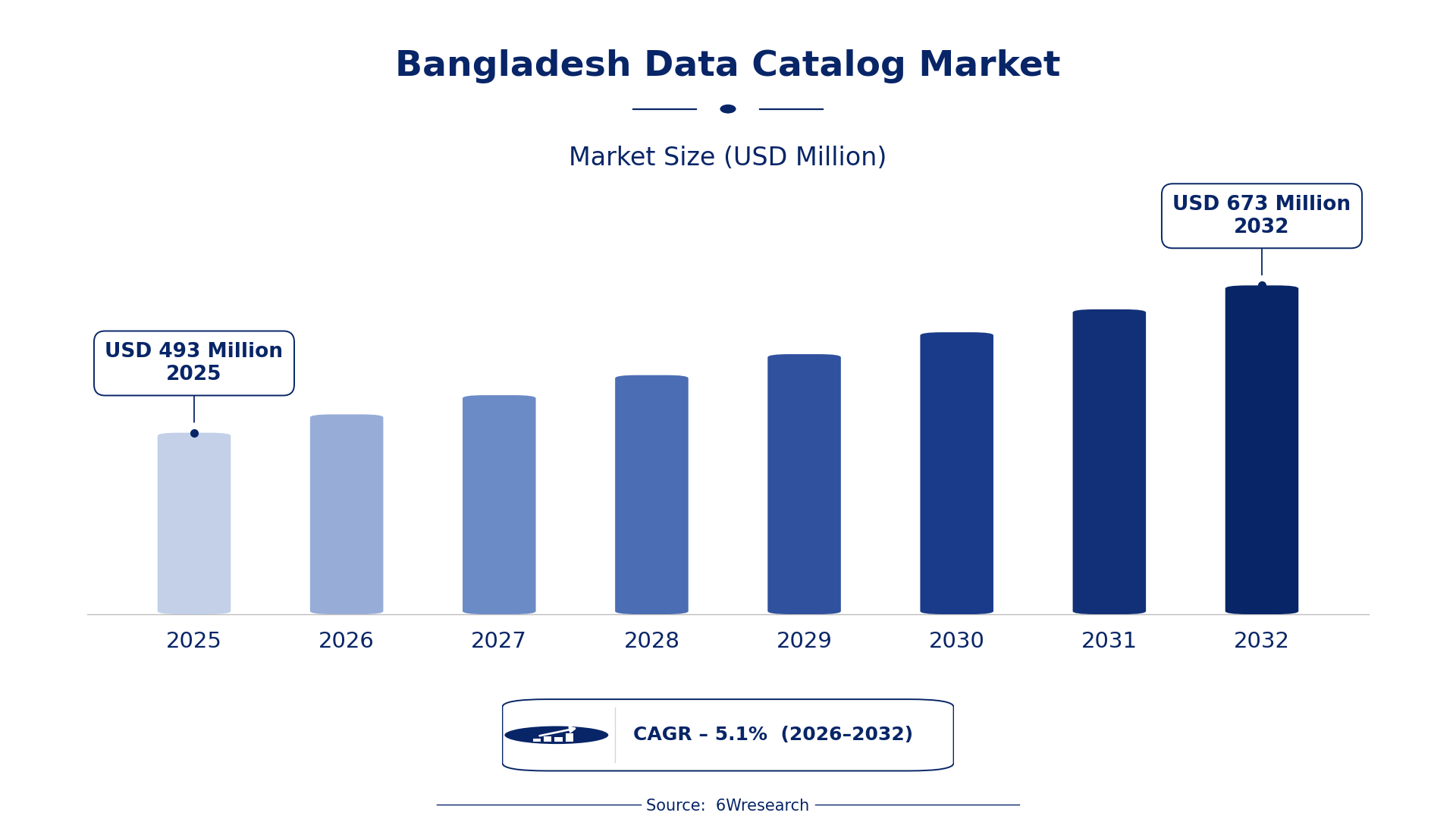
The Bangladesh Data Catalog Market was estimated at USD 493 Million in 2025 and is projected to reach USD 673 Million by 2032, growing at a CAGR of 5.1% from 2026 to 2032.
Bangladesh Data Catalog Market Synopsis
As organizations in Bangladesh generate and rely on vast amounts of data, the necessity for efficient data management solutions has surged. The demand for comprehensive data catalog platforms is becoming increasingly evident as businesses strive to enhance their data governance, organization, and analysis capabilities.
Recent trends indicate a solid momentum in the Bangladesh Data Catalog Market, driven by the urgency of regulatory compliance and the emphasis on data transparency. As companies embrace data-driven decision-making, the market is positioned for continuous growth, albeit challenged by issues like data quality and governance.
Bangladesh Data Catalog Market Year-wise Growth Rate and Key Drivers
This graph illustrates the annual growth rates of the Bangladesh Data Catalog Market from 2021 to 2032, highlighting a steady upward trajectory and projected expansion over the forecast period.
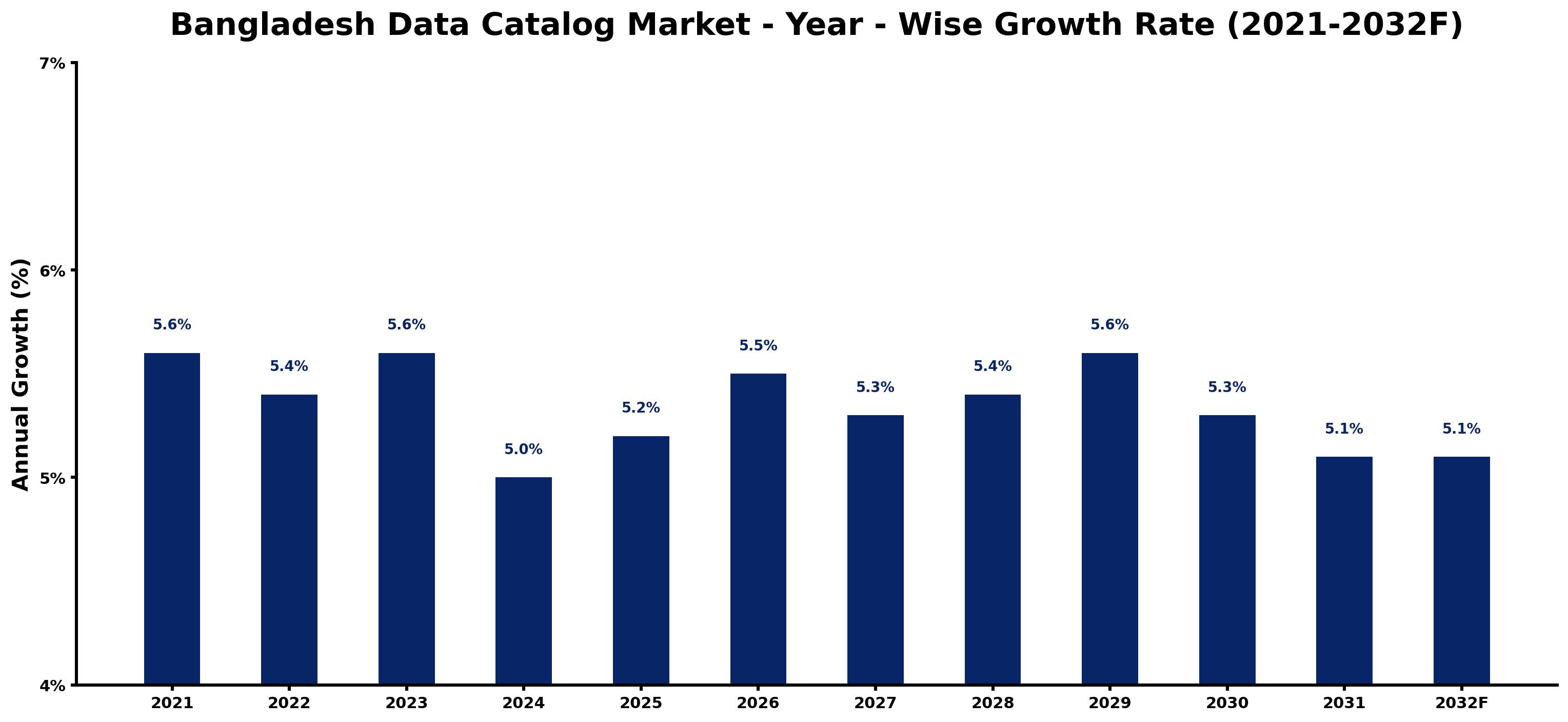
The table below presents the year‑wise growth rates along with the key drivers influencing the market
| Year | Growth Rate | Major Drivers |
| 2021 | 5.6% | Government push for open data initiatives enhances transparency |
| 2022 | 5.4% | Increased mobile internet penetration drives demand for data access |
| 2023 | 5.6% | Growing startup ecosystem fosters innovation in data solutions |
| 2024 | 5.0% | Digital Bangladesh Vision 2021 accelerates data management adoption |
| 2025 | 5.2% | Rise of e-commerce necessitates robust data cataloging systems |
| 2026 | 5.5% | Partnerships with global tech firms improve data infrastructure |
| 2027 | 5.3% | Emerging fintech sector requires comprehensive data solutions |
| 2028 | 5.4% | Increased foreign investments boost data management capabilities |
| 2029 | 5.6% | Government regulations mandate better data governance practices |
| 2030 | 5.3% | Demand for data analytics skills drives data access growth |
| 2031 | 5.1% | Nonprofit initiatives promote data sharing among public sectors |
| 2032 | 5.1% | Growing awareness of data privacy ensures demand for catalogs |
Note: Market size estimations and growth projections presented in this report are based on 6Wresearch's proprietary forecasting methodology, utilizing the latest available industry data, government publications, and primary research inputs.
Bangladesh Data Catalog Market Key Takeaways
Below are some of the specific key takeaways from the market, including:
- The rapid growth of data generation is a primary catalyst for the rising demand for data catalog solutions.
- Regulatory compliance and data governance frameworks are becoming critical for market players.
- Challenges related to data quality and standardization hinder the efficiency of data management practices.
- Organizations are increasingly investing in data catalog solutions to improve data discoverability and usability.
- The government’s supportive policies are enhancing the market's growth potential.
Evaluation of Restraints in Bangladesh Data Catalog Market
Despite the evident growth trajectory, the Bangladesh Data Catalog Market faces substantial restraints. One of the primary challenges is the lack of standardized data formats, which complicates the creation of effective data catalogs. Additionally, organizations struggle with maintaining data quality and ensuring compliance with evolving regulations. These issues can lead to inefficiencies in data management and may deter potential investments in robust data catalog solutions.
Bangladesh Data Catalog Market Trends
The market is currently shaped by several key trends. The push for data democratization is gaining traction, leading organizations to implement user-friendly data catalog tools that empower non-technical users. Alongside this, the focus on artificial intelligence and machine learning in data management is rising, as businesses seek to automate data classification and improve analytics. The integration of cloud-based solutions is also on the rise, enabling organizations to scale their data management capabilities efficiently.
Bangladesh Data Catalog Market Opportunities
Growth opportunities abound in the Bangladesh Data Catalog Market. Companies are increasingly looking for solutions that enhance data visibility and accessibility, creating space for innovative data catalog offerings. The drive towards digitization in both the public and private sectors opens avenues for partnerships and collaborations focused on data governance. Additionally, the growing awareness of data privacy laws presents a compelling case for investing in robust data catalog solutions to ensure compliance.
Government Initiatives in the Bangladesh Data Catalog Market
The Bangladeshi government has recognized the critical importance of data cataloging in enhancing data utilization across various sectors. With a clear vision to optimize data management practices, government policies are fostering an environment conducive to the adoption of data catalog solutions. This regulatory framework aims to support businesses in achieving compliance while improving data governance.
- A national digital infrastructure upgrade programme was recently completed to enhance data management capabilities across public agencies.
- Current initiatives include a government-sponsored project aimed at standardizing metadata management practices among businesses.
- Future plans involve implementing a regulatory framework expected to mandate data transparency requirements by 2027.
- Ongoing collaborations between government and private entities are focused on developing training programs to enhance data governance skills.
- The establishment of a data quality task force in 2026 is planned to address challenges related to data quality and compliance.
Future Insights of the Bangladesh Data Catalog Market
Looking ahead, the Bangladesh Data Catalog Market is expected to witness sustained growth from 2026 to 2032. The increasing reliance on data-driven insights across sectors will propel organizations to invest in sophisticated data catalog solutions. As regulatory frameworks become more stringent, the market will see a heightened demand for compliance-focused cataloging tools. This evolution signifies a shift toward a more mature data management environment, ultimately leading to improved operational efficiencies and better decision-making across the board.
Bangladesh Data Catalog Market Latest Developments
In the past year, the Bangladesh Data Catalog Market has experienced noteworthy developments that signal a growing recognition of data management's importance. Companies are increasingly adopting innovative solutions to enhance their data governance frameworks, reflecting a proactive approach to data utilization.
- A major technology vendor launched a new data catalog solution in early 2025, aimed at improving data discoverability for organizations.
- Ongoing partnerships between local businesses and international firms are focused on developing customized data catalog tools to meet regional needs.
- In mid-2025, a collaborative project began to create a centralized data repository to streamline access to public sector data.
- A rollout of training programs for data management skills is expected to commence in Q2 2026, targeting public sector employees.
- By late 2026, a planned initiative is set to enhance cloud-based data catalog offerings to support scalability for small and medium enterprises.
Bangladesh Data Catalog Market - Key Attractiveness of the Report
- 10 Years of Market Numbers
- Historical Data Starting from 2022 to 2025
- Base Year: 2025
- Forecast Data until 2032
- Key Performance Indicators Impacting the Market
- Major Upcoming Developments and Projects
Key Highlights of the Report:
- Bangladesh Data Catalog Market Outlook
- Market Size of Bangladesh Data Catalog Market, 2025
- Forecast of Bangladesh Data Catalog Market, 2032
- Historical Data and Forecast of Bangladesh Data Catalog Revenues & Volume for the Period 2022-2032F
- Bangladesh Data Catalog Market Trend Evolution
- Bangladesh Data Catalog Market Drivers and Challenges
- Bangladesh Data Catalog Price Trends
- Bangladesh Data Catalog Porter's Five Forces
- Bangladesh Data Catalog Industry Life Cycle
- Historical Data and Forecast of Bangladesh Data Catalog Market Revenues & Volume By Component for the Period 2022-2032F
- Historical Data and Forecast of Bangladesh Data Catalog Market Revenues & Volume By Solutions for the Period 2022-2032F
- Historical Data and Forecast of Bangladesh Data Catalog Market Revenues & Volume By Services for the Period 2022-2032F
- Historical Data and Forecast of Bangladesh Data Catalog Market Revenues & Volume By Data Consumer for the Period 2022-2032F
- Historical Data and Forecast of Bangladesh Data Catalog Market Revenues & Volume By Business Intelligence tools for the Period 2022-2032F
- Historical Data and Forecast of Bangladesh Data Catalog Market Revenues & Volume By Enterprise Applications for the Period 2022-2032F
- Historical Data and Forecast of Bangladesh Data Catalog Market Revenues & Volume By Mobile and Web Applications for the Period 2022-2032F
- Historical Data and Forecast of Bangladesh Data Catalog Market Revenues & Volume By Deployment Mode for the Period 2022-2032F
- Historical Data and Forecast of Bangladesh Data Catalog Market Revenues & Volume By Cloud for the Period 2022-2032F
- Historical Data and Forecast of Bangladesh Data Catalog Market Revenues & Volume By On-premises for the Period 2022-2032F
- Historical Data and Forecast of Bangladesh Data Catalog Market Revenues & Volume By Metadata Type for the Period 2022-2032F
- Historical Data and Forecast of Bangladesh Data Catalog Market Revenues & Volume By Technical Metadata for the Period 2022-2032F
- Historical Data and Forecast of Bangladesh Data Catalog Market Revenues & Volume By Business Metadata for the Period 2022-2032F
- Historical Data and Forecast of Bangladesh Data Catalog Market Revenues & Volume By Organization Size for the Period 2022-2032F
- Historical Data and Forecast of Bangladesh Data Catalog Market Revenues & Volume By SMEs for the Period 2022-2032F
- Historical Data and Forecast of Bangladesh Data Catalog Market Revenues & Volume By Large Enterprises for the Period 2022-2032F
- Historical Data and Forecast of Bangladesh Data Catalog Market Revenues & Volume By Vertical for the Period 2022-2032F
- Historical Data and Forecast of Bangladesh Data Catalog Market Revenues & Volume By BFSI for the Period 2022-2032F
- Historical Data and Forecast of Bangladesh Data Catalog Market Revenues & Volume By Retail and eCommerce for the Period 2022-2032F
- Historical Data and Forecast of Bangladesh Data Catalog Market Revenues & Volume By Manufacturing for the Period 2022-2032F
- Historical Data and Forecast of Bangladesh Data Catalog Market Revenues & Volume By Government and Defence for the Period 2022-2032F
- Historical Data and Forecast of Bangladesh Data Catalog Market Revenues & Volume By Healthcare and Life Sciences for the Period 2022-2032F
- Historical Data and Forecast of Bangladesh Data Catalog Market Revenues & Volume By Telecom for the Period 2022-2032F
- Historical Data and Forecast of Bangladesh Data Catalog Market Revenues & Volume By Media and Entertainment for the Period 2022-2032F
- Historical Data and Forecast of Bangladesh Data Catalog Market Revenues & Volume By Transportation and Logistics for the Period 2022-2032F
- Bangladesh Data Catalog Import Export Trade Statistics
- Market Opportunity Assessment By Component
- Market Opportunity Assessment By Data Consumer
- Market Opportunity Assessment By Deployment Mode
- Market Opportunity Assessment By Metadata Type
- Market Opportunity Assessment By Organization Size
- Market Opportunity Assessment By Vertical
- Bangladesh Data Catalog Top Companies Market Share
- Bangladesh Data Catalog Competitive Benchmarking By Technical and Operational Parameters
- Bangladesh Data Catalog Company Profiles
- Bangladesh Data Catalog Key Strategic Recommendations






































